
That growing gap between your garage floor and the wall isn’t just a cosmetic flaw; it’s a structural signal that Denver’s expansive clay soil is shifting beneath your home. Whether you’re navigating a new trip hazard at the driveway transition or watching water pool in the center of the slab, these issues compromise both safety and property value. Professional sunken garage floor repair Denver homeowners trust must address these environmental realities with technical precision rather than temporary patches.
You shouldn’t have to choose between a failing floor and the invasive mess of a full concrete replacement. It’s possible to achieve a level, stable surface that supports your vehicles without weeks of downtime. This guide explains how advanced polyurethane injection and specialized structural knowledge can permanently restore your garage. We’ll preview the modern restoration process that offers minimal disruption, allowing you to reclaim your space and your peace of mind the same day the repair is finished.
Key Takeaways
- Identify how Denver’s unique geological makeup, specifically expansive clay and bentonite, creates the soil instability responsible for garage floor settlement.
- Compare the technical advantages of lightweight polyurethane foam against traditional mudjacking to see why modern injection offers a more durable, load-bearing result.
- Learn why specialized knowledge of post-tension slabs is essential for safe sunken garage floor repair Denver projects, preventing catastrophic damage to internal cable systems.
- Follow a step-by-step overview of the professional restoration process, from initial soil testing to the final stabilization of your concrete slab.
- Realize the benefits of a precision-based approach that requires minimal downtime, allowing your garage to be fully functional immediately after the repair is complete.
Understanding Why Denver Garage Floors Sink: The Role of Expansive Soils
Denver’s landscape is defined by the majestic Front Range, but beneath the surface lies a geological challenge that complicates residential construction. Many homeowners encounter what professionals call the “Denver Sinking” phenomenon, where garage slabs begin to tilt or drop away from the main structure. Unlike the primary house foundation, which usually sits on deep footings or piers, garage floors are frequently “floating” slabs. This design makes them exceptionally vulnerable to the volatile movements of the earth below. The geological makeup of Denver and Aurora is heavily influenced by Expansive Soils, which act as a living, breathing layer that shifts with the seasons.
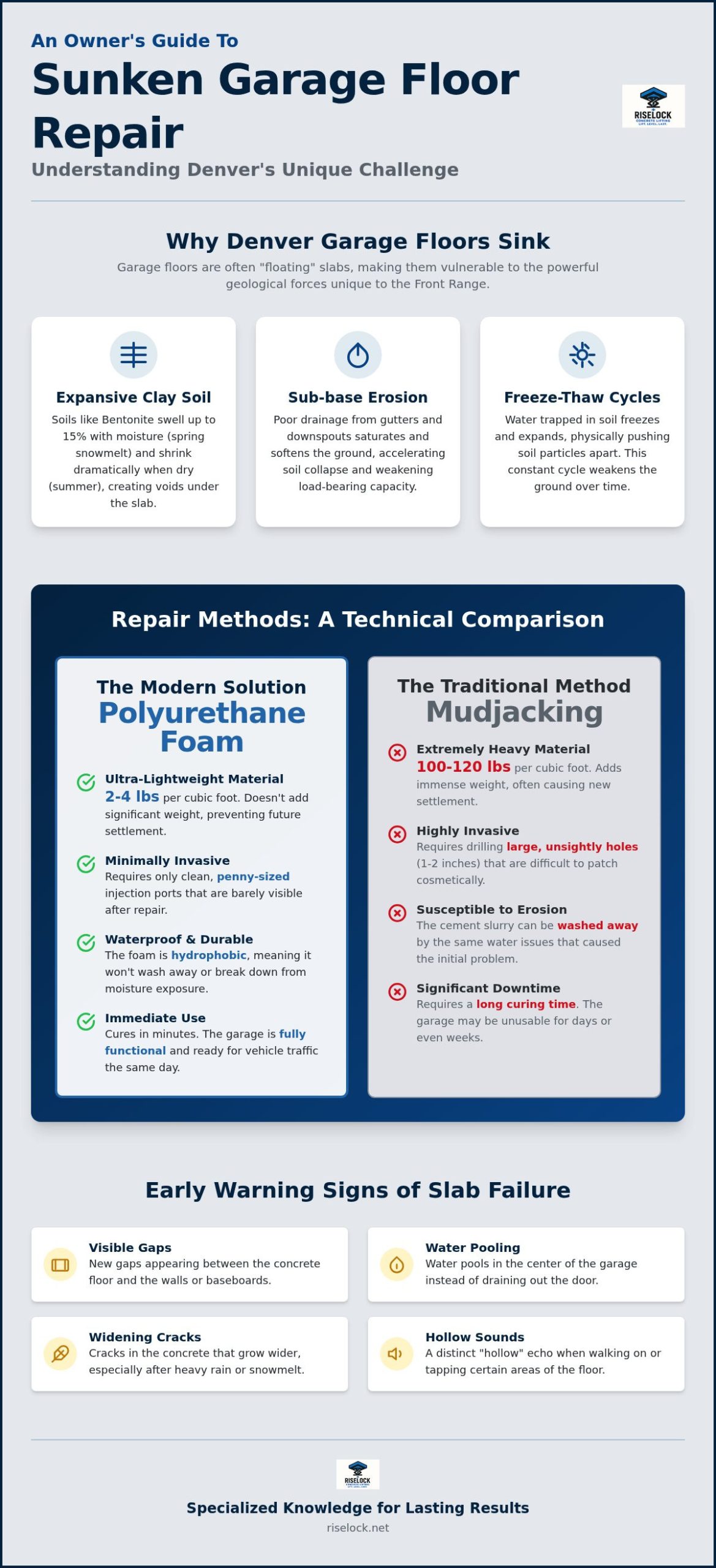
Expansive soil is the primary driver of slab failure in Colorado. This material undergoes a relentless cycle of settlement and heave as moisture levels fluctuate throughout the year. In the spring, heavy snowmelt saturates the ground, causing the soil to swell and push upward against the concrete. As the arid Colorado summer takes hold, the soil loses that moisture and shrinks, leaving the heavy garage slab suspended over a hollow space. Eventually, the weight of the concrete and your vehicles causes the slab to collapse into these voids. This is why sunken garage floor repair Denver homeowners require isn’t just about aesthetics; it’s about addressing a recurring geological cycle.
The Impact of Bentonite Clay on Your Foundation
Bentonite is a specific type of clay common throughout the Front Range that possesses a remarkable ability to absorb water. When saturated by Denver’s spring storms or melting snow, this clay can expand by as much as 15% in volume. This hydraulic pressure is powerful enough to lift heavy concrete. However, the real damage occurs when the clay dries out. During dry spells, the clay contracts significantly, creating substantial gaps between the soil and the bottom of your garage floor. Because the garage floor is often poured independently of the home’s deeper foundation, it lacks the structural support to span these newly formed voids, leading to the cracking and sinking many homeowners observe.
Water Intrusion and Sub-base Erosion
While geology sets the stage, water management often acts as the catalyst for rapid settlement. Poor gutter drainage or downspouts that discharge too close to the garage wall saturate the sub-base, accelerating the softening of the soil. Denver’s frequent freeze-thaw cycles further complicate this by expanding moisture within the soil pores, which physically pushes soil particles apart and weakens the ground’s load-bearing capacity. Identifying the early warning signs of sub-base failure can save you from extensive damage:
- New gaps appearing between the floor and the baseboards or walls.
- Water pooling toward the center of the garage instead of draining toward the door.
- Visible cracks that widen specifically after heavy precipitation or seasonal changes.
- A noticeable “hollow” sound when walking on certain sections of the floor.
Recognizing these symptoms early allows for precision intervention before the structural integrity of the slab is completely compromised. Professional sunken garage floor repair Denver services focus on stabilizing these underlying soils to prevent the cycle from repeating.
Polyurethane Foam Injection: The Advanced Alternative to Traditional Mudjacking
As we look toward 2026, high-density polyurethane injection has become the benchmark for professional concrete restoration. While traditional methods relied on brute force and heavy materials, modern sunken garage floor repair Denver homeowners select prioritizes precision and soil preservation. The most significant technical advantage lies in the material’s weight. Traditional mudjacking slurry weighs between 100 and 120 pounds per cubic foot. In contrast, high-density polyurethane foam weighs only 2 to 4 pounds per cubic foot. This radical reduction in mass ensures that the repair material doesn’t become a secondary cause of settlement by overloading the already fragile sub-base.
The physical application of foam is remarkably non-invasive. Technicians drill penny-sized injection ports that are barely visible once the repair is complete, contrasting sharply with the large, unsightly holes required for grout-based lifting. Once injected, the foam remains hydrophobic. It won’t dissolve or wash away when exposed to the heavy snowmelt or groundwater common in the Front Range. This chemical stability ensures that the support structure beneath your garage remains intact for decades, regardless of external weather conditions.
Why Mudjacking Often Fails in Colorado
Traditional mudjacking relies on a slurry of sand and cement that is fundamentally incompatible with the fragile nature of Colorado’s expansive soil. When you pump 120 pounds of grout under a sinking slab, you’re adding a massive weight on top of soil that’s already struggling to support the concrete. This often triggers a secondary collapse within just a few seasons. The process also requires significant curing time, often leaving your garage unusable for days. RiseLock utilizes polyurethane concrete lifting to avoid these pitfalls, providing a lightweight alternative that stabilizes the ground without adding unnecessary stress to the underlying environment.
Load-Bearing Capacity for Heavy Vehicles
High-density foam is specifically engineered to handle the compressive loads of a residential garage. While the material is lightweight, its PSI strength is designed to support heavy SUVs, trucks, and dense storage systems without compression. The foam expands to fill every micro-void in the sub-base, creating a uniform support structure that organic fill materials simply cannot match. Because the material is inorganic, it won’t rot or lose volume over time. This ensures your slab remains level even under the constant pressure of daily vehicle use, providing a permanent solution rather than a temporary patch.
Understanding the technical requirements of your specific floor is the first step toward a permanent fix. You can learn more about our precision leveling services to see how modern technology can safeguard your home’s value.
Structural Integrity and Post-Tension Slabs: Beyond Surface-Level Leveling
Many modern homes in the Denver metro area, from the newest developments in Centennial to the established neighborhoods in Boulder, utilize post-tension (PT) slabs. These are engineered foundations where high-strength steel cables are tensioned inside the concrete after it cures. This design is specifically chosen to combat the soil movement discussed in previous sections, as it allows the slab to move as a single unit. However, performing sunken garage floor repair Denver homeowners need on a PT slab requires a level of technical caution that many general contractors overlook. You aren’t just dealing with a flat piece of stone; you’re working with an active, pressurized structural system.
The greatest risk during restoration is “blind drilling.” If a technician drills an injection port without knowing the exact location of these cables, they risk severing a line under thousands of pounds of tension. This isn’t just a minor error; it’s a significant structural failure that can drastically increase the cost to repair a house foundation or garage floor if the tension is lost. RiseLock integrates post tension installation expertise into every project to ensure that every injection port is placed with mathematical certainty. We believe that protecting the internal reinforcement of your home is just as important as leveling the surface.
The Risk of Cable Blowouts
A severed post-tension cable can recoil with enough force to burst through the side of the concrete slab or even cause physical injury. Beyond the immediate danger, a broken cable compromises the entire floor’s ability to resist the soil pressure from below. Our approach to concrete repair in Denver Colorado includes specific protocols for identifying cable paths before the first drill bit touches the surface. We view cable mapping as a mandatory safety step rather than an optional service, ensuring the structural “skeleton” of your garage remains intact throughout the restoration process.
Stabilization vs. Lifting
While the goal is often to return the floor to its original height, there are instances where stabilization is more critical than a full lift. Over-lifting a post-tensioned slab can put undue stress on the internal cables if the surrounding soil isn’t properly supported first. We focus on high-precision void filling, where the polyurethane foam expands to create a stable base that works in harmony with the PT cables. This synergy ensures the floor is supported from below without compromising the internal tension that keeps the slab rigid. It’s a delicate balance of fluid dynamics and structural engineering. Homeowners should always ask their contractor for a clear plan on how they intend to map cables and manage the pressure within a tensioned system before any work begins.
The Repair Process: What to Expect During Your Garage Floor Restoration
Professional restoration follows a deliberate, five-step sequence that prioritizes both structural accuracy and homeowner convenience. The high standard for sunken garage floor repair Denver residents expect is a return to original architectural specifications with zero residual mess. Our technicians approach each project as a surgical intervention, ensuring the slab is stabilized from the bottom up. This methodical flow ensures that the root cause of the settlement is addressed before the surface is finished.
- Step 1: Comprehensive Site Assessment: We begin by testing the soil density beneath the slab to map the exact location and depth of the voids.
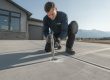
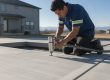
- Step 2: Strategic Drilling: Small, penny-sized injection ports are drilled in a grid pattern. These holes are non-invasive and specifically placed to avoid any internal reinforcement.
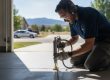
- Step 3: Precision Injection: High-density polyurethane is injected through the ports. We monitor the lift in real time to ensure the slab rises evenly.
- Step 4: Port Sealing and Joint Caulking: Once the slab is level, the ports are filled with color-matched cement, and joints are caulked to prevent future water intrusion.
- Step 5: Immediate Return to Service: Unlike traditional methods, the foam cures almost instantly. You can park your vehicles back in the garage within 30 minutes of completion.
Precision Monitoring and Leveling
Our technicians utilize advanced laser levels throughout the injection phase to ensure the surface is perfectly flat. This level of accuracy is critical for maintaining a tight seal at the base of your garage door, which keeps out pests and winter drafts. We can control the expansion of the foam to within 1/10th of an inch, allowing for a gradual, controlled lift that prevents new cracks from forming. Accurate concrete leveling also restores the original pitch of the floor, ensuring that snowmelt from your car drains toward the door rather than pooling against the back wall.
Cleanliness and Homeowner Convenience
Foam injection is the cleanest repair method available in 2026. Because the equipment is contained within a single truck and delivered through a slender hose, there’s no need for heavy machinery on your lawn or messy grout pumps in your driveway. In most cases, you don’t even need to empty your garage completely; we only require access to the specific areas where the sinking has occurred. Most Denver garage repairs are finished in less than four hours, allowing you to go about your day without the disruption of a multi-day construction project. To begin your own restoration, you can request a professional site inspection to receive a detailed structural plan.
Choosing RiseLock for Your Denver Garage Floor Repair
Selecting a partner for structural restoration is a significant decision that affects your home’s long-term value and safety. At RiseLock, we approach every sunken garage floor repair Denver homeowners entrust to us with a sense of professional pride and technical mastery. Our methodology is built on the unique combination of high-density polyurethane injection and deep expertise in post-tensioned systems. This dual focus allows us to address the surface-level symptoms of sinking while simultaneously protecting the internal structural “skeleton” of your slab. We avoid the hyperbolic claims of traditional marketing, focusing instead on grounded, confident solutions that provide lasting security.
Our commitment to professional reliability extends across the entire Front Range. Whether your property is in the growing developments of Castle Rock, the established neighborhoods of Boulder, or the residential hubs of Thornton and Aurora, we bring a methodical rhythm to our work. We view your structural challenges as our personal priority, guiding you through the technical details of the repair with the quiet authority of a subject matter expert. This approach ensures that you understand the “why” behind every injection port we place and every pound of foam we utilize.
The Advantage of a Local Denver Specialist
Denver’s geological landscape is notoriously complex, and successful restoration requires a deep understanding of local building codes and soil behaviors. As a locally owned business under the leadership of Alex Mon, RiseLock is intimately familiar with the specific challenges posed by the Front Range’s expansive clay. We don’t apply one-size-fits-all solutions; instead, we tailor our intervention to the specific soil profile and foundation type of your home. This regional expertise is why concrete lifting solutions in Colorado require a specialist who understands how seasonal moisture cycles affect sub-base stability. Our team provides direct access to expert knowledge, ensuring your project is handled with the precision it deserves.
Next Steps: Restoring Your Peace of Mind
The long-term value of professional restoration far outweighs the temporary relief offered by DIY patches or traditional mudjacking. By choosing a modern, foam-based solution, you’re investing in a permanent fix that stabilizes the ground and prevents the return of trip hazards or pooling water. We act as your professional guide, leading you away from the stress of structural settlement toward the peace of mind that comes with a level, stable floor. The process begins with a clear, technical evaluation of your garage’s current state. Request a professional assessment from RiseLock Concrete Lifting today to receive a precision estimate and a detailed plan for your structural restoration.
Secure the Future of Your Garage Foundation
Restoring a sinking slab in Colorado is a technical challenge that requires more than just filling a hole. It demands an understanding of how expansive clay interacts with high-density polyurethane and the specialized knowledge needed to navigate post-tension cable systems. By choosing a precision-based approach, you can eliminate trip hazards and drainage issues while ensuring your floor is capable of supporting heavy vehicle loads for years to come.
Professional sunken garage floor repair Denver homeowners trust is about more than just a level surface; it’s about long-term structural integrity. RiseLock brings specialized post-tension cable expertise and high-density polyurethane technology to every project across Denver, Aurora, and the Front Range. We don’t just patch the problem. We provide a permanent solution that respects the engineering of your home.
Request a Structural Assessment and Quote from RiseLock
You deserve the peace of mind that comes with a stable, reliable floor. We’re ready to help you reclaim your space with the precision and care your property deserves.
Frequently Asked Questions
How much does sunken garage floor repair cost in Denver?
The total investment for a repair depends on the volume of material required and the depth of the voids beneath your concrete. Factors such as the square footage of the settlement and the specific soil conditions at your property will influence the final estimate. This method is generally a more cost-effective alternative to full slab replacement, as it avoids the expenses associated with demolition and new concrete pouring.
Is polyurethane foam strong enough to hold my heavy truck?
High-density polyurethane is specifically engineered to support heavy loads, including full-sized trucks, SUVs, and dense storage units. Once the foam is injected, it expands to fill every micro-void in the sub-base, creating a uniform support structure. This material has a high compressive strength that resists the weight of heavy vehicles without settling or compressing over time.
How long does the garage floor leveling process take?
Most residential projects are completed in just two to four hours. Unlike traditional concrete replacement, which involves days of demolition and curing, polyurethane foam reaches its full strength almost immediately. You’ll be able to park your vehicles back in the garage and return to your normal routine within 30 minutes of the technicians finishing the work.
Can you fix a garage floor that has post-tension cables?
Yes, we can safely repair these slabs, but it requires a technician with specialized structural knowledge. Performing a sunken garage floor repair Denver homeowners can trust on a post-tensioned slab involves precise cable mapping before any drilling begins. This ensures that the internal steel reinforcement remains intact while we stabilize the ground beneath the concrete.
Why is my garage floor sinking while the rest of the house is fine?
Garage slabs are often “floating” structures that sit directly on the soil, whereas the rest of your house is likely built on deeper footings or piers. This design makes the garage floor much more vulnerable to the movement of Denver’s expansive clay. When the soil shrinks during dry seasons, the garage slab loses its support and settles, even if the main house foundation remains perfectly stable.
Will the foam injection process be messy or damage my garage?
The injection process is remarkably clean and non-invasive. Technicians only need to drill small injection ports about the size of a penny to deliver the foam beneath the slab. There’s no need for heavy machinery or messy grout pumps. Once the leveling is finished, the holes are filled and color-matched to the existing concrete, leaving your garage looking professional and undisturbed.
How long will a polyurethane concrete lift last in Colorado?
A polyurethane lift is considered a permanent solution because the material is inorganic and won’t decay or rot. It’s also hydrophobic, meaning it won’t wash away during heavy snowmelt or spring rains. This durability is essential for Colorado’s climate, as the foam remains stable through the state’s frequent freeze-thaw cycles and won’t lose its volume over time.
Is it better to replace the garage floor or repair it with foam?
Repair is usually the superior option if the concrete hasn’t completely crumbled. Foam injection is faster, less expensive, and addresses the root cause of the problem by filling the soil voids. If you simply pour a new slab over unstable soil, the new concrete will likely sink just as the old one did. Stabilizing the ground first ensures a long-term result that replacement alone can’t provide.