
The heavy, cement-based slurry used in traditional repairs might actually be the primary reason your driveway or sidewalk continues to sink. While mudjacking has been the standard for decades, adding thousands of pounds of weight to Denver’s already volatile soil often accelerates the very problem it’s meant to solve. You’ve likely noticed uneven seams in your patio or tripping hazards forming on your walkway; these aren’t just cosmetic eyesores. Effective concrete slab stabilization Denver requires a deep understanding of the region’s unique geotechnical environment. The expansive bentonite clay beneath our feet swells and shrinks with the seasons, creating voids that traditional, heavy materials simply cannot fill reliably.
We believe your home’s structural integrity deserves a solution grounded in modern engineering rather than outdated habits. This guide details how advanced polyurethane injection provides a lightweight, high-precision alternative that restores stability permanently and without the invasive mess of older methods. You’ll discover the technical advantages of high-density foam and why this sophisticated approach is the most effective way to secure your property’s value and ensure a level, safe surface for years to come.
Key Takeaways
- Learn how Denver’s expansive clay soils and semi-arid climate create the subgrade voids responsible for sinking concrete slabs.
- Understand the technical advantages of high-density polyurethane, a lightweight material that expands and hardens rapidly to provide permanent structural support.
- Discover why modern concrete slab stabilization Denver utilizes foam injection to avoid the secondary settlement often caused by the excessive weight of traditional mudjacking.
- Explore the precise, non-invasive restoration process that allows for immediate use of your driveway, sidewalk, or patio after repair.
- See how a specialized approach to structural restoration preserves property value while eliminating tripping hazards and visual eyesores.
Understanding Concrete Slab Instability in Denver’s Unique Climate
Concrete stabilization is the systematic restoration of the subgrade beneath a slab to ensure it can properly support its structural weight. In Denver, this process is rarely a simple fix if the underlying environmental factors are ignored. The region’s semi-arid climate creates a cycle of extreme moisture fluctuations that directly impact the soil’s volume and density. When the ground loses its ability to provide uniform support, the concrete above inevitably begins to fail. Identifying these issues early is critical for successful concrete slab stabilization Denver projects.
Property owners often see the symptoms before they understand the cause. You might notice stair-step cracks in your garage floor, water pooling in low spots on your patio, or uneven joints that create dangerous tripping hazards on your sidewalk. These aren’t just cosmetic flaws; they are clear indicators that the soil beneath has shifted or washed away, leaving the concrete suspended over a void. If left unaddressed, these minor shifts can lead to significant structural damage and a decrease in property value.
The Role of Expansive Soils in the Front Range
The primary geological challenge in Colorado is the presence of expansive bentonite clay. This specific soil type acts like a sponge. It swells significantly when it absorbs moisture and shrinks as it dries out. During Denver’s hot, dry summers, the clay loses moisture and retracts, creating large subterranean gaps or voids. When autumn rains or winter snows arrive, the soil expands again, but often unevenly. This constant movement places immense stress on rigid concrete. Without professional intervention, the weight of the slab eventually causes it to crack and settle into these newly formed hollows.
Freeze-Thaw Cycles and Hydrostatic Pressure
Denver is famous for rapid temperature swings, often fluctuating 40 degrees or more in a single day. These cycles are brutal on exterior structures. As snow melts, water seeps into the cracks and under the edges of the slab. When temperatures drop overnight, that water freezes and expands, exerting powerful upward hydrostatic pressure. This frost heave can lift sections of concrete, while the subsequent thaw leaves the slab unsupported.
Many homeowners attempt to fix these issues with surface-level patches or caulking. These temporary measures fail to address the deep-rooted subgrade instability. Traditional Concrete leveling methods like mudjacking were once the only option, but adding heavy grout to already unstable clay often worsens the settlement. Effective concrete slab stabilization Denver requires a more sophisticated, lightweight approach that fills the void without adding excessive weight to the fragile Front Range soil.
The Science of Polyurethane Foam Injection for Slab Stabilization
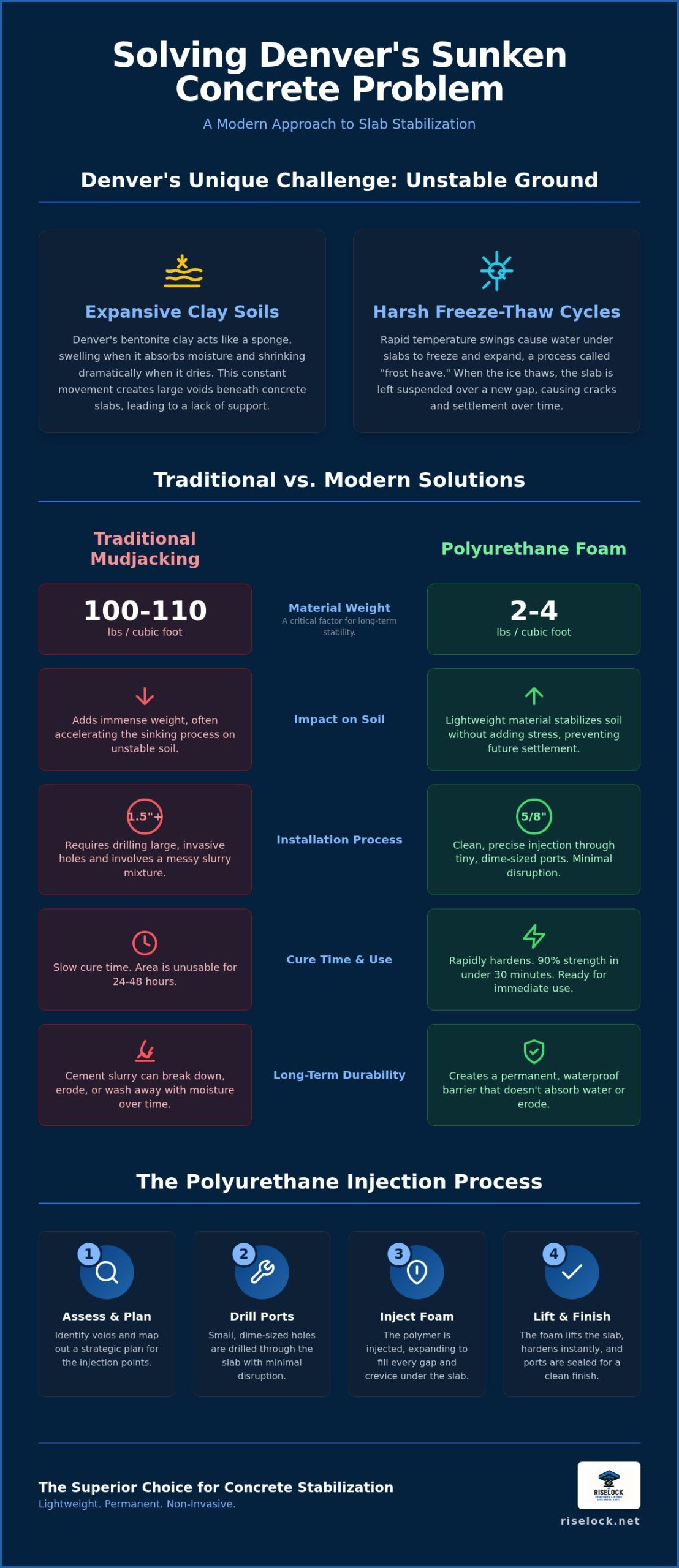
High-density polyurethane foam represents the modern standard for structural lifting and stabilization. Unlike traditional methods that rely on heavy grout, this two-part polymer liquid is injected through tiny ports beneath the slab. Once the components mix, a chemical reaction occurs, causing the material to expand rapidly into every available void. It hardens within minutes, reaching 90% of its total functional strength in less than half an hour. This speed allows for concrete slab stabilization Denver projects to be completed with minimal disruption to the property owner’s daily routine.
The structural integrity of the foam is derived from its closed-cell nature. This means the material consists of millions of microscopic, sealed bubbles that prevent water from passing through or being absorbed. In a climate where moisture fluctuations are constant, this characteristic is invaluable. The foam doesn’t just lift the concrete; it creates an impervious barrier that prevents future erosion and protects the subgrade from the cycle of saturation and drying that characterizes the Front Range. It’s a permanent solution that addresses the root cause of the shift rather than just masking the symptoms.
High-Density Foam vs. Native Soil Support
The weight of the repair material is a critical factor in long-term success. High-density polyurethane weighs approximately 2 to 4 pounds per cubic foot, which is a fraction of the weight of native Colorado soil or traditional cementitious fillers. This lightweight profile ensures the repair doesn’t contribute to further settlement of Denver’s expansive or swelling soil. By creating a solid, waterproof base, the foam provides a permanent foundation that won’t wash away during heavy spring runoff. Compressive strength represents the maximum load a material can withstand before failing, ensuring a driveway can support the weight of heavy vehicles without deformation.
Precision Control and Lifting Capabilities
Modern injection technology allows technicians to control the lifting process with incredible accuracy. We monitor the movement of the slab to within 1/10th of an inch, ensuring the surface returns to its original grade without over-correcting. This precision is possible because the foam expands predictably in a controlled environment. The process requires only penny-sized injection holes, which preserves the aesthetic of the concrete. Additionally, this minimally invasive technique is essential for protecting the integrity of post tension installation systems, where drilling large holes could accidentally sever critical reinforcement cables. If you’re concerned about the longevity of your surfaces, consulting with a specialist in foam concrete lifting can provide the clarity needed to protect your investment.
Why Denver Homeowners Choose Modern Foam Over Traditional Mudjacking
Choosing the right method for concrete slab stabilization Denver often comes down to a choice between traditional cementitious grouting and modern chemical polymers. Mudjacking, a process that has remained largely unchanged for decades, involves pumping a heavy mixture of sand, water, and cement under the slab. While this can provide a temporary lift, the material itself weighs upwards of 100 pounds per cubic foot. In a region dominated by Colorado’s expansive soils, adding this much mass to an already compromised subgrade is often counterproductive. The added weight can actually trigger further sinking as the weak soil collapses under the new load.
Modern polyurethane alternatives offer a far more sustainable path for long-term structural health. The high-density foam we utilize is chemically inert and specifically engineered to withstand the high-alkaline environments common in Colorado’s soil. Unlike mudjacking slurry, which can eventually dry out, shrink, or wash away during heavy rain cycles, polyurethane maintains its volume and structural integrity indefinitely. Additionally, the cure time is measured in minutes rather than days. You can drive a vehicle over a stabilized slab almost immediately after the injection process is complete, whereas mudjacking often requires 24 to 72 hours of restricted use.
The Weight Problem: Why Mudjacking Often Fails in Colorado
The fundamental flaw in mudjacking for local properties is that it ignores the load-bearing capacity of the underlying soil. When heavy slurry is injected, it further compresses the already weak subgrade, frequently leading to secondary settlement where the slab sinks again under the weight of the repair material itself. Choosing polyurethane concrete lifting eliminates this risk. Because the foam is incredibly lightweight, it stabilizes the slab without overloading the sensitive clay beneath. This ensures the restoration remains permanent rather than becoming a recurring maintenance headache.
Cleanliness and Property Impact
The logistical difference between the two methods is stark. Mudjacking requires massive equipment, long hoses, and large, two-inch diameter holes drilled throughout the concrete. It’s a messy, invasive process that often leaves dust and slurry residue on finished surfaces. In contrast, foam injection is a surgical procedure. The equipment is self-contained, and the injection ports are no larger than a penny. This protects your landscaping from heavy machinery ruts and ensures your driveway or patio remains clean throughout the process. This level of technical precision is why concrete slab stabilization Denver has shifted toward foam as the preferred professional standard for discerning homeowners.
The Professional Stabilization Process: What to Expect
Professional restoration is a methodical engineering process that begins long before any material is injected beneath your property. For successful concrete slab stabilization Denver, we start with a comprehensive structural assessment to identify the specific locations of subterranean voids. We use non-invasive techniques to map the subgrade, ensuring we understand the depth and volume of the hollows created by Colorado’s shifting clay soils. This diagnostic phase is critical; it allows our technicians to calculate the exact volume of high-density polyurethane required to provide a permanent, stable foundation.
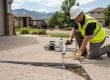
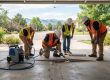
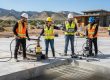
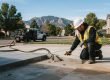
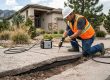
Once the mapping is complete, the physical restoration begins with surgical precision. Unlike traditional methods that require heavy machinery, our self-contained equipment allows us to work efficiently without damaging your lawn or landscaping. We monitor the slab’s movement in real time as the foam expands, using sensitive dial indicators to track the lift. This constant feedback loop ensures the concrete returns to its original grade without over-stressing the material or creating new pressure points. The final phase involves sealing the injection ports with a color-matched cementitious grout and thoroughly cleaning the work area, leaving your property looking as though we were never there.
Step-by-Step Execution of a Stabilization Project
- Step 1: Mapping the Slab. We identify the most critical support points where the slab has lost contact with the subgrade. This ensures the lift is uniform and structurally sound.
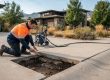
- Step 2: Drilling Injection Ports. Our technicians drill small 5/8-inch holes through the concrete. These penny-sized ports are strategically placed to reach the subgrade without compromising the slab’s structural integrity or cracking the surface.
- Step 3: Controlled Injection. We inject the two-part polyurethane foam through these ports. As it expands, it fills every crevice and void, exerting enough upward pressure to lift the slab back into its correct position.
Post-Stabilization: Maintenance and Care
The speed of modern chemical stabilization is one of its most significant benefits. Your driveway or patio is ready for full weight-bearing loads, including heavy vehicle traffic, in under 30 minutes. To protect your investment, we recommend sealing any existing cracks in the concrete surface. This simple maintenance step prevents future water infiltration, which is the primary driver of soil erosion and freeze-thaw damage in the Front Range. For more detailed advice on preserving your property’s exterior surfaces, you can explore our concrete leveling guide. If you’ve noticed uneven joints or pooling water on your property, you can schedule a professional structural assessment to determine the best path forward for your home.
Securing Your Investment with RiseLock’s Specialized Approach
Local expertise is a structural necessity in the Front Range. Successfully executing concrete slab stabilization Denver requires an intimate understanding of how our regional geology interacts with residential and commercial foundations. At RiseLock, we view your property’s structural challenges as a personal priority. Our team doesn’t just apply a generic fix; we utilize technical mastery and high-precision materials to ensure your concrete remains level and secure. This commitment to professional reliability transforms the stress of sinking slabs into long-term structural peace of mind.
Proactive intervention is the most cost-effective way to preserve your home’s value. Small cracks or minor shifts in your driveway might seem inconsequential, but they are often the first warnings of significant subgrade erosion. Addressing these issues early prevents the progression toward total foundation failure. By stabilizing the soil before the concrete undergoes catastrophic cracking, you avoid the high costs and extensive timelines associated with full slab replacement. We focus on providing a permanent fix that addresses the root cause of the movement, ensuring your property remains safe and functional for the long term.
Comprehensive Solutions: Beyond Simple Leveling
Structural restoration is rarely a standalone task. Our approach ensures that stabilization protects the integrity of concrete repair in Denver Colorado by providing a consistent, non-erodible base. We also bring specialized expertise in post-tension cable systems, allowing us to handle complex structural needs that traditional concrete companies might overlook. Every project we undertake across the Front Range is backed by a sense of professional pride and a dedication to industry-leading standards. This holistic view of structural health is what sets our modern restoration techniques apart from temporary surface fixes.
Next Steps for Denver Property Owners
If you aren’t sure whether your concrete requires professional intervention, look for these common indicators of subgrade instability:
- Exterior doors or garage doors that stick or fail to close properly.
- Gaps larger than 1/4 inch appearing between the slab and the foundation wall.
- Pooling water that remains on your patio or driveway hours after a storm.
- Tripping hazards created by uneven joints between concrete sections.
Identifying these signs early allows for a non-invasive restoration process. Getting a professional assessment in the Denver metro area is straightforward and provides you with a clear roadmap for repair. Don’t wait for environmental stressors to worsen the damage. You can request a professional structural assessment from RiseLock today to secure your investment with a permanent, modern solution.
Restoring Structural Integrity to Your Denver Property
Effective concrete slab stabilization Denver requires moving beyond surface-level patches to address the complex soil mechanics of the Front Range. We’ve explored how Denver’s expansive clay soils create subterranean voids that inevitably lead to sinking and settlement. By choosing specialized high-density polyurethane technology over outdated, heavy mudjacking, you ensure your repair doesn’t add unnecessary stress to the subgrade. This modern approach provides a permanent, waterproof foundation that protects your property from the region’s intense moisture fluctuations and freeze-thaw cycles.
As a locally owned business operated by structural experts, RiseLock is committed to providing the technical precision your home deserves. We view every project as a partnership in preserving your property’s value and safety. Taking action now prevents minor settlement from escalating into costly foundation failures, allowing you to enjoy a level, safe environment with minimal disruption. Secure your Denver property with RiseLock’s precision stabilization today and regain the peace of mind that comes with a stable, professionally restored structure.
Frequently Asked Questions
Is concrete stabilization better than replacing the entire slab?
Concrete stabilization is generally superior to replacement because it addresses the subgrade failure that caused the initial sinking. Replacing a slab without fixing the underlying soil often leads to the new concrete settling within a few years. Stabilization is also significantly less invasive and allows you to keep your existing surfaces without the color mismatch of new concrete sections.
How long does polyurethane concrete stabilization last in Denver’s weather?
Polyurethane concrete slab stabilization Denver is designed to last the lifetime of the structure. The high-density foam is a closed-cell material that doesn’t degrade, shrink, or wash away over time. Because it’s impervious to water, it remains unaffected by the intense moisture cycles and rapid temperature swings common in the Front Range.
Can polyurethane foam stabilize a slab over expansive bentonite clay?
High-density polyurethane is specifically engineered to perform well over expansive bentonite clay. Unlike traditional mudjacking, which adds thousands of pounds of weight to the soil, polyurethane is incredibly lightweight. It fills the voids created by shrinking clay without exerting the downward force that causes secondary settlement in Colorado’s sensitive soils.
Will the stabilization process damage my lawn or driveway landscaping?
The stabilization process is exceptionally clean and won’t damage your landscaping. We use self-contained equipment that stays on the street or driveway, and the injection ports are only about 5/8 of an inch in diameter. There is no heavy machinery required to drive across your lawn, and we don’t leave slurry or dust behind during the procedure.
How soon can I drive on my concrete after it has been stabilized?
You can drive on your concrete almost immediately after the injection is complete. While traditional cement-based repairs require days of cure time, polyurethane reaches 90% of its functional strength in roughly 15 to 30 minutes. This allows for nearly immediate use of driveways and garage floors without the long wait times associated with other methods.
What is the difference between concrete leveling and slab stabilization?
Concrete leveling refers to the visual result of lifting a slab back to its original grade, while stabilization focuses on the technical process of filling voids and strengthening the subgrade. Concrete slab stabilization Denver ensures that the ground beneath the concrete can actually support the weight of the slab and any vehicles parked on top of it.
Does insurance typically cover concrete slab stabilization in Colorado?
Most standard homeowners insurance policies in Colorado don’t cover concrete settlement or stabilization. These issues are typically classified under “earth movement” exclusions or considered part of routine property maintenance. It’s always advisable to review your specific policy or speak with your agent to confirm your coverage details regarding structural repairs.
Can you stabilize a post-tension slab without damaging the cables?
Yes, we can stabilize post-tension slabs with a high degree of safety and precision. Because our injection ports are penny-sized, we can strategically place them to avoid the internal cables. Our team’s expertise in post-tension systems ensures that the structural reinforcement remains intact while we restore the subgrade support through the specialized foam injection process.