

What if the right repair for an uneven driveway isn’t replacement, but lifting every slab isn’t necessary either? If you’re considering concrete driveway leveling Thornton homeowners should start by looking at the condition of the concrete and the support beneath it. A raised panel edge can make access difficult and create trip or drainage concerns, while clay soils, runoff, and snowmelt may contribute to settlement.
Whether a sunken driveway can be lifted or needs a broader repair depends on the slab’s cracks, surface condition, and support needs. This guide explains signs and limits of leveling, compares lifting with replacement using practical criteria, and outlines what to expect from a driveway assessment in Thornton.
For sound slabs that have settled, polyurethane concrete lifting uses high-density foam to lift and stabilize the concrete. It offers an alternative to traditional mudjacking and replacement. RiseLock provides polyurethane lifting and concrete leveling in Thornton. The sections ahead will help you assess your driveway’s condition and understand the options.
Key Takeaways
- Document panel positions, height changes, cracks, and drainage patterns before an assessment.
- Concrete driveway leveling Thornton homeowners consider should match the slab’s condition and support needs, not be treated as a one-size-fits-all fix.
- Compare lifting with replacement by considering settlement, surface damage, and the scope of repair required.
- High-density polyurethane foam can be injected beneath settled concrete to lift and support a slab through a controlled process.
- Include the garage-apron transition in your notes to show how the driveway meets nearby concrete.
Concrete Driveway Leveling in Thornton: What Uneven Slabs Can Tell You
A driveway may need closer attention when one panel tilts, neighboring sections no longer meet evenly, a gap appears beside the slab, or water collects after rain or snowmelt. These changes can affect how you enter the garage, where you walk, and how water moves across the paved area. An uneven garage apron, where the driveway meets the garage, can create another noticeable change in elevation.
Driveway leveling raises and supports settled concrete to address differences in slab height. The term concrete leveling covers methods used to reposition and support sunken slabs. Visible signs offer useful clues, but they don’t establish why a slab moved or whether lifting is suitable. Both the concrete’s condition and the support beneath it matter when considering concrete driveway leveling in Thornton.
Which driveway changes should Thornton homeowners notice?
Look for changes you can describe or photograph without trying to diagnose their cause. A height difference between two panels is different from a crack: panels can sit at different levels even when the concrete is mostly intact, while a crack can appear without an obvious step between sections. Note whether joints have widened, slab edges appear exposed, or the path into the garage feels different than before.
- Record which panels appear tilted or sit higher or lower than adjacent ones.
- Note gaps at joints and edges, including where the driveway meets the garage apron.
- After rain or snowmelt, observe where water remains or flows across the surface.
These observations help you describe the issue clearly. They don’t prove that settlement caused it, since cracks and pooling can have more than one explanation.
How can local soil and water conditions affect driveway slabs?
Clay soils, runoff, and snowmelt are possible factors in driveway settlement around Thornton. Water moving around or beneath a slab may affect the ground supporting it, and changes in ground support can contribute to movement. Conditions vary by property, however. A wet area or shifted panel alone can’t identify the cause.
Look for patterns: note where runoff travels, where snowmelt collects, and whether uneven areas sit near a joint, driveway edge, or garage apron. This information helps describe the slab and its surroundings, but it isn’t a diagnosis. For broader context on concrete damage and repair approaches, explore the concrete repair guide for Denver and Colorado. A careful assessment connects observable changes with slab condition and support needs before identifying an approach.
How Polyurethane Foam Lifting Raises and Supports a Thornton Driveway
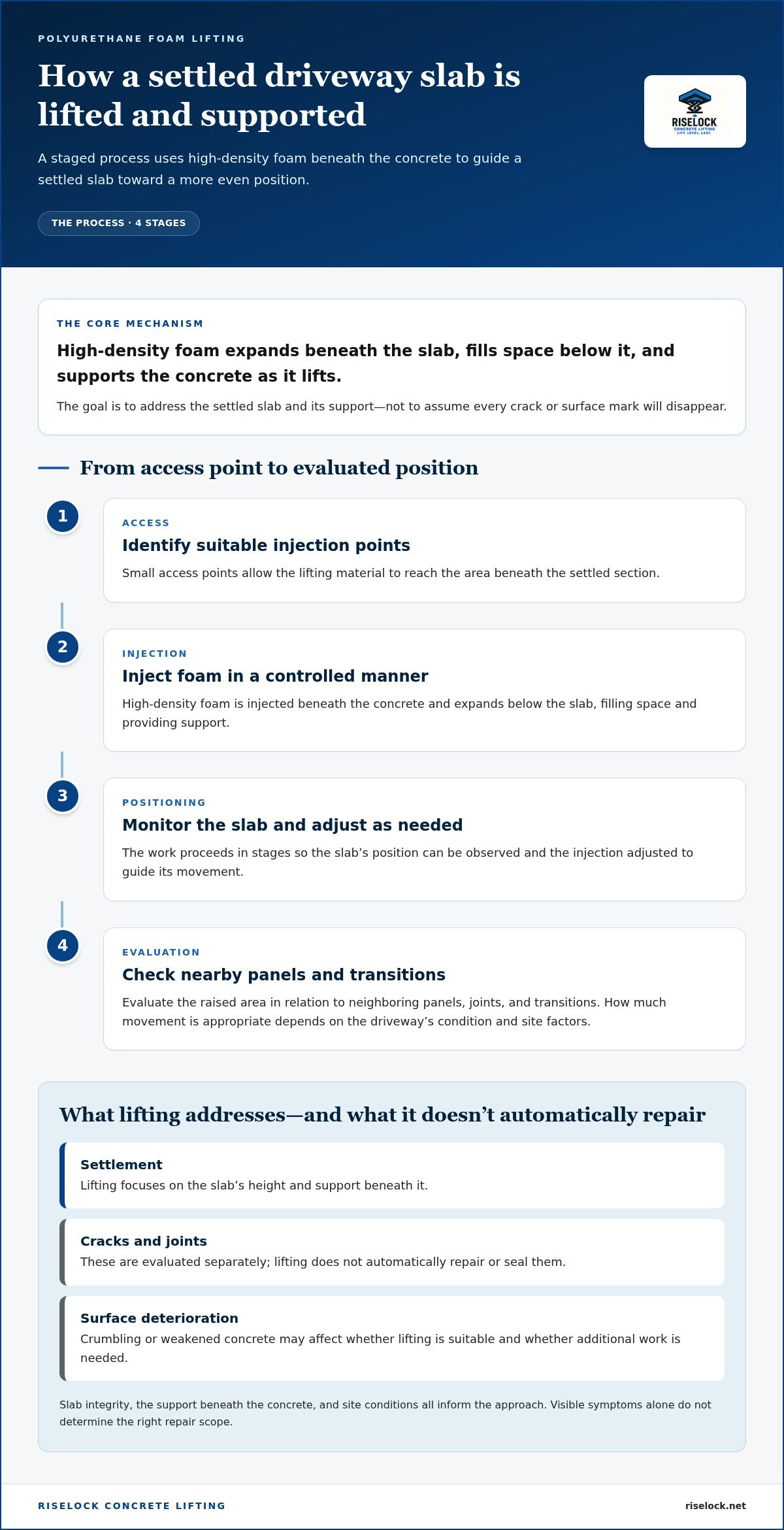
Polyurethane concrete lifting raises settled concrete by injecting high-density foam beneath the slab. As the foam expands, it fills space below the concrete and supports the slab as it lifts toward a more even position. For concrete driveway leveling in Thornton, the goal is to address the settled slab and its support, not to assume every crack or surface mark will disappear.
What happens during foam injection beneath a driveway?
Small access points allow the lifting material to reach the area beneath the slab. The work proceeds in stages so the slab’s position can be observed and adjusted. In broad terms, the process includes:
- Identify suitable access points for injecting foam beneath the settled section.
- Inject high-density foam in a controlled manner, allowing it to expand below the concrete.
- Monitor the slab and adjust the injection as needed to guide its position.
- Evaluate the raised area in relation to nearby panels, joints, and transitions.
The aim is to restore the slab’s position while supporting it from below. How much movement is appropriate depends on the driveway’s condition and site factors. Nearby concrete matters too, since one panel’s position affects how its edges meet the sections around it.
What can lifting address, and what may need separate repair?
Lifting focuses on settled concrete and its support. It isn’t the same as repairing a crack, sealing a joint, or restoring worn concrete. Those conditions need separate evaluation, particularly if a slab has extensive surface deterioration or damage that could affect its suitability for lifting.
- Settlement: Lifting focuses on the slab’s height and support.
- Cracks and joints: These are assessed separately; lifting doesn’t automatically repair or seal them.
- Surface deterioration: Crumbling or weakened concrete may affect whether lifting is suitable and whether additional work is needed.
A relatively sound panel sitting lower than its neighbor presents a different repair question from a slab with widespread crumbling. In either case, the visible symptoms alone don’t determine the right scope. Site conditions, slab integrity, and support beneath the concrete all inform the approach. The polyurethane concrete lifting guide provides broader context on how the method works.
RiseLock provides polyurethane concrete lifting and leveling in Thornton, using high-density foam to lift and stabilize sunken slabs. An assessment can help clarify whether lifting suits the driveway and whether separate concrete repair should also be considered. Learn more about RiseLock’s concrete lifting service.
Driveway Leveling or Replacement: How to Decide What Fits
Choose between leveling and replacement by looking at the concrete’s condition, not just how uneven it appears. A settled slab that remains intact may be a candidate for lifting, while extensive deterioration can call for a broader repair plan. Neither option fits every driveway, and lifting isn’t a guaranteed fix for every cracked or settled surface.
| Decision factor | Leveling may fit when… | Consider a broader repair plan when… |
|---|---|---|
| Slab condition | The concrete remains serviceable despite settlement. | Sections are broken, crumbling, or badly deteriorated. |
| Extent of settlement | The concern is a change in height or support under specific panels. | Movement is widespread or appears to be recurring. |
| Surface damage | Cracks or marks are limited and the slab can be assessed as a whole. | Damage affects large areas or the concrete’s integrity. |
| Disruption and scope | The repair can focus on lifting and supporting existing concrete. | Damaged material or wider site conditions call for more than repositioning slabs. |
When might lifting be a practical alternative to replacement?
Lifting may be worth considering when a driveway panel has settled but the concrete remains usable. It addresses the slab’s position and support while retaining the existing concrete, rather than removing and replacing it. Suitability still depends on access, slab condition, and factors that may have contributed to the movement. An assessment helps determine whether the panel can be lifted appropriately; appearance alone can’t guarantee a suitable result.
A sound panel sitting lower than its neighbor raises a different question from a section broken into pieces. The first may warrant considering lifting; the second calls for closer attention to the extent of damage and the repair scope. In either case, assess the entire affected area, not only the most noticeable edge.
When should the repair plan consider more than leveling?
Extensive deterioration, broken sections, and recurring movement are reasons to assess whether lifting alone addresses the problem. Raising a slab can improve its position, but it doesn’t automatically correct every condition in the ground or repair damaged concrete. If the surface is severely compromised, replacement or additional concrete repair may need consideration. The right scope depends on the slab and site, so don’t assume either option will resolve every issue.
For concrete driveway leveling in Thornton, weigh panel condition alongside the extent of movement and surface damage. A focused assessment can distinguish between settled but serviceable concrete and deterioration that calls for a different plan. The concrete leveling guide offers broader context on leveling methods and slab restoration; an evaluation of the driveway helps identify which approach fits its needs.
Prepare for a Thornton Driveway Leveling Assessment
A clear record of what you’ve noticed can make a driveway assessment more focused. Before discussing the repair scope, document where changes appear, how the concrete meets nearby surfaces, and what happens to water after rain or snowmelt. These observations help explain the issue, but they don’t replace an on-site evaluation of the slab and its support.
What should homeowners document before an assessment?
Start with a simple visual record. Take photographs from consistent angles so panel heights, joints, and transitions are easier to compare. Note when you first noticed movement and whether it became apparent after runoff or snowmelt. Timing can provide context, but it doesn’t prove what caused the movement.
- Mark affected panels. Identify each area by location, such as the section beside the garage or near the driveway entrance.
- Record height changes. Note where one panel appears higher or lower than the next, especially at joints and edges.
- Photograph cracks and gaps. Capture their locations and visible extent rather than trying to diagnose their cause.
- Track water behavior. After rain or snowmelt, note where water pools and which direction it appears to flow.
- Include nearby transitions. Document the garage apron and any change in access, without assuming nearby areas share one cause.
A photograph showing a panel edge beside the garage apron, for example, can communicate a height change that’s difficult to describe. A note about when water collects adds context, but an assessor still needs to examine the site.
Which questions help clarify the proposed repair scope?
After the driveway is assessed, ask how the proposed work relates to the visible conditions. Understanding what the repair addresses, and what falls outside its scope, helps you compare the plan with the concerns you documented.
- How does the observed slab condition relate to the recommended lifting work?
- Is the proposed work intended to address settled concrete, and which areas are included?
- Would cracks, joints, or surface deterioration require separate repair?
- What conditions could affect the suitability or scope of leveling?
These questions keep the discussion focused on the slab rather than assumptions based on appearance. Bring your notes and photographs to a professional assessment to help clarify the repair scope. Learn about RiseLock’s concrete lifting service.
Choose RiseLock for Concrete Driveway Leveling in Thornton
A practical repair plan starts with the driveway’s actual condition: the state of each slab, the pattern of settlement, and the work needed to address it. RiseLock provides polyurethane concrete lifting and leveling for residential and commercial concrete in Thornton. For homeowners considering concrete driveway leveling in Thornton, the discussion can focus on whether lifting fits the slab and what the repair scope should include.
What to expect from RiseLock’s concrete lifting approach
RiseLock uses high-density polyurethane foam to lift and stabilize sunken concrete slabs. The foam is injected beneath settled concrete, where it expands to support and raise the slab. This method offers an alternative to traditional mudjacking and, when the slab and site conditions are suitable, may provide an option other than replacing the concrete.
The method has a specific focus: lifting addresses the position and support of settled concrete. It doesn’t automatically repair every crack, damaged joint, or deteriorated surface. Those conditions are important to the assessment and may affect the repair scope. A driveway with intact panels and localized settlement presents a different project from one with widespread deterioration or broken sections.
RiseLock’s approach considers the concrete’s condition and the settlement being addressed. An assessment relates those observations to the proposed work, including which areas are part of the lifting scope and whether separate concrete repair should be considered. This helps set clear expectations without assuming one method suits every driveway.
How to take the next step on an uneven driveway
Gather the observations that best describe what you see. Identify affected panels, note height differences, and record cracks, joint changes, pooling water, and the transition to the garage apron. If you noticed changes after runoff or snowmelt, include when they appeared. These details help frame the discussion, but the repair plan should follow an assessment of the driveway itself.
Focus on how the proposed work relates to the slab condition and settlement pattern. Clarify which areas the plan addresses, whether cracks or joints fall within a separate repair scope, and what the lifting work is intended to accomplish. This keeps the decision grounded in the driveway’s needs rather than a general promise that leveling will solve every visible issue.
RiseLock serves Thornton with polyurethane concrete lifting and leveling. Discuss your Thornton driveway leveling project and the repair scope that may fit the observed slab condition.
Move Forward With a Clear Driveway Repair Plan
A driveway repair decision is easier to make when it’s based on the concrete’s actual condition, not pressure to choose a quick fix. Use your observations as a starting point, then let an on-site assessment clarify what the slab needs and which work belongs in the repair scope. That keeps the next step practical, even when the right approach isn’t immediately obvious.
For concrete driveway leveling in Thornton, bring your questions, photos, and notes about changes in access or water flow to a project discussion. The goal is to understand what the proposed work addresses and whether other concrete concerns need separate attention. RiseLock serves Thornton and can help you consider the driveway’s needs.
When you’re ready to discuss the project, contact RiseLock about concrete driveway leveling in Thornton.
Frequently Asked Questions
Can a sunken concrete driveway in Thornton be leveled instead of replaced?
Yes, lifting may be an option if the settled slab remains suitable for the method. For concrete driveway leveling in Thornton, an assessment looks beyond the height difference: cracking, weakened areas, signs of ongoing movement, and site conditions can all affect the repair plan. A shifted but intact panel differs from one that’s breaking apart. Review the slab’s condition and the proposed scope before choosing between lifting and replacement.
How does polyurethane foam driveway leveling work?
Polyurethane foam leveling injects high-density foam beneath settled concrete to lift and support the slab. The work is done through access points in the concrete, with injection controlled as the slab is raised. The method addresses the slab’s position and support, not every surface defect. A raised panel, for example, may still have a crack or joint that needs separate attention. The slab’s condition and the site help determine the appropriate scope.
Why do concrete driveways settle in Thornton, Colorado?
Clay soils, runoff, snowmelt, and changes in support beneath a slab are possible contributors to settlement in the Thornton area, but none identifies the cause at a particular home. Note whether water gathers near one edge, whether several panels appear to move, and when you first noticed the change. This assessment approach applies across RiseLock’s service area, including Denver, Aurora, Centennial, Parker, Colorado Springs, Englewood, Littleton, Lakewood, Arvada, Thornton, Wheatridge, Castle Rock, Castle Pines, and Boulder.
Is driveway leveling suitable for cracked concrete?
Cracks don’t automatically rule out lifting, but they don’t establish that lifting is appropriate either. Consider their extent alongside the slab’s overall condition, how much it has settled, and what you want the repair to address. A stable panel with limited cracking raises a different question from concrete fractured across a large area. Lifting concerns slab position and support; crack treatment may be a separate part of the work.
What is the difference between driveway leveling and driveway replacement?
Leveling raises and supports existing concrete, while replacement involves removing the existing slab and installing new concrete. The driveway’s condition helps determine which scope to consider. If panels remain serviceable but have shifted, consider whether lifting fits their condition. If sections are badly deteriorated or broken, account for how the damage affects the repair plan. Compare each approach with the driveway’s actual needs and intended use rather than assuming one is always better.
How should I prepare for a concrete driveway leveling assessment?
Take photos showing the whole driveway and close views of affected areas, then label panels or edges in your notes. Record visible cracks, uneven joints, water pooling after rain or snowmelt, and changes near the garage or walkway. Include when you first noticed movement and whether nearby sections changed too. An organized record makes it easier to describe what you’ve observed, but it can’t replace an on-site assessment.
Does polyurethane foam lifting repair driveway cracks and drainage problems too?
Not necessarily. Foam lifting targets settled concrete and the support beneath it; cracks or open joints may need separate attention. Changing a slab’s position can also change how its surface meets neighboring panels, but that doesn’t guarantee every drainage concern will be resolved. Water may collect for reasons beyond the slab’s height. Before work begins, clarify which panels are included, what the lifting is intended to address, and whether other observed damage falls outside that scope.