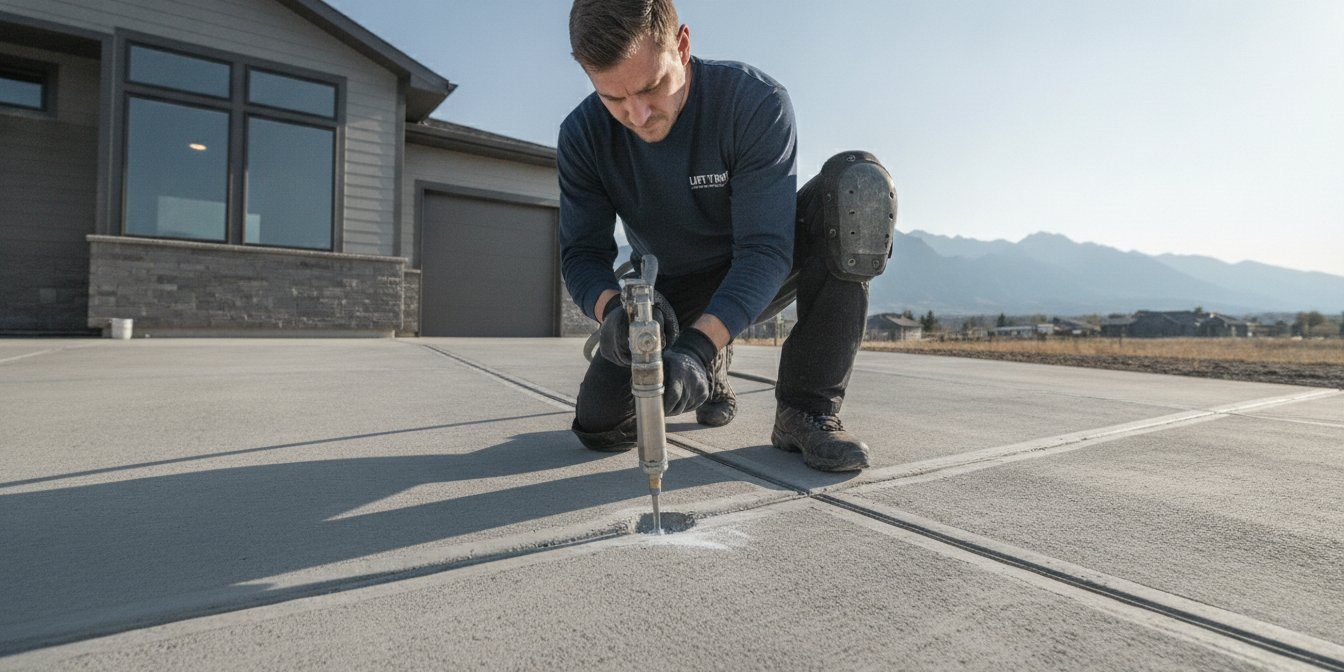
Did you know that Colorado’s expansive soils cause more property damage than floods, earthquakes, and tornadoes combined? In a city like Denver, where the ground expands up to 20 percent when wet and experiences 157 nights of freezing temperatures annually, your driveway is a structural element under constant siege. When you require sunken driveway repair Denver, you aren’t just seeking a cosmetic fix; you’re looking to eliminate trip hazards and stop water from pooling near your foundation. It’s a serious issue that demands a precise, professional response.
We understand the frustration of watching your curb appeal drop as ugly cracks form and slabs shift. This guide explores why local driveways sink and how modern polyurethane lifting provides a permanent, non-invasive solution for your property. You’ll discover how high-density foam injection stabilizes the soil to ensure a level driveway that stays level. We’ll walk through the entire restoration process, demonstrating why this clean and fast method is the superior, long-term alternative to the mess of traditional replacement.
Key Takeaways
- Learn why Denver’s expansive bentonite clay and frequent freeze-thaw cycles make professional sunken driveway repair Denver a necessity for maintaining structural integrity.
- Discover how high-density polyurethane foam provides a lightweight, non-invasive alternative to traditional mudjacking, ensuring your driveway stays level without adding excess weight to unstable soil.
- Understand the technical precision required during the foam expansion phase to achieve a perfectly level surface and permanent soil stabilization.
- Identify the hidden risks of ignoring sunken slabs, from legal liability regarding trip hazards to potential water damage near your home’s foundation.
- Explore the importance of specialized expertise, including post-tension system awareness, to ensure a safe and durable restoration for modern Denver properties.
Why Driveways Sink in Denver: Colorado Soil Challenges
Denver’s geology presents a unique challenge for concrete longevity. Most homeowners assume a sinking slab is a product defect, but it’s actually a complex soil-structure interaction. The ground beneath our feet is rarely static. In the Front Range, the primary culprit behind the need for sunken driveway repair Denver is the composition of the earth itself, specifically the presence of expansive clay.
The Bentonite Factor: Colorado’s Moving Ground
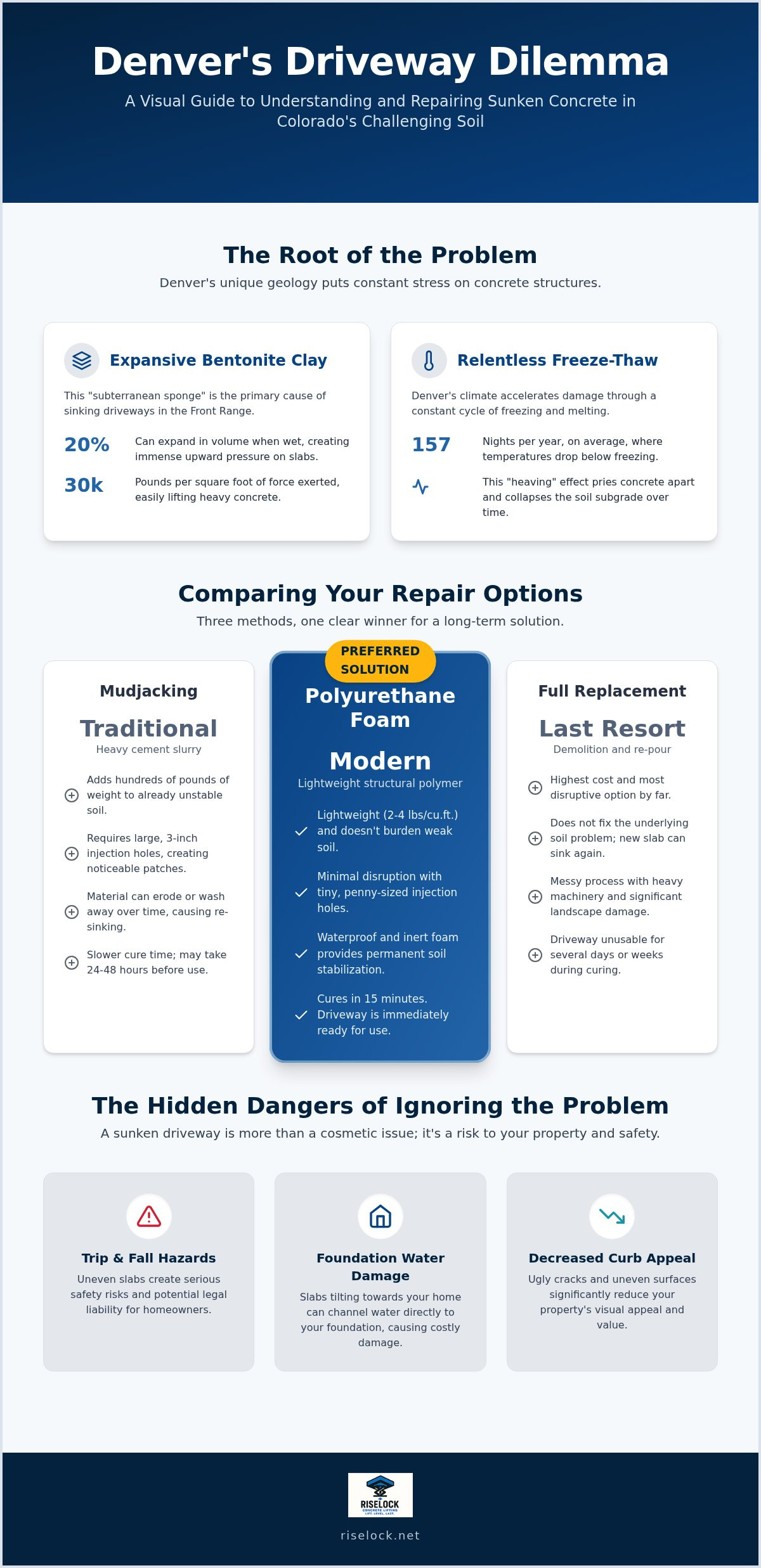
Bentonite clay acts like a subterranean sponge. When it absorbs moisture during our spring rains, it can expand up to 20 percent in volume. This expansion exerts incredible force, sometimes up to 30,000 pounds per square foot, pushing slabs upward. When the dry summer heat arrives, the soil shrinks, leaving behind significant voids. This constant cycle of swelling and shrinking creates an unstable foundation. Without a solid base to rest on, the heavy concrete eventually cracks and settles into the empty spaces created by the retreating soil.
Freeze-Thaw Cycles and Moisture Intrusion
Our local climate accelerates this deterioration. Denver’s 300 days of sunshine often mask a harsher reality: we experience approximately 157 nights per year where temperatures drop below freezing. During the day, snow melts and the resulting water seeps into existing cracks or along the edges of your driveway. At night, that water freezes and expands, physically prying the concrete apart. While traditional concrete leveling techniques have existed for decades, they often fail if they don’t account for this relentless moisture cycle. The repeated “heaving” effect eventually leads to a structural collapse of the subgrade.
Poor drainage and aging fill dirt further complicate the issue. Many homes built in the mid-1970s or during rapid expansion periods utilized builder’s fill dirt that wasn’t properly compacted. Over five to ten years, this loose soil naturally settles. If your gutters aren’t extended or your landscaping creates “ponds” near the driveway, water will wash out what little support remains. This results in a “washout” where the soil is physically transported away from the slab, leaving the concrete suspended in the air. Professional sunken driveway repair Denver must address these underlying voids to prevent the same sinking patterns from returning within a few seasons.
The Precision of Polyurethane: How Modern Foam Lifting Works
Modern restoration has moved beyond the heavy, imprecise methods of the past. High-density polyurethane injection represents the peak of technical mastery for sunken driveway repair Denver. This process involves injecting a specialized, two-part polymer into the voids beneath the slab. Once the components mix, a chemical reaction occurs, transforming the liquid into a rigid, structural foam that expands with immense force. Unlike traditional fillers, this material is engineered to stabilize the ground while providing a permanent lift.
The Injection Process: Precision from Below
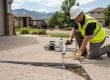
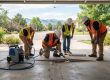
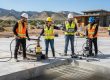
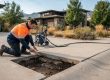
Technicians begin by mapping the subsurface voids. This ensures the foam reaches every pocket of empty space. The expansion phase is the most critical stage for achieving precision. Because the foam expands in all directions, it doesn’t just lift from a single point; it creates a uniform support structure. This allows for adjustments within 1/10th of an inch, restoring the slab to its original grade. Unlike traditional mudjacking, which requires boreholes as large as three inches, this method uses penny-sized holes. These small injection points preserve the aesthetic and structural integrity of the existing concrete. Given Denver’s unique soil conditions, this high-precision approach is essential for a lasting fix.
Cure Time and Immediate Usability
Speed is one of the most practical advantages of this technology. While new concrete can take several days to reach full strength, polyurethane cures in about 15 minutes. This rapid stabilization means you don’t have to park on the street for a week. You can drive your vehicle onto the driveway immediately after the technicians finish. This efficiency doesn’t compromise quality; the high-density foam is inert and waterproof, meaning it won’t wash away during heavy rain or snowmelt. It provides a permanent solution for sunken driveway repair Denver by addressing the root cause of the settlement. For those dealing with uneven slabs, exploring modern concrete leveling can save time and prevent future structural failures.
Comparing Your Options: Polyurethane vs. Mudjacking vs. Full Replacement
Selecting the correct method for sunken driveway repair Denver requires a clear understanding of structural physics and long-term value. Homeowners typically face three choices: traditional mudjacking, full slab replacement, or modern polyurethane lifting. While each approach aims to restore a level surface, their impact on your property’s foundation and your wallet varies significantly. Precision restoration isn’t just about the surface; it’s about managing the weight and stability of the soil beneath.
Why Mudjacking is Outdated for Denver Soils
Mudjacking is a legacy technique that involves pumping a heavy slurry of sand, soil, and cement under the concrete. This approach has a fundamental flaw: weight. A single cubic foot of mudjacking material can weigh approximately 100 pounds. When added to already unstable or expansive Denver soils, this massive increase in burden often leads to secondary settlement. The very material meant to fix the problem becomes the catalyst for further sinking. Additionally, mudjacking slurry is susceptible to water erosion. During heavy Colorado rainstorms or rapid snowmelt, the material can wash out from beneath the slab, recreating the original voids. From an aesthetic standpoint, mudjacking requires large boreholes up to three inches in diameter, leaving behind noticeable, circular patches across your driveway.
The Hidden Costs of Concrete Replacement
Many homeowners assume that starting over with new concrete is the only permanent fix. However, full replacement is often the most disruptive and expensive path. Beyond the cost of the pour, you must account for demolition and disposal fees for the old slabs. This process involves heavy machinery, significant noise, and clouds of concrete dust that can linger for days. There is also the aesthetic risk of color mismatch; new concrete rarely blends perfectly with existing walkways or garage floors. Most importantly, pouring new concrete on the same poorly compacted soil does not solve the underlying issue. Without stabilizing the subgrade, the new driveway is likely to settle within a few years. Lifting with high-density foam typically costs 50 to 70 percent less than full replacement while providing the structural stabilization necessary to keep the slab level. This makes it a more efficient and ethically sound choice for sunken driveway repair Denver.
Polyurethane provides a distinct advantage in terms of disruption. Because the equipment is self-contained and the material cures in minutes, the footprint on your daily life is minimal. There’s no need for jackhammers or large crews. You get a level driveway that stays level, supported by a material that won’t wash away or add unnecessary weight to the Front Range’s challenging soils.
Safety and Curb Appeal: Why You Shouldn’t Ignore a Sunken Driveway
A sunken driveway is more than a visual nuisance; it’s a progressive structural liability. While the drop in curb appeal is immediate, the secondary effects on property value and safety are often far more costly. Homeowners who delay sunken driveway repair Denver often find that minor hairline cracks quickly evolve into major slab failures as water and ice exploit the gaps. This “curb appeal tax” is a tangible reality during property transactions. Home appraisers and inspectors view uneven concrete as a red flag for deferred maintenance, which can negatively impact your home’s final valuation and marketability.
Protecting Your Home’s Foundation
The relationship between your driveway and your home’s foundation is critical for moisture management. A properly installed driveway should slope away from the structure to direct runoff toward the street or drainage systems. When a slab sinks near the garage entrance or along the front porch, it creates a reverse grade that funnels rain and snowmelt directly toward your foundation. This localized soil saturation is a leading cause of basement leaks and foundation settlement. Addressing the pitch of your driveway is a proactive step in total structural preservation. For a broader look at maintaining your property’s integrity, see our guide on concrete repair in Denver.
Trip Hazard Mitigation and ADA Compliance
Safety remains the most urgent reason to address concrete settlement. In the industry, any vertical offset greater than 1/4 inch is classified as a critical trip hazard. These lips create significant legal liability for homeowners if a guest or delivery person is injured on the property. Some attempt to solve this by grinding down the higher slab, but this is a temporary and visually unappealing fix. Grinding weakens the concrete’s wear surface and leaves a scarred, dusty finish that doesn’t solve the underlying void. Professional polyurethane lifting restores a perfectly flush transition from the driveway to the garage floor. This level of precision is vital for maintaining a safe environment and ensuring your property remains accessible for everyone.
Ignoring a sinking slab doesn’t just hurt your home’s appearance; it compromises the safety of everyone who walks on your property. Stopping the cycle of damage early prevents the need for full replacement later. If you’ve noticed uneven transitions or pooling water, it’s time to request a professional driveway assessment to secure your home’s foundation and restore its market value.
Professional Driveway Restoration: The RiseLock Approach
RiseLock Concrete Lifting views each project as a unique structural challenge. Our method for sunken driveway repair Denver is built on a foundation of technical mastery and ethical service. We don’t believe in temporary patches or messy, invasive procedures. Instead, we use high-density polyurethane foam to provide a precise, long-term solution that stabilizes the soil and restores the slab’s integrity. This commitment to precision ensures that your property remains secure for years to come.
Our expertise extends across the Front Range. We serve homeowners from Boulder and Thornton down through the Denver metro area, including Aurora and Centennial, and into Colorado Springs. This local focus allows us to understand the specific geological pressures affecting your property. When you partner with RiseLock Concrete Lifting, you’re choosing a team that values quiet authority and reliable results. We take professional pride in doing the job right the first time, providing a sense of long-term security for every client.
Expertise in Post-Tensioned Slabs
A significant portion of modern Colorado homes utilize post-tensioned concrete slabs for driveways and foundations. These slabs contain high-strength steel cables that are stressed to thousands of pounds of tension. You shouldn’t let a standard contractor drill into a post-tensioned slab without specialized knowledge. Severing a cable can compromise the structural integrity of the concrete and create an immediate safety hazard. It’s a risk that requires an expert eye to mitigate.
RiseLock Concrete Lifting technicians are trained to identify and protect these critical structural cables during the injection process. We use specialized mapping techniques to ensure our penny-sized injection holes never interfere with the tensioned system. This level of care is what separates a professional restoration from a simple lift. If you want to understand the complexity of these systems, you can learn more about post tension installation and how it reinforces your property. We treat your structural problems as a personal priority, ensuring the repair is both safe and effective.
Getting Started with a Structural Assessment
Every restoration begins with a thorough site visit. During a RiseLock Concrete Lifting assessment, we don’t just look at the surface cracks; we analyze the drainage patterns and the extent of the subsurface voids. Our goal is long-term stabilization, not just a quick lift that might fail in a few seasons. We explain the science behind the settlement so you can make an informed decision about your property. You’ll receive a clear plan that details how we’ll restore your driveway to its original grade while securing the soil beneath.
We believe that professional guidance is the first step toward peace of mind. If you’re ready to address uneven slabs and protect your home’s value, contact RiseLock Concrete Lifting for a professional driveway assessment today. Our team is ready to provide the high-precision intervention your property requires to stay level and stable for the long term.
Restoring Your Property’s Structural Integrity
Addressing a sinking driveway is a matter of long-term preservation for your home. We’ve explored how Denver’s unique geology and climate demand a specialized response that goes beyond surface fixes. When you choose sunken driveway repair Denver through high-density polyurethane injection, you’re investing in a solution that stabilizes the soil and provides a level surface without the heavy burden of traditional mudjacking. This modern approach ensures your driveway remains safe, functional, and visually appealing for years to come.
RiseLock Concrete Lifting brings technical mastery to every project, offering specialized expertise in post-tensioned foundations and high-density polyurethane technology. We serve the entire Denver Metro area with a focus on precision and reliability. Don’t let uneven concrete compromise your property’s safety or curb appeal any longer. Request a Professional Concrete Lifting Estimate from RiseLock Concrete Lifting today. It’s time to trade the stress of structural damage for the peace of mind that comes with a permanent, professional restoration. Your home deserves a stable foundation that stands up to Colorado’s challenging environment.
Frequently Asked Questions
Is sunken driveway repair in Denver permanent?
Polyurethane foam provides a permanent solution because it is an inert material that does not decompose or wash away over time. Unlike traditional fillers, it addresses the root cause by stabilizing the underlying soil. While we can’t control future geological shifts in Colorado’s expansive clay, the foam itself remains a structural support indefinitely. This makes it a highly reliable choice for long-term sunken driveway repair Denver.
How much does it cost to fix a sunken driveway in Colorado?
The cost of driveway restoration depends on the square footage of the slab and the volume of the subsurface voids. Generally, lifting and leveling with polyurethane foam is significantly more affordable than full concrete replacement, often costing 50 to 75 percent less. Each project requires a specific assessment to determine the material requirements and technical complexity. We recommend a professional evaluation to get an accurate understanding of the investment required.
Can you lift a driveway that has large cracks?
We can often lift driveways with large cracks, provided the individual slabs retain enough structural integrity to be moved. Our technicians inject foam strategically to bring separated sections back into alignment. Once the slabs are level, we recommend sealing the cracks to prevent future moisture intrusion. If the concrete is severely crumbled or spider-webbed, replacement might be necessary, but most cracked driveways are excellent candidates for lifting.
How long does the polyurethane lifting process take?
Most residential driveway projects are completed within one to three hours. The efficiency of the process is one of its primary advantages over traditional methods. Because we use specialized equipment and a non-invasive injection technique, the setup and cleanup are minimal. Our crew can typically arrive, restore your driveway to its original grade, and depart in a single morning or afternoon, minimizing disruption to your daily schedule.
Will the foam wash away during a heavy Denver snowmelt?
High-density polyurethane is hydrophobic, meaning it repels water and won’t wash away during heavy snowmelt or rain. This is a critical advantage in Denver’s climate, where moisture intrusion is a constant threat. Once the foam expands and cures, it forms a rigid, waterproof barrier that remains unaffected by the freeze-thaw cycle. It effectively seals the underside of the slab, protecting the subgrade from further erosion.
What is the difference between polyjacking and mudjacking?
The primary differences lie in material weight and precision. Mudjacking utilizes a heavy cement-based slurry that adds significant weight to the soil, potentially causing secondary sinking. Polyjacking uses a lightweight polymer that stabilizes the ground without adding a heavy burden. Additionally, foam injection requires only penny-sized holes, whereas mudjacking requires large, three-inch boreholes. Polyurethane also resists water erosion, while mudjacking material can eventually wash away.
Can I drive on my driveway immediately after it is leveled?
You can drive your vehicle on the driveway almost immediately after the process is finished. Polyurethane foam reaches 90 percent of its full structural strength within 15 minutes of injection. This rapid cure time allows for immediate usability, unlike new concrete pours that require days of waiting. By the time our team has packed up their equipment and cleaned the work area, your sunken driveway repair Denver project is ready for normal traffic.
Do you offer concrete leveling in Aurora and Centennial?
We provide comprehensive concrete leveling services throughout the entire Denver metro area, including Aurora, Centennial, and the surrounding Front Range communities. Our local expertise allows us to address the specific soil challenges found across these regions. Whether you’re dealing with settling in a newer development or an established neighborhood, our team is equipped to provide the specialized intervention needed for a durable, level driveway.