In the Denver Metro area, 73% of foundation and slab repairs are directly linked to water-related soil saturation and erosion, making professional concrete lifting solutions a necessity for many homeowners. When your driveway or patio begins to settle, it’s natural to feel a sense of urgency. You’re likely concerned about the liability of trip hazards and the decline of your property’s value, yet you want to avoid the mess and high cost of a full-scale replacement. It’s a stressful position to be in, especially when you need a permanent fix that doesn’t disrupt your daily life.
This guide helps you evaluate modern restoration methods to restore your property’s safety and value efficiently. By choosing advanced polyurethane systems over outdated alternatives, you can achieve level, safe surfaces with minimal downtime and total structural peace of mind. We’ll walk through the technical advantages of high-density foam, the importance of understanding Colorado’s expansive clay soils, and how to protect the integrity of specialized post-tension slabs during the repair process.
Key Takeaways
- Understand how Colorado’s expansive bentonite soils create the voids that cause concrete to sink and why addressing soil conditions is the first step in a lasting repair.
- Compare the technical performance of high-density foam against traditional mudjacking to identify the most effective concrete lifting solutions for long-term stability.
- Recognize the unique risks of repairing post-tension slabs, where specialized drilling techniques are required to avoid catastrophic damage to structural cables.
- Learn the essential criteria for vetting local contractors in the Denver Metro area, including the importance of local licensing and soil-specific expertise.
- Explore how modern injection methods provide a clean, surgical alternative to the disruption and high cost of total concrete replacement.
The Science of Settlement: Why Concrete Sinks in Colorado
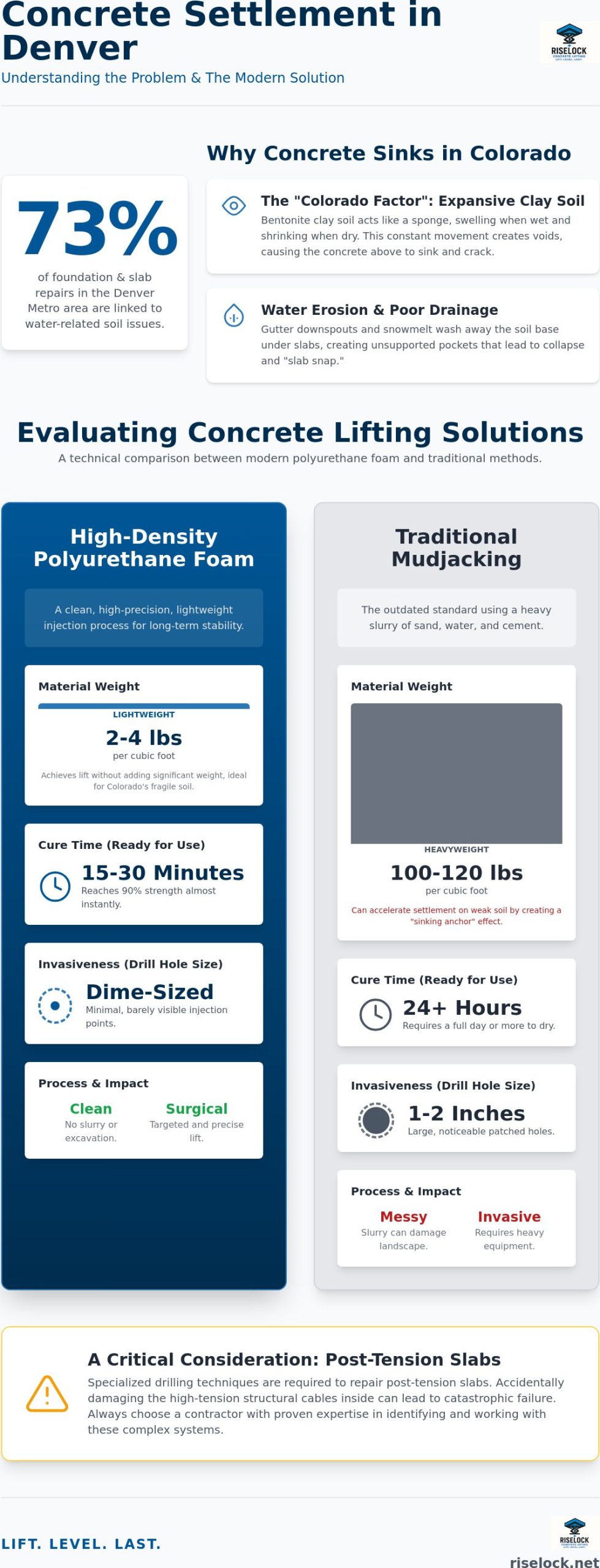
Colorado’s geology presents a unique set of challenges for residential and commercial structures. Concrete doesn’t just sink; it responds to the volatile earth beneath it. The Front Range is largely defined by expansive bentonite clay, a material that behaves like a sponge. This “Colorado Factor” is the primary reason property owners in Denver and Aurora require concrete leveling (slab jacking) and other stabilization methods. When moisture levels fluctuate, these soils swell with immense pressure, only to shrink and leave behind significant gaps as they dry. This constant movement undermines even the most well-poured slabs.
Ignoring the early signs of settlement often leads to a compounding cycle of damage. As a slab tilts, it frequently redirects surface water toward your home’s foundation rather than away from it. Since approximately 73% of foundation repairs in Denver are linked to water saturation and erosion, a sunken sidewalk or driveway is often a warning sign of a larger structural threat. Beyond the structural risks, uneven surfaces create immediate liability issues. Uneven sidewalk trip hazard repair on public-facing walkways can prevent legal complications, making professional concrete lifting solutions a matter of both safety and financial prudence.
Soil Erosion and Voids
Improper drainage is a common catalyst for structural failure. When gutter downspouts or heavy Colorado snowmelt discharge directly onto a slab’s edge, the moving water washes away the fine particles of the sub-base. This process creates underground pockets where the concrete is no longer supported by the earth. Without a solid foundation, the weight of the slab eventually exceeds its tensile strength. This results in a sudden “slab snap.” Effective concrete lifting solutions must address these voids directly to prevent the cycle from repeating.
The Problem with Poor Compaction
In many newer developments, settlement occurs because the soil wasn’t properly compacted before the concrete was poured. When builders move large amounts of earth to level a site, they must mechanically settle the soil to ensure it can support weight. If this step is rushed, the soil naturally compacts over time under the weight of the slab and vehicles. Driveways are particularly at risk. They bear the most weight. A professional soil assessment is often the first step in determining if the underlying ground has finally reached a state of natural equilibrium or if further stabilization is required.
Evaluating Concrete Lifting Solutions: Polyurethane vs. Traditional Methods
Property owners facing sinking slabs usually weigh three choices: full replacement, traditional mudjacking, or modern polyurethane foam. While replacement is a permanent solution, it’s often an unnecessary expense that involves heavy machinery and significant landscape damage. Mudjacking, once the industry standard, relies on a heavy slurry of sand, water, and cement. Polyurethane concrete lifting is a high-precision, lightweight injection process. It offers a middle ground that provides the structural integrity of replacement with the speed of a repair.
The weight of the repair material is a critical engineering consideration. Traditional mudjacking slurry weighs roughly 100 to 120 pounds per cubic foot. In the context of Colorado’s expansive clay soils, adding this much mass to an already sinking slab often accelerates the problem. It creates a “sinking anchor” effect. Conversely, high-density polyurethane foam weighs only about 2 to 4 pounds per cubic foot. It achieves the same lift without overloading the subgrade. This makes it one of the most effective concrete lifting solutions for the Front Range’s fragile geological conditions. For a comprehensive overview of how these modern techniques compare across different surface types, our definitive guide to modern slab restoration breaks down the full technical picture for property owners.
Time is a major differentiator. Full concrete replacement requires a curing period of several days before you can park a vehicle or walk on the surface. Mudjacking needs at least 24 hours to dry. Polyurethane foam undergoes a chemical reaction that allows it to reach 90% of its full compressive strength within 15 to 30 minutes. You can use your driveway immediately after the technicians pack their tools. If you’re ready to restore your property’s function today, you can explore our specialized leveling services to see how we handle these projects.
The Limitations of Mudjacking
Mudjacking is a messy, invasive process. It requires drilling large holes, typically one to two inches in diameter, into the concrete. These holes are difficult to patch aesthetically and often leave a “polka-dot” appearance on your slab. Additionally, mudjacking materials are often organic or mineral-based, meaning they can wash away or decay over time. Because this method lacks long-term durability and introduces excessive weight, RiseLock specifically avoids this outdated technology in favor of more reliable alternatives.
Polyurethane: The Modern Standard
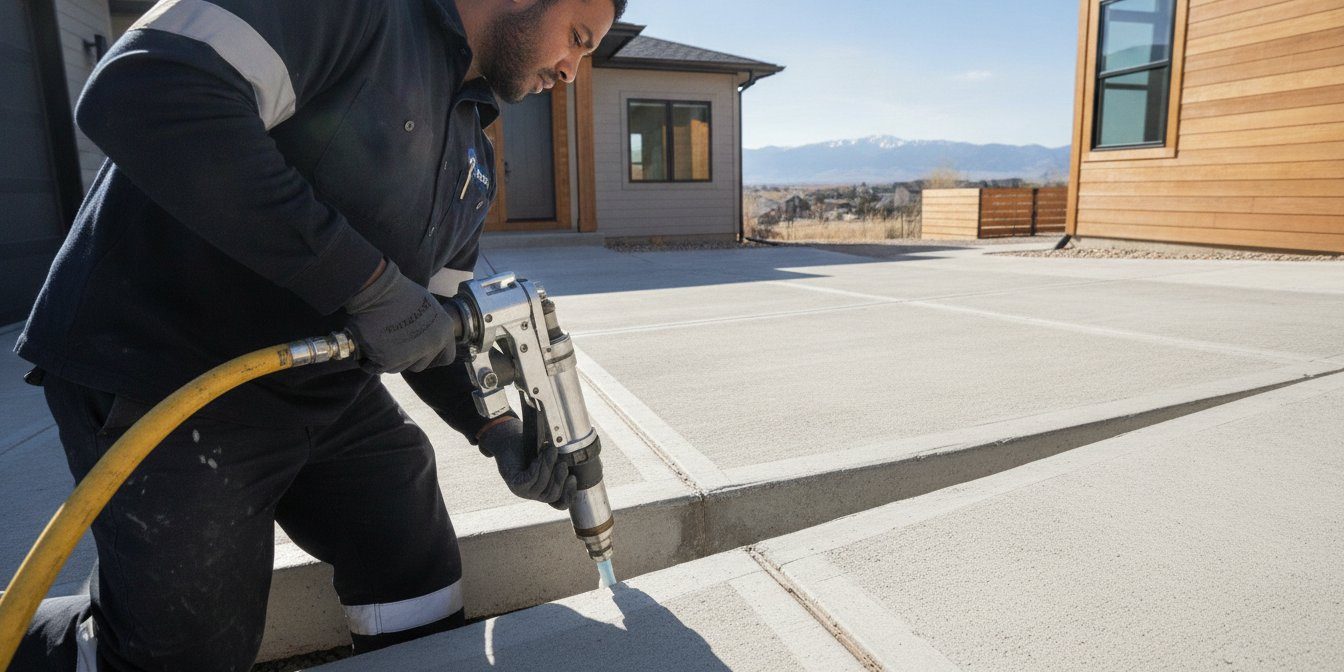
Polyurethane is an engineered polymer that expands upon injection to fill every void and stabilize the soil. The process is “surgical” because it uses tiny 5/8-inch injection holes, which are eventually finished with a penny-sized patch that blends into the existing concrete. This material is closed-cell and water-impermeable, so it won’t wash away during heavy snowmelt or rain. For a deeper look at the technical specifications of this material, read our precision guide to modern slab restoration to understand why this is the preferred choice for structural engineers.
Structural Integrity and Post-Tension Slabs: A Critical Consideration
Many modern homes in Colorado, particularly those built in the expansive soil zones of the Denver Metro area, utilize post-tension (PT) slabs. These foundations are engineered with high-strength steel cables that are stressed to thousands of pounds of tension after the concrete has cured. This design allows the slab to flex and resist the upward pressure of swelling bentonite clay. However, this internal tension makes the slab a complex environment for any repair work. Standard concrete lifting solutions that involve aggressive drilling can lead to catastrophic results if the technician doesn’t understand the underlying reinforcement system.
The primary danger in repairing these foundations is the risk of severing a tensioned cable. Unlike traditional rebar, which is passive, a post-tension cable is an active structural component. If a drill bit strikes a cable, the resulting “blowout” can be violent, causing the cable to whip through the concrete and potentially through walls or flooring. This doesn’t just create a safety hazard; it compromises the entire structural integrity of the foundation. A specialized approach is required to ensure that your concrete lifting solutions don’t turn a minor settlement issue into a major structural failure.
Our deep background in post tension installation provides a unique advantage during the lifting process. We understand the typical grid patterns and anchorage points of these systems. This technical mastery allows us to map out injection ports with surgical precision, avoiding cables while ensuring the high-density foam reaches the necessary voids. There’s a natural synergy between polyurethane stabilization and PT systems. By restoring the subgrade support, we relieve the improper stress that settlement places on the cables, allowing the tensioning system to function as originally intended.
Identifying Post-Tension Systems
Homeowners can often identify a post-tension system by looking for a stamp in the garage floor that warns against drilling or cutting. You might also notice small, circular plastic or concrete patches along the exterior edge of your foundation where the cables were anchored and trimmed. If these signs are present, you must verify that your contractor has specific experience with PT systems. The risk of a cable blowout during a poorly planned repair is too high to leave to a general concrete crew. Specialized knowledge is the only way to guarantee a safe restoration.
Post-Tension Cable Repair and Maintenance
If a cable has already snapped due to corrosion or previous accidental damage, it requires immediate intervention. We provide expert services for fixing broken post-tension cables to restore the skeleton of your foundation. Once the cables are repaired and re-tensioned, lifting the slab with polyurethane foam provides the final layer of stabilization. This dual-pronged approach ensures that the slab is both level and structurally sound for years to come.
How to Choose the Right Concrete Lifting Contractor in Denver
Selecting a provider for concrete lifting solutions in the Front Range is a decision that impacts your property’s long-term value and structural safety. It’s not merely about finding the lowest bid. It’s about finding a technical partner who understands the complex relationship between Colorado’s soil and your concrete. A professional contractor should act as a consultant, identifying the root cause of settlement rather than just treating the symptom. This ensures the repair doesn’t just look good on the surface but stands the test of time. Before committing to any provider, use a structured approach like our concrete leveling contractors near me vetting checklist to ensure you’re selecting a technically qualified partner.
A comprehensive estimate should never be a simple price per square foot. It must include a thorough site evaluation that covers drainage patterns and soil stability. If a contractor doesn’t look at your gutters or the slope of your yard, they’re missing the reason your concrete sank in the first place. This level of detail is especially important when moving from residential patios to heavy-duty infrastructure. Projects involving high-traffic areas or industrial loads require the specialized equipment and materials found in commercial concrete leveling, which utilizes higher-density foams to withstand extreme weight.
If you’re looking for a partner who views your structural integrity as a priority, you can schedule a technical assessment with our team to discuss your specific needs. Choosing the right expert for concrete lifting solutions means prioritizing precision over speed and engineering over guesswork.
Technical Vetting Questions
When interviewing potential contractors, their answers to technical questions will reveal their level of mastery. Ask specifically about the materials and methods they intend to use. A reliable provider won’t hesitate to explain the “why” behind their process.
- “What density of foam do you use for driveway applications?” Standard residential foam might not support the weight of multiple vehicles over time. High-density foam is necessary for weight-bearing slabs.
- “How do you account for post-tension cables in your drilling pattern?” As established in the previous section, drilling into a PT cable is a catastrophic error. Your contractor should have a clear protocol for identifying and avoiding these cables.
- “Do you offer a warranty against further sinking?” A confident contractor stands behind their work with a guarantee that the soil stabilization will hold under normal conditions.
Local Knowledge and Logistics
The geology of the Front Range varies significantly between cities. A contractor familiar with the expansive clay in Castle Rock or the specific drainage challenges in Boulder will provide a more accurate repair plan than a generalist. Proximity to hubs like Aurora or Colorado Springs also affects logistics, as local experts can respond more quickly to shifting project needs and environmental conditions.
Beyond the soil, you should evaluate a contractor’s understanding of local regulations. In Denver, for example, municipal sidewalk codes are strict regarding trip hazards and repair methods. Hiring someone who knows these standards ensures your repair meets legal requirements. If you need guidance on identifying and addressing walkway offsets before they become a liability, our uneven sidewalk trip hazard repair safety checklist provides a step-by-step framework for property owners. Finally, look at reviews that mention clean-up and professionalism. A professional repair should leave your property looking better than when the crew arrived, with only penny-sized patches as evidence of the intervention.
The RiseLock Approach: Precision Engineering for Lasting Stability
RiseLock provides a high-precision alternative to traditional repair methods. We’ve built our reputation on the quiet authority of technical mastery. While others might offer a quick patch, we deliver a comprehensive engineering solution designed for the unique soil conditions of the Front Range. Our concrete lifting solutions address the underlying void rather than just the visible surface misalignment. We view every structural challenge as a personal priority, ensuring that your property receives the same level of care and precision we’d apply to our own.
Every project begins with a detailed assessment of the site’s topography and drainage. We use non-invasive methods to evaluate the subgrade before we ever pick up a drill. When we do begin the injection, the process is surgically precise. We utilize 5/8-inch ports that allow us to place the high-density foam exactly where it’s needed to achieve a controlled, gradual lift. Once the restoration is complete, we finish the work with a penny-sized patch that blends into your existing slab. It’s an efficient, clean process that respects your time and your property’s aesthetic integrity.
Our commitment to long-term structural health means we don’t settle for cosmetic fixes. We focus on the stabilization of the sub-base, creating a water-impermeable foundation that resists the freeze-thaw cycles common in Colorado. This ethical approach ensures that once a slab is lifted, it stays level. We take professional pride in maintaining high standards, providing a sense of trust and long-term security for every client we serve.
From Driveways to Foundations
Our expertise extends from residential walkways to complex structural foundations. We specialize in sunken driveway repair, where we restore the load-bearing capacity of the slab to handle daily vehicle traffic safely. We apply the same level of precision to large-scale commercial projects, ensuring that industrial floors remain stable under heavy loads. By choosing RiseLock, you’re investing in concrete lifting solutions that secure your property’s future against the ongoing movement of Colorado’s expansive soils.
Schedule Your Professional Assessment
Getting started is a straightforward, professional process. We begin with a technical evaluation where we explain the specific causes of your settlement and the details of our proposed intervention. We don’t believe in aggressive sales tactics. Instead, we act as a dependable guide for your structural restoration. If you’re ready to move away from the stress of structural damage toward the peace of mind offered by specialized intervention, we invite you to reach out. Secure your property’s value and safety today by scheduling a consultation with our local experts.
Securing Your Property’s Future with Precision Restoration
Restoring the structural integrity of your property requires an understanding of the unique geological forces at play in the Front Range. While sinking slabs and trip hazards create immediate safety concerns, the solution should focus on permanent stabilization rather than temporary cosmetic fixes. By prioritizing high-density polyurethane and technical mastery over outdated, heavy mudjacking methods, you ensure that your investment is protected from the volatile nature of expansive clay soils. It’s a choice that favors longevity and engineering over a quick, heavy patch that might fail.
Choosing professional concrete lifting solutions means partnering with an expert who respects the complexity of your foundation, especially when dealing with high-risk post-tension systems. We take professional pride in delivering surgical precision and high-density industrial polyurethane to every project. Our team serves the entire Front Range corridor, providing the technical expertise necessary to level your surfaces and restore your peace of mind. We don’t just fill voids; we stabilize your property’s future.
Request Your Precision Concrete Assessment from RiseLock today. With specialized post-tension mastery and a commitment to ethical service, we look forward to being your dependable partner in structural restoration.
Frequently Asked Questions
How much do concrete lifting solutions cost compared to replacement?
Lifting is generally 30% to 50% less expensive than full concrete replacement. This cost efficiency is achieved because the process eliminates the need for demolition, debris hauling, and the purchase of large volumes of new concrete. By preserving your existing slab, you also avoid the secondary costs of landscape restoration that typically follow the use of heavy excavation machinery on your property.
Is polyurethane foam safe for the environment and my local soil?
Fully cured polyurethane foam is an environmentally inert material that does not leach chemicals into the surrounding soil or groundwater. Once the initial chemical reaction is complete, the foam becomes a stable, solid structure. It is a responsible choice for Colorado’s delicate ecosystems. This material acts as a permanent barrier that won’t degrade or react with the minerals found in Front Range soils.
How long does the concrete lifting process take from start to finish?
Most residential projects are completed in a single day, often within just a few hours. One of the primary advantages of this method is the rapid cure time. While traditional concrete requires days to reach a usable strength, high-density foam reaches 90% of its compressive strength within 15 to 30 minutes. You can walk or drive on the surface immediately after our team finishes the work.
Can you lift a concrete slab that has already cracked significantly?
We can successfully lift slabs with significant cracking as long as the individual sections are large enough to be moved as units. The process stabilizes the subgrade and levels the sections to eliminate trip hazards. While the lift won’t “heal” the cracks themselves, we patch our injection holes and can seal existing cracks to prevent future water infiltration. This prevents the damage from worsening over time.
Will the foam eventually compress or wash away under heavy rain?
High-density polyurethane is a closed-cell polymer that will not wash away or compress even under extreme moisture conditions. Unlike traditional mudjacking slurry, which is susceptible to erosion from heavy rain or snowmelt, these concrete lifting solutions create a water-impermeable base. The material maintains its structural integrity indefinitely, providing a permanent solution that resists the unique drainage challenges of the Denver Metro area.
Do I need to be home while the concrete lifting team is working?
You don’t necessarily need to be present for exterior work such as driveway or sidewalk repair, provided our technicians have clear access to the area. We prioritize professional communication and can provide updates throughout the day. If the project involves interior slabs or garage floors, we generally require someone to be home to grant access. We always leave the worksite clean and secured upon completion.
What is the difference between concrete leveling and foundation repair?
Concrete leveling focuses on restoring flatwork like patios and driveways, while foundation repair typically involves the main structural skeleton of the home. Leveling is a less invasive way to eliminate trip hazards and correct drainage issues near the house. Both services are essential for property health. We offer specialized expertise in both concrete lifting solutions and complex post-tension foundation stabilization to ensure your entire property remains secure. To understand the full scope of what concrete leveling for modern slab restoration can address, our detailed resource walks through every surface type and soil condition common to the Front Range.
How long will the lifted concrete stay level?
A professionally lifted slab should remain level for as long as the underlying soil is properly managed. By filling the voids and stabilizing the sub-base with non-degradable foam, we eliminate the primary cause of sinking. While we can’t control future geological shifts, the foam itself provides a permanent support structure. Ensuring your gutters and downspouts direct water away from the slab will further maximize the longevity of the repair.