What if the material you choose to fix a trip hazard actually accelerates the structural failure of your property? In Denver, where expansive clay soils and over 100 annual freeze-thaw cycles create a volatile environment for pavement, the heavy weight of traditional stone slurry often does more harm than good. For property owners managing commercial concrete lifting denver projects, the stakes involve more than just property value; they include strict ADA compliance and the threat of fines exceeding $75,000 for non-compliant surfaces.
You likely recognize that ignoring a settled sidewalk or cracked entrance isn’t an option when liability and safety are on the line. This guide provides a technical checklist to help you identify the root causes of settlement and select a lifting method that offers permanent stability without the invasive mess of heavy slurries. We’ll examine the 2025 Denver Building Code requirements, the precision of high-density polyurethane foam, and how to protect your investment against Colorado’s unique soil challenges.
Key Takeaways
- Identify how Denver’s expansive clay soils drive concrete settlement and why traditional repairs often fail to address the underlying subgrade issues.
- Compare the structural advantages of lightweight polyurethane foam against traditional mudjacking to prevent secondary sinking caused by excessive material weight.
- Utilize a comprehensive checklist for commercial concrete lifting denver to ensure your property meets 2026 ADA standards while minimizing operational downtime.
- Learn the critical safety protocols for identifying post-tension cables to prevent expensive structural damage during the injection process.
- Gain insights into selecting a contractor who uses high-density, closed-cell structural foam specifically engineered for the Front Range’s unique climate.
Identifying Concrete Settlement in Denver’s Expansive Soils
Concrete settlement occurs when the soil beneath a slab can no longer support its weight. This isn’t a random occurrence. In the Front Range, it’s often a direct result of subgrade erosion or soil compaction. For those managing commercial concrete lifting denver projects, understanding that the problem starts underground is the first step toward a permanent fix. When the subgrade fails, the concrete slab loses its foundation, leading to cracks, dipping, and eventual structural failure.
Denver’s geology presents a specific challenge for property owners. The presence of bentonite and expansive clays means the ground beneath your commercial property is constantly in motion. These soils act like a sponge; they swell when wet and shrink during our dry spells. This cycle creates significant voids. When the soil retreats, the concrete has nothing to rest on, leading to the inevitable drop. In Denver, the pressure exerted by expansive soils forces concrete foundations to shift and heave, compromising the structural integrity of the entire slab.
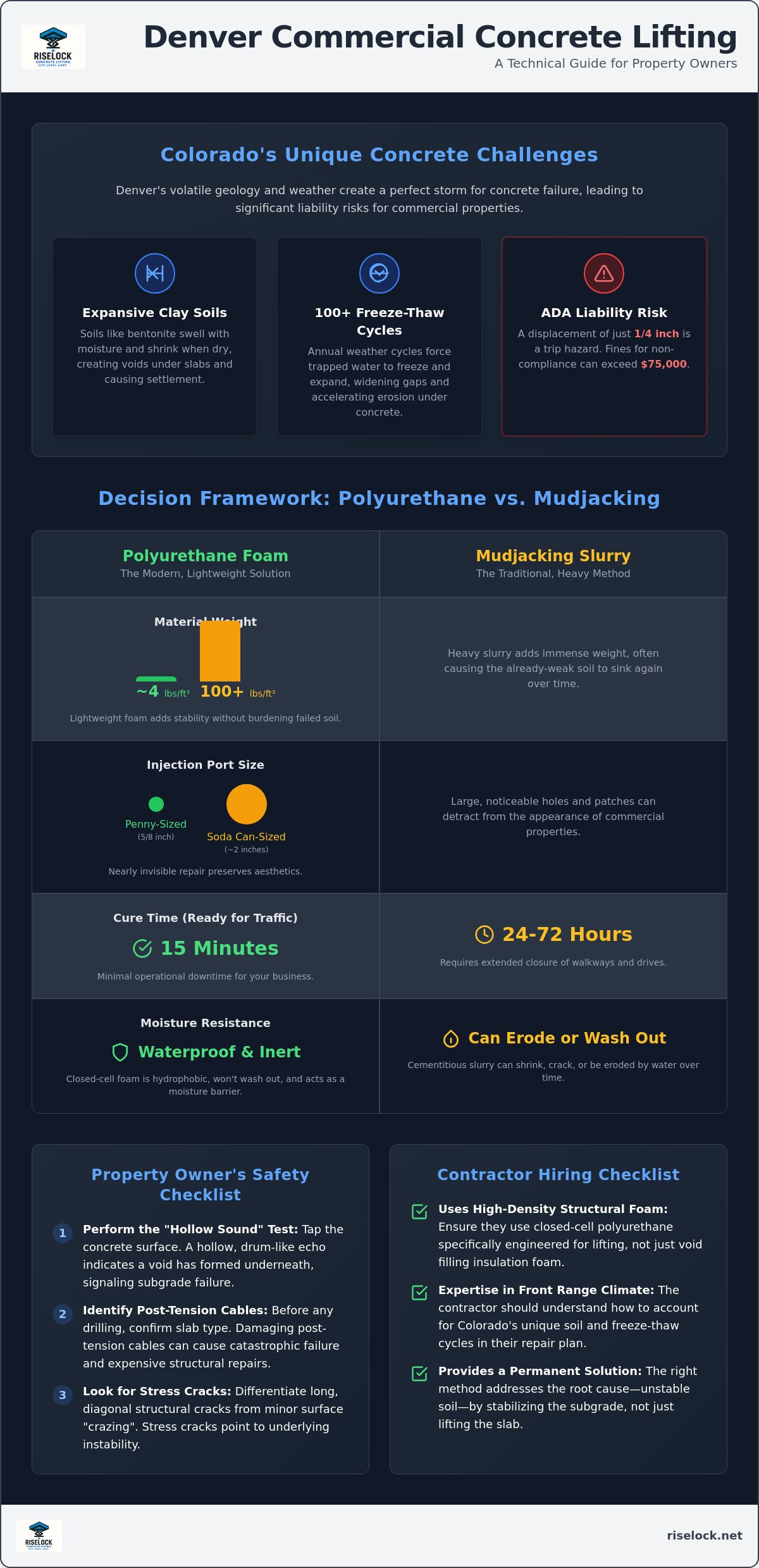
Many property owners view a slightly uneven sidewalk as a minor annoyance. However, once a vertical displacement reaches 1/4 inch, it often qualifies as a trip hazard under the Americans with Disabilities Act (ADA). For a business, this isn’t just a maintenance issue; it’s a significant legal liability. Ignoring the problem leads to higher costs. What begins as a simple Concrete leveling task can quickly escalate into a full-scale replacement if the underlying soil issues aren’t stabilized promptly.
Visual Signs of Subgrade Failure
Identifying settlement early requires a keen eye for more than just surface cracks. One reliable method is the hollow sound test. If you tap the concrete and hear a drum-like echo, it indicates that a void has formed and the subgrade has eroded. Structural stress cracks usually appear as long, diagonal breaks, which differ from the small, web-like “crazing” found on the surface. You might also notice the slab pulling away from your building’s foundation or garage walls, creating a channel where water can further damage the subgrade.
The Impact of Colorado Weather Cycles
Our climate is particularly harsh on pavement. With over 100 freeze-thaw cycles every year, any small gap under your concrete becomes a reservoir for snowmelt. When this water freezes, it expands, pushing against the concrete with immense hydrostatic pressure. This cycle accelerates erosion, turning a minor settlement into a major structural failure. Effective commercial concrete lifting denver strategies must account for this moisture-driven movement to ensure the repair survives the extreme temperature swings of the Front Range.
Polyurethane vs. Mudjacking: The Decision Framework
Selecting the right repair method for commercial concrete lifting denver requires a shift from traditional masonry thinking to modern structural engineering. While mudjacking has existed for decades, its reliance on a heavy mixture of water, dirt, and cement often conflicts with the delicate nature of expansive soils in Colorado. Adding hundreds of pounds of slurry to a subgrade that has already failed under the weight of the original slab frequently leads to secondary settlement. In contrast, high-density polyurethane foam offers a lightweight alternative that addresses the void without overloading the soil.
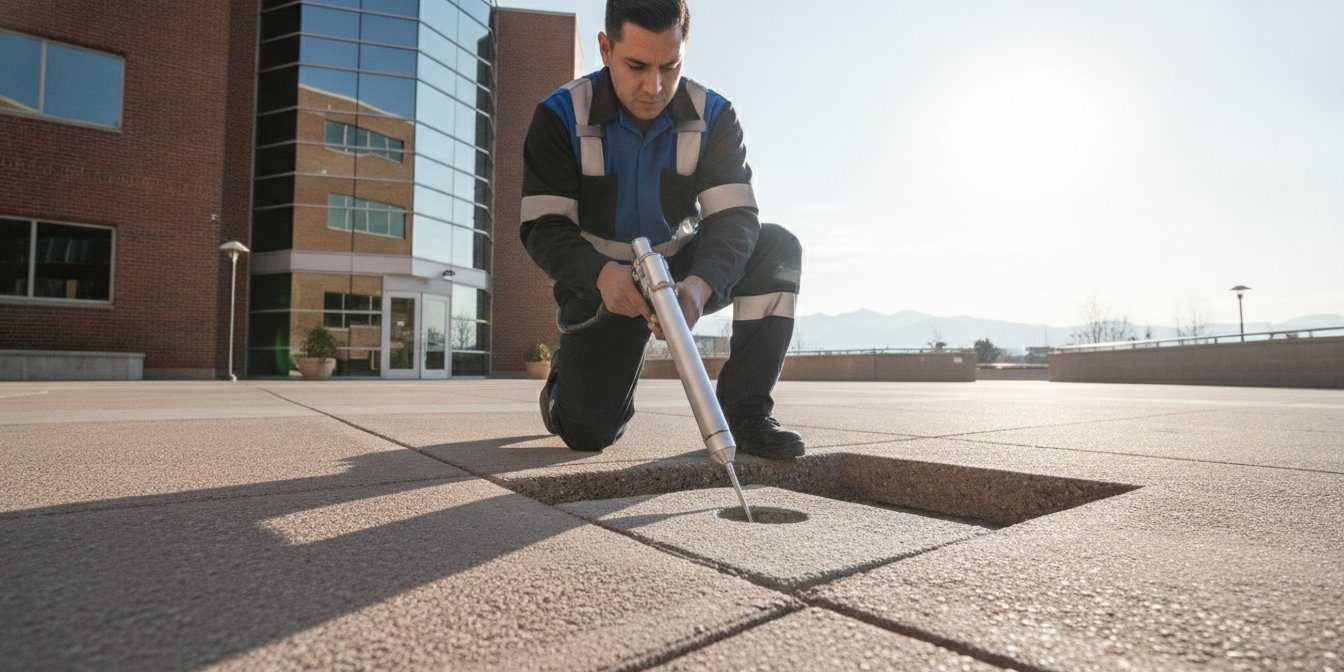
The physical footprint of the repair also differs significantly. Mudjacking requires drilling holes approximately the size of a soda can, which can be visually jarring on high-traffic commercial walkways. Polyurethane injections utilize penny-sized ports, resulting in a nearly invisible finish once patched. Beyond aesthetics, the chemical composition of the material matters. Polyurethane is impervious to water and chemical erosion, whereas cementitious slurries can eventually degrade or wash away when exposed to Denver’s heavy snowmelt and runoff. For businesses, the most critical factor is often cure time. Mudjacking can require days to fully set before heavy traffic can resume, while polyurethane is ready for use in minutes.
Why Modern Slabs Require Lightweight Solutions
Traditional cementitious slurries are remarkably heavy, often adding over 100 pounds per cubic foot to the subgrade. On Denver’s loose fill dirt, this weight can cause the soil to compress further, negating the lift within a few seasons. Property owners should review The Critical Disadvantages of Mudjacking to understand why modern commercial slabs require a more surgical approach. Closed-cell foam is not only lighter but also non-toxic and environmentally stable, ensuring that no harmful chemicals leach into the local water table during the restoration process.
High-Density Polyurethane Benefits
The primary advantage of foam lies in its ability to expand and compact the underlying soil as it cures. This process fills every microscopic void, providing a stable, uniform base that prevents future shifting. Technicians can achieve precision lifting within 1/10th of an inch, which is essential for meeting strict ADA slope requirements. Because the material reaches 90% of its structural integrity almost immediately, commercial operations face minimal downtime. For a comprehensive technical overview of injection protocols and 2026 compressive strength standards, consult our polyurethane foam concrete leveling professional reference. For a deeper look at the lifecycle of these repairs, consult How Long Does Polyurethane Concrete Lifting Last?. If you aren’t sure which method fits your property’s specific soil profile, a professional assessment of your commercial concrete lifting denver options can prevent costly mistakes.
Structural Safety Checklist: Protecting Your Slab and Cables
Ensuring a successful restoration involves more than just bringing a slab back to its original grade. An essential component of commercial concrete lifting denver involves a thorough assessment of the slab’s internal reinforcement. Many modern commercial properties in the Front Range utilize post-tensioned concrete, a system where high-strength steel cables are stressed to provide structural integrity. If a contractor drills into a slab without identifying these cables, the result can be a catastrophic cable blowout. These incidents don’t just compromise the building’s safety; they lead to incredibly expensive repairs that far exceed the cost of the initial lifting project.
Safety also dictates a “void-fill first” strategy. Before any vertical lift is attempted, the technician must ensure the entire cavity beneath the concrete is occupied by stabilizing material. Attempting to lift a slab that is only partially supported can cause the concrete to snap under its own tension. Once the void is filled and the slab is supported, precision lifting can begin. However, lifting is only half the battle. If the water diversion issues that caused the original erosion aren’t addressed through proper drainage management, the soil will continue to wash away, leaving the newly stabilized slab vulnerable once again.
Managing the Post-Tension Cable Risk
Identifying post-tension reinforcement is a specialized skill. Property owners should look for plastic end caps along the edge of the slab or specific stamps in the concrete that indicate “PT” or “Post-Tensioned.” Inexperienced concrete raising companies often engage in “blind drilling,” where they place injection ports without regard for what lies beneath the surface. Because RiseLock possesses deep technical knowledge in post tension installation, we integrate structural engineering safety protocols into every lift. We use specialized equipment to locate cables before a single hole is drilled, ensuring the structural skeleton of your property remains untouched.
Soil Stabilization Requirements
A durable repair depends entirely on the quality of the subgrade. If a slab has settled because it was poured over organic debris or poorly compacted trash-fill, simply adding material on top is a temporary fix. Technicians must assess the load-bearing capacity of the remaining soil to ensure it can support both the lifting material and the weight of commercial vehicles. High-density polyurethane foam is the preferred choice for stabilizing heavy commercial slabs in Denver because its expansive properties allow it to penetrate deep into the subgrade, creating a rigid, waterproof foundation that resists the crushing weight of industrial traffic. This stabilization process turns the unstable Denver soil into a reinforced base that prevents the “rocking” motion that often leads to secondary cracking in high-traffic areas like loading docks and parking structures.
The Property Owner’s Hiring Checklist for Denver
Selecting a partner for commercial concrete lifting denver requires more than just comparing bottom-line quotes. It involves vetting the technical competency of the team that will be working on your property’s structural foundation. The Front Range presents unique variables. If a contractor doesn’t understand the behavior of bentonite or the load-bearing requirements of a post-tensioned slab, their repair might fail within a single freeze-thaw cycle. A professional approach prioritizes precision over speed, ensuring that the stabilization is as durable as the original construction.
Precision equipment is the hallmark of a reliable contractor. You should verify that the provider uses integrated pumping systems that monitor foam temperature and pressure in real-time. This ensures a consistent density throughout the injection process, preventing “soft spots” that lead to future settlement. Additionally, the warranty must be transparent. A standard surface warranty is insufficient for commercial applications. You need clarity on whether the guarantee covers re-sinking caused by subgrade soil failure, which is the primary risk in Colorado’s expansive environment. Understanding the 2026 standards for polyurethane foam concrete leveling can help you ask more informed questions when evaluating contractor proposals.
Essential Questions for Your Estimator
Technical transparency during the bidding phase is a strong indicator of a contractor’s expertise. Don’t hesitate to ask specific questions about their materials and safety protocols. A qualified estimator should provide detailed answers without resorting to vague marketing language. Consider these three critical inquiries:
- “What is the specific density of the foam you’ll use for this load?” Commercial driveways and loading docks require higher-density, closed-cell structural foam than residential patios.
- “How do you ensure you won’t strike a post-tension cable during the drilling phase?” As discussed in previous sections, a “blind drilling” approach is a significant liability for your property.
- “Is the estimate inclusive of total void filling or just the lifting itself?” Lifting a slab without fully supporting the underlying cavity leaves the concrete vulnerable to snapping under heavy commercial traffic.
Vetting the Contractor’s Reputation
Local experience is non-negotiable when dealing with Denver’s soil chemistry. A contractor who primarily works in regions with sandy or stable soils won’t be prepared for the aggressive movement of Colorado clays. Look for a proven track record in specific municipalities like Aurora, Centennial, Boulder, and Castle Rock. Reviewing project galleries can reveal the quality of their work; look for clean injection port finishes and precise leveling that aligns perfectly with existing structures. Finally, confirm they carry comprehensive insurance specifically for structural concrete repair work. If you’re ready to secure your property’s foundation with a technical assessment, contact our team for commercial concrete lifting denver services today.
RiseLock’s Precision Approach to Denver Slab Restoration
RiseLock Concrete Lifting views concrete restoration as a technical discipline rather than just a repair service. By combining deep structural engineering knowledge with high-density polyurethane injection, we provide a permanent solution for commercial concrete lifting denver. Our team recognizes that every slab, whether it’s a small residential walkway or a massive commercial foundation, requires a tailored stabilization plan that accounts for the specific subgrade conditions of the Front Range. We serve the entire region, including Denver, Centennial, Boulder, and Castle Rock, bringing a standard of precision that traditional contractors often overlook.
As established in earlier sections, the expansive clays of the Denver metro area don’t tolerate the excessive weight of traditional mudjacking. RiseLock Concrete Lifting exclusively utilizes lightweight, closed-cell polyurethane that expands to fill voids without adding unnecessary stress to the unstable soil. This commitment to modern materials ensures that our repairs don’t contribute to the very settlement issues they are designed to fix. We treat your property’s structural integrity as our personal priority, ensuring that every injection serves to stabilize the subgrade while restoring the slab to its proper elevation.
Why Precision Matters
In the field of concrete restoration, “lifting” is only part of the equation. Over-lifting a slab can be just as damaging as settlement, potentially causing stress fractures or improper drainage patterns. Our methodical approach involves incremental injections, allowing us to monitor the movement of the slab with surgical accuracy. This precision ensures that we meet ADA requirements and restore the structural alignment of your property without overextending the concrete’s capacity. For a deeper technical dive into our methodology, explore Polyurethane Concrete Lifting: The Precision Guide. Beyond structural integrity, we prioritize the aesthetic finish of your property. We utilize penny-sized injection holes that are meticulously patched to match the color and texture of your existing concrete, leaving behind a surface that is both safe and visually seamless.
Get Started with a Professional Assessment
Restoring your property begins with a comprehensive on-site structural evaluation. During this process, a RiseLock Concrete Lifting technician examines the extent of the settlement, identifies potential soil erosion causes, and maps out any post-tension cables to ensure a safe intervention. We provide transparent pricing based on the volume of high-density material required and the complexity of the stabilization, ensuring you have a clear understanding of the project scope before work begins. Our goal is to minimize your operational downtime, often completing repairs in a single day so your business can return to normal function immediately. Schedule your expert concrete lifting assessment with RiseLock Concrete Lifting today.
Securing Your Property’s Structural Future
Addressing concrete settlement in the Front Range requires a move away from heavy, outdated methods that fail to account for Colorado’s expansive soils. By prioritizing high-density polyurethane technology, you ensure a lightweight and waterproof stabilization that won’t overload the subgrade. It’s also essential to protect your investment by choosing a partner with specialized post-tension cable expertise to prevent catastrophic damage during the repair process. These technical considerations are the difference between a temporary patch and a permanent structural solution.
Navigating the complexities of commercial concrete lifting denver doesn’t have to be a source of stress for property managers. When you focus on precision materials and technical mastery, you achieve a level, safe surface that meets current building codes and ADA standards. RiseLock provides this expert intervention across the entire Denver metro area, restoring stability with minimal disruption to your daily operations. We view every project as an opportunity to provide the long-term security your commercial assets require.
Request Your Precision Concrete Lifting Estimate today to begin the process of professional restoration. We’re ready to help you turn structural challenges into lasting peace of mind.
Frequently Asked Questions
Is concrete lifting cheaper than replacement in Denver?
Concrete lifting is typically more cost-effective than a full replacement because it eliminates the expenses associated with demolition, debris removal, and the labor required for a new pour. For those considering commercial concrete lifting denver, this method also saves money by preventing the operational downtime that a multi-day curing process for new concrete would demand. While replacement might be necessary for shattered slabs, lifting restores function and safety at a fraction of the structural investment.
How long does the polyurethane lifting process take?
Most polyurethane lifting projects are completed within a few hours, depending on the square footage and the volume of the underlying voids. Unlike traditional methods that require days to cure, high-density foam reaches 90% of its structural integrity within 15 to 30 minutes of injection. This allows commercial traffic, including heavy vehicles, to resume using the surface almost immediately after our technicians finish the work.
Can you lift concrete that is severely cracked or crumbled?
Lifting is highly effective for slabs that have settled but remain structurally intact; however, it cannot restore concrete that has completely crumbled or shattered. If a slab has significant spider-web cracking or has deteriorated into small fragments, the material can no longer distribute the lifting pressure evenly. In these specific cases, a full replacement is often the only ethical and durable recommendation to ensure long-term safety.
Will the foam lifting process damage my landscaping or sprinkler lines?
The foam lifting process is non-invasive and designed to protect your surrounding landscaping and utility lines. Because we only require penny-sized injection ports drilled directly through the slab, there is no need for heavy excavation or large equipment that could crush sprinkler heads or disturb flower beds. Our equipment utilizes long hoses that allow us to work from the street or driveway, keeping the impact on your property’s exterior minimal.
How do I know if my Denver slab has post-tension cables?
You can often identify post-tensioned slabs by looking for plastic end caps or circular patches along the edge of the foundation, or by checking for PT stamps in the concrete surface. Because Denver’s expansive soils often require this type of reinforcement, it’s critical to verify cable locations before any drilling begins. RiseLock uses specialized scanning technology to identify these high-tension cables, ensuring the structural skeleton of the slab remains untouched during the lifting process.
What happens if the concrete sinks again after it is lifted?
If concrete sinks again after a lift, it’s usually due to ongoing subgrade issues like poor drainage or further soil erosion that wasn’t addressed during the initial repair. High-density polyurethane itself is waterproof and won’t wash away; however, it cannot prevent the ground beneath it from shifting if water continues to undermine the foundation. We provide a clear warranty that details the specific coverage for re-settlement based on the underlying soil conditions identified during our assessment.
Is polyurethane foam environmentally friendly for my yard?
Modern high-density polyurethane foam is an environmentally stable material that won’t leach harmful chemicals into your yard or local groundwater. Once the material cures, it becomes an inert, closed-cell solid that is impervious to moisture and chemical breakdown. This makes it a safe choice for commercial concrete lifting denver projects located near sensitive landscaping or local waterways in the Front Range.
Can you lift a garage floor that has heavy cabinets or vehicles on it?
High-density foam possesses the compressive strength required to lift garage floors even when they’re supporting heavy cabinets, machinery, or vehicles. The expansion force of the foam is powerful enough to overcome the weight of the loaded slab, provided the concrete itself is strong enough to withstand the pressure. This allows us to restore your floor’s elevation without requiring you to clear out your entire workspace or storage area.