What if the most effective way to save your sunken driveway isn’t to replace the slab, but to stabilize the soil beneath it for the next fifty years? For Colorado homeowners dealing with expansive clay and shifting terrain, the question of how long does polyurethane concrete lifting last is more than just a technical curiosity; it’s a matter of protecting your property’s value and safety. While traditional methods often fail within a few seasons, modern high-density foam is engineered to remain stable for the entire lifespan of the concrete it supports.
We understand the frustration of watching a previous repair fail or seeing a dangerous trip hazard reappear after a heavy mountain snowmelt. It’s a cycle of recurring costs that many property owners simply accept as inevitable. This 2026 durability guide explains the science behind polyurethane foam injections and why this precision-engineered solution offers decades of stability. You’ll discover how this lightweight material resists moisture and erosion to provide a level surface that stays level for 20 or more years. We’ll also break down the long-term ROI of foam jacking versus slab replacement to help you secure your investment with confidence.
Key Takeaways
- Property owners often ask how long does polyurethane concrete lifting last; the answer lies in the material’s resistance to biological and chemical degradation over 20 to 50 years.
- Learn why the hydrophobic properties of structural foam prevent erosion and maintain high compressive strength, even in moisture-heavy environments.
- See how specialized foam injections stabilize Colorado’s expansive clay soils by providing a thermal barrier and a moisture-resistant foundation beneath the slab.
- Compare the multi-decade lifespan of polyjacking against the short-term nature of traditional mudjacking and the recurring costs of concrete replacement.
- Explore the precision-based methods required to achieve a level surface that restores property safety and ensures long-term structural integrity.
Understanding the Lifespan of Polyurethane Concrete Lifting
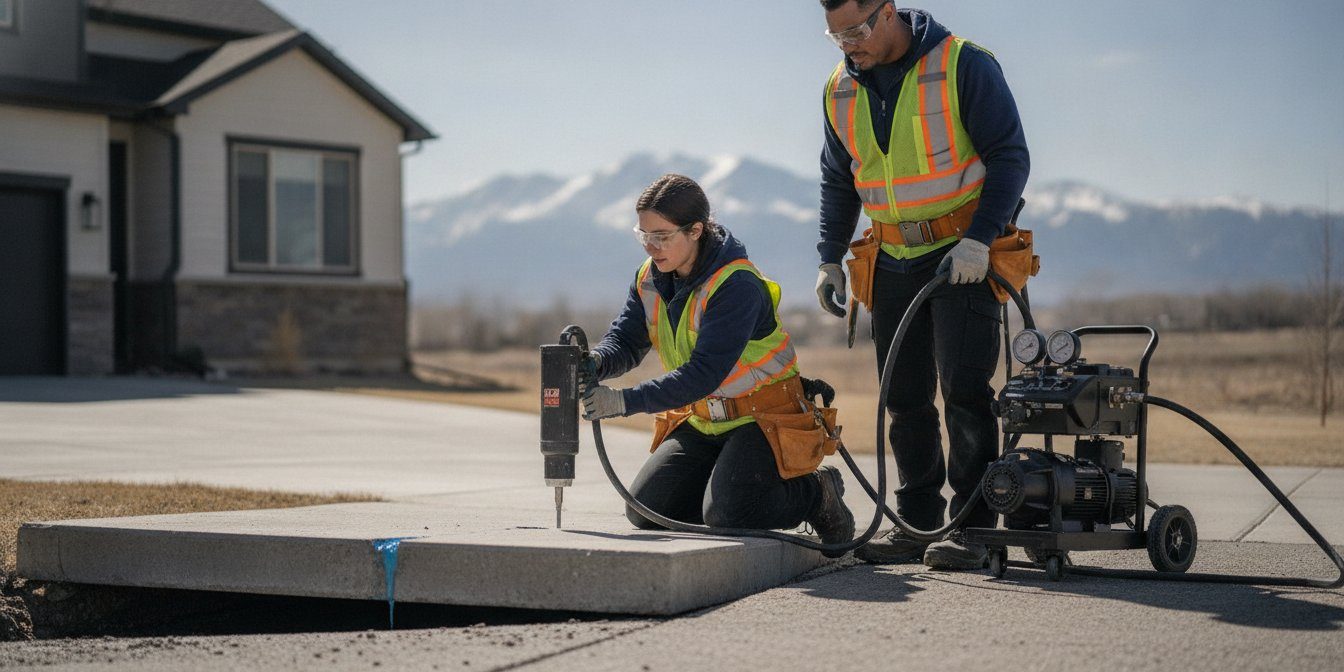
Polyurethane concrete lifting involves injecting high-density structural foam beneath a settled slab to restore its original elevation and stability. Unlike traditional methods that rely on heavy soil-and-cement slurries, this modern process uses a two-part polymer that expands to fill voids and compress the underlying soil. When property owners ask how long does polyurethane concrete lifting last, the answer is rooted in material science. The foam is engineered to be a permanent structural fix; it’s designed to provide support for 20 to 50 years, often outlasting the concrete slab it’s supporting.
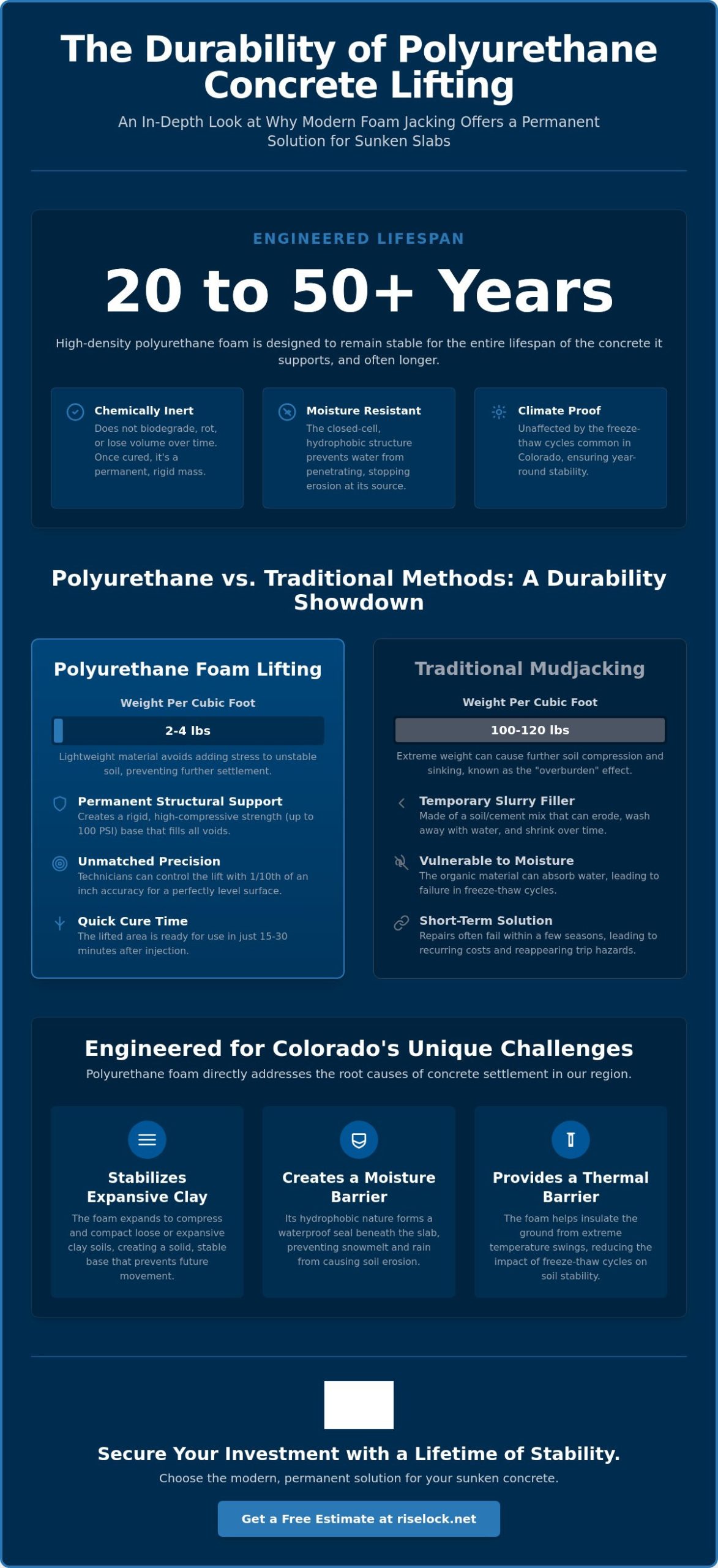
It’s vital to distinguish between the lifespan of the material itself and the stability of the entire system. High-density foam doesn’t biodegrade, rot, or lose its volume over time. Once it has cured, which takes approximately 15 to 30 minutes, it remains a rigid, inert mass that’s unaffected by moisture or the freeze-thaw cycles common in Colorado. Because the material doesn’t shrink or wash away, the lift remains accurate as long as the underlying soil is properly stabilized.
Is Polyurethane Lifting a Permanent Solution?
The construction industry views polyurethane as a permanent solution because of the “indefinite” chemical life of closed-cell polymers. Unlike organic fillers or loose soil, this foam does not break down when exposed to groundwater. Various concrete leveling methods have evolved over the decades, but polyjacking stands out because the foam becomes a physical part of the soil structure. Because the foam is much lighter than mudjacking slurry, weighing only 4-8 pounds per cubic foot, it doesn’t add significant weight that could cause further soil settlement. This characteristic makes the repair inherently more stable than heavier alternatives.
The 2026 Standard for Concrete Restoration
The 2026 standard for concrete restoration prioritizes technical precision and long-term chemical resistance. Modern formulations have been refined to withstand exposure to harsh chemicals and UV rays, although the foam is typically shielded from direct sunlight by the concrete itself. We’ve seen a decisive industry shift away from temporary, cementitious fillers toward these structural polymers. This transition is driven by the need for accuracy. Using specialized equipment, technicians can control the lift with 1/10th of an inch precision. This level of control ensures the slab is perfectly aligned, reducing the stress points that often lead to cracking and future sinking. By addressing the root cause of the void, we provide a foundation that remains reliable for decades.
The Science of Durability: Why High-Density Foam Lasts
The longevity of structural restoration depends entirely on the material’s ability to withstand environmental pressure without degrading. While traditional fillers rely on mass and gravity, high-density polyurethane utilizes a chemical reaction to create a stable, rigid structure beneath the concrete. This process addresses the primary reason concrete sinks in the first place: the presence of underground voids. By expanding to fill every crevice, the foam eliminates the empty spaces where water would otherwise collect and cause further erosion. If you’re evaluating how long does polyurethane concrete lifting last, you must look at the material’s compressive strength, which can reach up to 100 psi. This ensures the foam can support the weight of the slab and any additional loads without compressing or losing its shape.
One of the most significant advantages of this modern approach is its lightweight profile. Traditional mudjacking slurry weighs upwards of 100 to 120 pounds per cubic foot, which often places an unnecessary burden on already unstable soil. In contrast, structural foam weighs only 2 to 4 pounds per cubic foot. This drastic reduction in weight prevents the “overburden” effect, where the repair material itself causes the soil to sink further. By choosing a solution that works with the existing soil rather than against it, property owners can achieve a much higher level of concrete leveling precision that remains stable for decades.
Closed-Cell Structure and Moisture Resistance
The durability of polyurethane is largely due to its closed-cell structure. In this formulation, the material consists of millions of tiny, independent bubbles that are completely sealed off from one another. This configuration prevents water from permeating the material, making it entirely waterproof. Because the foam cannot absorb moisture, it’s immune to the “washout” effect that frequently destroys mudjacking repairs during heavy rain or snowmelt. Hydrophobic polyurethane is a material that maintains its physical properties even in saturated soil. This chemical resilience is supported by academic research on polyurethane durability, which confirms the material’s stability under extreme environmental stress.
Soil Stabilization and Load Bearing Capacity
Precision injection does more than just lift the slab; it actively improves the foundation. As the foam expands, it exerts a powerful force that compacts loose sub-base soils. This compaction creates a firmer, more unified foundation that’s capable of supporting heavy vehicle traffic and industrial machinery. Unlike new concrete replacement, which simply sits on top of the same problematic soil, polyurethane lifting integrates with the ground to prevent future movement. This dual action of lifting and stabilizing is what allows the repair to last for the remaining life of the concrete itself.
Environmental Factors and Soil Stability in Colorado
Colorado’s geology presents a unique set of challenges for any structural repair. The Front Range is characterized by high concentrations of bentonite and expansive clay, which act like a sponge. These soils swell significantly when saturated and shrink during our dry spells, creating a volatile foundation for driveways, patios, and garage floors. When determining how long does polyurethane concrete lifting last in this specific climate, the material’s chemical resilience is the deciding factor. Unlike traditional methods that use heavy, rigid materials, high-density foam maintains its volume and position regardless of the soil’s moisture content. It creates a stable environment where organic materials and traditional grouts would typically fail.
Local expertise is vital when assessing how soil drainage impacts a property. Poorly managed runoff often exacerbates the movement of expansive clay, leading to recurring settlement issues. Polyurethane injections address this by acting as a thermal insulator for the soil directly beneath the slab. This insulation layer helps regulate sub-base temperatures, which can mitigate the extreme fluctuations that lead to soil fatigue. By stabilizing the environment under the concrete, we ensure the lift remains accurate for decades. Understanding how long does polyurethane concrete lifting last requires looking at this ability to shield the foundation from environmental stress.
Managing Expansive Soils in the Denver Metro Area
Property owners in Aurora, Parker, and Centennial often struggle with “slab curl” and settlement caused by aggressive soil movement. Traditional repairs frequently fail in these areas because they add too much weight to the already stressed clay. Polyurethane provides a strategic advantage by offering a firm yet slightly flexible support system. It moves in unison with the earth’s natural cycles rather than resisting them to the point of fracture. This compatibility with Colorado’s high-alkaline soil ensures that the foam does not break down or lose its structural integrity over time.
Freeze-Thaw Resilience and Thermal Protection
Colorado’s intense freeze-thaw cycles are a primary catalyst for concrete failure. In regions like Castle Rock, water often migrates into the voids beneath a slab, freezes, and causes destructive frost heave. Polyurethane prevents this cycle by completely sealing the sub-base and repelling water. This approach is consistent with the FHWA Slab Stabilization Guidelines, which emphasize the importance of effective void filling to maintain pavement performance. Denver homeowners see longer-lasting results because the foam eliminates the water pockets that lead to ice expansion and subsequent cracking.
Durability Comparison: Polyjacking vs. Mudjacking vs. Replacement
Choosing the right restoration method requires looking beyond the initial price tag to the actual cost of failure. When homeowners evaluate how long does polyurethane concrete lifting last, they’re usually comparing it to more traditional, albeit less durable, alternatives like mudjacking or full slab replacement. While mudjacking typically offers a lifespan of only two to five years in unstable soil environments, high-density polyurethane is designed to provide structural stability for 20 to 50 years. This massive difference in longevity is a direct result of the material’s weight-to-strength ratio and its impact on the underlying sub-base.
The non-invasive nature of foam injection also plays a critical role in preserving the surrounding structures. Traditional methods require heavy equipment and large drill holes that can weaken the existing slab. In contrast, polyurethane utilizes 5/8-inch injection ports, roughly the size of a penny, which minimizes the structural footprint of the repair. Understanding how long does polyurethane concrete lifting last involves recognizing that it stabilizes the ground rather than just filling a gap, creating a foundation that resists the erosion common in Colorado’s climate. For property managers and business owners navigating ADA compliance and liability concerns, our Denver commercial concrete lifting checklist provides a technical framework for selecting the right solution in 2026.
Why Mudjacking is a Temporary Band-Aid
Mudjacking is often perceived as a cost-effective alternative, but its reliance on heavy cementitious slurries creates a fundamental engineering flaw. A typical mudjacking project adds thousands of pounds of weight to soil that has already proven it cannot support the original slab. This added overburden often accelerates soil settlement, causing the concrete to sink even further than before. Additionally, the grout used in mudjacking is prone to significant shrinkage as the water evaporates during the drying process. This creates new voids that invite water intrusion, often leading to repair failure within a few seasons. For a deeper understanding of why this approach falls short, see our detailed breakdown of the disadvantages of mudjacking and why modern slabs need more.
The Hidden Risks of Full Concrete Replacement
Many property owners assume that tearing out and repouring is the ultimate fix, but new concrete often sinks again within 10 years. This happens because replacement addresses the symptom (the cracked slab) without fixing the cause (uncompacted or unstable soil). Pouring a heavy new slab on top of the same problematic sub-base is a recipe for repeat failure. When you factor in the cost of demolition, disposal, and the downtime of waiting for new concrete to cure, the long-term ROI of replacement is often poor. Polyurethane concrete lifting costs significantly less over a 20-year period than multiple mudjacking attempts.
If you’re ready to invest in a permanent solution that protects your property value, our team can provide a high-precision assessment for your concrete repair project.
Ensuring a Lifetime of Stability with RiseLock
RiseLock views every project as a unique structural challenge rather than a simple repair task. We don’t just “lift” concrete; we restore the integrity of the property’s foundation using a combination of technical mastery and high-performance materials. Our process utilizes industrial-grade polymers specifically formulated for the high-altitude environments and volatile soils found throughout Colorado. By prioritizing precision over speed, we address the root cause of settlement. This ensures that when clients ask how long does polyurethane concrete lifting last, they receive a solution that remains stable for decades. Our commitment to ethical service means we only recommend intervention when it provides a genuine, long-term benefit to the property owner.
The reliability of our work stems from the use of specialized equipment that allows for total control over the chemical reaction occurring beneath the slab. Unlike generic foam applications, our structural polymers are designed to maintain their compressive strength even in saturated conditions. This level of professional-grade intervention is what separates a temporary fix from a permanent restoration. We treat your property’s structural health as our personal priority, ensuring that every injection port is placed with surgical accuracy to provide maximum support with minimal disruption.
The RiseLock Precision Injection Method
Achieving a perfectly level surface requires more than just filling a void. Our technicians use high-accuracy laser-leveling technology to monitor the slab’s elevation in real-time as the foam expands. This allows for adjustments within 1/10th of an inch, which prevents structural stress and ensures perfect alignment with adjacent slabs. Because the expansion rate of high-density foam is sensitive to ambient temperature and soil pressure, our experts constantly calibrate the delivery systems for optimal density. For a deeper look at the technical specifications of our process, you can explore the Precision Guide to Polyurethane Concrete Lifting.
Comprehensive Structural Security
A critical factor in Colorado residential construction is the prevalence of post-tension slabs. These foundations are reinforced with high-strength steel cables under immense tension, and drilling into these cables during a lift can lead to catastrophic structural failure. At RiseLock, we integrate our deep knowledge of Post Tension Installation into our leveling projects. We use specialized mapping to ensure every injection port is placed safely, preserving the internal reinforcement of your foundation while we stabilize the soil beneath it.
While the foam itself is permanent, the surrounding environment still requires basic care to ensure the longest possible lifespan for your concrete. We recommend that homeowners maintain proper drainage by keeping gutters clear and caulking concrete joints to prevent surface water from reaching the sub-base. This proactive approach, combined with our precision methods, is why we can confidently answer the question of how long does polyurethane concrete lifting last with a timeline of 20 to 50 years. If you’re ready to secure your property’s future with a level, stable surface, schedule your professional concrete assessment with RiseLock today.
Secure Your Property with Precision Engineering
Choosing a restoration method is a significant investment in your home’s safety and long-term value. While the question of how long does polyurethane concrete lifting last is central to your decision, the answer is found in the material’s ability to create a moisture-resistant, high-strength foundation. By addressing sub-base voids and compacting expansive Colorado soil, high-density foam provides a stable alternative that typically outlasts the concrete it supports. This modern approach eliminates the cycle of recurring repairs and the mess associated with traditional demolition and repouring.
RiseLock brings a level of technical mastery to the Front Range that goes beyond simple leveling. Our expertise in structural reinforcement and post-tension installation allows us to navigate complex projects in Denver, Aurora, and the surrounding areas with surgical precision. We prioritize long-term security over temporary patches, ensuring your property remains level and safe for decades to come. It’s time to move past the stress of sinking concrete and secure a foundation built on modern innovation and professional pride.
Request a Free Precision Estimate from RiseLock
Frequently Asked Questions
Is polyurethane concrete lifting better than mudjacking for long-term results?
Polyurethane is significantly more effective for long-term stabilization because it doesn’t degrade or lose volume like traditional mudjacking slurries. While mudjacking relies on a heavy soil and cement mixture that often sinks again under its own weight, high-density foam provides a permanent, lightweight solution. This material durability is why property owners asking how long does polyurethane concrete lifting last can expect results that span several decades without the need for repeat intervention.
Can the foam wash away during heavy Colorado rains or snowmelt?
The foam cannot wash away because it’s a hydrophobic, closed-cell material that repels water. Unlike the organic materials used in mudjacking, which can erode during intense Colorado snowmelts or heavy spring rains, cured polyurethane remains a solid, inert mass. It maintains its structural integrity even when submerged in groundwater, ensuring the slab stays supported through every season and weather event.
Will the foam lose its lifting power over time under heavy vehicles?
Structural foam won’t lose its lifting power or compress under the weight of heavy vehicles. With a compressive strength of up to 100 psi, the material is engineered to support the load of residential vehicles and even industrial machinery. Once the foam has expanded and cured, it becomes a rigid foundation that resists deformation over the 20 to 50 year lifespan of the repair.
How soon can I drive on my driveway after polyurethane lifting?
You can typically drive on your driveway within 15 to 30 minutes of the injection process. Polyurethane cures extremely quickly, reaching nearly 90% of its full strength in less than half an hour. This rapid turnaround is a major advantage over traditional replacement, which requires several days of curing time before it can support the weight of a car.
Does the foam attract rodents or insects under my slab?
Polyurethane foam does not attract rodents, insects, or other pests. It’s an inert, synthetic polymer that offers no nutritional value to animals or wood-destroying organisms like termites. Because it fills the entire void beneath the slab, it actually removes the dark, hollow spaces where pests would typically build nests or colonies.
What happens to the foam if the soil continues to shift in the future?
If the underlying soil continues to shift due to deep geological factors, the polyurethane remains a permanent part of the concrete slab’s structure. However, the injection process itself helps mitigate future movement by compacting the loose sub-base soils during expansion. This creates a more unified and stable foundation that is much less likely to experience the settlement issues seen with untreated soil.
Is the polyurethane material environmentally safe and non-toxic?
Modern polyurethane materials are environmentally safe and non-toxic once they’ve fully cured. The foam is an inert plastic that doesn’t leach harmful chemicals into the surrounding soil or groundwater. It’s a sustainable choice for property owners because it preserves the existing concrete, reducing the environmental impact and waste associated with demolition and new production.
How much does polyurethane concrete lifting cost compared to replacement?
Polyurethane lifting is generally a more cost-effective investment than full concrete replacement. While replacement requires expensive demolition, haul-away fees, and the cost of new materials, lifting restores the existing surface at a fraction of the total expense. When you consider how long does polyurethane concrete lifting last, the long-term ROI is significantly higher than temporary fixes that require repeat intervention every few years.