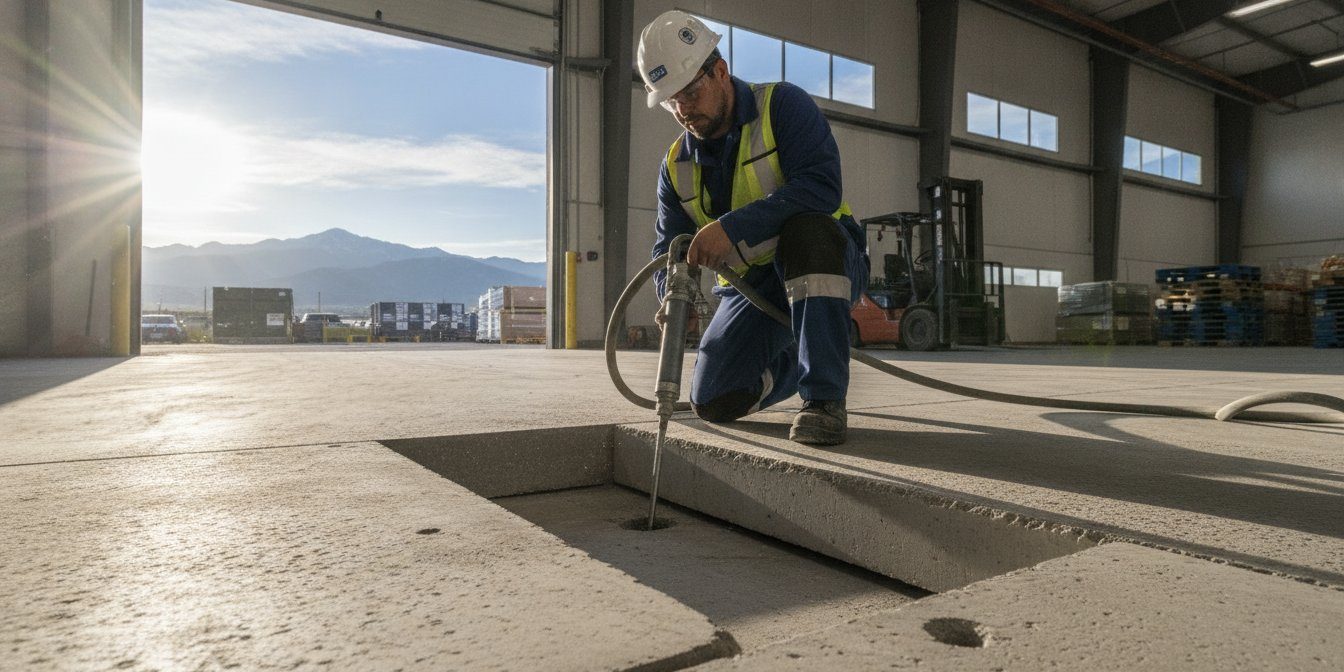
The traditional “rip and replace” approach to failing slabs is no longer a sustainable strategy for a business that values its operational flow and bottom line. You already understand that uneven warehouse floors or settling loading docks are more than cosmetic issues. They are significant liabilities that create trip hazards and slow down your daily productivity. When every hour of downtime translates to lost revenue, the prospect of a week-long concrete replacement project is often impossible to justify.
This guide details how commercial concrete leveling via modern polyurethane injection provides a sophisticated alternative that prioritizes precision and speed. You’ll discover how these advanced materials restore structural integrity with curing times as fast as 15 minutes, allowing your facility to remain fully operational. We will examine the technical mastery behind foam stabilization, the impact of 2026 OSHA silica dust enforcement on repair protocols, and why a data-driven approach to restoration ensures long-term security for your commercial assets.
Key Takeaways
- Identify the subtle signs of structural failure, such as slab pitching and joint separation, before they escalate into costly operational hazards.
- Discover why modern commercial concrete leveling using high-density polyurethane is the most efficient method for restoring integrity with minimal business disruption.
- Evaluate the significant return on investment when choosing restoration over replacement, often saving 50-70% in direct costs.
- Learn the importance of pre-project engineering and slab mapping to identify the root cause of settlement and ensure a uniform, permanent lift.
- Understand how specialized knowledge of Colorado’s Front Range soil conditions is essential for achieving long-term structural stability.
The Impact of Concrete Settlement on Commercial Operations
Commercial concrete leveling represents a high-precision structural intervention designed to address the root causes of slab instability. It isn’t merely a cosmetic patch; it’s a technical necessity for maintaining the operational capacity of a facility. When a slab begins to pitch or separate at the joints, it indicates that the sub-base has failed. Concrete leveling involves restoring the necessary support beneath the surface to ensure the structure can handle its intended load. In commercial environments, this settlement often manifests as void formation under heavy traffic areas, leading to joint separation and significant pitching that disrupts workflow.
For businesses operating along Colorado’s Front Range, these issues are accelerated by the region’s unique geography. The combination of expansive bentonite soils and extreme freeze-thaw cycles creates a volatile environment for rigid concrete structures. As soil shifts, the support beneath the slab vanishes, leaving the concrete to suspend itself across empty space until it inevitably cracks under pressure. Identifying these failures early prevents the hidden costs of settlement, such as accelerated machinery wear, drainage failure, and mounting legal liabilities. Understanding the full range of concrete lifting solutions available for Colorado’s unique soil conditions is an essential first step for any facility manager facing these challenges.
Safety and Liability: The Primary Commercial Driver
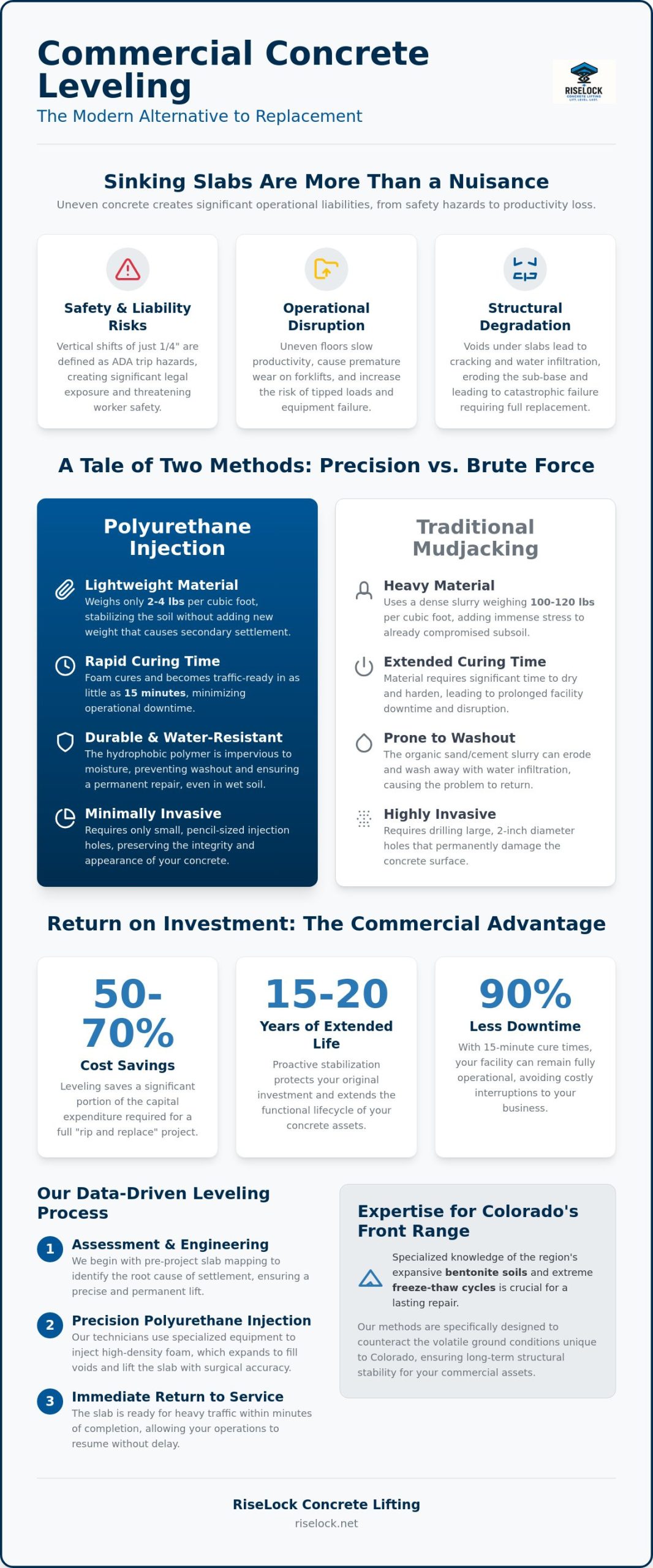
Safety is a regulatory requirement that demands constant vigilance. The Americans with Disabilities Act (ADA) defines a trip hazard as any vertical change in level of 1/4 inch or greater. Ignoring these small shifts can lead to significant legal exposure. Beyond pedestrian safety, uneven floors pose a direct threat to warehouse operations. Forklifts traveling over uneven joints experience increased tire wear and mast strain, while the risk of tipped loads becomes a daily operational hazard. Proactive commercial concrete leveling mitigates these risks before they result in worker’s compensation claims or equipment failure.
Structural Integrity and Long-Term Asset Protection
The presence of a void is a precursor to catastrophic failure. When air pockets exist beneath a slab, the concrete is forced to bear weight it wasn’t engineered to support without a solid base. This leads to deep, structural cracking that eventually requires total replacement. Water infiltration further complicates this by eroding the remaining sub-base material during rain events or snowmelt. By stabilizing these voids through commercial concrete leveling, you prevent the cycle of erosion and can extend the functional lifecycle of your concrete assets by 15 to 20 years. This technical restoration preserves the original investment and avoids the massive capital expenditure of a full teardown.
Polyurethane Injection vs. Traditional Repair Methods
The transition from traditional mudjacking to polyurethane injection represents a significant shift from brute force to chemical precision. Mudjacking relies on a slurry of sand, cement, and soil to fill voids. This material is incredibly heavy, weighing between 100 and 120 pounds per cubic foot. In contrast, the high-density polymers used in commercial concrete leveling weigh only 2 to 4 pounds per cubic foot. This weight differential is a critical factor for long-term stability. Applying thousands of pounds of wet slurry to already compromised sub-soil often causes secondary settlement, especially in the expansive clay soils found across the Front Range. We choose to avoid this risk by using lightweight materials that stabilize the slab without overloading the ground beneath it.
The Science of High-Density Polyurethane Foam
The injection process involves a two-part liquid that undergoes a controlled exothermic reaction. This reaction creates a powerful expansion force that lifts the slab from beneath with surgical accuracy. Because the foam is hydrophobic, it remains entirely stable even in the saturated soil conditions common during Colorado’s spring runoff. This moisture resistance ensures the repair won’t degrade or shift when exposed to groundwater. Commercial-grade polyurethane foam provides a compressive strength that significantly exceeds the load-bearing capacity of the natural soil it replaces.
Why Mudjacking Fails in Modern Commercial Environments
Traditional mudjacking presents several challenges for modern facilities that prioritize durability and cleanliness. The slurry is prone to washout, where water infiltration slowly erodes the organic materials in the mix, eventually leading to new voids. For high-traffic areas like loading docks or warehouse floors, this lack of permanent support is unacceptable. Additionally, mudjacking is inherently invasive. It requires large 2-inch holes and heavy equipment that can damage surrounding surfaces. When maintaining commercial concrete leveling standards, we prioritize non-invasive techniques. Our injection ports are only 5/8 of an inch, which is roughly the size of a penny. This allows for a clean, professional finish in sensitive interior spaces like retail floors or medical offices. For businesses concerned about long-term stability, understanding the nuances of concrete pavement maintenance and repair is essential to making an informed decision.
The speed of the cure is perhaps the most immediate benefit for a busy operation. While mudjacking requires days to dry and harden, polyurethane reaches 90% of its full strength in less than 30 minutes. This allows heavy machinery and commercial traffic to resume almost immediately after the crew finishes. If you’re managing a facility that can’t afford a multi-day shutdown, exploring modern foam concrete lifting is the logical next step to restore your facility’s integrity without the wait.
Evaluating the ROI of Commercial Concrete Leveling
Choosing polyurethane concrete lifting is a strategic financial decision that extends beyond the immediate invoice. When you compare the direct costs of restoration against total slab replacement, the savings are substantial. Professional commercial concrete leveling typically costs 50% to 70% less than the alternative of tearing out and repouring. This price gap exists because restoration eliminates the need for demolition, debris hauling, and the massive volume of new material required for a full replacement. You’re paying for a technical solution rather than a labor-intensive demolition project.
The “Downtime Tax” is often the most overlooked expense in facility management. A traditional concrete replacement can easily shut down a critical loading dock or warehouse aisle for seven to ten days while the new material cures. You must factor in the lost revenue, rerouted logistics, and labor inefficiencies during that period. Polyurethane injection eliminates this tax by allowing for a rapid return to service. This efficiency transforms a potential week-long crisis into a manageable maintenance task. Additionally, the environmental ROI is significant. By avoiding demolition, you keep tons of debris out of landfills and reduce the carbon footprint associated with the production of new cement.
Operational Continuity and Business Flow
Maintaining business flow is a high priority for any commercial operation. We often utilize night and weekend scheduling to perform repairs during off-peak hours, ensuring your customers and staff are never inconvenienced. The equipment used is compact and non-invasive, requiring no heavy machinery that would block access or damage surrounding landscaping. Because the foam reaches its full load-bearing capacity within minutes, your heavy vehicle traffic can resume immediately after we pull the injection ports. This immediate utility is a hallmark of modern commercial concrete leveling.
Complementary Structural Reinforcement
In certain commercial settings, leveling is only one part of the structural solution. If the slab has significant structural cracks or was originally engineered with high-tension cables, we may integrate post tension installation to provide additional lateral strength. Identifying when a slab requires this extra reinforcement is key to a permanent fix. We ensure that the lifted slab and the reinforcement system work in tandem, providing a stable foundation that resists future shifting. This comprehensive approach addresses both the vertical settlement and the lateral integrity of the concrete asset.
The Commercial Assessment and Leveling Process
Successful commercial concrete leveling begins long before the first injection port is installed. We treat every project as a technical engineering challenge, first identifying the root cause of the settlement. Whether the issue stems from poor initial soil compaction or a broken utility line causing sub-surface erosion, addressing the “why” is essential for a permanent fix. Our team maps the slab to determine the optimal grid for injection points, ensuring a uniform lift that distributes pressure evenly across the sub-grade rather than creating new stress points. Facility managers who want to make a fully informed decision before committing to a repair method will benefit from reviewing a comprehensive buyer’s guide to concrete lifting solutions for structural restoration in Colorado.
Site Preparation and Safety Protocols
Safety is non-negotiable in a busy commercial environment. We strictly adhere to OSHA standards and integrate with your specific facility safety requirements to maintain a secure work zone. Before any drilling occurs, we perform utility locating and sub-surface imaging to avoid damaging buried electrical lines or plumbing. Our equipment footprint is kept compact and contained, allowing us to maintain a professional site that doesn’t disrupt your daily operations or block critical access points.
Precision Injection and Stabilization
The injection phase requires a high degree of control, particularly for delicate interior slabs or areas adjacent to sensitive heavy machinery. We monitor the expansion rate of the polyurethane foam in real time, using laser levels to achieve 1/16-inch precision. This methodical approach ensures that we aren’t just lifting the concrete, but fully stabilizing the environment beneath it. Laser-guided precision ensures that the slab reaches its exact target elevation without the risk of over-lifting or creating new structural tension. We prioritize 100% void filling to guarantee that the entire slab has direct, continuous contact with a stabilized sub-grade.
Once the lift is complete, we perform final site restoration protocols to ensure a professional finish. This includes removing the injection ports and filling the 5/8-inch holes with a high-strength grout that matches your existing concrete surface. We also check for joint integrity and offer sealing options to prevent future water infiltration, which is a primary cause of sub-base erosion. This thorough process ensures your facility is left clean, safe, and structurally sound for years to come. If your facility requires a technical assessment, schedule a professional consultation for commercial concrete leveling today.
RiseLock: Denver’s Partner in Commercial Concrete Restoration
RiseLock views every structural challenge as a personal priority. We combine advanced polyurethane technology with an intimate understanding of Colorado’s geological landscape. This dual focus is why local expertise is non-negotiable for commercial concrete leveling along the Front Range. While the science of polymer injection remains consistent, the success of the application depends entirely on the technician’s ability to account for specific regional environmental factors. We don’t just offer a service; we provide a partnership rooted in technical mastery and ethical reliability.
Expertise in Colorado Soils
Expansive clay is a primary adversary for any rigid structure in cities like Aurora and Thornton. These bentonite-heavy soils swell significantly when wet and shrink during dry spells, creating a relentless cycle of movement that destabilizes concrete slabs from beneath. We understand these nuances because we live and work in the same environment. Our team takes professional pride in restoring Denver’s commercial infrastructure, drawing on a portfolio of local references and successful projects across the Centennial state. We ensure that your repair accounts for these specific soil pressures, providing a level of long-term security that out-of-state contractors often overlook.
Getting Started with Your Restoration
A professional evaluation is the first step toward regaining structural control of your facility. When our technicians arrive on-site, they perform a comprehensive assessment that goes beyond surface-level damage. We analyze drainage patterns, sub-surface voids, and the specific load-bearing requirements of your daily operations. This data allows us to develop customized repair plans tailored to your industry’s unique needs, whether you’re managing a high-traffic retail center or a heavy-industrial warehouse. Before committing to any provider, reviewing a professional vetting checklist for concrete leveling contractors near me can help you identify qualified specialists who use high-density polyurethane technology and adhere to current OSHA standards. Our service area extends across the entire Denver metro region, providing reliable support from Boulder down to Colorado Springs. We act as your professional guide, leading you away from the risks of failing concrete toward a stable, safe, and efficient facility. To begin your restoration, Request a Commercial Concrete Evaluation today and secure the future of your commercial assets.
Securing the Future of Your Commercial Infrastructure
Structural integrity serves as the foundation for any successful commercial operation. Prioritizing technical restoration over simple cosmetic fixes protects your facility from the compounding costs of settlement and liability. Modern commercial concrete leveling provides a high-precision solution that integrates seamlessly with your business flow. We utilize high-density polyurethane technology to deliver a stable, load-bearing surface that withstands the unique pressures of Colorado’s Front Range soil conditions. Whether your project requires straightforward foam injection or a more complex approach involving post-tension reinforcement, our focus remains on achieving permanent results with minimal disruption.
Our team views your structural challenges as a personal priority, combining technical mastery with an ethical commitment to high standards. We don’t just lift slabs; we provide the peace of mind that comes from a secure, safe environment for your staff and equipment. Taking a proactive approach today prevents the necessity of a total teardown tomorrow.
Secure your facility’s foundation with a RiseLock commercial evaluation today. We look forward to helping you restore the strength and safety of your facility.
Frequently Asked Questions
How long does commercial concrete leveling take to complete?
Most commercial projects are completed within a single business day, with smaller sections often taking as little as two to four hours. Because the polyurethane foam cures to 90% of its full strength in under 30 minutes, your facility can resume heavy traffic almost immediately after we finish. This efficiency is a primary advantage for operations that cannot afford the week-long curing times required for traditional concrete replacement.
Is the polyurethane foam used in leveling environmentally friendly?
Modern high-density polyurethane is an inert material once cured, meaning it will not leach chemicals or contaminants into the surrounding soil or groundwater. Using this method also provides a significant environmental benefit by preserving existing slabs and keeping tons of concrete debris out of local landfills. It’s a sustainable choice for businesses looking to maintain their infrastructure while reducing the carbon footprint associated with new cement production.
Will commercial concrete leveling fix large cracks in my slab?
The leveling process focuses on restoring the structural sub-base and closing the vertical gaps caused by settlement, but it doesn’t chemically bond cracked sections back together. While the lift often brings separated pieces back into alignment, we recommend a professional commercial concrete leveling assessment followed by high-grade joint sealing to prevent future water infiltration. This combination ensures the structural lift is protected by a moisture-resistant surface seal.
Can you level concrete that has post-tension cables inside?
Yes, we can safely level post-tension slabs by utilizing sub-surface imaging and precision drilling techniques. Our injection ports are only 5/8 of an inch in diameter, which allows us to navigate the reinforcement grid without compromising the integrity of the high-tension cables. This technical precision is essential for maintaining the lateral strength of the slab while restoring its vertical elevation.
How much weight can polyurethane foam concrete leveling support?
Commercial-grade polyurethane foam is engineered to support the extreme loads found in industrial environments, including heavy machinery, forklifts, and fully loaded semi-trucks. The material typically offers a compressive strength of 80 to 100 psi, which far exceeds the load-bearing capacity of the natural soil it replaces. This ensures that once the slab is stabilized, it can handle its original design loads without further risk of settlement.
What is the difference between residential and commercial concrete leveling?
The primary differences lie in the scale of the project, the density of the material used, and the required safety protocols. Commercial concrete leveling utilizes higher-density polymers specifically formulated to withstand constant heavy traffic and industrial equipment. Commercial projects also require more rigorous site-specific safety planning and engineering oversight to ensure the repair integrates with the facility’s broader structural requirements and operational flow. When evaluating providers, using a structured checklist to vet concrete leveling contractors near me ensures you select a specialist with the technical credentials and commercial experience your project demands.
How long will the concrete leveling repair last in Colorado?
A professional polyurethane repair is considered a permanent solution because the material does not degrade, wash out, or lose its volume over time. In Colorado’s Front Range, the foam remains stable through extreme freeze-thaw cycles and won’t be affected by the expansive clay soils that typically cause mudjacking to fail. As long as the facility’s drainage is properly maintained, the stabilized sub-base will remain secure for the life of the concrete.
Does commercial concrete leveling require a permit in Denver?
Permit requirements generally depend on the location of the slab and the specific nature of the facility. While most leveling projects on private commercial property don’t require a permit, work involving public right-of-ways or sidewalks may require specific city authorization. We recommend checking with the Denver Department of Transportation and Infrastructure or your local building department to confirm the specific regulatory requirements for your site before beginning work.