What if the uneven slab in your driveway isn’t just an eyesore, but a clear signal that your property’s foundation is losing its battle with Colorado’s expansive clay soil? Most homeowners naturally worry that sunken concrete requires a total, messy replacement to ensure safety and restore property value. It’s a common concern; it brings up valid fears regarding trip hazard liability and the potential for long-term structural failure. However, choosing a professional concrete leveling service is often a more precise and effective strategy than starting from scratch.
This guide explains how modern polyurethane technology restores structural integrity by addressing the root cause of settlement. You’ll learn how this method can be 50% to 75% more cost-effective than replacement while providing a permanent fix that stabilizes the ground beneath your feet. We will detail the technical advantages of foam injection, including its rapid 15 to 30 minute cure time and its ability to withstand the unique challenges of local soil conditions. This overview provides the clarity you need to move from the stress of damage to the security of a professionally stabilized surface.
Key Takeaways
- Understand that professional restoration is a structural process designed to stabilize the ground beneath your slab, not just a temporary surface fix.
- Learn why high-density polyurethane is the preferred material for a concrete leveling service due to its lightweight nature and its ability to withstand moisture.
- Apply the “70% rule” to determine if your concrete is a candidate for cost-effective restoration or if it requires full replacement.
- Discover how specialized repair techniques account for Colorado’s unique soil dynamics, including expansive Bentonite clay and extreme temperature shifts.
- Identify the essential criteria for selecting a contractor who prioritizes technical mastery and thorough site assessments over quick estimates.
What is a Professional Concrete Leveling Service?
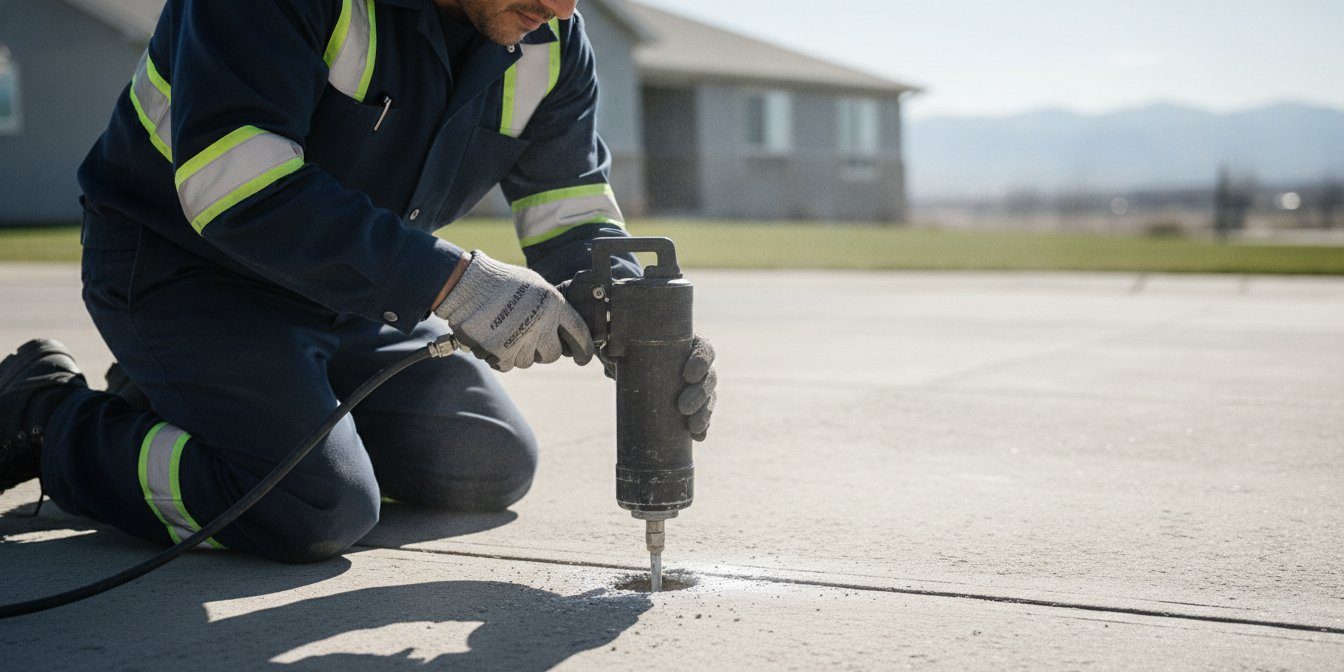
A professional concrete leveling service is a specialized engineering solution designed to restore the structural integrity of sunken or uneven slabs. It is not a simple cosmetic fix or a surface-level patch. Instead, it is a high-precision process that addresses the root cause of concrete failure: the instability of the soil beneath the surface. By injecting stabilizing materials through small, strategically placed holes, technicians fill the subterranean gaps and gently lift the concrete back to its original position. This process focuses on deep-tissue restoration, ensuring that the slab is supported by a solid foundation rather than resting on air pockets.
To gain a broader perspective on the evolution of these techniques, one might explore the foundational principles of What is Concrete Leveling. Historically, the industry relied on mudjacking, which involved pumping a heavy mixture of soil and cement under the slab. While effective for some applications, the sheer weight of the slurry often caused further soil compression. Modern systems have transitioned toward high-density polyurethane, a lightweight material that offers superior control and long-term stability without adding unnecessary burden to the sub-base. This shift represents a move toward technical mastery and precision in the field of slab restoration.
The Mechanics of Slab Settlement
Concrete slabs don’t sink without a reason. Settlement is almost always the result of changes in the soil’s ability to support the weight of the concrete. Poor compaction during the initial construction phase is a common culprit, as loose soil naturally settles over time. Additionally, moisture fluctuations and soil erosion caused by improper drainage can wash away the fine particles that provide structural support. This creates the “void” phenomenon. These air pockets represent weak points where the slab is left unsupported. You will typically notice these issues first in areas subjected to heavy loads or constant weather exposure, such as:
- Driveways and garage floors that bear the weight of vehicles.
- Pool decks and patios where water runoff is frequent.
- Entryways and sidewalks where safety and aesthetics are paramount.
Leveling vs. Raising: Understanding the Terminology
In the world of structural repair, you may hear terms like “slab jacking” or “concrete raising” used interchangeably. While they describe the same basic action, “leveling” is the industry standard term because it defines the intended outcome: a surface that is flush with its surroundings and restored to its original grade. Accuracy is vital here. A professional concrete leveling service requires technical mastery to ensure that the lift is incremental and controlled. The goal is a seamless transition between slabs that eliminates trip hazards and restores proper water drainage. This level of precision protects the property’s value and provides long-term security for the owner.
Polyurethane Foam vs. Mudjacking: The Technical Superiority of Foam
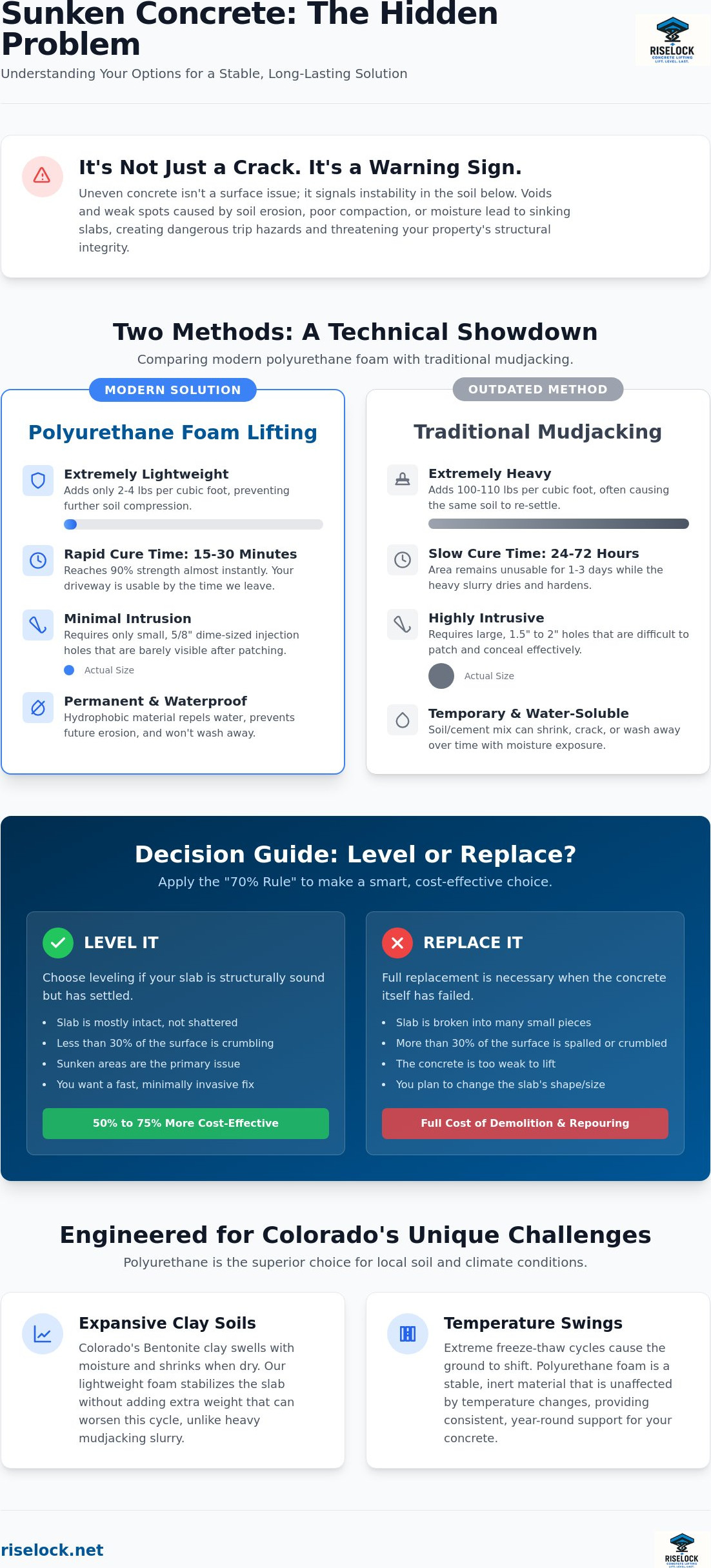
The transition from traditional slurry-based repairs to modern chemical stabilization represents a significant leap in structural engineering. When you choose a professional concrete leveling service, the primary advantage lies in the specific chemical reaction of high-density polyurethane. Two liquid components meet at the injection tip, initiating an expansive reaction that travels through the path of least resistance. This expansion ensures a 100% void fill, reaching deep into crevices that traditional grout simply cannot penetrate. This creates a fully supported slab that remains stable long after the initial lift.
Unlike organic mudjacking mixtures, polyurethane is inherently hydrophobic. It doesn’t just resist water; it actively displaces it during the injection process. This is particularly critical when dealing with Colorado’s unique soil dynamics, where moisture fluctuations frequently cause traditional materials to erode or wash away. While mudjacking slurry requires 24 to 72 hours to cure before it can bear weight, polyurethane foam reaches approximately 90% of its full compressive strength within 15 to 30 minutes. This allows for immediate return to service, ensuring your driveway or sidewalk is ready for use before the technician even leaves the site.
Why Weight Matters in Concrete Restoration
There’s a fundamental irony in traditional mudjacking: it attempts to fix a slab failing due to weak soil by adding massive amounts of heavy material. Mudjacking grout typically weighs upwards of 100 pounds per cubic foot, which often leads to “secondary settlement” as the overburdened soil collapses further under the new weight. In contrast, high-density foam weighs only 2 to 4 pounds per cubic foot. This lightweight profile provides the necessary lift without stressing the underlying strata. High-density foam is a structural-grade material that supports thousands of pounds per square foot. Choosing a partner who specializes in polyurethane concrete lifting ensures your property is treated with the highest technical standards.
The Non-Invasive Advantage
Precision is maintained through a remarkably clean and non-invasive injection process. Traditional methods require holes the size of a soda can, which are difficult to patch and often leave permanent scars on the concrete. Modern foam systems utilize penny-sized injection points that are virtually invisible once sealed. This concrete leveling service approach also eliminates the need for heavy trucks or messy slurry pumps on your lawn. Because the material is synthetic and inert, it won’t break down or leach into the environment over time. You gain a repair that is expected to last 10 to 15 years, significantly outperforming the 5 to 10 year lifespan typically associated with legacy mudjacking.
Evaluating Your Slab: When to Level vs. Replace
Deciding whether to restore or replace concrete is a matter of structural assessment rather than just aesthetics. A reliable industry standard is the 70% rule. If the slab remains structurally sound but has simply sunken, a professional concrete leveling service is almost always the superior choice. This approach preserves the existing material while correcting the underlying soil issues. It’s a precise intervention that provides a level surface without the massive disruption of a full construction project.
There are, however, specific “Point of No Return” signs where replacement becomes necessary. If the concrete is crumbling into gravel or exhibits severe spider-web cracking across the entire surface, the internal reinforcement has likely failed. Similarly, if the sub-base has completely collapsed beyond the reach of stabilization, a new pour is required. In most other cases, restoration is more ethical and efficient. By choosing to level, you prevent old concrete from entering landfills and restore your property’s ROI for a fraction of the cost of a new installation. When evaluating the true concrete leveling cost vs replacement, industry data indicates that leveling is often 50% to 75% cheaper than replacement, making it a financially prudent decision for any property owner.
The Homeowner’s Assessment Checklist
Before requesting a quote, you can perform a basic evaluation of your property. Start by measuring the “drop,” which is the vertical distance between the sunken slab and its original position. Most professional systems can easily handle a lift of several inches. Check the slab’s edges for thickness and look for signs of reinforcement integrity, such as rebar or mesh. Maintaining your home’s curb appeal through residential concrete leveling ensures that small settlement issues don’t evolve into major structural failures. If the slab is mostly intact but tilted, it’s a prime candidate for restoration.
Commercial and Industrial Considerations
In a commercial environment, the decision to level is often driven by the high cost of downtime. Tearing out a warehouse floor or a loading dock can halt operations for days or even weeks. A concrete leveling service using modern foam technology allows for a near-instant return to service. This is vital for maintaining safety for forklifts and heavy machinery, where even a half-inch deviation can cause equipment damage or worker injury. Leveling provides a flush, stable surface that meets industrial standards without the logistical nightmare of a full-scale replacement.
The Colorado Context: Soil Dynamics and Post-Tensioned Slabs
Colorado’s Front Range presents a unique set of geological hurdles that require a specialized approach to structural repair. The primary culprit is Bentonite clay, a type of expansive soil that undergoes dramatic volume changes based on moisture levels. When wet, this clay swells, exerting massive upward pressure on concrete; when dry, it shrinks, leaving the slab completely unsupported. This constant “heave and shrink” cycle is exacerbated by the extreme freeze-thaw patterns seen in Denver and Aurora. These fluctuations accelerate settlement and create subsurface voids, making a professional concrete leveling service an essential maintenance requirement for local property owners who want to avoid foundation failure.
Navigating Expansive Clay in the Front Range
Traditional repair methods often fail in this environment because they lack the physical properties to adapt to the soil’s movement. High-density polyurethane foam is uniquely suited for Colorado because its closed-cell structure remains stable even as the underlying clay shifts. Unlike heavy cement slurries that can crack or wash away during heavy spring runoffs, foam provides a resilient, hydrophobic barrier that won’t degrade. RiseLock’s local expertise in Denver and Colorado Springs informs our specific injection patterns, ensuring the material is placed precisely where the soil is most prone to collapsing. This technical mastery prevents the recurring settlement issues that plague less specialized repairs.
The Intersection of Leveling and Post-Tension Integrity
Many modern Colorado foundations rely on post tension installation to combat soil movement. These slabs contain high-strength steel cables under immense tension. When a post-tensioned slab sinks, it places abnormal stress on these cables, which can lead to a dangerous blowout if the lift isn’t managed with extreme care. Lifting such a slab requires a deep understanding of structural mechanics to avoid accidental cable damage during the drilling process. A general concrete lifter often lacks the specialized knowledge or equipment to account for these internal systems.
Because there’s no statewide general contractor license in Colorado, the responsibility falls on the property owner to verify that their technician understands these complexities. We prioritize the safety of your foundation by utilizing high-precision techniques that respect the internal reinforcement system. If you’re concerned about the stability of your post-tensioned garage or driveway, it’s time to request a professional site assessment from a specialist who understands the physics of the Front Range.
Choosing a Concrete Leveling Contractor: Why Precision Matters
Selecting a partner for structural restoration requires a focus on technical mastery rather than marketing claims. A contractor should demonstrate a deep understanding of structural mechanics, viewing the injection process as a controlled engineering feat. This quiet authority is what separates a long-term solution from a temporary patch. You should avoid providers who offer ballpark phone quotes without seeing the property in person. A detailed site inspection is the only way to evaluate soil compaction, moisture levels, and the specific needs of your slab. A professional concrete leveling service must be tailored to the unique geological conditions of your site to be truly effective.
Technical mastery also involves an ethical backbone. A reliable contractor will be honest about whether your concrete is a candidate for lifting or if it has reached the point of no return. They should be well-versed in local building codes and the specific behaviors of Colorado soil. This expertise ensures that the repair doesn’t just look good on the surface but provides a stable foundation that lasts for a decade or more. When you trust a professional with your property, you’re looking for more than a quick fix; you’re looking for a dependable partner who views your structural problems as a priority.
Vetting for Technical Mastery
Ask potential contractors about their injection equipment and the specific density ratings of their materials. High-density polyurethane must be calibrated for the specific weight of the slab it supports. Using cheap or low-density foam often leads to shrinkage and re-settlement within months, as the material lacks the compressive strength to withstand the pressure of the concrete and the soil. A dependable partner ensures that every injection point is calculated for maximum stability. This level of care reflects a commitment to high standards and long-term security, ensuring you don’t have to repeat the repair in the near future.
The RiseLock Difference: Restoring Peace of Mind
When you deal with complex foundations, there’s immense value in choosing a specialist who understands both polyurethane concrete lifting and the intricacies of structural reinforcement. Many contractors can pump foam, but few possess the expertise to manage post-tensioned systems or navigate the specific building codes of the Front Range. We provide this dual expertise to homeowners and businesses throughout the region. Our team serves communities from Denver to Castle Rock and Boulder with a focus on precision and reliability. This comprehensive approach leads you away from the stress of damage toward the peace of mind offered by specialized, high-precision intervention.
Schedule a precision assessment with RiseLock Concrete Lifting.
Restoring Stability to Your Property
Choosing a professional concrete leveling service is a strategic investment in the longevity and safety of your property. By prioritizing high-density polyurethane over traditional mudjacking, you ensure a lightweight, hydrophobic solution that won’t fail under the pressure of moisture. This technical choice is particularly vital in the Front Range, where Bentonite clay and extreme freeze-thaw cycles demand a repair that can adapt to shifting soil conditions. We’ve seen how precision in both material choice and injection technique prevents the need for invasive and expensive slab replacement.
At RiseLock, we specialize in these engineered solutions, providing technical mastery in both polyurethane foam and post-tension systems. Our team serves the entire Colorado Front Range, offering the specialized expertise required to handle expansive clay soils with confidence. You don’t have to live with the stress of uneven surfaces or the liability of trip hazards. Taking the first step toward a level, safe surface is straightforward when you partner with a specialist focused on structural integrity.
Request a Professional Concrete Leveling Assessment from RiseLock and secure the long-term stability your property deserves.
Frequently Asked Questions
Is concrete leveling permanent?
A professional concrete leveling service using polyurethane foam provides a long-term solution that typically lasts between 10 and 15 years. While the material itself is durable and waterproof, the ultimate longevity of the repair depends on the stability of the underlying soil. If the root cause of the settlement, such as poor drainage or soil erosion, is addressed, the lift can remain stable for the remaining lifespan of the concrete. Foam is significantly more resilient than traditional slurry mixes because it doesn’t break down or wash away over time.
Can you level a slab that has a post-tensioned cable system?
Yes, technicians can safely level post-tensioned slabs by utilizing high-precision drilling and injection techniques. This process requires a deep understanding of structural mechanics to ensure that the small injection holes don’t interfere with the high-strength steel cables under tension. Because post-tensioned systems are common in modern Colorado foundations, it’s essential to work with a specialist who understands how to stabilize these reinforced structures without compromising their internal integrity.
How much does concrete leveling service cost compared to replacement?
Restoring your existing concrete is generally 50% to 75% more cost-effective than the total cost of tearing out and replacing the slab. For a detailed breakdown of what drives these savings, reviewing a comprehensive analysis of concrete leveling cost vs replacement can help you make a fully informed decision. These savings are achieved by eliminating the need for expensive demolition, debris disposal, and the high price of new concrete pours. Choosing a concrete leveling service also prevents the logistical costs and potential property damage associated with bringing heavy construction equipment onto your landscaping or driveway.
How soon can I drive on my driveway after foam leveling?
You can typically drive on your driveway within 15 to 30 minutes after the polyurethane injection is complete. The high-density foam reaches approximately 90% of its full compressive strength almost immediately upon expansion. This rapid cure time allows for a near-instant return to service, which is a significant advantage over mudjacking slurry that often requires 24 to 72 hours to cure before it can support the weight of a vehicle.
Will the foam used in concrete leveling harm my landscaping or soil?
The high-density polyurethane used for structural lifting is an inert, environmentally stable material that will not harm your landscaping or soil. Once the foam has cured, it doesn’t leach chemicals into the ground or react with groundwater. Its hydrophobic properties ensure that it remains a solid, stable mass that won’t degrade or wash away, providing a clean and non-toxic solution for stabilizing the foundation of your home or business.
Can concrete leveling fix a slab that is already cracked?
Leveling can restore a cracked slab to its original height and eliminate uneven edges, but it doesn’t physically “heal” or fuse the crack back together. After the slab is stabilized and leveled, you should seal the cracks with a professional-grade sealant to prevent water from infiltrating the sub-base. Addressing the settlement through leveling is the only way to stop the progression of the crack and prevent further structural failure caused by unsupported weight.
What is the difference between mudjacking and polyurethane foam lifting?
The primary differences are found in the weight of the material and the size of the injection points. Polyurethane foam is extremely lightweight, weighing only 2 to 4 pounds per cubic foot, while mudjacking slurry can weigh 100 pounds or more per cubic foot. Foam requires small, penny-sized holes for injection, whereas mudjacking requires larger, more invasive holes. Foam is also waterproof and reaches full strength in minutes, while mudjacking can take days to dry and is susceptible to water erosion.
Does concrete leveling work on garage floors in Denver?
Concrete leveling is an ideal solution for garage floors in Denver, where expansive clay soils frequently cause slabs to sink or tilt. By filling the voids created by the “heave and shrink” cycle of local soils, we can restore the floor to its original grade and ensure it’s fully supported. This process is particularly effective for correcting the common “lip” that forms where the garage floor meets the driveway, restoring safety and structural alignment to your property.