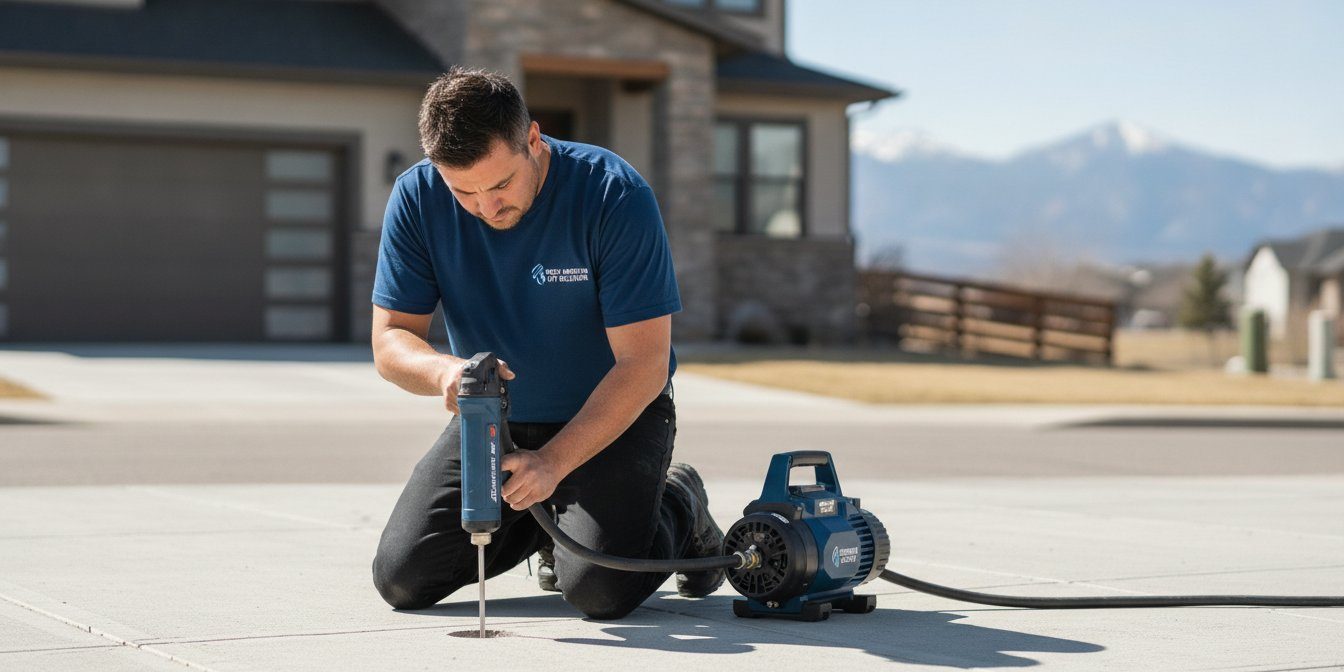
What if you could permanently stabilize a settling driveway without the noise, debris, or heavy machinery required for a total replacement? Most homeowners see a sunken sidewalk or water pooling near their foundation and assume the only remedy is a jackhammer and a costly new pour. It’s a frustrating situation that often leads to procrastination, yet ignoring these tripping hazards only allows soil voids to grow. High density foam concrete lifting has emerged as the professional standard for addressing these issues with surgical precision.
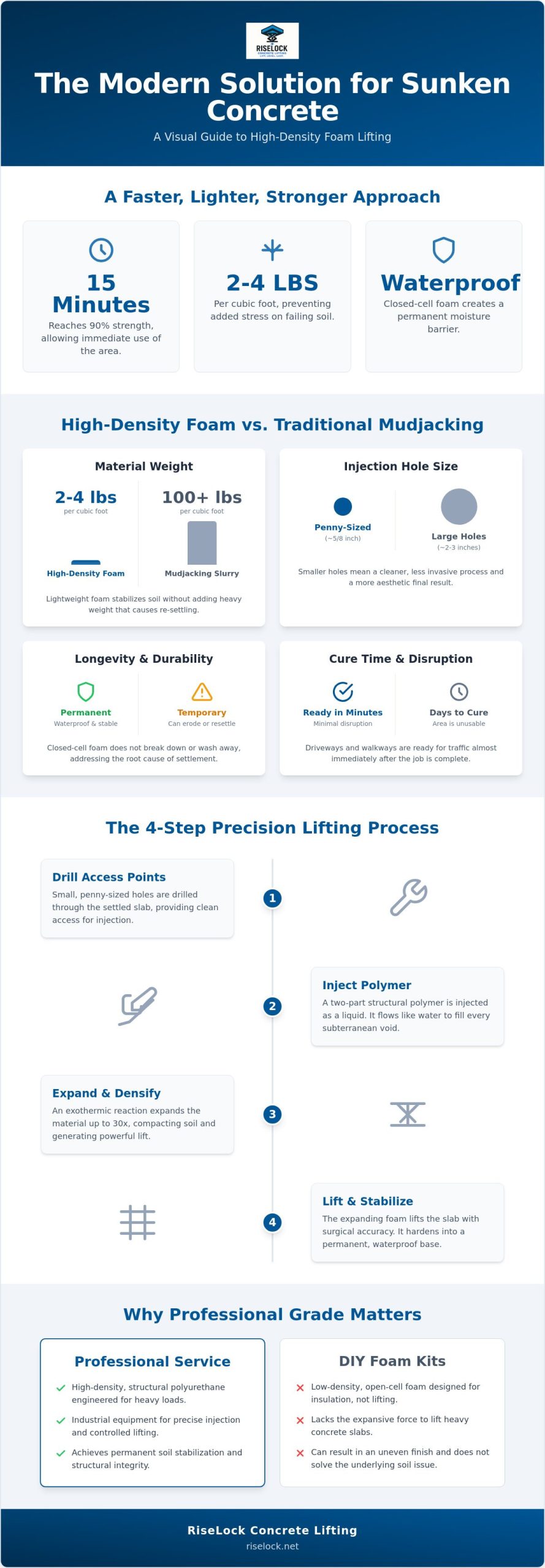
We understand that structural integrity is a personal priority for any property owner. In this guide, you’ll discover how high-density polyurethane foam provides a permanent, non-invasive solution for sunken slabs and long-term stabilization. Unlike traditional methods that add heavy weight to already failing soil, this material weighs only two to four pounds per cubic foot and reaches 90 percent of its strength in just 15 minutes. We will examine the technical advantages of structural polymers, including their impressive compressive strength and water-resistant properties, to help you transition from the stress of damage to the security of a level, safe surface.
Key Takeaways
- Understand how two-part structural polymers provide precise lifting force through a controlled chemical reaction that transitions from liquid to solid.
- Learn why high density foam concrete lifting offers a more permanent fix by avoiding the excessive weight that typically causes traditional mudjacking repairs to fail.
- Discover how expanding polyurethane seeks out and fills subterranean voids to stabilize the ground before the actual lifting process begins.
- Identify the technical advantages of using water-resistant foam to mitigate the impact of Colorado’s expansive bentonite clays and extreme temperature shifts.
- Recognize why professional-grade industrial equipment is necessary to achieve the structural accuracy and slab stabilization that consumer-level DIY products cannot provide.
What is High-Density Foam Concrete Lifting?
High-density foam concrete lifting is a sophisticated geotechnical process that uses two-part structural polyurethane to restore settled slabs to their original position. It’s a method built on precision and chemical engineering. Unlike the single-component foams found in retail hardware stores, this industrial material consists of a specific blend of resin and an isocyanate. When these components meet at the tip of an injection nozzle, they trigger an exothermic chemical reaction. This reaction causes the material to expand rapidly, transitioning from a liquid that fills every tiny soil void into a rigid, high-strength solid. This controlled expansion generates the immense hydraulic-like force required to lift thousands of pounds of concrete with surgical accuracy.
When exploring What is concrete leveling?, it’s clear that while several methods exist, high-density foam has become the preferred choice for modern structural stabilization. The “high density” aspect isn’t just a marketing term; it’s a critical metric. Higher density correlates directly with compressive strength, ensuring the foam can support the weight of vehicles on a driveway or the structural load of a foundation without compressing over time.
The Evolution from Mudjacking to Polyjacking
For decades, the standard approach to slab repair was mudjacking. This process involves pumping a heavy slurry of sand, water, and cement under the concrete. While functional, mudjacking introduces a significant problem: weight. The slurry often exceeds 100 pounds per cubic foot. Adding this much mass to soil that’s already failing frequently leads to secondary settlement, essentially repeating the original problem. The industry’s shift toward lightweight synthetic polymers corrected this fundamental flaw. Professional-grade high density foam concrete lifting uses material that weighs only 2 to 4 pounds per cubic foot, yet it offers the compressive strength necessary to support heavy residential and commercial loads. This evolution allows for smaller injection holes, roughly the size of a penny, and a much cleaner restoration process.
Closed-Cell Technology Explained
The secret to the longevity of this repair method lies in its closed-cell structure. While open-cell foams are designed for insulation and can absorb water like a sponge, closed-cell structural foams consist of tiny, pressurized pockets of gas that are completely sealed. This design ensures the material remains dimensionally stable even in saturated environments. Closed-cell foam acts as an impermeable barrier against moisture. Because it doesn’t absorb water, it won’t wash away, freeze, or degrade over time. This creates a permanent, waterproof foundation that stabilizes the slab and prevents future erosion of the underlying soil.
The Science of the Lift: How Polyurethane Injections Work
The effectiveness of high density foam concrete lifting lies in the precision of the expansion phase. When the two-part polymer is injected beneath a slab, it remains a liquid for only a few seconds. During this brief window, it flows like water, seeking out the path of least resistance to fill every subterranean void and crevice. As the chemical reaction takes hold, the material expands to 20 or 30 times its original liquid volume. This controlled expansion generates significant upward pressure, allowing technicians to lift tons of concrete with remarkable accuracy. This mechanical advantage is well-documented in an Oregon Department of Transportation study, which highlights how injected polyurethane effectively stabilizes and raises highway-grade pavement by addressing the root cause of the settlement.
Speed is one of the most practical benefits of this technology. While traditional cement-based repairs require days to cure, polyurethane reaches 90 to 95 percent of its full compressive strength within just 15 minutes. This means a driveway or garage floor can be returned to full service almost immediately after the technicians pack their equipment. If you are noticing uneven surfaces on your property, a professional assessment of foam concrete lifting can determine the best path forward for your specific soil conditions.
The 4-Step Injection Process
The application is methodical and minimally invasive. It begins with drilling penny-sized access holes through the settled concrete. These small ports serve as the entry points for the injection tapered nozzle. Technicians then deliver the polymer in short, calculated bursts, monitoring the slab’s movement in real-time with laser levels to ensure a perfectly flush finish. Once the lift is complete, the injection ports are cleaned and patched with a matching concrete mixture, making the repair virtually invisible to the naked eye.
Hydrophobic Properties and Soil Displacement
A critical technical advantage often overlooked is the hydrophobic nature of structural polyurethane. Unlike many other materials, this foam is specifically engineered to repel water. If the material encounters groundwater or saturated soil during the injection, it doesn’t dilute or wash away; instead, it displaces the moisture. This creates a “compaction” effect, where the expanding foam pushes against the surrounding soil, increasing its density and load-bearing capacity. This makes high density foam concrete lifting the superior choice for areas prone to poor drainage or seasonal flooding, as it creates a permanent, waterproof foundation that resists future erosion.
High-Density Foam vs. Mudjacking: A Structural Comparison
Selecting the right restoration method requires an understanding of the load-bearing dynamics beneath the slab. Traditional mudjacking has been the industry standard for decades, yet it carries a fundamental structural flaw: excessive weight. By pumping a heavy mixture of sand and cement under a settled surface, mudjacking adds approximately 100 pounds per cubic foot to the subgrade. In contrast, high density foam concrete lifting utilizes a material that weighs a mere 2 to 4 pounds per cubic foot. This stark difference in mass determines whether a repair will last for years or fail within a few seasons.
The aesthetic impact is also significant. Mudjacking requires drilling holes up to two inches in diameter to accommodate the thick slurry. These large patches are often unsightly and difficult to blend with the original concrete. High-density polyurethane requires only 5/8-inch access points, which are easily hidden once the work is complete. Additionally, cured polyurethane is chemically inert and does not leach into the surrounding ecosystem, whereas traditional soil-based slurries remain susceptible to erosion and washout over time.
Weight and the Secondary Settlement Cycle
The primary reason concrete sinks is that the underlying soil can no longer support the weight of the slab. Introducing a heavy cementitious grout creates “overburden,” a term geotechnical engineers use to describe excessive weight that forces further compression of the sub-soil. This often triggers a secondary settlement cycle, where the new repair causes the concrete to sink even deeper than before. Modern foam injection concrete leveling prevents this cycle by providing structural support without the unnecessary mass. By choosing lightweight polymers, you ensure that the subgrade remains stable and the repair remains permanent.
Precision and Control in Leveling
Precision is where modern technology truly outshines legacy methods. High-pressure mud pumps are difficult to control, often leading to over-lifting or “blowouts” where the slurry escapes from the sides of the slab. Polyurethane expansion is predictable and allows technicians to achieve height adjustments within 1/10th of an inch. This level of accuracy is essential for matching existing joints and ensuring proper water drainage away from foundations. The foam reaches 90% of its full structural strength within 15 minutes of injection. This immediate stabilization provides a level of security that traditional methods simply cannot match.
Solving Colorado Soil Challenges with Foam Lifting
The geological landscape of the Colorado Front Range presents a unique set of challenges for structural stability. Property owners from Fort Collins down to Pueblo often face the consequences of highly active soils that shift significantly with the seasons. While previous sections detailed the mechanical advantages of polyurethane, its application in the Colorado climate is where the material truly proves its worth. High density foam concrete lifting is particularly effective here because it addresses the volatile relationship between the slab and the subsurface without adding the massive weight that traditional methods require. This is especially important given the extreme temperature fluctuations in the Front Range, which can lead to rapid freeze-thaw cycles and frost heave. For a deeper understanding of how these regional soil conditions affect structural stability, the definitive guide to concrete slab lifting in Colorado provides a comprehensive examination of the soil mechanics at work beneath Front Range properties.
The Bentonite Factor in Denver and Aurora
Bentonite clay is a primary concern for homeowners in Denver, Aurora, and the surrounding suburbs. This expansive soil behaves like a sponge; it swells significantly when saturated during spring snowmelt and shrinks as it dries during the arid summer months. This constant cycle of movement creates voids and uneven pressure points under concrete surfaces. High-density foam acts as a semi-rigid buffer between the concrete and this volatile soil. For residents in Castle Rock and Parker, where bentonite deposits are notoriously dense, using a lightweight polymer prevents the “punching” effect. This occurs when a heavy slab, often weighed down further by traditional mudjacking, is forced into softened clay, leading to even more severe settlement.
Managing Drainage and Erosion
Effective water management is the most critical factor in maintaining a level surface. In the Front Range, rapid snowmelt and heavy thunderstorms often lead to improper drainage, which is a major part of what causes sunken concrete driveways. When water infiltrates the subgrade, it washes away the supporting material and leaves the slab suspended over a hollow space.
High-density foam is far more effective than simple soil replacement or gravel infill, particularly in the sandy, erodible soils found around Colorado Springs. It seals the under-slab environment by creating a waterproof barrier that redirects water away from the foundation. By filling the entire void and bonding to the underside of the concrete, the foam prevents future erosion from taking hold. If you are dealing with settling surfaces on your property, you can request a structural assessment to determine how polyurethane can stabilize your specific soil profile and protect your investment.
Why Professional High-Density Foam Beats DIY Solutions
The market is currently flooded with retail kits promising a quick fix for uneven sidewalks, but there is a fundamental difference between filling a small void and performing a structural lift. Professional high density foam concrete lifting requires more than just a chemical; it requires specialized industrial proportioners that maintain precise temperature and pressure throughout the injection. Retail cans or hand-held kits lack the hydraulic force necessary to move a multi-ton slab. They often provide just enough expansion to fill a hole without ever addressing the underlying settlement, leaving the property owner with a temporary patch rather than a permanent solution.
Achieving a flush, stable finish involves more than just pointing a nozzle. It requires a deep understanding of soil mechanics and load distribution. Because high density foam concrete lifting is a “one-shot” process, there is no margin for error. Once the material expands and cures, it cannot be easily removed or adjusted. This is why polyurethane concrete lifting requires geotechnical expertise to ensure the pressure is applied exactly where it’s needed to prevent structural failure.
The Danger of Amateur Slab Jacking
Amateur attempts at lifting often lead to permanent damage. If the foam is injected too quickly or in the wrong location, it creates localized stress points. These points of uneven pressure can cause the concrete to fracture, turning a simple settlement issue into a total replacement project. Beyond these physical risks, many DIY foams are formulated for insulation rather than support. They lack the compressive strength required to handle the weight of a vehicle. Over time, these softer materials compress, leading to a repeat of the original sinking problem and wasted investment.
RiseLock Concrete Lifting’s Precision Approach to Concrete Restoration
We view every structural challenge as a personal priority. Our technicians combine technical mastery with the highest industry standards to deliver results that last. This precision is especially critical when working in complex post tension installation environments, where drilling into a hidden cable could compromise the entire building’s integrity. RiseLock Concrete Lifting provides the quiet authority and reliability needed to navigate these technical risks safely, ensuring your property is restored with surgical accuracy.
Restore your concrete today with RiseLock Concrete Lifting’s professional foam lifting.
Securing Your Property’s Structural Future
Choosing a restoration method for your property is a decision that impacts the longevity of your infrastructure. As we’ve examined, high density foam concrete lifting addresses the underlying cause of settlement by re-engineering the soil-to-slab relationship without the burden of excessive weight. By opting for advanced structural polymers over traditional fillers, you ensure that your driveway, sidewalk, or foundation remains stable regardless of the environmental pressures common in the Front Range.
Since 2026, RiseLock Concrete Lifting has served Denver and the surrounding communities as a dependable partner in structural stabilization. Our team specializes in the technical mastery required for both high-density polyurethane and complex post-tension systems, offering a non-invasive, clean approach that yields same-day results. You can Request a Professional Concrete Assessment from RiseLock Concrete Lifting to receive a precise evaluation of your property’s needs. We act as your professional guide, moving you away from the stress of structural damage toward the peace of mind that comes with a permanent, expertly executed fix.
Common Questions About High-Density Polyurethane
Is high-density foam concrete lifting permanent?
Structural polyurethane provides a permanent solution because it is a chemically stable, non-biodegradable polymer. Unlike traditional mudjacking slurry that can erode or shrink, high density foam concrete lifting creates a rigid structure that remains dimensionally stable for the life of the concrete. It effectively seals the soil to prevent future water infiltration and void formation, ensuring the slab remains supported indefinitely.
How much weight can high-density polyurethane foam support?
Industrial-grade lifting foams are engineered to support significant loads, typically offering a compressive strength between 50 and 100 PSI. This capacity is more than sufficient for residential driveways, garage floors, and even heavy commercial vehicle traffic. The material’s ability to distribute weight across a larger surface area reduces the stress on the underlying soil, which prevents the secondary settlement often seen with heavier repair materials.
Will the foam wash away during heavy Colorado rains?
No, the foam is completely hydrophobic and will not wash away or lose its structural integrity when exposed to water. Once the chemical reaction is complete, the material becomes an inert solid that is impervious to moisture. This characteristic is particularly valuable in the Front Range, where seasonal snowmelt and heavy thunderstorms can easily erode traditional soil-based repair materials or mudjacking slurries.
Can I drive on my driveway immediately after foam lifting?
You can typically return your driveway to full service within 15 to 30 minutes of the final injection. Polyurethane reaches approximately 90 percent of its full compressive strength almost immediately upon curing. This rapid turnaround is a primary advantage over cementitious methods, which often require 24 to 48 hours of curing time before they can safely support the weight of a vehicle.
Does high-density foam harm the environment or groundwater?
Cured structural polyurethane is environmentally neutral and does not leach harmful chemicals into the soil or groundwater. The material is chemically inert and stable once it has transitioned from its liquid state to a solid. Many of the high-density foams used in professional applications are formulated to meet strict safety standards, ensuring they remain a responsible choice for both residential properties and municipal infrastructure.
How does the cost of foam lifting compare to replacing the entire slab?
The investment for foam lifting is significantly lower than the cost of a total concrete tear-out and replacement. Industry data indicates that professional leveling typically costs 50 to 80 percent less than a new pour. Beyond the direct financial savings, property owners avoid the additional expenses associated with landscaping repairs and the extended downtime required for new concrete to cure and reach full strength.
Is foam lifting effective for post-tensioned slabs in Denver?
Foam lifting is an ideal solution for post-tensioned slabs because it requires much smaller access holes than traditional methods. The 5/8-inch injection ports significantly reduce the risk of striking a high-tension cable during the drilling process. These projects require specialized technical mastery to ensure the lift is performed evenly without stressing the internal reinforcement system, making it a preferred choice for modern Denver foundations.
What is the difference between 2 lb and 4 lb density foam?
These measurements refer to the weight of the material per cubic foot and directly correlate to its compressive strength. While 2 lb density foam is the standard for most residential sidewalks and driveways, 4 lb density foam is reserved for heavy structural applications or industrial floors. Selecting the correct density is a critical part of the process, ensuring the material can handle the specific load requirements of the project without compressing over time.