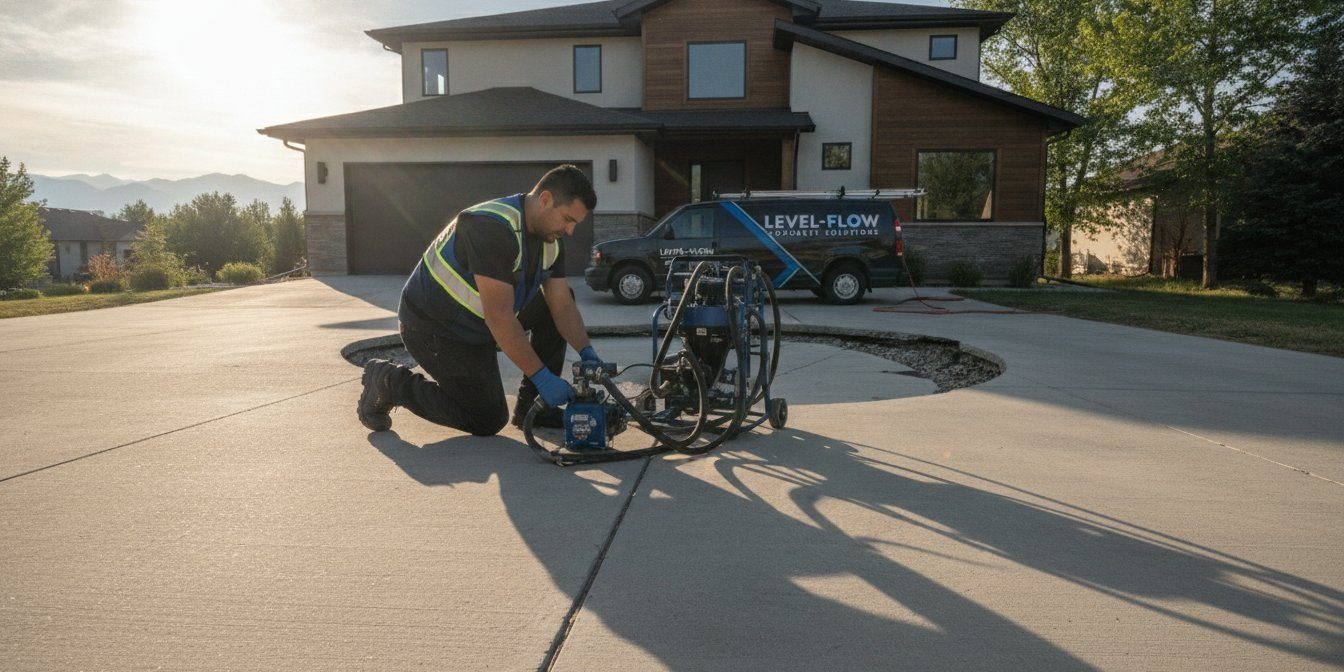
The visible damage on your driveway is rarely the result of poor concrete quality. While it’s common to focus on the surface, understanding what causes sunken concrete driveway issues requires looking several feet underground at the soil structure. You’ve likely noticed an unsettling dip near the garage or pooling water that turns into an icy hazard during the winter. It’s frustrating to watch your property’s aesthetic decline while worrying about trip hazards for your family or potential damage to your vehicle’s suspension.
In regions like Denver, expansive clay soils and shifting moisture levels create hidden voids that leave heavy slabs unsupported. This article will help you identify the root causes of settlement and determine if your situation requires urgent intervention. We’ll also examine how modern, non-invasive technology like polyurethane concrete lifting provides a precise and long-lasting solution to restore your home’s structural integrity and peace of mind. By addressing the subgrade failure directly, you can protect your property value and ensure a safe environment for your guests.
Key Takeaways
- Understand that concrete stability depends entirely on the subgrade and how subsurface voids lead to structural settlement.
- Identify what causes sunken concrete driveway failure by examining the roles of poor soil compaction and hydraulic erosion.
- Learn why Colorado’s expansive clays and semi-arid climate accelerate the “shrink-swell” cycles that destabilize residential slabs.
- Recognize the urgency of repair to mitigate trip hazard liabilities and prevent water from being diverted toward your home’s foundation.
- Discover why lightweight polyurethane concrete lifting provides a precision solution that restores your driveway without the risks of secondary sinking.
The Mechanics of Settlement: Why Concrete Slabs Sink
Concrete is a remarkably durable material, but its strength is deceptive. While a driveway appears to be a solid, immovable mass, its structural integrity depends entirely on the soil beneath it. When homeowners investigate what causes sunken concrete driveway issues, they often focus on the surface of the slab. However, the true failure occurs in the subgrade. Structural settlement is the technical term for the downward movement of the ground, which leads to a critical loss of support for the heavy concrete above. When the soil can no longer bear the load, gravity inevitably pulls the slab downward.
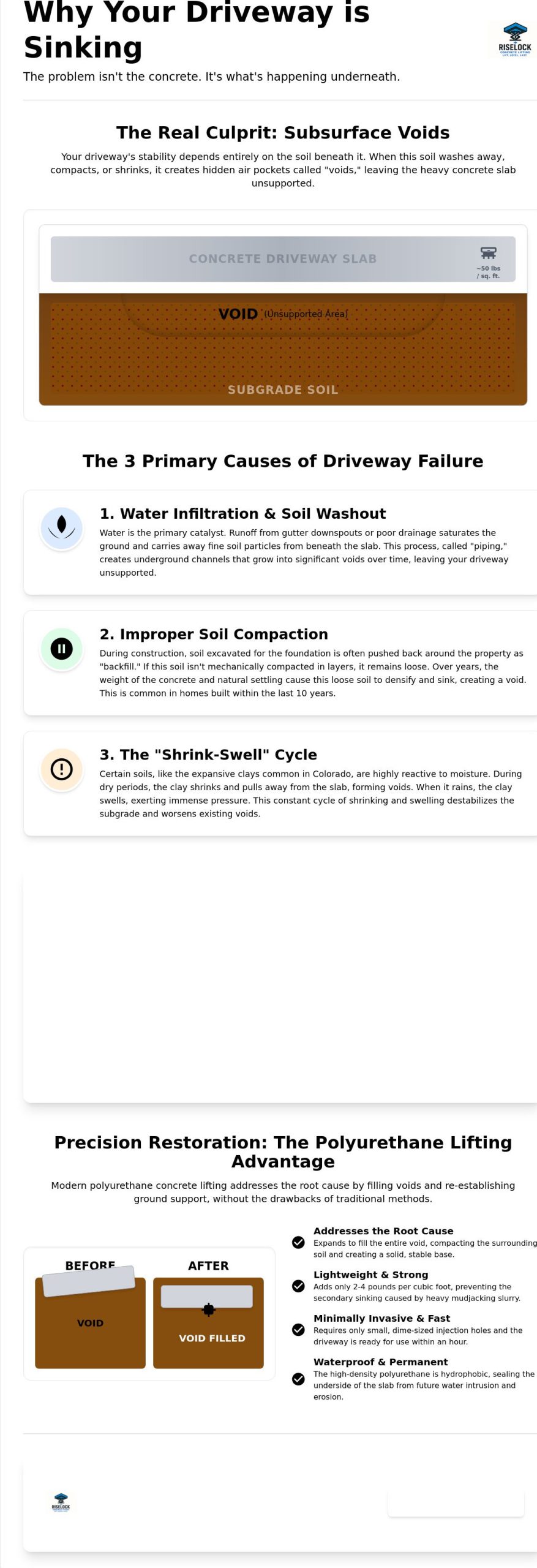
This process typically begins with the formation of a “void.” A void is an air pocket that develops between the bottom of the concrete and the top of the soil. These pockets occur when soil washes away, shrinks, or was never properly compacted during construction. Once a void exists, the concrete is no longer resting on a solid foundation; it is essentially hanging in mid-air. Because concrete has high compressive strength but relatively low tensile strength, it cannot support its own weight over an empty space for long. Eventually, the density of the underlying soil becomes the deciding factor in whether the driveway stays level or begins to fail.
The Relationship Between Slab Weight and Soil Support
To understand the physics of a sinking driveway, you must consider the sheer mass of the material. A standard four-inch thick concrete driveway slab weighs approximately 50 lbs per square foot. For a typical two-car driveway, this translates to tens of thousands of pounds pressing down on the earth. In the early stages of subsurface failure, you might benefit from a “bridging” effect. This occurs when the concrete temporarily spans a small void without breaking, much like a bridge. However, as the void grows, the weight of the slab exceeds its ability to bridge the gap, leading to the first structural cracks. Subgrade stability is the foundation of all concrete longevity.
Surface Symptoms vs. Subsurface Reality
It is important to distinguish between minor cosmetic issues and true structural failure. A crack in your driveway is often just the messenger for a deeper subsurface problem. While hairline shrinkage cracks are common and usually occur shortly after the concrete is poured, structural settlement cracks are different. These cracks typically show a vertical offset, where one side of the crack is higher than the other. If you notice your driveway is tilting toward the garage or if a corner is physically lower than the surrounding grass, you are likely dealing with a significant void. Identifying what causes sunken concrete driveway movement early can prevent the slab from breaking into smaller, unrepairable fragments.
The Big Three: Primary Causes of Driveway Failure
Identifying the specific triggers for slab failure is the first step toward a permanent fix. While the mechanical weight of the concrete is constant, the variables that destabilize the ground beneath it are often preventable or predictable. Understanding what causes sunken concrete driveway issues involves looking at three primary environmental and human factors: hydraulic erosion, structural compaction errors, and seasonal moisture cycles. By pinpointing the source of the movement, we can implement a restoration strategy that addresses the root problem rather than just the surface symptoms.
Water Infiltration and Soil Washout
Water is the most persistent catalyst for driveway failure. When gutter downspouts discharge directly near the edge of a slab, the water seeks the path of least resistance, which is often the loose soil beneath the concrete. This leads to a process called “piping,” where underground channels form as water carries away the “fines” or smaller particles of the soil. Over time, these channels expand into large voids. Slab sinking is frequently cited in engineering documents as one of the primary Types of Rigid Roadbed Failures, typically resulting from this base failure. Additionally, hydrostatic pressure from trapped water can exert upward force on the slab, destabilizing its position before the water eventually drains and leaves behind a hollow, unsupported space.
Improper Compaction During Construction
It’s a common misconception that older driveways are more prone to sinking. In reality, homes built within the last 10 years often experience more rapid settlement. This is usually due to the “backfill” process used during residential construction. When a home is built, the soil excavated for the foundation is later pushed back into place around the garage and driveway areas. If this soil isn’t professionally tamped using heavy machinery, it remains loose and full of air pockets. As you drive heavy vehicles over these sections, the weight accelerates the natural settling of the uncompacted earth. If you notice early signs of dipping or uneven edges, a professional concrete leveling service can stabilize the area before the slab fractures under its own weight.
Beyond water and construction errors, natural cycles play a significant role in driveway longevity. Tree roots can grow beneath the slab, physically lifting sections or creating large gaps as they eventually decay. Similarly, the constant cycle of soil shrinking during dry spells and swelling during heavy rains creates a rhythmic movement that gradually compromises the density of the subgrade. This is particularly common in areas with high clay content, where the soil acts like a sponge, expanding and contracting with every season. Rather than accepting costly demolition, many homeowners are discovering that foam injection concrete leveling can address these recurring soil voids with a permanent, surgical solution that restores the original slab height.
The Colorado Factor: Why Denver Driveways Sink Faster
Geography plays a decisive role in the lifespan of your pavement. While general erosion and poor compaction are universal issues, homeowners along the Front Range face a unique set of geological challenges. When investigating what causes sunken concrete driveway failure in this region, the answer often lies in the specific composition of the soil. The Rocky Mountains have influenced the local terrain for millennia, leaving behind a high concentration of bentonite and expansive clays that behave very differently than the sandy or loamy soils found in other parts of the country.
Denver’s semi-arid climate further complicates these geological factors. The region experiences extreme cycles of moisture followed by periods of intense drought. This creates a volatile environment for any heavy structure resting on the surface. Because the soil is rarely stable for long, the concrete is subjected to constant movement that eventually leads to structural failure. Understanding these local variables is essential for choosing a repair method that can withstand the specific demands of the Colorado landscape.
Expansive Clay and Bentonite Issues
The clay found from Denver to Colorado Springs acts much like a high-density sponge. When it rains or snow melts, these clay particles absorb water and expand significantly. This expansion creates an upward force called “heave,” which can physically lift a driveway slab several inches. Conversely, during our hot, dry summers, the moisture evaporates and the soil shrinks back down. This repetitive shrink-swell cycle can cause repetitive 2-inch movements in the subgrade. Over time, the soil loses its original density and creates the very voids that lead to a sunken driveway. Homeowners often notice their driveways “heave” in the wet spring months and “sink” by late summer as the subgrade retreats.
The High-Altitude Freeze-Thaw Cycle
Denver’s famous 300+ days of sun are a double-edged sword for concrete longevity. During a typical winter day in cities like Aurora, Parker, or Castle Rock, the intense high-altitude sun melts snow and ice quickly. This water seeps into every available crack and pore in the concrete. However, once the sun sets, temperatures often drop well below freezing. This causes the trapped water to expand as it turns into ice, a process known as the “jacking” effect. These ice lenses form directly beneath the slab, pushing against the concrete with immense pressure. The rapid temperature swings common in the Front Range accelerate this damage, making it a primary factor in what causes sunken concrete driveway issues for local residents.
The Danger of Delay: When Sinking Becomes a Liability
Ignoring a sinking slab is a gamble that rarely pays off. While you may have identified what causes sunken concrete driveway issues on your property, the transition from a cosmetic nuisance to a structural liability happens quickly. When concrete settles, it creates uneven surfaces that pose significant safety risks to residents and visitors alike. According to Americans with Disabilities Act (ADA) standards, a vertical displacement of just 1/4 inch is considered a trip hazard. On a residential property, these offsets can lead to legal liability if a guest or delivery driver is injured on your premises.
There is also a “point of no return” for every slab. If the settlement is left unaddressed, the concrete will eventually fracture into small, unstable pieces that can no longer be lifted. Once the structural integrity of the slab is compromised to this degree, the only option is a full tear-out and replacement. This process is far more expensive and disruptive than a precision stabilization. Acting early preserves the existing material and prevents the need for heavy demolition equipment on your lawn.
Foundation Risks and Water Management
The most severe consequence of delay is the creation of a “negative grade.” This occurs when the driveway sinks toward the garage or the home’s main structure, effectively turning the pavement into a funnel for rainwater and snowmelt. In neighborhoods across Centennial and Lakewood, this redirected water often bypasses original drainage systems and pools against foundation walls. Over time, this moisture can lead to flooded basements, mold growth, or even structural cracks in the foundation itself. A $1,500 driveway fix can prevent a $20,000 foundation repair. Addressing the problem early ensures that water is diverted away from your home, maintaining the integrity of your most valuable asset. To further protect your property’s exterior, you may also want to explore Residential Roof Replacement to ensure your home is shielded from the top down.
Liability and Curb Appeal
Beyond the structural risks, sunken concrete significantly diminishes your home’s marketability. Real estate professionals often note that curb appeal is the first thing buyers evaluate, and uneven slabs signal a lack of maintenance. Home inspectors will flag these areas as safety hazards, often requiring repairs before a sale can proceed. Attempting to “patch” the gaps with asphalt or mortar is a temporary measure that looks unprofessional and fails within a single season. If you notice your driveway beginning to dip, seeking professional concrete repair now will save you from the high costs of total replacement later. Understanding what causes sunken concrete driveway movement allows you to act with precision before the damage becomes irreversible.
Precision Restoration: Why Polyurethane is the Superior Fix
Restoring a sinking driveway requires a solution that addresses the original subgrade failure without compounding the problem. Traditional methods like mudjacking often involve injecting a heavy slurry of sand, cement, and water beneath the slab. While this may temporarily lift the concrete, adding 100 lbs or more of material per cubic foot can actually accelerate secondary sinking. If the underlying soil was already struggling to support the concrete, adding the weight of a heavy slurry often causes the entire section to settle again. Modern polyurethane concrete lifting solves this by using a high-density foam that is incredibly strong yet weighs only a fraction of traditional fill materials.
This lightweight nature is the primary reason why specialized foam is the preferred choice for modern structural repair. It allows for the stabilization of the slab without putting additional stress on the fragile subgrade. Beyond the weight advantage, the speed of the process is a significant benefit for the homeowner. While traditional repairs might require you to stay off your driveway for 24 hours or more, you can typically drive on a polyurethane-stabilized slab in as little as 15 minutes after the injection is complete.
Polyurethane vs. Traditional Mudjacking
The differences between these two methods extend beyond just weight and speed. Polyurethane is a hydrophobic material, meaning it does not absorb water and will not wash away during heavy rain or snowmelt cycles. This is a critical advantage when you consider what causes sunken concrete driveway issues in the Front Range, where moisture fluctuations are constant. Traditional mudjacking slurry can eventually erode or shrink, leading to the return of the original void. Polyurethane remains chemically stable and maintains its volume for decades. For a deeper technical understanding of how this process works, our complete guide to foam concrete lifting explains the precision engineering behind modern polymer injection and why it is the only logical choice for Colorado’s shifting ground.
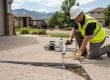
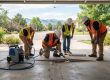
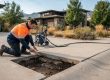
The “mess factor” is also significantly reduced with modern foam. Instead of heavy trucks and large hoses running through your yard, the material is delivered through a small, specialized hose. This method requires only penny-sized injection holes, which are far less invasive than the two-inch holes required for mudjacking. These small access points are easily patched and become virtually invisible once the job is complete, preserving the aesthetic value of your property. For homeowners looking to maintain this high standard of property care, specialized exterior cleaning from companies like Snugs Services can ensure that every surface remains in peak condition.
The RiseLock Approach to Structural Integrity
We prioritize precision and technical mastery in every restoration project. Our high-density foam expands to fill the specific voids identified during our assessment, restoring the original pitch of the slab to ensure proper water drainage away from your garage and foundation. This precision is essential for long-term security. A well-maintained driveway can increase a home’s value by up to 10%, according to industry statistics, making professional restoration a sound investment. If you’re ready to secure your home’s foundation and eliminate safety hazards, schedule your free concrete inspection with RiseLock today.
Securing Long-Term Structural Stability
Understanding what causes sunken concrete driveway failure is the first step toward protecting your home’s value and safety. We’ve examined how subsurface voids, driven by Colorado’s expansive clays and hydraulic erosion, compromise the ground beneath your heavy slabs. While these issues are common along the Front Range, they don’t have to lead to a costly full replacement. By identifying the root cause of the settlement early, you can prevent secondary damage to your foundation and eliminate dangerous trip hazards before they become a legal liability.
RiseLock provides a modern, non-invasive approach to restoration. As a locally owned and operated Denver business, we specialize in high-precision polyurethane foam injection that stabilizes the soil without adding unnecessary weight to the subgrade. This technical mastery ensures your driveway remains level and functional for years to come. Don’t let subsurface failure dictate the safety of your property. Get a Free Estimate for Precision Concrete Lifting today and experience the peace of mind that comes with professional structural stabilization. Your property’s integrity is our priority.
Frequently Asked Questions
How do I know if my driveway is sinking or just cracked?
Sinking is characterized by vertical displacement where one section of concrete sits lower than the adjacent slab. While surface cracks can be cosmetic results of shrinkage or age, settlement creates uneven joints and “negative grades” that slope toward your home. If you notice a trip hazard or water pooling in specific areas, the issue is likely a subgrade failure rather than a simple surface crack.
Can a sunken driveway cause foundation problems in my house?
Yes, a sunken driveway frequently acts as a funnel that directs rainwater and snowmelt toward your home’s foundation. This concentrated moisture creates hydrostatic pressure against your foundation walls, which can lead to basement leaks, mold growth, or structural cracking. Addressing the driveway’s pitch early is a critical step in protecting the overall structural integrity of your home.
Is it cheaper to lift concrete or replace it entirely?
Concrete lifting is significantly more cost-effective than a total replacement. A full replacement requires expensive demolition, hauling away old material, and the labor-intensive process of pouring and curing new slabs. Lifting utilizes your existing concrete and stabilizes the subgrade for a fraction of the cost, making it the more efficient and sustainable choice for most homeowners.
What is the best time of year in Colorado to fix sunken concrete?
You can perform concrete lifting year-round in Colorado as long as the ground isn’t deeply frozen. Many homeowners choose the spring or fall to address what causes sunken concrete driveway issues before extreme winter freeze-thaw cycles or heavy summer rains exacerbate existing voids. Fixing the problem during these seasons prevents further soil erosion during the most volatile weather months.
How long does polyurethane concrete lifting actually last?
Polyurethane foam is an inert, permanent material that does not degrade, rot, or wash away over time. Once the high-density foam expands and cures beneath the slab, it provides a stable foundation that typically lasts for the remaining life of the concrete. Unlike traditional fill materials, it maintains its volume and structural strength regardless of environmental changes.
Will the foam used to lift my driveway wash away during heavy rain?
No, the high-density polyurethane used for structural lifting is hydrophobic, meaning it repels water. It is specifically engineered to maintain its integrity in wet conditions. Unlike traditional mudjacking slurry, which can erode or shrink when exposed to moisture, the foam creates a water-resistant barrier that stays firmly in place even during heavy Colorado rainstorms.
Can I drive my SUV or RV on the driveway immediately after lifting?
You can typically drive a standard SUV on your driveway within 15 to 30 minutes of the injection process. The material reaches nearly full compressive strength almost instantly after curing. For exceptionally heavy loads like a large RV, we may recommend waiting a short additional period to ensure the subgrade has fully stabilized under the new support structure.
Does insurance cover a sunken concrete driveway?
Most standard homeowners’ insurance policies do not cover concrete settlement, as insurance providers generally categorize it as a maintenance issue or normal wear and tear. Settlement caused by gradual soil movement or poor compaction is typically excluded from coverage. It’s always advisable to review your specific policy or speak with your agent to confirm your coverage details.