
Your home’s foundation isn’t just a static block of concrete; it’s a high-tension mechanical system holding thousands of pounds of pressure in check. When these internal steel cables are compromised, the results can be far more sudden and severe than traditional foundation issues. It’s common for homeowners to feel overwhelmed by the technical complexity of these systems or the potential costs of cable restoration. You want to know if that hairline fracture is a simple cosmetic fix or one of the serious signs of post tension slab damage that requires expert intervention.
We’ll provide you with a clear, professional framework to identify critical warning signs and understand the mechanics of slab failure. You’ll learn how to spot early indicators like “cone-outs” or cable corrosion before they escalate into dangerous blowouts. RiseLock Concrete Lifting offers the technical clarity you need to move from uncertainty to a position of informed security, helping you protect your property’s integrity against the expansive soils common in Denver and Colorado Springs. By understanding the why behind the how, you can ensure your home remains a stable and secure asset for decades.
Key Takeaways
- Learn to distinguish between benign cosmetic cracks and the critical signs of post tension slab damage that indicate internal cable stress.
- Identify why rust stains on slab edges or stair-step patterns in masonry are immediate indicators of tendon corrosion and structural vulnerability.
- Understand the mechanics of a cable blowout and why sudden auditory cues, such as a gunshot sound, signal an urgent need for professional intervention.
- Discover how the expansive bentonite soils of the Colorado Front Range create unique upward pressures that can compromise even the most robust foundations.
- Explore specialized diagnostic tools like Ground Penetrating Radar that reveal hidden structural failures invisible to standard home inspections.
Understanding Post-Tension Slabs: Why Damage is Unique
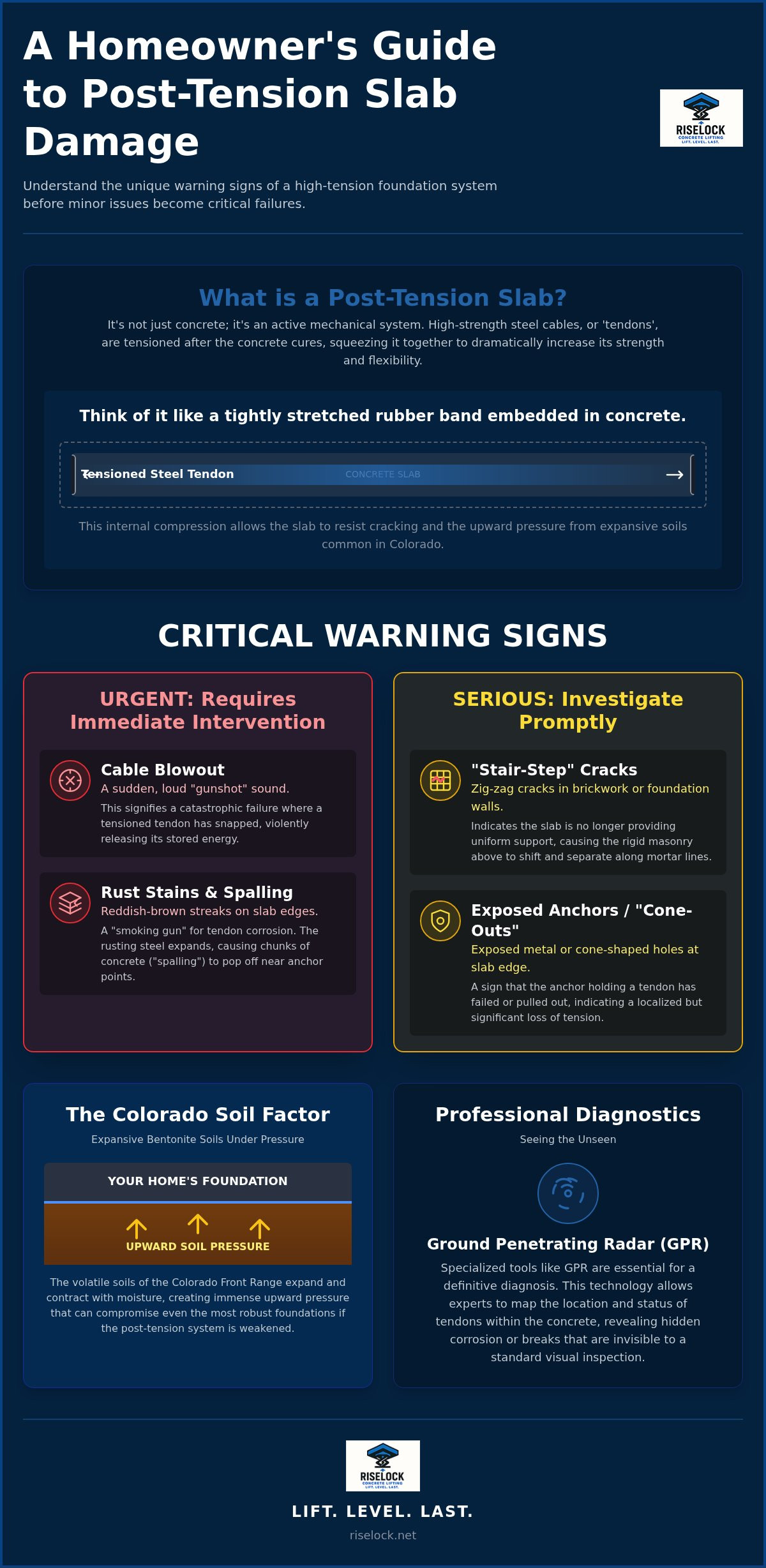
Post-tensioning is a sophisticated method of creating prestressed concrete, a technique that allows engineers to build thinner, more flexible slabs that can withstand the volatile soil conditions of the Front Range. Unlike traditional reinforced concrete that relies on passive steel rebar, a post-tensioned slab is an active mechanical system. It uses high-strength steel tendons that are stressed to immense levels of tension after the concrete has cured. This process essentially squeezes the concrete together, dramatically increasing its tensile strength and preventing the structural cracks that often plague standard foundations. Because of this high-pressure environment, the signs of post tension slab damage are markedly different from those found in traditional masonry.
At RiseLock Concrete Lifting, we prioritize precision in post tension installation to ensure these systems function exactly as designed. When a standard rebar slab fails, it typically does so through gradual cracking and settling. In contrast, a post-tension failure involves the release of stored mechanical energy. Think of the slab like a heavy-duty rubber band held under extreme tension. If the band remains intact, the system is incredibly strong. If the band is nicked or corroded, the stored energy can release violently. This means that when a tendon is compromised, the failure can be sudden, loud, and potentially hazardous to the building’s structural integrity.
The Role of Steel Tendons and Anchors
The heart of the system lies in the interaction between the steel tendons and the anchors located at the slab’s perimeter. These anchors are the terminal points that hold the tensioned cables in place. To protect the steel from the elements, each tendon is encased in a plastic sheathing and coated in a specialized corrosion-inhibiting grease. The integrity of this grease and sheathing is paramount. If moisture penetrates the sheath, the resulting oxidation can weaken the steel, leading to a catastrophic loss of tension. When the protective barrier fails, the anchor can no longer hold the load, which is often the primary cause of localized foundation failure.
Unbonded vs. Bonded Systems
Most residential projects in Colorado utilize unbonded systems. In an unbonded slab, the tendons aren’t permanently glued to the concrete; they are free to move within their protective sheathing. This flexibility is what allows the slab to breathe and resist expansive soil pressure. However, it also creates a unique vulnerability. If an unbonded cable snaps due to corrosion or mechanical stress, it can retract through the entire length of the slab, potentially erupting from the anchor point. Bonded systems, which are more common in heavy commercial bridges or high-rises, involve grouting the tendons directly into the concrete to localize damage if a break occurs. Recognizing the signs of post tension slab damage in unbonded residential systems is critical because the failure of a single cable can impact the stability of the entire foundation.
Visible Warning Signs: From Surface Cracks to Rust Stains
Identifying the signs of post tension slab damage requires a keen eye for detail and an understanding of how these foundations interact with the surrounding structure. While all concrete is prone to minor settling, certain visual anomalies serve as early warnings of internal distress. One of the most common indicators is the presence of “stair-step” cracks in foundation walls or the brickwork directly above the slab. These patterns often suggest that the slab is no longer providing uniform support, causing the rigid masonry above to shift and separate along mortar lines. When the slab loses its ability to squeeze the concrete together, the building’s exterior is usually the first place to show the strain.
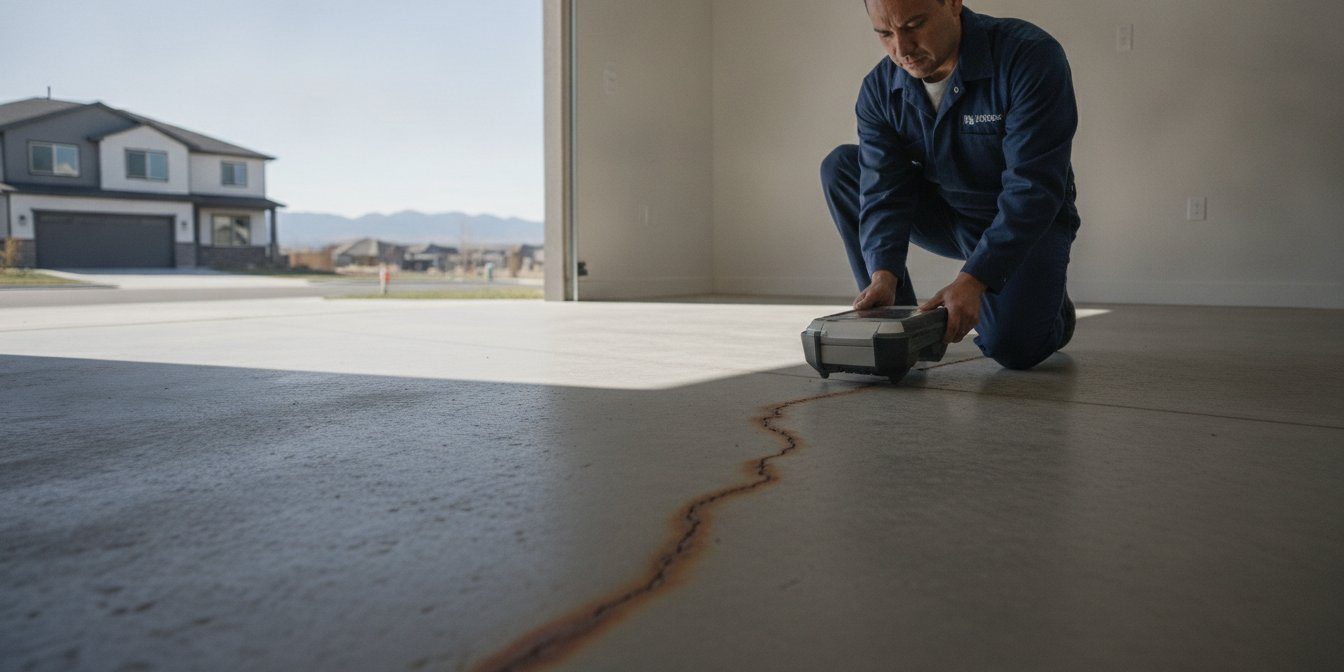
Rust stains appearing on the edge of the slab are a “smoking gun” for tendon corrosion. These reddish-brown streaks indicate that water has reached the high-strength steel, causing it to oxidize and expand. This expansion puts immense internal pressure on the concrete, often leading to spalling, where chunks of concrete literally pop off near the anchor points. If you see exposed metal or chunks of concrete missing from the slab’s edge, it’s a sign that the protective environment around the cable has been compromised. Addressing these issues early through professional concrete repair can prevent the damage from migrating deeper into the foundation’s core.
Analyzing Cracking Patterns
Not all cracks are created equal. Horizontal cracks often point to soil pressure issues, while vertical cracks might indicate simple shrinkage. However, diagonal cracks that run perpendicular to the direction of the internal tendons are particularly concerning. These suggest that the tensioned cables are failing to hold the concrete in compression. If you notice cracks that are significantly wider at one end than the other, it often indicates a localized failure where a cable anchor may have slipped or lost tension entirely. Understanding these nuances is a key part of the evaluation and repair of existing post-tensioned concrete structures.
The Danger of Moisture and Efflorescence
Moisture is the primary enemy of a post-tensioned system. When water migrates through the concrete, it often leaves behind efflorescence, which appears as white, powdery salt deposits on the surface. Efflorescence is a clear precursor to internal steel corrosion, signaling that moisture is actively moving through the concrete matrix. As water reaches the steel, the resulting oxidation takes up more space than the original metal, creating internal “jacking” forces that can eventually snap the cable. Watching for these mineral deposits is a simple way to gauge the moisture levels affecting your slab’s health.
- Stair-step cracks: Signal uneven support and masonry stress.
- Rust streaks: Indicate active corrosion of high-strength steel tendons.
- Spalling: Concrete popping off near anchors due to internal pressure.
- Efflorescence: White powdery deposits that warn of moisture intrusion.
Mechanical Failures: Identifying Post-Tension Cable Blowouts
A post-tension cable blowout represents the most severe and dramatic of all signs of post tension slab damage. Unlike the slow, silent progression of a settling crack, a blowout is a high-energy event that occurs when a steel tendon snaps while under its immense design load. Homeowners often report a sudden, startling sound similar to a gunshot or a heavy explosion coming from beneath the floor or the exterior of the home. This noise is the sound of the steel cable recoiling within its plastic sheath, instantly releasing the mechanical energy that was previously holding the concrete in compression.
Physically, a blowout often leaves behind a distinct “cone-out” or circular crater on the edge of the foundation. This happens when the anchor head, no longer held by the tensioned steel, erupts through the concrete and the protective grout plug. While a single broken cable might not cause an immediate collapse, it significantly compromises the load-bearing capacity of the surrounding area. Each cable is part of a calculated grid; when one fails, the neighboring cables must absorb the extra stress. This loss of compression means the concrete is now susceptible to the very tensile forces the system was designed to prevent, often leading to rapid structural deterioration in that specific zone.
Exposed Tendons and Loose Cables
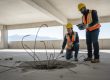
If you discover a steel strand protruding from your foundation wall, the system has reached a critical state of failure. These exposed tendons are often the result of a snap where the cable has fully retracted and pushed through the anchor point. You must treat these cables with extreme caution. The risk of recoil damage is high. A cable under partial tension can move with enough force to damage nearby structures or cause serious physical injury. Never attempt to cut, pull, or re-tension a loose cable yourself. These repairs require specialized hydraulic equipment and technical mastery to safely restore the slab’s integrity without causing further damage.
Anchor Head Displacement
Properly maintained slabs have grout-filled “pockets” along the perimeter where the cables were originally stressed. If you notice these grout plugs are missing, cracked, or if the anchor head appears to have “sunk” into the concrete, the tendon’s grip is failing. Anchor head displacement is a subtle but dangerous indicator that the internal mechanics of the slab are shifting. At RiseLock Concrete Lifting, we specialize in broken post tension cable repair. We use high-precision techniques to secure the anchors and restress the system, ensuring the slab returns to its original structural capacity. Identifying these shifts early allows us to stabilize the foundation before a full, violent blowout occurs.
- Auditory Cues: Sudden loud bangs or “gunshot” sounds.
- Coning: Circular craters on the slab edge where an anchor has erupted.
- Protruding Steel: Visible cable strands sticking out of the foundation.
- Missing Grout: Empty or damaged anchor pockets on the slab perimeter.
Secondary Indicators: How Colorado Soil Impacts Slab Stability
The geology of the Colorado Front Range presents a unique challenge for residential foundations. In communities like Parker and Castle Rock, the presence of bentonite and expansive clay soils means that the ground beneath your home is constantly shifting. When these clays absorb moisture, they expand with significant force, creating a phenomenon known as “heave.” This upward pressure can stress even the most robust foundations, eventually manifesting as visible signs of post tension slab damage. Proper drainage is essential in these regions. Without it, concentrated moisture leads to localized soil swelling that forces the slab out of its original plane. In areas like Castle Rock, where steep grades are common, poor gutter management can dump hundreds of gallons of water directly against the foundation, triggering the expansive properties of the soil.
When a slab undergoes heave, homeowners often notice “crowning,” where the center of a room feels higher than the perimeter. Alternatively, the floor may begin to slope toward one side of the structure. These shifts aren’t just aesthetic concerns; they indicate that the internal tensioned cables are being subjected to bending forces they weren’t primarily designed to handle. If you suspect your foundation is shifting due to soil movement, you can schedule a professional structural assessment to determine the extent of the deflection. Identifying these signs of post tension slab damage early allows for stabilization before the mechanical integrity of the tendons is permanently compromised.
Sloping Floors and Interior Distress
Sticking doors and windows are frequently the first indicators of slab deflection. As the foundation moves, the rigid frames of your home’s openings become misaligned, making them difficult to operate. You can use a standard carpenter’s level to check for floor variance, but significant movement is often mirrored in the interior finishes. Diagonal drywall cracks radiating from the corners of door frames or windows are classic symptoms of the foundation movement occurring below. These cracks typically follow the direction of the stress, widening as the slab continues to shift away from its level position.
The Role of Polyurethane in Slab Stabilization
Stabilizing the underlying soil is a critical first step in preventing further stress on the internal cable system. We utilize polyurethane concrete lifting to address sunken or unlevel sections with surgical precision. High-density foam provides a lightweight, durable alternative to traditional mudjacking. We avoid traditional mudjacking because it adds significant weight to the soil, which can actually exacerbate the heave issues common in Front Range clays. By injecting this stabilizing material, we can fill voids and restore the slab’s level without the invasive demolition required by traditional methods.
Next Steps: Professional Evaluation and Repair Strategies
Visual inspections are a vital first step, but they rarely tell the complete story of a foundation’s internal health. Standard home inspectors often lack the specialized training required to differentiate between benign shrinkage cracks and the technical signs of post tension slab damage. Because these systems are encased in concrete, the most critical failures remain hidden from the naked eye until a blowout occurs. To gain a definitive understanding of your slab’s condition, we utilize Ground Penetrating Radar (GPR). This non-destructive testing method allows our technicians to peer through the concrete matrix, mapping the exact location of steel tendons and identifying internal voids or snapped cables without invasive drilling.
Once a failure is confirmed, the strategy shifts toward precision restoration. We employ several advanced methods to return the slab to its design capacity. Epoxy injection is used to seal structural cracks, preventing the moisture intrusion that leads to tendon oxidation. For snapped cables, we perform cable splicing and re-tensioning, a process that involves uncovering the broken ends, joining them with specialized couplers, and using hydraulic jacks to restore the original tension. As a leader in concrete repair and structural restoration, we focus on solutions that address the root cause of the failure rather than simply masking the symptoms.
When to Call a Structural Engineer vs. a Contractor
For major structural failures or complex heave issues, we often recommend obtaining a third-party engineering report. A structural engineer provides an unbiased diagnostic assessment, while RiseLock provides the technical mastery to execute the repair plan. This partnership ensures that every intervention is backed by sound data and professional accountability. Taking immediate action when you first notice distress can save you thousands in long-term structural costs. Ignoring a compromised cable only increases the load on the rest of the system, accelerating the timeline for a more catastrophic failure.
The RiseLock Approach to Post-Tension Mastery
Our commitment to technical precision defines our work throughout the Denver Metro and Colorado Springs areas. We don’t rely on outdated methods that can further stress a delicate post-tensioned system. Instead, we utilize modern materials for concrete lifting and leveling, such as high-density polyurethane, to stabilize the soil without adding unnecessary weight to the foundation. This approach ensures your home remains secure against the challenges of Colorado’s expansive soils. If you’ve identified potential signs of post tension slab damage, don’t wait for the situation to escalate. Schedule a professional inspection for your post-tension foundation today to ensure your home’s long-term safety and structural integrity.
- GPR Scanning: Locates hidden cable breaks with high-frequency radar.
- Cable Splicing: Restores the mechanical “squeeze” of the foundation.
- Epoxy Sealing: Creates a waterproof barrier against tendon corrosion.
- Soil Stabilization: Uses polyurethane to prevent future slab deflection.
Restoring Confidence in Your Foundation’s Integrity
Maintaining a post-tensioned foundation requires a shift in perspective. You aren’t just managing concrete; you are overseeing a complex mechanical system that balances immense internal forces. By learning to identify the early signs of post tension slab damage, such as perimeter rust stains or interior floor crowning, you can address vulnerabilities before they manifest as violent cable blowouts. Understanding how the expansive Front Range soils interact with these tendons is the first step toward long-term structural security.
Professional intervention provides the precision necessary to stabilize these high-stakes systems. As specialized post-tension repair experts serving the Denver Front Range and Colorado Springs, we combine technical mastery with advanced polyurethane leveling technology to restore your slab’s performance. You don’t have to navigate the stress of foundation failure alone. Protect your foundation with a professional RiseLock inspection today. Our team is ready to provide the clarity and specialized care your home deserves.
Frequently Asked Questions
Can a post-tension slab be repaired once a cable snaps?
Yes, a snapped cable can be professionally repaired using specialized splicing and re-tensioning techniques. Our technicians locate the broken ends, install a coupler, and use hydraulic equipment to restore the original tension levels. This process returns the slab to its intended structural capacity and prevents the surrounding cables from overstressing due to the localized loss of compression.
Is it normal for a post-tension foundation to have small cracks?
Small hairline cracks caused by concrete shrinkage are common in many foundations, but post-tensioned slabs are specifically designed to remain in compression to prevent significant cracking. If you observe cracks that are wider than a credit card or those that run perpendicular to the direction of the tendons, these are likely signs of post tension slab damage. These patterns suggest the internal compression is failing to hold the concrete matrix together.
How much does it cost to fix a broken post-tension cable in Denver?
The cost to repair a broken post-tension cable in the Denver area varies based on the location of the break and the accessibility of the anchor points. Factors such as whether the repair requires interior floor removal or exterior excavation will influence the final scope of work. We provide technical assessments to determine the most efficient restoration strategy for your specific foundation’s needs.
What is the “gunshot” sound people hear with post-tension slabs?
The “gunshot” sound is the auditory signature of a high-strength steel tendon snapping under thousands of pounds of pressure. When the steel fails, the stored mechanical energy is released instantly, causing the cable to recoil violently within its plastic sheath. This sound is a definitive indicator of a major mechanical failure that requires immediate professional evaluation to prevent further structural shifting.
How can I tell if my slab is post-tensioned or standard rebar?
You can typically identify a post-tensioned slab by looking for grout-filled “pockets” along the exterior edge of your foundation. These circular or rectangular plugs cover the anchor points where the cables were originally stressed. Many homes also have a stamped warning in the garage floor concrete stating “Post-Tensioned Slab; Do Not Cut or Core,” which serves as a permanent record for future renovations.
Will polyurethane lifting damage my post-tension cables?
High-density polyurethane lifting is a safe and effective method for stabilizing post-tensioned slabs when performed by technical experts. Unlike traditional mudjacking, which adds heavy material, polyurethane is lightweight and injected through small ports that avoid the internal cable grid. This precision ensures the soil is stabilized and the slab is leveled without putting mechanical stress on the tensioned tendons.
What happens if I ignore rust stains on my foundation edge?
Ignoring rust stains on your foundation edge allows moisture to continue its corrosive attack on the internal steel tendons. As the steel oxidizes, it expands and weakens, eventually leading to a cable snap or a violent blowout. Addressing these signs of post tension slab damage early through epoxy injection and proper drainage can prevent the need for more expensive cable replacement later.
Can expansive Colorado soil cause a cable blowout?
Expansive Colorado soil is a primary contributor to cable failures because the upward pressure of “heave” forces the slab to bend. This bending creates tensile stresses that can exceed the cable’s capacity, especially if the steel is already weakened by corrosion. In areas like Castle Rock and Parker, significant soil movement is a leading cause of the mechanical distress that eventually triggers a blowout.