Would you rather pay for a permanent structural solution once or settle for a temporary fix that fails when the seasons change? For Colorado property owners, the sight of a sinking driveway or a cracked sidewalk often triggers a sense of dread. You likely worry about the trip hazard liability and the immediate impact on your curb appeal, yet the fear of a messy, expensive demolition often leads to procrastination. Because budget is always a primary concern, understanding the cost of polyurethane concrete lifting is the first step toward reclaiming your property’s safety. It’s a common frustration, especially given how our state’s expansive bentonite clay soils constantly shift and undermine traditional masonry work.
We understand that you need a repair that lasts longer than a single freeze-thaw cycle. This guide clarifies the specific factors that influence project pricing and why high-density foam technology remains the most cost-effective choice for our unique geography. You’ll learn how we evaluate variables like injection volume and site accessibility to provide a precise estimate. We also preview the long-term savings found in a non-invasive process that restores your surface to full use in minutes, ensuring your investment remains stable for years to come.
Key Takeaways
- Learn how Colorado’s expansive bentonite clay creates unique structural challenges that require specialized, high-density foam solutions for lasting stability.
- Discover why the cost of polyurethane concrete lifting is determined by material volume and project complexity rather than just the surface area of the slab.
- Compare the long-term benefits of lightweight polyurethane against traditional mudjacking, which often leads to secondary settlement due to its extreme weight.
- Understand the immediate return on investment provided by fast-curing repairs that eliminate business downtime and restore property curb appeal.
- Explore the precision-engineered approach to leveling that ensures your driveway or foundation remains stable without the need for messy, loud demolition.
Understanding the Financial Impact of Sunken Concrete in Colorado
Sunken concrete is rarely a standalone issue; it’s a clear indicator of unstable sub-grade conditions. Polyurethane concrete lifting provides a high-precision, minimally invasive structural repair that addresses these voids without the need for heavy machinery or total demolition. In Colorado, the presence of expansive bentonite clay creates a cycle of soil movement that leads to frequent settlement. When property owners ignore these early signs of failure, the eventual financial loss often compounds as the slab loses its structural integrity entirely. Understanding the cost of polyurethane concrete lifting is essential for any property owner who values long-term maintenance over temporary fixes.
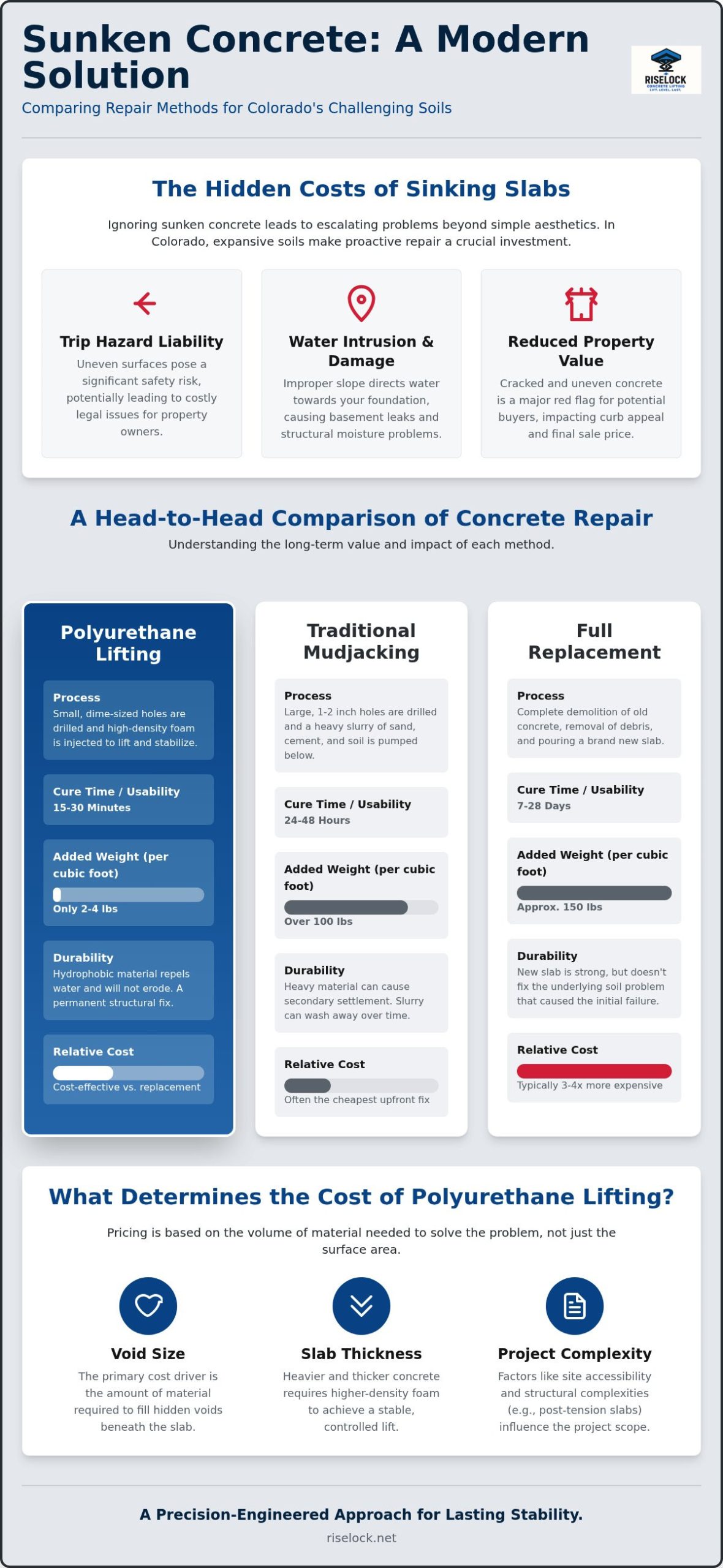
Choosing early intervention helps you avoid the ‘Replacement Trap.’ Many people assume that a cracked or sunken driveway requires a full tear-out and repour, yet specialized lifting often costs significantly less than the total expense of demolition. When you consider the cost of polyurethane concrete lifting against the labor-intensive process of removing old concrete and pouring new material, the value of stabilization becomes clear. It’s a proactive investment that protects the existing slab before it becomes unrepairable and requires a complete replacement that can cost three to four times more than a precision lift.
The True Cost of Doing Nothing
Delaying a repair creates hidden expenses that go beyond the surface. For Denver homeowners and commercial property managers, trip hazard liability is a primary concern that can result in costly legal settlements. Sunken slabs frequently alter the slope of your property, directing water toward the foundation rather than away from it. This poor drainage leads to moisture intrusion and basement leaks; these issues are far more expensive to remediate than a simple leveling project. In the competitive Colorado real estate market, uneven concrete also serves as a major detractor for potential buyers, often resulting in lower offers or required repair credits during the closing process.
Why Polyurethane is the Modern Standard
Polyurethane has become the industry benchmark due to its resilience in harsh climates. The material is inherently hydrophobic, meaning it won’t wash away or erode when exposed to groundwater. This is critical for surviving Colorado’s intense freeze-thaw cycles, where moisture trapped beneath a slab can cause traditional fillers to fail. While older methods like mudjacking rely on a heavy slurry of sand and cement, expanding structural foam leveling uses a lightweight resin that won’t further compress the soil. The lift-to-weight ratio of high-density polyurethane is its greatest technical advantage; it provides massive lifting power while adding only two to four pounds of weight per cubic foot to the underlying earth.
Primary Factors That Determine the Cost of Polyurethane Injection
While many property owners look for a flat rate per square foot, professional assessments calculate the cost of polyurethane concrete lifting based on three-dimensional volume rather than two-dimensional surface area. The primary driver of any quote is the amount of material required to fill the subterranean void and generate the necessary lifting pressure. A six-inch slab that has dropped four inches requires significantly more material than a four-inch patio with a minor one-inch settlement. We evaluate the thickness and weight of the concrete to determine the specific density of foam needed to achieve a permanent lift without over-pressurizing the slab.
The size of the cavity beneath your concrete dictates the total material usage. In Colorado’s varied terrain, soil erosion or poor compaction often creates large, hidden pockets of air that aren’t visible from the surface. Our technicians use specialized equipment to map these voids before injection, ensuring we address the root cause of the settlement rather than just the visible crack. Logistics also play a role in the final estimate. Projects in high-density areas of Boulder or the steep inclines of Castle Rock may require additional setup time or specialized hose lengths to reach the repair site efficiently.
Structural Complexity: Post-Tension Slabs
Lifting post-tensioned concrete requires a higher level of technical mastery than standard reinforced slabs. These structures contain high-strength steel cables under extreme tension; any accidental contact during the drilling or injection process could compromise the entire foundation. Our deep expertise in post tension installation allows us to navigate these internal reinforcements with surgical precision. While the protective measures and specialized scanning required for these slabs can influence the cost of polyurethane concrete lifting, they’re essential for maintaining the structural integrity of your home or commercial building.
Material Density and Soil Stabilization
Not all polyurethane resins are created equal. We differentiate between ‘lifting’ foam, designed for rapid expansion and upward force, and ‘stabilization’ foam, which permeates loose or sandy soil to create a solid base. In areas with particularly unstable ground, we may recommend deep-injection techniques to solidify the earth several feet below the surface. This proactive stabilization prevents future sinking but requires a higher volume of high-density material. The high compressive strength of our specialized resins justifies their cost by ensuring the repair can withstand the heavy loads of vehicles or structural weight without secondary failure. If you’re concerned about a sinking slab, it’s helpful to consult with a structural specialist who understands these technical nuances.
Polyurethane vs. Mudjacking: A Comparative Cost-Benefit Analysis
When evaluating structural repairs, property owners often encounter traditional mudjacking as a secondary option. It’s true that mudjacking typically carries a lower upfront sticker price because it utilizes a basic mixture of sand, water, and cement. However, the technical limitations of this method often lead to higher expenses over time. The primary reason for the higher initial cost of polyurethane concrete lifting lies in the sophisticated chemistry of the material and the precision of the delivery system. While mudjacking relies on hydraulic pressure to force a heavy slurry under the slab, polyurethane uses a chemical reaction to expand and lift the concrete from within the void.
The most significant drawback of traditional slurry is its weight. Mudjacking material weighs over 100 pounds per cubic foot, which adds immense stress to Colorado’s already volatile soil. This weight often triggers secondary settlement, where the repair itself causes the ground to sink further. In contrast, high-density foam weighs only two to four pounds per cubic foot. By choosing a lightweight solution, you ensure the repair doesn’t become the catalyst for future structural failure. The visual impact is also drastically different. Mudjacking requires holes the size of a soda can, whereas polyurethane concrete lifting utilizes penny-sized injection points that are nearly invisible once sealed.
The Hidden Costs of Traditional Mudjacking
Choosing the cheaper upfront option often leads to recurring maintenance. The large drill holes required for mudjacking are prone to cracking and aesthetic degradation over time. Furthermore, the cement-based slurry is susceptible to washout during heavy Colorado spring rains. If water infiltrates the area beneath the slab, it can erode the mudjacking material, leaving the concrete unsupported once again. Many property owners find themselves paying for the same repair twice within a few years because the traditional method failed to address the underlying soil stability. We view the cost of polyurethane concrete lifting as a one-time investment in a permanent, waterproof barrier that won’t wash away.
Efficiency and Cleanliness as Cost Savers
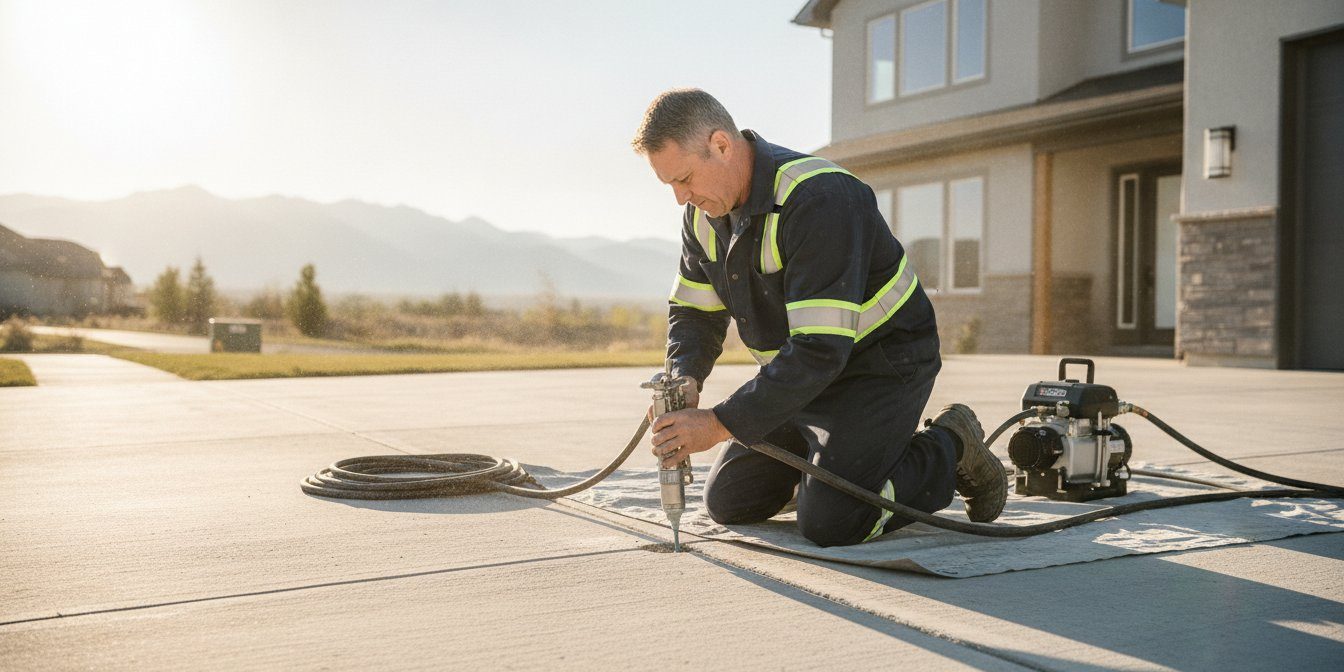
The speed of the injection process translates directly into reduced labor requirements. Polyurethane expands and cures in minutes, allowing driveways and commercial loading docks to return to full service almost immediately. Traditional slurry can take days to harden sufficiently for vehicle traffic, causing significant downtime. Our process also preserves your landscape. Because we don’t require heavy mixing trucks or large pump equipment to traverse your lawn, you avoid the secondary costs of sod replacement and sprinkler repair. This clean, efficient approach ensures that the price you’re quoted is the final price you pay for a restored, functional surface.
Beyond the Quote: Calculating Long-Term ROI and Property Value
The initial quote for a repair is only one part of the financial equation. When you evaluate the cost of polyurethane concrete lifting, you’re looking at a structural investment that pays dividends in property valuation and liability reduction. A level, well-maintained driveway or storefront serves as a silent indicator of a property’s overall health. Sunken slabs signal neglect to prospective buyers and insurance adjusters alike. Choosing a precise, high-density foam injection doesn’t just fix a surface; it preserves the underlying equity of your real estate by preventing further soil erosion.
Environmental stewardship also factors into the modern ROI of structural repair. Traditional replacement requires heavy machinery to break up old slabs, which then end up in Colorado landfills. Lifting utilizes the existing concrete, reducing the carbon footprint of your repair while avoiding the massive energy consumption required to manufacture and transport new cement. At RiseLock, we view every project through the lens of structural mastery, ensuring that our intervention provides a permanent resolution rather than a temporary patch that will need attention again in two years.
Residential Resale and Inspection Readiness
Home inspectors in growing communities like Aurora and Parker are particularly vigilant about drainage and safety. A sunken walkway is often flagged as a major defect, which can stall a sale or force a seller to offer thousands in concessions. By presenting a professional repair certificate for your concrete, you demonstrate to buyers that the home’s structural integrity has been handled by experts. This proactive approach eliminates the stress of last-minute negotiations and ensures your property stands out for its meticulous maintenance rather than its trip hazards.
Commercial Liability and Safety Standards
For business owners, the ROI of concrete leveling is often measured in the avoidance of disaster. An ADA non-compliance fine or a single “slip and fall” lawsuit can dwarf the cost of polyurethane concrete lifting many times over. Beyond legal risks, uneven warehouse floors cause premature wear on forklifts and pallet jacks, leading to increased equipment maintenance costs. Because our foam cures in minutes, your facility avoids the revenue loss associated with “closed for repair” signs. If you’re ready to secure your facility’s safety, you can request a detailed property evaluation to identify high-risk areas before they become liabilities.
Securing Your Foundation: The RiseLock Approach to Precise Leveling
Precision is the cornerstone of structural restoration. While many contractors offer general masonry services, RiseLock focuses exclusively on the technical mastery required to stabilize and lift sunken slabs in Colorado’s challenging environment. We understand that a successful repair depends on more than just filling a hole; it requires a deep understanding of soil mechanics and material science. By choosing a specialist who truly understands concrete repair in Denver, you’re ensuring that your property is treated with the level of care and technical accuracy it deserves. Our approach prioritizes long-term security over temporary cosmetic fixes.
A professional site evaluation is a non-negotiable step in our process. While some companies provide “ballpark” estimates over the phone, these figures are often inaccurate because they cannot account for the hidden void volume beneath the surface. To determine the actual cost of polyurethane concrete lifting for your specific project, we must assess the slab’s weight, the degree of settlement, and the condition of the underlying soil. This thoroughness allows us to provide a transparent, fixed quote that reflects the true scope of work, preventing the “hidden fees” that often plague less specialized repair projects.
The RiseLock Precision Process
We utilize advanced laser levels to monitor every injection in real-time, achieving sub-millimeter accuracy during the lifting process. This level of control is essential for complex projects, such as leveling pool decks or garage floors where drainage slopes are critical. Our high-density injections are engineered to withstand the unique pressures of the Front Range’s shifting earth. We also take immense pride in the cleanliness of our job sites. Unlike the heavy equipment and wet slurry associated with older methods, our non-invasive system leaves your property exactly as we found it, only safer and more level. This focus on structural integrity and professional conduct sets us apart from general handyman services that lack our specialized equipment.
Getting Your Personalized Quote
Obtaining an accurate estimate for the cost of polyurethane concrete lifting is a straightforward process designed for busy property owners. To help us provide the most efficient service, it’s helpful to have the following information ready:
- The type of slab (e.g., driveway, patio, or warehouse floor).
- The estimated “drop” or distance the concrete has sunken.
- The location of the property and its accessibility for our service trailer.
We prioritize speed and accuracy in our communication, ensuring you have the data you need to make an informed decision about your property’s health. If you’re ready to eliminate trip hazards and restore your concrete’s structural value, request a professional evaluation from RiseLock today. Our team is ready to provide the precision-engineered solution your Colorado property requires.
Advancing Your Property’s Structural Integrity
Addressing sunken concrete is an essential step in preserving your property’s long-term value and safety. We’ve explored how high-density foam provides a lightweight, hydrophobic barrier that resists the shifting nature of Colorado’s expansive soils. Unlike traditional methods that add weight and invite secondary settlement, this modern intervention solves the root cause of the issue with surgical precision. When you evaluate the cost of polyurethane concrete lifting, it’s clear that the durability and technical accuracy of this method far outweigh the risks of temporary patches or the compounding expense of a total replacement.
Our team brings specialized expertise to every project, including the technical mastery required for post-tension slab integrity across the Denver Metro and Front Range. We utilize non-invasive technology to restore your surfaces in minutes; this ensures minimal disruption to your daily routine or business operations. You don’t have to live with the stress of trip hazards or deteriorating curb appeal. Restore your concrete with RiseLock’s precision foam lifting and gain the peace of mind that comes with a permanent, professional repair. We look forward to helping you stabilize your foundation for the years ahead.
Frequently Asked Questions
Is polyurethane concrete lifting cheaper than replacement?
Yes, polyurethane lifting is almost always more cost-effective than a full replacement. By preserving the existing slab and correcting the underlying soil issues, you avoid the heavy labor costs associated with demolition and hauling away old concrete. This method typically saves property owners a substantial percentage of the total project cost compared to the expense of a new pour and the disposal of the old material.
How long does a polyurethane concrete lift actually last in Colorado?
A professional lift can last as long as the concrete itself. The high-density foam we use is chemically inert and does not degrade over time, even in Colorado’s shifting soils. While the cost of polyurethane concrete lifting reflects a premium material, its lifespan far exceeds traditional slurry; provided that the initial drainage issues that caused the sinking are addressed during the repair process.
Can polyurethane lift a post-tension slab foundation?
Yes, but it requires specialized technical mastery to avoid damaging the internal steel cables. Our team has deep expertise in managing these complex structures safely. We use high-precision monitoring to ensure the slab is lifted evenly without compromising the structural tension that holds the foundation together, making it a safe alternative to expensive foundation replacement.
How much weight can high-density foam support?
High-density polyurethane foam is engineered to support immense loads, often exceeding the weight-bearing capacity of the soil beneath it. It can easily support heavy vehicles, machinery, and structural loads without compression. This strength is why it is the preferred choice for industrial warehouse floors and commercial loading docks across the Front Range where heavy equipment is common.
Will the foam wash away during heavy rain or snowmelt?
No, the material is hydrophobic and will not erode or wash away when exposed to groundwater. Once the foam cures, it forms a rigid, waterproof barrier that remains stable through intense spring snowmelt and heavy rains. This durability is a primary reason why the cost of polyurethane concrete lifting is a superior long-term investment compared to water-soluble mudjacking mixtures that can eventually fail.
Does the cost of concrete lifting include filling the cracks?
The initial quote typically focuses on stabilization and leveling, but crack sealing is often recommended as an essential secondary step. Filling surface cracks is vital to prevent water from infiltrating the sub-grade and causing future settlement. We suggest discussing a comprehensive repair plan during your site evaluation to ensure the entire surface is protected from the elements and remains stable.
How soon can I drive on my driveway after the injection?
You can typically drive on your driveway within fifteen to thirty minutes of the final injection. The rapid expansion and curing process of the resin allow it to reach full structural strength almost immediately. This minimal downtime is a significant advantage for businesses that don’t want to close their entrances for several days while waiting for traditional concrete or mudjacking to cure.
Are there any hidden fees in a concrete lifting quote?
Professional estimates should be transparent and based on a thorough site evaluation. While “ballpark” phone quotes can lead to surprises, a precise on-site assessment identifies the exact volume of material and labor required for your specific soil conditions. We prioritize ethical pricing, ensuring that the quote you receive covers all technical requirements for a successful, permanent lift without unexpected surcharges.