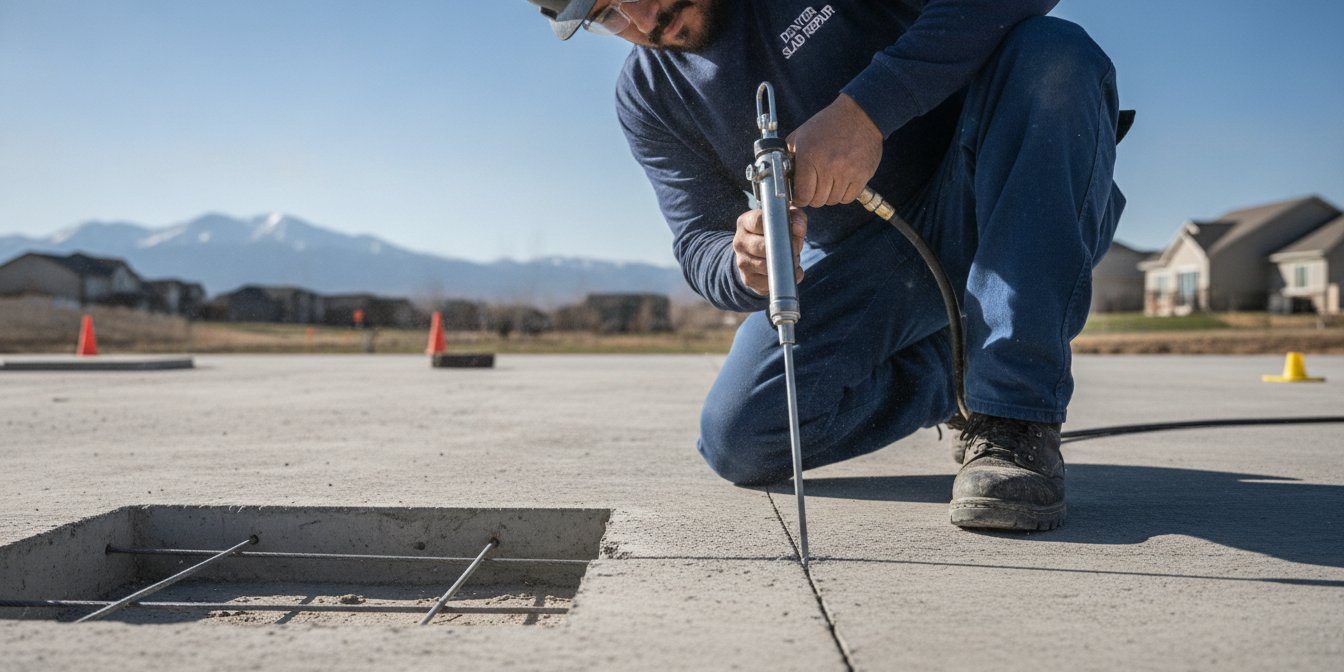
What if the cracks in your foundation aren’t just cosmetic signs of aging, but a warning that your building’s internal tension system is reaching its breaking point? It’s natural to feel overwhelmed when faced with the prospect of structural slab repair in Colorado, especially when the threat of expansive clay soil and the high cost of total concrete replacement loom over your property. You shouldn’t have to choose between a failing structure and a disruptive, expensive demolition.
This article details how modern post-tension reinforcement and high-density polyurethane stabilization protect Colorado structures from the destructive cycle of soil swelling and shrinking. Our goal is to show you how these precision methods restore safety and value without the chaos of a full tear-out. We’ll examine the technical requirements for PT cable safety, the mechanics of advanced soil stabilization, and why a dual-threat approach is necessary to ensure long-term structural integrity in our state’s unique geological landscape. By understanding the “why” behind these advanced materials, you can move away from the stress of structural damage toward the peace of mind offered by specialized, high-precision intervention.
Key Takeaways
- Understand how Colorado’s expansive bentonite clay creates unique pressure on foundations and why specialized structural intervention is necessary to prevent failure.
- Learn the critical differences between post-tensioned slabs and traditional rebar, including the vital role high-strength steel cables play in maintaining structural load.
- Discover why high-density polyurethane injection has replaced traditional mudjacking as the preferred method for stabilizing structural loads without the mess or weight of cement slurry.
- Explore the precision tactics used to re-anchor and re-tension broken PT cables, restoring your foundation to its original engineered specifications.
- Gain expert insight into navigating structural slab repair Colorado to achieve long-term stability with minimal disruption to your home or business operations.
The Challenge of Structural Slab Repair in Colorado’s Expansive Soils
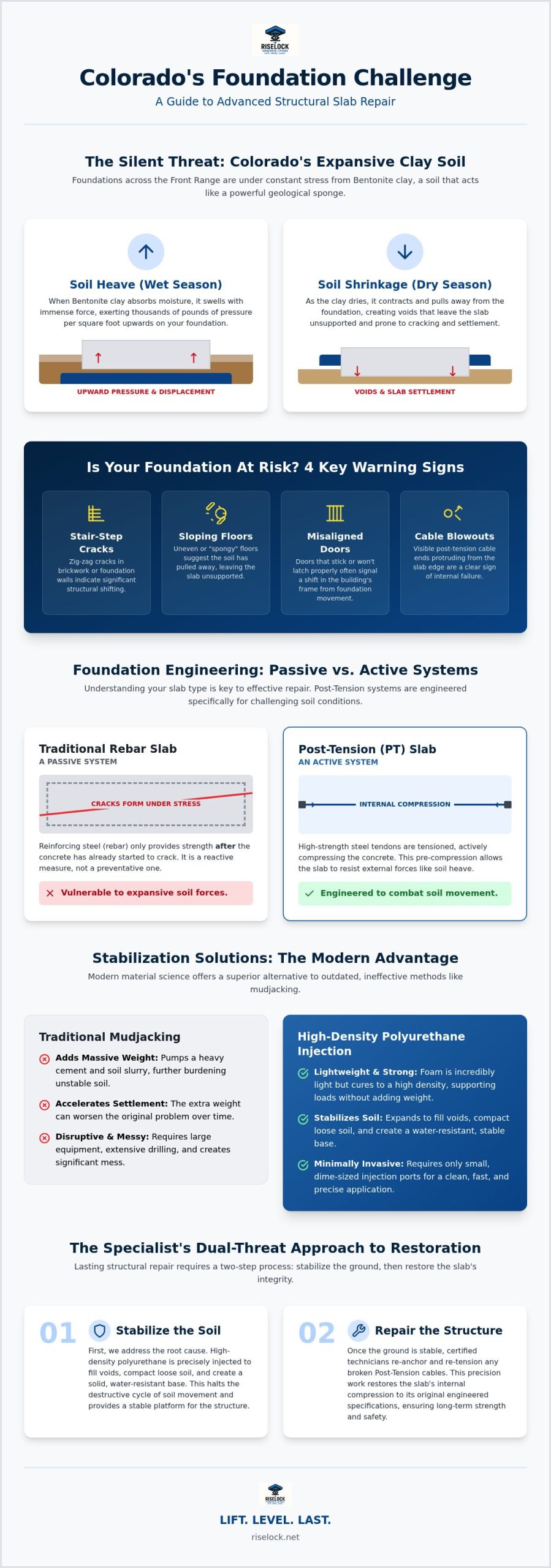
Structural slab repair Colorado is a specialized technical discipline focused on restoring the load-bearing capacity of a foundation. It isn’t merely about correcting a trip hazard or making a floor look flat. True structural repair ensures that the concrete can safely support and distribute the weight of the building above it. In our region, this process is uniquely complicated by the ground itself. Much of the Front Range, specifically the areas surrounding Denver and Colorado Springs, sits atop high concentrations of bentonite clay. These Expansive Soils act like a geological sponge. When they absorb moisture, they swell with incredible force, a phenomenon known as “heave.” When they dry out, they contract, causing the ground to “shrink” and pull away from the foundation.
This constant cycle of movement subjects structural slabs to intense tension and compression that standard concrete is rarely designed to withstand indefinitely. Traditional mudjacking often fails in these volatile conditions. Pumping a heavy cement and soil slurry under a slab adds significant weight to already unstable soil. This extra mass often accelerates the very settlement it was intended to fix. As the soil beneath the slurry continues to move, the heavy patch can crack or sink further, leaving the property owner with a more expensive and complex problem than they started with.
Colorado’s Geological Impact on Foundations
The pressure exerted by swelling clay can reach thousands of pounds per square foot. This upward force often exceeds the weight of the slab itself, leading to displacement and severe cracking. Front Range properties are uniquely susceptible to these issues because of the high density of bentonite found in local soil profiles. Understanding these regional pressures is vital for any successful restoration project. Relying on specialized expertise in concrete repair in Denver, Colorado ensures the solution accounts for these specific geological stresses rather than applying a generic fix that ignores local soil chemistry.
Signs Your Colorado Slab Needs Structural Intervention
Early detection of structural failure can prevent total foundation collapse and minimize restoration costs. If you notice any of the following, your property likely requires a professional assessment:
- Stair-step cracks: These typically appear in exterior brickwork or interior foundation walls and indicate significant shifting.
- Sloping floors: A floor that feels uneven or “spongy” underfoot often suggests the soil has pulled away from the slab.
- Misaligned doors: Interior doors that stick or no longer latch correctly usually signal that the frame has shifted due to foundation movement.
- Cable blowouts: Visible post-tension cable ends protruding from the slab edge are a clear sign of internal structural failure.
Ignoring these signs allows the heave and shrink cycle to further compromise the steel reinforcement inside your concrete. Precision intervention is required to stabilize the ground and restore the slab’s integrity before the damage becomes irreversible.
The Mechanics of Post-Tension Slab Integrity and Damage
Standard rebar-reinforced concrete is a passive system; it only begins to provide strength once the concrete starts to crack. In contrast, post-tensioned (PT) slabs are active. They’re compressed internally by high-strength steel cables before any external load is ever applied. This internal compression allows the concrete to resist the extreme tension caused by Colorado’s most significant geologic hazard: expansive soil. For property owners, recognizing the role of these cables is the first step in successful structural slab repair Colorado.
Anatomy of a Post-Tensioned System
A PT system relies on steel tendons encased in plastic sheathing. These tendons are anchored at the slab edges and pulled to a specific tension using hydraulic jacks. In unbonded systems, which are the standard for most Colorado residential foundations, the cables are coated in a specialized grease to prevent bonding with the concrete. This allows the cable to remain active throughout the life of the structure. This constant squeezing effect gives the slab the flexibility to bridge gaps created by soil movement, which is something traditional rebar simply can’t do as effectively.
Identifying Post-Tension Cable Blowouts
A cable blowout occurs when a tendon snaps, releasing its stored energy through the side of the slab. This isn’t a subtle event. You’ll likely see a hole in the concrete or a length of steel cable protruding from the foundation’s edge. A blowout is a critical safety hazard; the force released can be enough to penetrate interior walls. Beyond the physical danger, a snapped cable means the slab has lost its engineered compression in that specific area. This leads to rapid structural degradation and further cracking.
Corrosion and accidental damage are the most common culprits behind these failures. If moisture reaches the steel, it can rust the tendon until it can no longer hold the tension. Similarly, improper drilling or cutting into a slab without scanning for cables can lead to immediate failure. Because these cables are under roughly 33,000 pounds of force, any structural slab repair Colorado must be handled with extreme precision. If you’ve noticed rust stains or visible cable ends, reaching out for professional concrete repair is essential to restore the safety and balance of your structure.
Structural Stabilization: Polyurethane Injection vs. Traditional Methods
While post-tensioning provides the internal strength required for Post-tensioned slabs-on-ground, that strength is only effective if the slab remains supported by the underlying soil. When voids form due to Colorado’s shifting bentonite clay, the slab loses its uniform bedding. This creates localized stress points that can snap cables or cause deep structural cracks. Effective structural slab repair Colorado requires a solution that addresses this soil instability without adding massive weight to the already fragile ground.
Traditional mudjacking relies on a heavy mixture of sand, cement, and water. This slurry can weigh up to 100 pounds per cubic foot. In a state where soil movement is already the primary cause of failure, adding tons of new weight is often counterproductive. High-density polyurethane, by contrast, weighs only 2 to 4 pounds per cubic foot while offering a compressive strength capable of supporting heavy structural loads. It’s a precise, lightweight intervention that solves the problem without creating a new one.
Why High-Density Foam is a Structural Game-Changer
The process of foam concrete lifting is fundamentally different from older methods. As the liquid polyurethane is injected through small, 5/8-inch holes, it undergoes a chemical reaction that causes it to expand. This expansion doesn’t just lift the concrete; it actively compacts the surrounding soil and fills every microscopic void. This creates a dense, stable foundation that prevents future moisture infiltration. Because the material reaches 90% of its full strength within 15 minutes, property owners can return to service almost immediately, avoiding the days of downtime required for cement to cure.
Polyurethane vs. Mudjacking in the Colorado Climate
Colorado’s weather is notoriously hard on traditional repairs. Mudjacking slurry is susceptible to erosion and can break down during the intense freeze-thaw cycles common in the Front Range. Polyurethane is hydrophobic, meaning it repels water and won’t wash away or lose its volume over time. It acts as a permanent barrier against moisture, which is essential for managing the “shrink” part of the soil cycle. When viewed as a long-term strategy, concrete leveling with foam is an exceptionally cost-effective structural alternative. It provides the necessary stabilization at a fraction of the cost of full slab replacement, ensuring the longevity of both the concrete and the post-tensioning system it houses.
Precision Tactics for Repairing Broken Post-Tension Cables
Restoring a failed tendon is a high-stakes engineering task that requires more than a simple patch. Because these cables are under massive tension, any attempt at structural slab repair Colorado must prioritize safety and technical accuracy. The goal is to return the slab to its original engineered state, ensuring the internal compression is balanced and consistent across the entire foundation. A precise repair protects the building’s structural integrity while preventing the safety risks associated with snapped steel strands.
Successful restoration often involves integrating modern post-tension installation techniques into the existing damaged structure. This process doesn’t just fix the break; it fortifies the tendon against future corrosion and failure. Precision equipment and specialized training are non-negotiable when dealing with the thousands of pounds of force stored within these steel strands. Our approach focuses on methodical execution to ensure the restored tension matches the original design specifications perfectly.
The Step-by-Step PT Cable Repair Process
The repair begins by carefully excavating the anchor points and cleaning the damaged tendon to assess the extent of corrosion. Once the failed section is identified, we splice a new piece of high-strength steel to the existing cable using specialized couplers designed for high-tension loads. The most critical phase is hydraulic tensioning. Using a calibrated hydraulic jack, we pull the cable to the exact design tension specified in the building’s original plans. This restores the active compression that keeps the concrete from cracking under the weight of the structure and the pressure of the soil.
Structural Slab Reinforcement Strategies
In some cases, cable repair is just one part of a multi-layered approach. When a slab has undergone significant stress, we may use external carbon fiber reinforcement (FRP) to provide additional tensile strength to the concrete surface. We also utilize high-pressure epoxy injection to seal structural cracks. This prevents moisture from reaching the newly repaired tendons, which is a vital step in preventing the cycle of corrosion from restarting in Colorado’s damp soil conditions.
The most effective long-term solution often combines cable restoration with polyurethane concrete lifting. While the cables provide internal strength, the foam provides external stability by filling the voids that caused the cable stress in the first place. This dual-action method ensures the foundation is supported from both the inside and the bottom. If you’ve discovered a snapped cable or significant structural cracking, you can schedule a professional evaluation to determine the most precise path forward for your property.
RiseLock’s Specialist Approach to Colorado Structural Restoration
Effective structural slab repair Colorado requires more than just high-grade materials; it demands a partner who views technical mastery as a baseline requirement rather than a premium feature. At RiseLock Concrete Lifting, we approach every project with a sense of quiet authority and professional reliability. We understand that a failing foundation is a source of significant stress for property owners. Our role is to act as a dependable guide, leading you away from the uncertainty of structural damage toward the security of a precisely restored asset. We don’t just fix concrete; we restore the engineered balance of your home or commercial building.
Our commitment to long-term safety means we never advocate for temporary patches or “band-aid” solutions. Colorado’s geological conditions are too volatile for shortcuts. By focusing on the synergy between high-density polyurethane stabilization and post-tension cable restoration, RiseLock Concrete Lifting addresses both the symptoms and the root causes of slab failure. This methodical approach ensures that once a repair is completed, the structure remains stable through the inevitable cycles of soil expansion and contraction that define our region.
Expertise You Can Trust Across the Front Range
Regional expertise is the cornerstone of our service. From the dense bentonite clay in Aurora and Parker to the complex soil profiles found in Boulder and Castle Rock, we tailor our methods to the specific geological demands of your location. Serving the entire corridor from Denver to Colorado Springs, RiseLock Concrete Lifting maintains high ethical standards by providing honest, data-driven assessments of every property. We position ourselves as a modern innovator, utilizing concrete lifting solutions that represent the current peak of industry technology. This allows us to deliver results that are cleaner, faster, and more durable than traditional alternatives.
Your Path to a Stable Foundation
The journey to a secure foundation begins with a thorough structural evaluation. During this process, our specialists inspect the slab for signs of cable failure, identify void locations using advanced diagnostic tools, and measure the degree of settlement or heave. RiseLock Concrete Lifting then develops a customized repair plan that prioritizes precision and structural integrity over speed. You’ll receive a clear explanation of the “why” behind each recommended intervention, ensuring you have the information needed to make an informed decision about your property’s future. If you’re ready to address your foundation issues with a partner who values technical excellence, you can contact RiseLock Concrete Lifting for a professional structural assessment today. We’re here to provide the expert guidance and high-precision intervention your structure deserves.
Restoring the Integrity of Your Colorado Foundation
Protecting your building from the pressure of expansive soil requires a shift from reactive patching to proactive, engineered restoration. We’ve explored how stabilizing the underlying ground and re-tensioning failed cables creates a foundation that can withstand the Front Range’s volatile geology. This technical synergy is the only reliable way to achieve permanent structural slab repair Colorado. By addressing the root causes of settlement and cable failure, you ensure that your property remains safe and valuable for years to come.
RiseLock Concrete Lifting brings specialized post-tension mastery and high-density polyurethane precision to every project. Our team serves Denver, Aurora, and the entire Front Range with a commitment to high standards and professional pride. We view your structural challenges as our personal priority, providing the expert guidance needed to move past the stress of foundation damage. It’s time to replace uncertainty with the peace of mind that comes from a precisely restored structure.
Secure Your Foundation with RiseLock Concrete Lifting’s Structural Experts
Your property’s long-term security is within reach, and we’re here to help you achieve it with confidence.
Frequently Asked Questions
What is the difference between a standard slab and a post-tensioned slab?
A standard slab relies on passive rebar that only provides strength after the concrete cracks, while a post-tensioned slab is an active system. High-strength steel cables are tensioned during construction to compress the concrete from within. This internal compression allows the slab to flex and resist the extreme pressure exerted by Colorado’s expansive soils. This fundamental difference makes post-tensioned systems more resilient but also requires specialized knowledge during the repair process.
Can a structural slab be repaired without completely replacing the concrete?
Yes, a structural slab repair Colorado can often be achieved without the need for full replacement. By using high-density polyurethane injection to fill voids and stabilize the soil, we can restore the slab’s bedding. If the internal reinforcement is compromised, specialized cable re-tensioning can restore the engineered strength. These modern methods are designed to be non-invasive, allowing property owners to avoid the high costs and significant disruption of traditional demolition.
How much does it cost to repair a broken post-tension cable in Colorado?
The total cost for repairing a broken tendon is determined by the specific location of the break and the access required for hydraulic equipment. Factors such as the depth of the slab and the number of cables involved will influence the final project scope. While professional restoration is a specialized service, it remains a fraction of the cost of a full foundation replacement or the structural failure that can occur if blowouts are ignored.
Is polyurethane foam strong enough to support a commercial structural slab?
High-density polyurethane foam is specifically engineered for high-load applications, including commercial and industrial structural slabs. It offers high compressive strength while remaining much lighter than traditional cement slurries. This allows the foam to provide stable support without adding weight that would further compress the underlying soil. It’s a precise solution for stabilizing warehouses, retail spaces, and other heavy structures that require long-term durability and immediate return to service.
How long does a typical structural slab repair take to complete?
Most structural slab repairs are completed in one to two business days. The exact timeframe depends on the number of cables requiring re-tensioning and the amount of soil stabilization needed. Because high-density polyurethane cures rapidly, the slab is ready for full weight-bearing loads within minutes of injection. This speed is a significant advantage over traditional concrete replacement, which can require several days or even weeks for the material to reach full strength.
What happens if I ignore a post-tension cable blowout in my foundation?
Leaving a post-tension cable blowout unaddressed is a significant safety and structural risk. When a cable snaps, the slab loses the internal compression that keeps it from cracking under heavy loads. This leads to accelerated structural failure, potentially causing the foundation to shift or buckle. Over time, moisture can enter the blowout point and corrode neighboring cables, turning a single repair into a much more complex and expensive foundation project.
Does structural slab repair come with a warranty in Colorado?
Industry standards for structural slab repair Colorado often include warranties that cover the stability of the injected materials and the integrity of the cable repairs. It’s essential to review the specific terms provided by your contractor to understand the duration and scope of the protection. A reliable partner will offer a clear warranty that reflects their confidence in the precision and technical mastery of their work, providing you with long-term security.
How do I know if my concrete cracks are structural or just cosmetic?
Structural cracks are typically wider than hairline fractures and often appear in patterns, such as stair-stepping through brickwork or spanning the entire width of a slab. If you notice cracks accompanied by uneven floors or doors that no longer latch, the issue is likely structural. While cosmetic cracks are common as concrete shrinks, any crack in a post-tensioned foundation should be inspected by a specialist to ensure the internal cables haven’t been compromised by moisture.