Tearing out an industrial slab is often an unnecessary disruption that ignores the underlying subgrade movement causing the damage. When operating high-volume distribution hubs, unlevel concrete directly threatens facility productivity. If you are researching warehouse floor leveling Lakewood facilities need, you likely recognize how quickly a sunken joint leads to severe forklift mast oscillation, shifting pallet racks, and urgent OSHA compliance risks.
Halting operations for weeks to pour fresh concrete simply isn’t a viable option for active supply chains. Industrial concrete restoration succeeds through deep subgrade stabilization rather than cosmetic surface patches or heavy repours. In this guide, you’ll discover how industrial polyurethane concrete leveling restores sunken Lakewood warehouse slabs with minimal operational downtime, supporting high-capacity equipment while counteracting the expansive clay soils native to Jefferson County. We’ll walk through the precision injection process, load-bearing performance requirements, and best practices for stabilizing joint transitions across active loading zones.
Key Takeaways
- Understand how Front Range expansive clay soils destabilize industrial slabs and why subgrade stabilization is vital to eliminate forklift mast rocking.
- Discover why high-density polyurethane foam outperforms traditional mudjacking by supporting heavy machinery loads without adding thousands of pounds of heavy slurry to weak soils.
- Learn how laser-monitored warehouse floor leveling Lakewood facilities rely on restores tight joint tolerances with rapid cure times that keep logistics moving.
- Evaluate the total operational economics of structural slab lifting versus full concrete tear-out to protect production schedules and avoid rack disassembly.
- Identify the core qualification standards for commercial concrete lifting partners, from commercial foam density specifications to industrial OSHA safety compliance.
Why Lakewood Industrial Concrete Slabs Settle and Destabilize
Industrial slabs rarely fail because of surface defects alone. In Jefferson County, structural slab movement almost always originates deep in the subgrade. When distribution centers and light manufacturing facilities experience uneven floor panels, understanding the geological profile beneath the foundation explains why surface patching consistently falls short. Precision concrete leveling addresses these foundational root causes rather than simply masking surface damage.
The Impact of Lakewood Clay Soils on Heavy Slabs
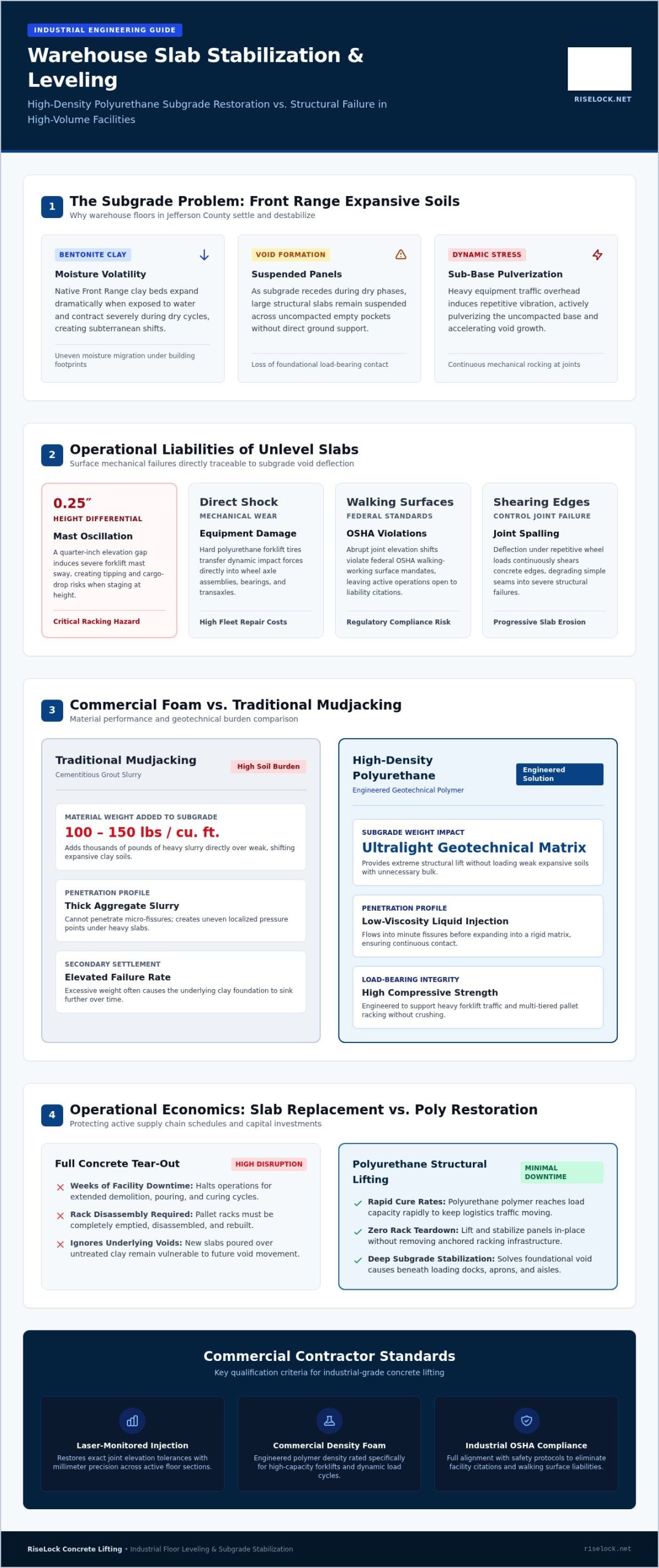
Lakewood facilities sit directly above the expansive clay beds characteristic of Colorado’s Front Range. These soils, rich in bentonite, swell dramatically when exposed to moisture and shrink as they dry. Because large warehouse envelopes prevent natural precipitation from evenly permeating the soil, moisture migration beneath the slab creates irregular subterranean voids. As dry cycles pull moisture out, the soil recedes, leaving massive structural panels suspended across empty pockets. When heavy machinery passes overhead, repetitive vibration pulverizes the uncompacted sub-base, accelerating sub-slab void formation.
Warehouse Hazards Caused by Uneven Floor Panels
A void beneath an industrial floor quickly translates into tangible mechanical failures on the surface. When heavy point loads travel over unseated panels, the slab rocks, generating severe joint displacement and stress fractures along control joints. Facility managers facing warehouse floor leveling Lakewood requirements routinely encounter these specific operational liabilities:
- Forklift mast oscillation: Even a quarter-inch height differential across a joint causes severe mast sway, creating significant tipping risks when staging freight at vertical racking heights.
- Premature equipment wear: Hard polyurethane forklift tires transfer direct shock into wheel axle assemblies, transaxles, and bearings every time they strike an unlevel joint.
- Regulatory compliance violations: Abrupt elevation changes create tripping hazards that fail to satisfy federal OSHA walking-working surface mandates, leaving operations exposed to liability citations.
- Progressive joint spalling: Deflection under wheel loads shears concrete edges, degrading the seam until slabs require structural repair instead of simple joint sealing.
External variables worsen these dynamics. Undetected plumbing leaks or concentrated downspout discharge wash away fine subgrade aggregate beneath dock aprons. Investing in targeted warehouse floor leveling Lakewood facilities need prevents these subterranean voids from compromising daily shipping schedules.
Evaluating Commercial Concrete Leveling: High-Density Foam vs Mudjacking
Selecting the right remediation method for high-load industrial floors requires looking beyond short-term fixes. Industrial facilities sustain intense dynamic stresses that crush residential-grade repairs. When evaluating options for warehouse floor leveling Lakewood logistics managers often weigh modern high-density polymers against traditional cementitious mudjacking.
Load-Bearing Capacity and Compressive Strength
Commercial-grade geotechnical foams are engineered specifically to support heavy industrial operations. Commercial polyurethane delivers the rigorous compressive strength required to handle high-capacity forklifts and multi-tiered pallet racking without crushing. The polymer enters beneath the slab as a low-viscosity liquid, flowing into minute sub-slab fissures before expanding uniformly into a dense, rigid matrix. As detailed in our polyurethane concrete lifting overview, this controlled expansion delivers continuous support along slab joints, effectively eliminating deflection and mitigating dangerous hazards from uneven floors.
Subgrade Burden: Material Weight Comparison
The most critical engineering flaw of traditional mudjacking in Colorado is material weight. Pumping heavy slurry beneath settled concrete creates serious compounding issues:
- Excessive subgrade load: Mudjacking slurry weighs 100 to 150 pounds per cubic foot, introducing thousands of pounds of added deadweight onto Lakewood’s already fragile, moisture-sensitive clay.
- Minimal added mass: Geotechnical polyurethane foam weighs just 2 to 4 pounds per cubic foot while delivering exceptional lifting force.
- Hydrophobic resilience: Polyurethane is completely impervious to moisture, meaning it won’t wash away, erode, or degrade during Front Range freeze-thaw cycles.
- Precision injection ports: Polyurethane requires only five-eighths-inch drill holes, preserving joint sealants and floor coatings, whereas mudjacking requires large two-inch cores that weaken the slab profile.
Pumping tons of wet grout beneath settled slabs frequently accelerates secondary subgrade collapse in Jefferson County soils. Polyurethane foam stabilizes the underlying aggregate base without burdening the foundation, offering a dependable, long-term solution. If your facility is experiencing joint settlement, partnering with the engineers at RiseLock ensures your concrete is stabilized with precision-engineered polymer systems rather than outdated slurry methods.
The Precision Polyurethane Lifting Process for Active Facilities
Executing structural concrete remediation inside an active fulfillment center demands a surgical methodology. Unlike residential projects, industrial facilities cannot tolerate structural over-lifting, prolonged disruptions, or uncontrolled airborne particulate. Professional warehouse floor leveling Lakewood operations follow a disciplined, five-step technical execution framework designed for high-traffic environments:
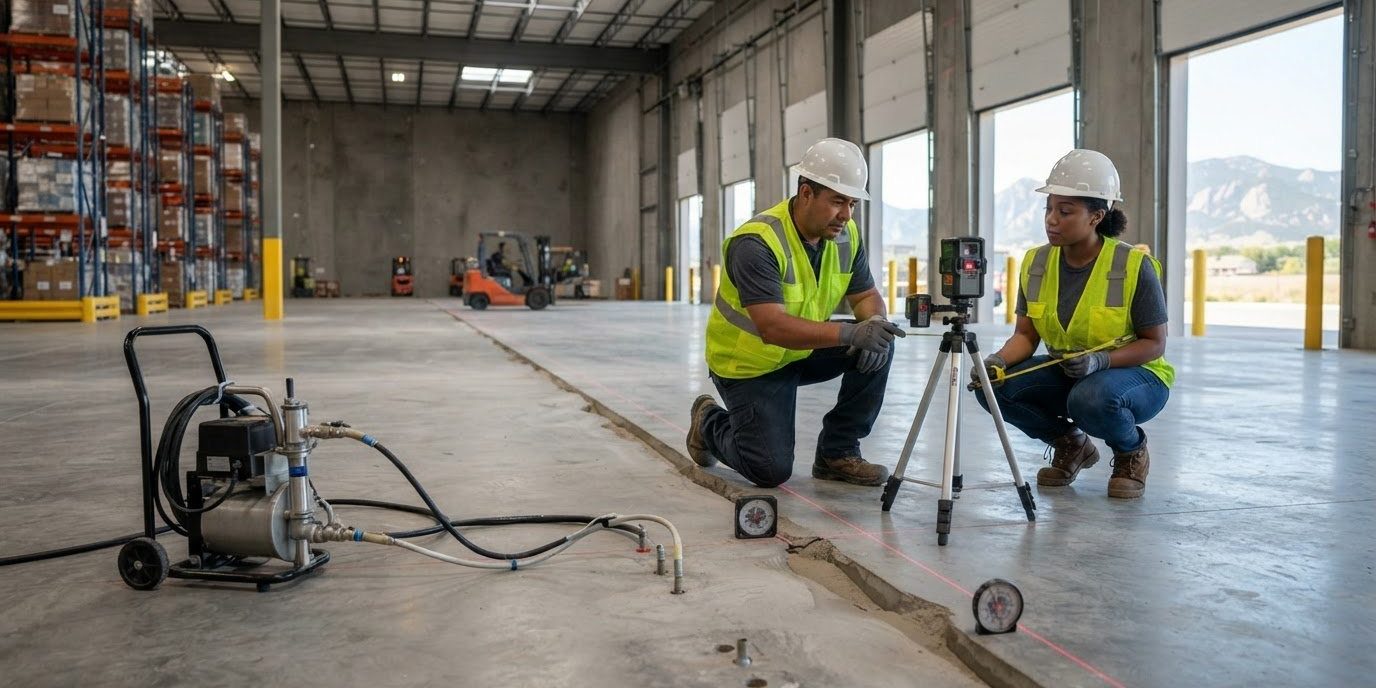
- Precision laser mapping: Technicians establish baseline elevation grids using optical measuring equipment to pinpoint deflection along travel corridors and joint interfaces.
- Strategic port layout: Crews drill small five-eighths-inch injection holes through the slab in calculated patterns, avoiding sub-floor utilities and reinforcing rebar.
- High-density polymer injection: Technicians inject dual-component geotechnical foam at controlled flow rates, expanding beneath the concrete to consolidate weak soils and eliminate sub-base voids.
- Dynamic elevation monitoring: Continuous optical verification tracks elevation gains to fractions of an inch, halting material delivery the moment joints realign perfectly.
- Flush port patching: Crews clear drill holes and seal them using industrial-grade, non-shrink repair mortar tinted to match existing slab concrete.
Laser-Guided Elevation and Joint Realignment
Industrial slabs require exceptionally tight tolerances to ensure automated equipment and forklifts operate smoothly. Optical sensors continuously read elevation gains throughout the injection cycle. Technicians meter volumetric material flow carefully to prevent upward deflection of adjacent panels that are already structurally sound. To understand how specialized teams execute foam concrete lifting under strict operational tolerances, continuous real-time measurement remains the standard that prevents slab cracking.
Non-Invasive Execution in Active Operating Zones
Facility managers cannot afford to halt logistics across entire distribution hubs for concrete restoration. Technicians work in designated zones, setting up mobile delivery systems that contain dust and maintain floor cleanliness. Because geotechnical polyurethane reaches 90% of its full compressive strength in roughly 15 to 20 minutes, staging lanes reopen almost immediately. Crews can complete warehouse floor leveling Lakewood distribution centers require during normal shift transitions, allowing high-capacity reach trucks back on the restored surface without missing shipping deadlines.
Operational Economics: Slab Replacement vs Polyurethane Restoration
Facility managers facing unlevel slabs often default to replacement bids without tallying indirect operational disruption. When comparing structural remedies for warehouse floor leveling Lakewood facilities, evaluating total business interruption tells the true economic story. Demolishing damaged panels looks straightforward on a construction estimate, but lost facility throughput routinely dwarfs the contractor’s invoice.
Downtime and Facility Disruption Calculations
Replacing an interior industrial panel triggers extensive logistical bottlenecks. Heavy demolition introduces airborne concrete dust that requires erecting plastic containment barriers to safeguard active inventory and sensitive sorting conveyors. Once poured, fresh concrete requires up to twenty-eight days to reach its full design compressive strength, during which heavy material handling equipment must stay completely off the pad. Polyurethane injection bypasses this disruption by lifting and stabilizing the slab in hours. Production shifts can proceed uninterrupted because crews schedule injections during routine maintenance windows or slow operational shifts.
Long-Term Structural ROI for Lakewood Facilities
Polyurethane restoration solves subgrade instability without resetting the clock on foundation settling. It protects your operational bottom line through three distinct mechanisms:
- Pallet rack preservation: Leveling slabs from beneath avoids tearing down, moving, and re-anchoring high-density structural racking systems, keeping storage bays fully active.
- Automated equipment protection: Maintaining true floor flatness stops premature wear on wire-guided order pickers, automated guided vehicles (AGVs), and narrow-aisle trucks sensitive to millimeter-level deviations.
- Zero disposal overhead: Leaving the original concrete panel in place completely eliminates concrete crushing fees, haul-away logistics, and heavy concrete truck access issues inside your secure facility.
Subgrade stabilization yields lasting structural dividends. It permanently closes the underlying voids, stopping repeat joint deterioration before costly equipment breakdowns happen. Explore comprehensive remediation techniques in our guide on concrete leveling methodologies. To restore your industrial floor without halting shipping schedules, schedule a precision site evaluation with RiseLock.
Selecting a Commercial Slab Leveling Partner in Lakewood, Colorado
Selecting a contractor for an industrial facility involves vastly different operational criteria than hiring a residential repair crew. Warehouse concrete must withstand severe dynamic axle stresses and multi-ton static loads day after day. When contracting warehouse floor leveling Lakewood plant managers must verify that the provider possesses specialized commercial equipment, technical engineering literacy, and rigorous industrial safety certifications.
Key Commercial Contractor Qualifications
Residential contractors often deploy low-density foam formulations designed merely to support pedestrian foot traffic on patios or driveways. In an industrial distribution center, that material quickly crushes under heavy forklift cycles. Facility teams should evaluate prospective partners against several core operational standards:
- Verified industrial references: Request recent project histories from distribution hubs, cold storage facilities, or manufacturing plants operating under similar heavy loading conditions.
- Material performance ratings: Confirm the contractor uses commercial-grade high-density polyurethane polymers engineered specifically to handle concentrated wheel pressures.
- Safety and compliance standards: Ensure field technicians carry comprehensive commercial liability coverage, maintain active OSHA compliance, and follow plant-specific PPE protocols.
- Subgrade diagnostic capabilities: Look for documented experience addressing Front Range expansive bentonite clay and sub-base moisture migration.
Reviewing comprehensive concrete lifting solutions across Colorado helps facility operators identify partners capable of managing intricate industrial tolerances.
RiseLock Precision Leveling for Lakewood Warehouses
RiseLock delivers dedicated industrial slab stabilization and warehouse floor leveling Lakewood operations rely on to protect equipment and personnel. We don’t use light residential mixtures. Our technicians deploy specialized high-density structural polyurethane systems engineered specifically to support continuous, high-capacity forklift traffic and vertical racking installations.
Every commercial project incorporates precision laser monitoring to map subgrade void structures and realign joint interfaces down to the millimeter. We isolate active work corridors so your shipping operations can continue without interruption, re-establishing structural support within tight shift windows. To eliminate mast oscillation and restore safety across your facility, request a commercial warehouse floor assessment from RiseLock today.
Restore Structural Stability to Your Lakewood Distribution Facility
Protecting throughput in an industrial setting requires foundational floor integrity. Sunken panels and rocking joints don’t have to halt shipping schedules or force disruptive multi-week concrete repours. By stabilizing the subgrade with high-density structural foam, industrial facilities permanently eliminate void cavities while protecting sensitive automated equipment and high-reach forklifts.
RiseLock brings specialized geotechnical mastery to warehouse floor leveling Lakewood logistics managers count on. As a local Front Range specialist, our team understands how Jefferson County expansive clay behaves beneath heavy operational loads. Our high-density polymer systems are specifically engineered for heavy machinery traffic, curing fully in roughly fifteen minutes to ensure near-zero operational downtime.
Take the proactive step to safeguard your personnel, protect your material handling fleet, and secure your structural foundation. Schedule a Precision Commercial Floor Assessment with RiseLock to restore your warehouse floors with permanent laser precision.
Frequently Asked Questions
How quickly can forklifts resume driving over leveled concrete slabs?
Forklifts can safely resume traffic in as little as 15 to 20 minutes after injection. Geotechnical polyurethane foam cures through an exothermic chemical reaction rather than evaporation, reaching near-full structural load-bearing capacity almost immediately. This rapid cure window allows industrial facilities to execute warehouse floor leveling Lakewood projects without interrupting shift schedules or closing critical dock bays for multi-day curing intervals typical of poured concrete.
Can high-density polyurethane foam support heavy warehouse pallet racking?
Yes, commercial-grade polyurethane foam provides exceptional compressive strength engineered to support high-tonnage static racking systems. When injected beneath structural footings, the polymer fills uncompacted subterranean voids and compacts surrounding subgrade soils without compressing under load. Technicians calculate the appropriate density formulation based on your specific upright post weights and storage rack configurations to guarantee long-term dimensional stability.
Will polyurethane concrete leveling fix rocking joints between warehouse floor panels?
Yes, polyurethane leveling eliminates rocking joints by completely filling the empty voids beneath concrete edges. Slabs deflect and rock when subgrade erosion leaves control joints unsupported under heavy wheel traffic. By injecting rigid polymer beneath both adjacent panels, technicians re-establish solid sub-base contact, equalizing floor elevation and halting joint deflection that damages reach truck mast bearings and hard forklift tires.
Why is foam lifting superior to mudjacking for Lakewood industrial properties?
High-density foam weighs only two to four pounds per cubic foot, whereas mudjacking slurry adds over one hundred pounds of deadweight onto Lakewood’s delicate bentonite clay. Adding heavy cementitious slurry compounds subgrade settlement over time. Polyurethane also requires much smaller drill ports, cures within minutes instead of days, and completely resists erosion from moisture fluctuations common across the Front Range.
Do warehouse floor leveling projects require shutting down our entire distribution facility?
No, complete facility shutdowns aren’t necessary for commercial polyurethane concrete leveling. Injection equipment operates from compact mobile units using extended delivery hoses, allowing technicians to isolate individual staging aisles or loading bays. Our crews coordinate work around operational shift changes or low-traffic periods, completing targeted warehouse floor leveling Lakewood logistics centers need without disrupting adjacent picking zones or overhead inventory systems.
How does polyurethane foam react to Lakewood groundwater and seasonal moisture?
Polyurethane foam is completely hydrophobic and chemically inert, meaning it won’t break down, rot, or wash away when exposed to moisture. In Lakewood and Jefferson County, seasonal freeze-thaw cycles and groundwater fluctuations often destabilize clay bedding. Polyurethane acts as a durable, impermeable subterranean barrier that resists water intrusion, maintaining slab support regardless of regional soil moisture shifts.
What size injection holes are drilled into our polished warehouse slab?
Technicians drill small five-eighths-inch injection ports, roughly the diameter of a standard coin. In contrast to mudjacking methods that require disruptive two-inch core cuts, these minimal penny-sized holes preserve structural slab reinforcement and floor aesthetics. Once injection and laser leveling are complete, crews clean the ports and fill them flush with color-matched industrial repair mortar, leaving a smooth, seamless finish.