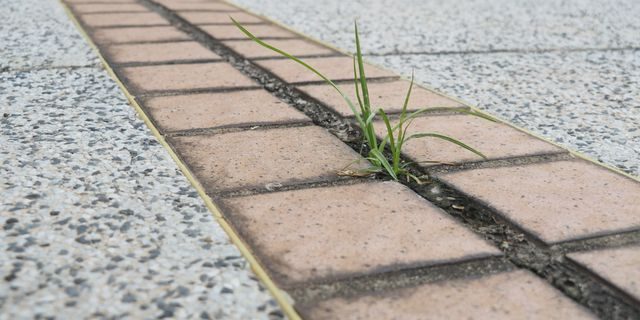
Denver homeowners are well-acquainted with the wild shifts of Front Range weather. But beneath our feet lies an even more volatile antagonist: bentonite clay. This highly expansive soil acts like a geological accordion, swelling by up to 20% when winter snowpacks melt and contracting sharply during dry summer spells. This relentless shifting cracks foundations and turns pristine driveways into undulating trip hazards.
When dealing with a sunken patio or an unaligned garage floor, the instinctive reaction is often to look for the fastest, cheapest way to prop it back up. However, falling back on traditional mudjacking instead of modern Polyurethane concrete lifting can accidentally trigger a vicious cycle of structural failure.
The Anchor Effect: Why Heavy Slurries Fail
Traditional mudjacking relies on a dense, thick mixture of sand, topsoil, and cement pumped under high pressure. This slurry weighs roughly 100 pounds per cubic foot. In a hydro-geologically stable environment, that sounds sturdy. In Denver’s clay, it operates like an anchor on a sinking ship.
When you add thousands of pounds of heavy slurry onto an already compromised, shifting subgrade, you create massive downward stress. Once the clay inevitably contracts during the next dry spell, that newly added weight accelerates the re-sinking process. The underlying soil simply cannot support both the original concrete slab and the massive block of heavy mud underneath it.
The Physics of the Foam Fix
This is where Polyurethane concrete lifting entirely changes the math. Instead of fighting volatile soil with raw weight, it uses precise, material science.
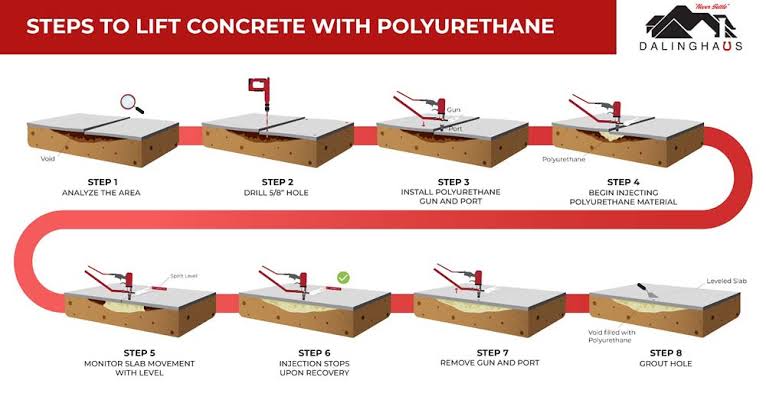
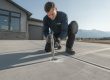
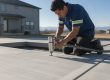
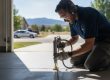
The material is injected as a thin liquid that penetrates deep into the shifting soil matrix before undergoing a rapid chemical expansion. This approach tackles the unique challenges of the Front Range through three distinct mechanisms:
-
-
Featherweight Compressive Strength: The cured foam weighs only 2 to 4 pounds per cubic foot—nearly 95% lighter than traditional mudjacking materials. It exerts thousands of pounds of lifting pressure upward without overloading the sensitive clay below.
-
Hydrophobic Security: Denver’s extreme freeze-thaw cycles mean subgrade moisture is constantly moving. Polyurethane foam is entirely waterproof. It won’t wash away, erode, or absorb water, keeping the void permanently sealed.
-
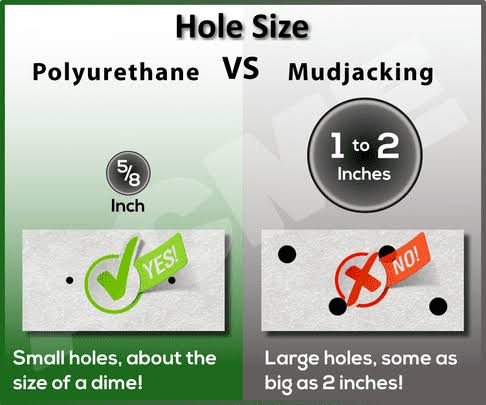
Minimal Structural Intrusion: Traditional mudjacking requires drilling large, unsightly 2-to-3-inch holes across your concrete surface. Polyjacking relies on injection ports the size of a dime (5/8 of an inch), ensuring your concrete doesn’t look like a patchwork quilt after the repair is complete.
-
Debunking Two Critical Front Range Misconceptions
Misconception #1: “If it’s a chemical foam, it’s bad for my lawn and the Denver water table.”
This is a frequent concern for eco-conscious Coloradans. While the liquid components are highly reactive inside the injection gun, the fully cured foam is completely inert, stable, and non-toxic. It does not leach chemicals into the surrounding soil or degrade over time, making it fundamentally safer for the local ecosystem than eroding cement-slurry mixtures that can alter soil pH.
Misconception #2: “Mudjacking is cheaper, so it’s worth the gamble.”
Upfront, mudjacking might cost less on an initial invoice. But when you factor in Colorado’s high-risk soil profile, it is prone to fail within a couple of seasons. Because mudjacking contractors cannot control how their heavy slurry interacts with expanding clay, they rarely provide long-term warranties. Polyurethane repairs frequently come with extensive guarantees because the material physically stabilizes the subgrade rather than just temporarily stacking weight under it.
The Bottom Line
Fixing concrete along the Front Range isn’t just about leveling a flat surface; it’s about outsmarting the soil beneath it. By utilizing Polyurethane concrete lifting, you aren’t just hitting a temporary reset button on your sunken slab—you are installing an engineered, moisture-proof barrier that keeps your property level, no matter how volatile Denver’s dirt decides to be.