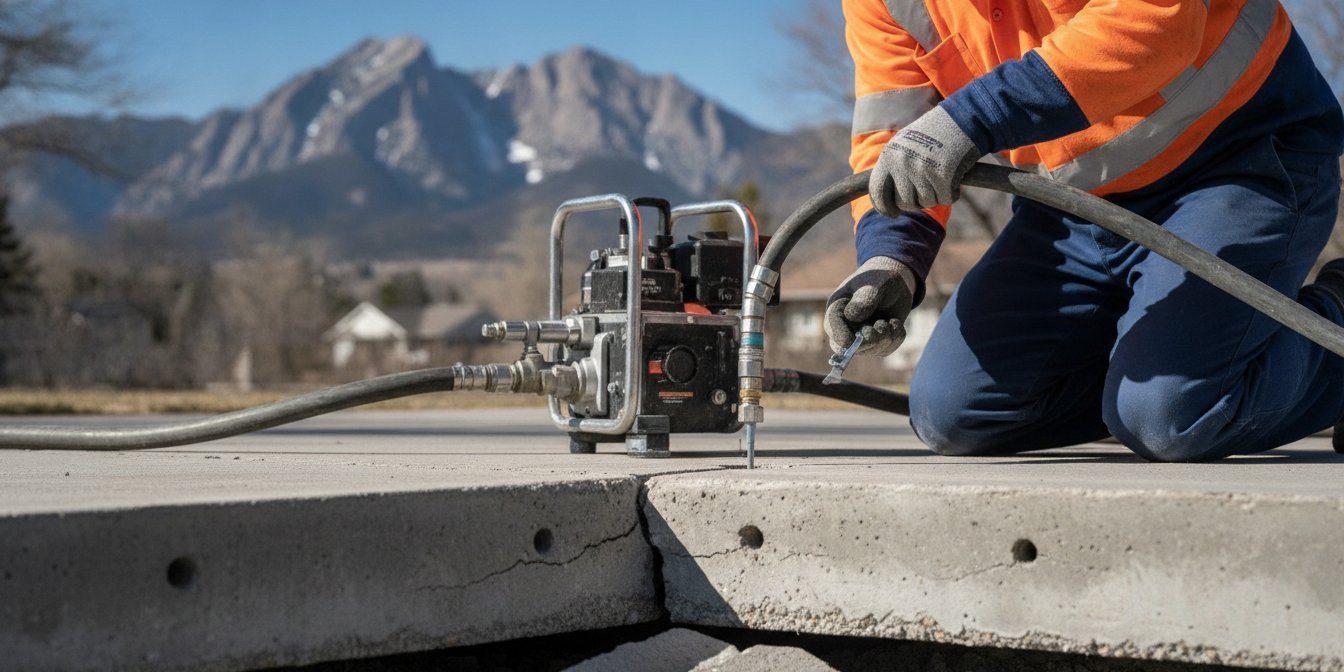
In the shifting landscape of the Front Range, a foundation repair that ignores the unique chemistry of Boulder’s expansive clay is little more than a temporary bandage. You’ve likely watched with growing concern as hairline cracks expand or basement doors begin to stick, sensing that the ground beneath your home is constantly in motion. Utilizing polyurethane foam injection for foundation repair Boulder offers a sophisticated, precision-engineered alternative to the invasive disruption of traditional excavation. It’s frustrating to face the prospect of structural failure, especially when older methods involve heavy machinery that can leave your property in shambles for weeks.
We understand that your home’s structural integrity is a personal priority. By choosing a high-density polymer approach, you can achieve a stable, level foundation without the mess or high costs of traditional methods. This article details how this modern technology works, why it’s the superior choice for stabilizing sinking foundations in our local environment, and how it provides the long-term security every homeowner deserves. You’ll discover the technical advantages of specialized polymers and the methodical, non-invasive process used to restore your peace of mind. We’ll explain the science behind soil stabilization and why precision matters when protecting your most significant investment.
Key Takeaways
- Understand the impact of Boulder’s expansive Bentonite clay and how seasonal moisture cycles trigger the structural settlement that threatens local homes.
- Learn why polyurethane foam injection for foundation repair Boulder is the preferred modern alternative to heavy, invasive excavation and messy traditional methods.
- Compare the technical advantages of lightweight structural geofoam against mudjacking, focusing on rapid cure times and reduced weight on sensitive subsoils.
- Discover the precision of laser-level mapping and strategic injection patterns that allow for controlled lifting without damaging your property or landscaping.
- Gain confidence in a solution that accounts for local geology and integrates advanced structural techniques for lasting foundation security.
Understanding Foundation Settlement in Boulder’s Expansive Soils
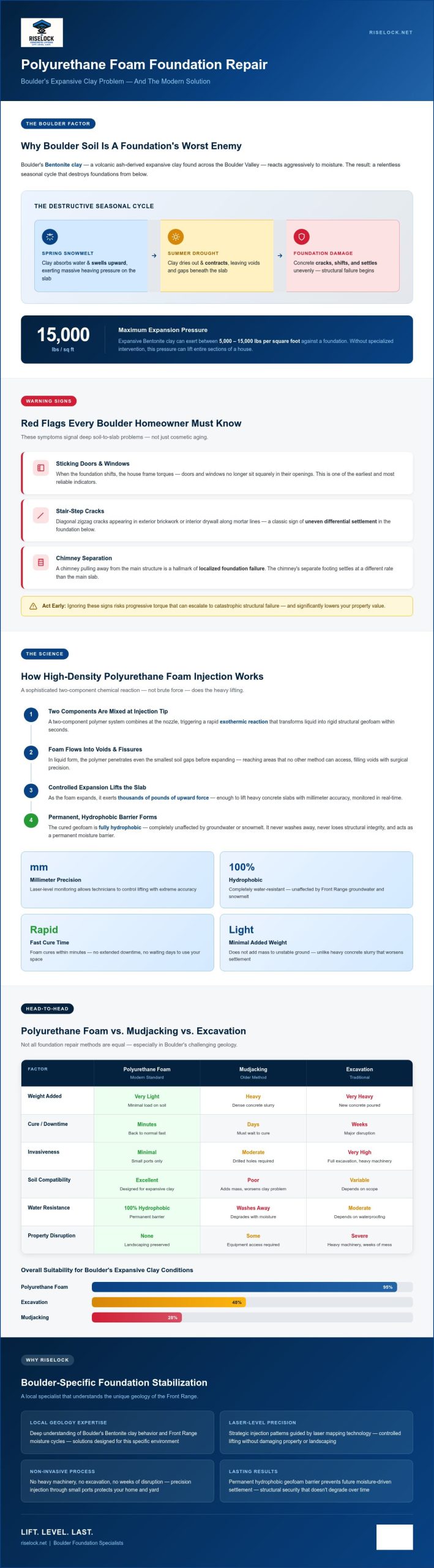
Boulder’s geological profile presents a unique challenge for structural stability. The Boulder Valley is home to high concentrations of Bentonite, a type of volcanic ash-derived clay that is notoriously expansive. Unlike stable sandy soils, these clays react aggressively to moisture. During the heavy snowmelt of a Front Range spring, the soil absorbs water and swells, exerting massive upward pressure on your home. When the summer droughts arrive, the soil parches and retracts, leaving voids beneath your slab. This constant cycle of heaving and shrinking eventually compromises the rigid concrete above.
Distinguishing between minor cosmetic settling and true structural failure is difficult for the untrained eye. Many homeowners assume that a few cracks are just part of a house “finding its place,” but in Colorado, these are often symptoms of deep-seated soil volatility. Traditional repair methods often fail because they don’t account for this local chemistry. Adding heavy concrete slurry can actually exacerbate the problem by placing more weight on unstable ground. This is exactly why polyurethane foam injection for foundation repair Boulder is the modern standard; it stabilizes the soil without adding unnecessary mass.
The ‘Boulder Factor’: Local Geology and Your Slab
The soil profiles near the Flatirons and across the surrounding plains are characterized by high plasticity. Poor drainage around a foundation allows water to pool, which triggers the maximum expansion of these clay layers. Expansive soil is a clay-rich earth that increases in volume as it absorbs water, often exerting pressure between 5,000 and 15,000 pounds per square foot against a foundation. Without specialized intervention, this pressure can lift entire sections of a house, leading to significant structural displacement that simple surface repairs cannot fix.
Warning Signs Every Boulder Homeowner Should Monitor
Identifying the difference between a cosmetic settling crack and a structural failure is essential for timely intervention. While minor hairline cracks might appear in any aging home, certain indicators suggest a deeper problem with the soil-to-slab relationship. Look for these specific red flags:
- Sticking doors and windows: When the foundation shifts, the house frame torques, preventing doors and windows from sitting squarely in their openings.
- Stair-step cracks: These typically appear in exterior brickwork or interior drywall, following the mortar lines in a zigzag pattern that indicates uneven settlement.
- Chimney separation: A chimney that begins to pull away from the main structure is a classic sign of localized foundation failure.
Ignoring these signs doesn’t just lower your property value; it risks the long-term safety of the structure. Addressing the root cause through high-density polymer injection ensures that your home remains level despite the shifting ground beneath it. By acting early, you prevent the progressive torque that eventually leads to catastrophic failure.
The Science of High-Density Polyurethane Foam Injection
The efficacy of modern foundation stabilization relies on a sophisticated chemical reaction rather than brute force. High-density polyurethane is a two-component polymer system. When these components mix at the injection tip, they undergo a rapid exothermic reaction, transforming from a liquid into a rigid, structural geofoam. This transition allows the material to flow into the smallest fissures and voids in the soil before expanding with immense, controlled pressure. It’s a process of surgical precision that addresses the root cause of settlement without the need for heavy equipment.
This expansion is the engine behind polyurethane foam injection for foundation repair Boulder. As the foam expands, it exerts thousands of pounds of upward force, allowing technicians to lift heavy concrete slabs with millimeter accuracy. Unlike traditional methods that rely on the sheer volume of material alone, polyurethane utilizes the physics of expansion to achieve lift. Because the foam is hydrophobic, it remains completely unaffected by the groundwater and snowmelt typical of the Front Range. It doesn’t wash away or lose its structural integrity when the water table rises, acting as a permanent moisture barrier beneath your home. This durability ensures the repair doesn’t degrade like organic fill or traditional cementitious slurries.
Structural Load Bearing and PSI Ratings
Closed-cell polymers are essential for structural applications because of their high compressive strength and density. While native soils in the Boulder Valley vary in stability, the cured geofoam often possesses a PSI rating that far exceeds the requirements of the structure it supports. The foam doesn’t just sit on top of the dirt; it “knits” together loose soil particles. This process effectively turns a weak, porous sub-base into a consolidated, load-bearing mass. By using closed-cell polymers, we ensure that the material remains impermeable to water, creating a stable foundation that resists the “heave and shrink” cycles common in Colorado.
Environmental Impact and Safety
Safety is a cornerstone of professional structural work. Once the chemical reaction is complete, which usually takes less than fifteen minutes, the polyurethane becomes an inert solid. It won’t leach chemicals into the surrounding soil or groundwater, making it a responsible choice for sensitive Colorado ecosystems. There’s also a significant “no-waste” advantage. Because we inject only what is needed to achieve the lift, we avoid the massive debris and material waste associated with total concrete replacement. If you’re concerned about the long-term health of your property, choosing specialized foam concrete lifting ensures a permanent soil amendment that won’t degrade over time. This approach respects both the structural requirements of your home and the environmental standards of the Boulder community.
Polyurethane Foam vs. Mudjacking for Foundation Repair
When evaluating options for structural stabilization, the choice usually comes down to traditional mudjacking or modern polyurethane. While mudjacking has been used for decades, it’s often a counterproductive solution for the specific soil conditions found in the Front Range. Utilizing polyurethane foam injection for foundation repair Boulder provides a technical advantage that traditional cementitious slurry simply cannot match. The primary difference lies in the material’s weight and how it interacts with the sensitive subsoils that caused the initial settlement.
Why Weight is the Enemy of Foundation Stability
The concept of “overburden” is critical in foundation repair. If your home is sinking because the soil is weak or porous, adding more weight to that soil is fundamentally illogical. Mudjacking involves pumping a heavy mixture of sand, water, and cement under the slab to fill voids. One cubic yard of mudjacking slurry can weigh as much as 2,500 pounds, while the same volume of high-density polyurethane foam weighs approximately 100 pounds. This massive weight difference means that mudjacking often triggers secondary settlement by compressing the soil further. For a more detailed technical comparison, you can explore this Polyurethane vs Mudjacking guide to modern slab restoration.
Precision and Control in the Lifting Process
Precision is where modern polymer technology truly excels. Technicians can achieve leveling accuracy within 1/10th of an inch, a feat nearly impossible with hydraulic mudjacking. Traditional methods rely on high-pressure pumps that can lead to “blowouts,” where the heavy slurry escapes from the sides of the slab or creates uneven pressure pockets. This lack of control often results in over-lifting or cracking the very concrete you’re trying to save. Modern structural contractors are moving away from these legacy methods because they prioritize the long-term integrity of the foundation over a quick, heavy fix.
Beyond technical performance, the practical differences are stark. Mudjacking requires drilling large, 2-inch holes that are difficult to patch discreetly. In contrast, polyurethane requires only 5/8-inch holes, which are roughly the size of a penny. The cure time is also a significant factor. While mudjacking requires several days of “no-load” time to dry and harden, polyurethane reaches 90% of its full structural strength in about 15 minutes. While the initial price of mudjacking might seem lower, the long-term value of a non-invasive, permanent solution makes polyurethane the more ethical and cost-effective choice for Boulder homeowners.
The Precision Injection Process: What to Expect
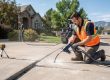
A successful foundation restoration begins long before the first injection. It starts with a comprehensive technical audit of the structure. We utilize digital laser levels to create a precise map of the foundation’s current elevation, identifying the exact zones of settlement. This data allows us to design a strategic drill pattern that maximizes load distribution. By placing 5/8-inch injection ports in a calculated grid, we ensure that the stabilization material reaches the specific areas where the soil has failed, rather than applying a generic, one-size-fits-all approach.
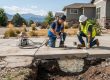
The injection phase is a two-stage process that requires constant monitoring. First, the high-density polymer is injected to achieve soil densification. In this stage, the foam expands to fill subterranean voids and compress loose, porous soil into a solid, load-bearing mass. Only after the sub-base is fully consolidated does the lift begin. This methodical approach is why polyurethane foam injection for foundation repair Boulder is considered a precision-engineered solution. Technicians watch digital sensors in real-time, stopping the expansion the moment the structure reaches its original, level position. This prevents the “over-lifting” common in less sophisticated methods.
Laser-Guided Accuracy and Monitoring
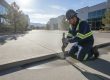
Precision isn’t just a goal; it’s a requirement for structural work. We track the lift to the millimeter using digital levels that provide instant feedback. These sensors are sensitive enough to detect the moment the soil is fully densified before any upward movement of the slab occurs. Depending on the specific void architecture, we may select a ‘slow-rise’ foam to ensure the material penetrates deep into the soil profile or a ‘fast-rise’ formula for immediate lifting power. This level of technical control ensures that the repair accounts for the unique soil dynamics of your specific property.
Clean-up and Final Restoration
The final steps are designed to be as non-invasive as the injection itself. Once the stabilization is complete, the injection ports are removed, and the small holes are patched with a color-matched concrete grout. Unlike traditional concrete work that leaves a lasting mess, the site is left clean and functional. Because the high-density polymer reaches nearly its full structural strength in approximately 15 minutes, you can return to using the space immediately. You don’t have to wait days to move furniture back or park your car on the slab. We finish every project with a final inspection and a walkthrough to ensure you have total confidence in the work. If you’re ready to stabilize your home with this advanced method, you can schedule a professional site assessment to get started.
Why RiseLock for Boulder Foundation Stabilization?
RiseLock Concrete Lifting brings a unique combination of modern innovation and traditional ethical standards to every project. We understand that foundation repair in the Boulder Valley requires more than just a truck and a pump. It demands a deep understanding of the local geology and the specific engineering of Colorado homes. Our approach to polyurethane foam injection for foundation repair Boulder is grounded in technical mastery, ensuring that every injection serves the dual purpose of soil stabilization and structural restoration. We view your home’s integrity as a personal priority, moving beyond simple leveling toward long-term security.
Integrating Post-Tension Knowledge with Foundation Repair
A significant number of modern residential slabs in Boulder are post-tensioned, meaning they contain high-strength steel cables under immense pressure. Inexperienced contractors often overlook this, which creates a severe risk of “cable blowouts” during the drilling phase. Because we specialize in post tension installation and repair, we possess the specialized skills to identify cable layouts and protect the structural concrete reinforcement. This expertise allows us to perform lifts that other companies might find too risky or complex. We ensure that the stabilization process preserves the structural tension of your slab from the ground up.
Your Partner in Structural Security
Our commitment to professional reliability means we operate with an ethical backbone. We don’t believe in hyperbolic marketing or recommending services that aren’t vital to your home’s health. We provide grounded, confident assessments that focus on what you actually need to protect your property’s value. Serving the entire Front Range, we act as a professional guide through the stress of structural damage. By choosing a partner that stays at the forefront of industry technology while maintaining high standards of craft, you gain more than a level floor. You gain the peace of mind that comes from a permanent, precision-engineered intervention. If you’ve noticed the warning signs of settlement, request a professional evaluation from RiseLock today to begin the restoration process.
Restoring Structural Confidence in the Front Range
Stabilizing a home in the Boulder Valley requires an approach that respects both the local geology and the specific engineering of the structure. We’ve explored how high-density polymer methods address the root cause of settlement by densifying unstable soils without adding the burdensome weight of traditional cementitious slurry. This precision-engineered intervention ensures that your foundation remains level and secure, even as seasonal moisture cycles continue to affect the surrounding Bentonite clay.
By choosing polyurethane foam injection for foundation repair Boulder, you’re opting for a non-invasive, permanent solution that protects your property’s long-term value. Our team’s technical mastery in specialized post-tension structural reinforcement and high-density polyurethane ensures that every lift is executed with surgical accuracy. We’re proud to serve Boulder and the Front Range as a dependable partner in structural restoration and stabilization. Secure your foundation with RiseLock’s precision foam injection today. You can move forward with confidence, knowing your home rests on a stable and professionally reinforced base.
Frequently Asked Questions
Is polyurethane foam injection permanent for foundation repair?
Utilizing high-density polyurethane foam injection for foundation repair Boulder is considered a permanent solution for soil stabilization. Once the polymer cures, it becomes an inert, rigid solid that doesn’t degrade or wash away due to seasonal groundwater cycles. It effectively amends the soil structure by filling deep voids and densifying the sub-base. While the material itself is permanent, it’s essential to maintain proper drainage to prevent new soil movement in untreated areas.
How much does polyurethane foundation repair cost in Boulder?
The cost of foundation stabilization in the Front Range varies based on the volume of material required and the complexity of the lift. Factors such as the depth of subterranean voids and the total square footage of the affected area influence the final investment. While we don’t provide flat-rate pricing without a site assessment, this modern method is typically more economical than total concrete replacement. It provides long-term value by preventing catastrophic structural failure.
Will the foam injection process damage my landscaping or driveway?
This process is remarkably non-invasive and won’t damage your property or landscaping. We use small, 5/8-inch injection ports that are roughly the size of a penny, requiring only minimal drilling. Unlike traditional methods that use heavy machinery and large trucks, our equipment is lightweight and often stays on the street. This approach preserves your curb appeal and keeps your property clean throughout the entire restoration and stabilization process.
Can polyurethane foam lift a heavy two-story foundation?
High-density structural polymers possess the expansion force necessary to lift multi-story residential structures. Technicians select specific foam densities designed for heavy load-bearing applications rather than simple slab-on-grade work. The material expands with thousands of pounds of pressure, allowing for a controlled, precise lift of heavy footings. We monitor the process with digital sensors to ensure the lift is gradual and doesn’t compromise the structural integrity of the upper floors.
What is the difference between polyjacking and foundation piering?
Polyjacking, or foam concrete lifting, focuses on stabilizing the soil and filling voids directly beneath the slab to provide uniform support. Foundation piering involves driving mechanical steel piles deep into the earth until they reach load-bearing strata or bedrock. While piering is necessary for some deep-seated structural issues, polyurethane injection is often the superior choice for stabilizing slabs affected by the “heave and shrink” cycles of Boulder’s expansive clay.
How long do I have to wait to use my floors after the injection?
You can resume normal use of your floors almost immediately after the process is complete. High-density polyurethane reaches approximately 90% of its full structural strength within 15 minutes of injection. This rapid cure time is a significant advantage over traditional cementitious repairs, which often require days of restricted access. You don’t have to wait to move furniture back or walk on the treated areas, making it an efficient choice for busy households.
Does the foam attract pests like termites or rodents?
Polyurethane foam does not attract termites, rodents, or other pests. The material is a synthetic, non-organic polymer that offers no nutritional value to insects or animals. Once cured, it forms a dense, rigid barrier that is extremely difficult for pests to penetrate. This inorganic nature ensures that the stabilization material won’t rot or become a nesting ground, providing a clean and durable foundation for your home over the long term.
Is polyurethane foam environmentally friendly for Colorado yards?
Modern polyurethane is an environmentally responsible choice for Colorado homeowners. Once the chemical reaction is complete, the foam becomes an inert solid that won’t leach harmful chemicals into the soil or the local water table. It’s a “no-waste” solution because we only inject the precise amount of material needed. This method avoids the heavy carbon footprint and massive debris associated with tearing out and replacing large sections of concrete.