

Polyurethane foam can be recycled mechanically or chemically, but not every discarded piece is recovered. Rigid foam does not biodegrade easily, so it can persist in landfills. In Colorado Springs, polyurethane foam’s environmental impact depends on how it is made and how it is handled at the end of its life.
Recycling can turn foam scrap into useful materials, and chemical methods can recover components for manufacturing. But disposal choices matter, too. Foam in landfills may leach chemicals into soil and groundwater, while incineration can release toxic compounds, making effective emission controls important.
This article explains how polyurethane foam is made, how its feedstocks and manufacturing affect emissions, and how chemical safety concerns change throughout the material’s life. It also compares mechanical and chemical recycling with landfill disposal and incineration, showing where environmental burdens can arise and how end-of-life options differ.
Key Takeaways
- Assess insulation’s environmental footprint across its service life, including energy used in production and energy savings during use.
- Follow polyurethane foam from petrochemical feedstocks through manufacturing to see where energy use and material waste can arise.
- Distinguish exposure concerns during uncured chemical handling from the properties of foam after it has fully cured.
- If your concern is uneven concrete rather than foam disposal, learn how polyurethane concrete lifting and concrete leveling can address settled slabs.
What is Spray Polyurethane Foam?
Spray polyurethane foam forms when polyols and diisocyanates mix and react, creating a plastic-like material used in insulation and other applications. In spray systems, expanding foam can provide a thermal and air barrier. Its environmental profile involves more than climate effects: production energy, chemical inputs, use, and end-of-life handling all matter.
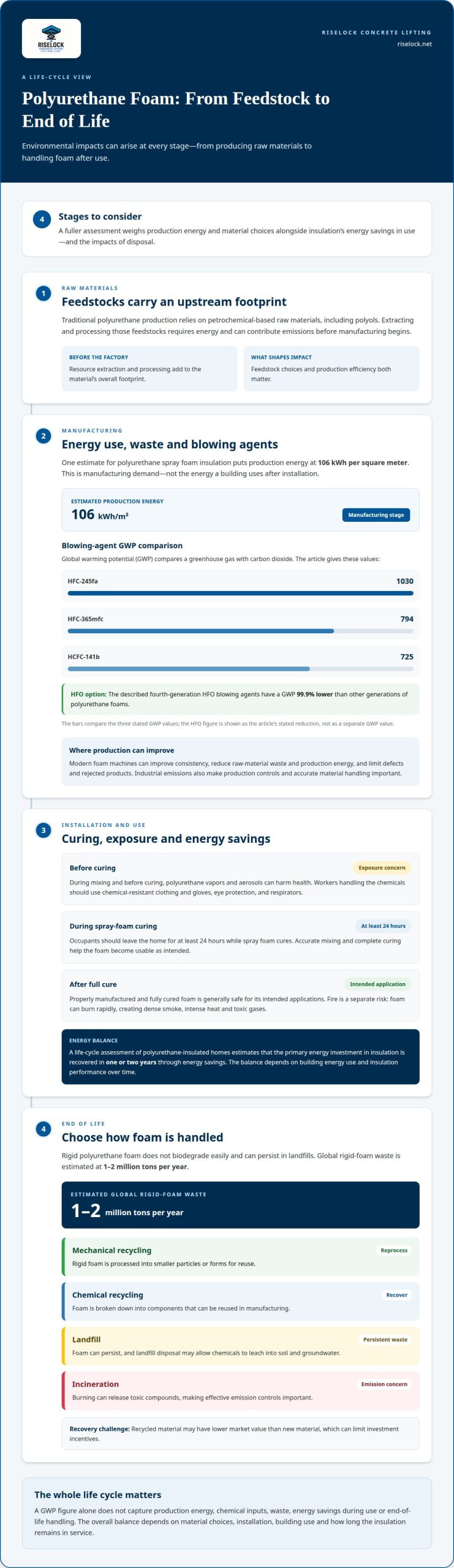
Global warming potential (GWP) compares greenhouse gases with carbon dioxide. It measures energy absorbed over a given period by emissions of 1 ton of a gas, relative to emissions of 1 ton of carbon dioxide. HFC-245fa has a GWP of 1030; HFC-365mfc has a GWP of 794; HCFC-141b has a GWP of 725. The described fourth-generation HFO blowing agents have a GWP 99.9% lower than other generations of polyurethane foams. Blowing-agent selection can therefore significantly change the climate impact compared across formulations.
Beyond global warming potential (GWP), an environmental assessment considers energy demand, chemical inputs, waste, and effects during use. Insulation can reduce a building’s energy consumption, so operating benefits belong alongside manufacturing burdens. The balance depends on how the building is used, how much insulation is installed, and how long it remains in service. A GWP figure alone cannot represent these factors or describe production energy and discarded material.
Global rigid polyurethane foam waste is estimated at 1-2 million tons per year. Mechanical recycling processes rigid foam into smaller particles or forms for reuse; chemical recycling breaks it into components that can be reused in manufacturing. These routes produce different outputs, and recycled material may have lower market value than new material, limiting investment incentives. That makes recovery and landfill diversion relevant parts of the environmental assessment, in addition to blowing-agent emissions.
Manufacturing emissions and chemical safety
Polyurethane’s impacts depend on its chemical manufacturing and on how carefully the material is mixed and installed. Exposure concerns differ before curing, after curing, and during a fire.
Chemical Releases and Biodegradability
Biodegradability describes whether microorganisms can break a material down naturally. Polyurethane foam is not naturally biodegradable, so discarded foam can persist instead of quickly returning to the environment.
Do polyurethane foam products release VOCs or other chemicals over time? During mixing and before curing, polyurethane vapors and aerosols can harm health. Properly manufactured and fully cured foam is generally safe for its intended applications. Workers handling the chemicals should use chemical-resistant clothing and gloves, eye protection, and respirators.
For spray foam, occupants should leave the home for at least 24 hours while it cures. Installation quality matters because accurate mixing and complete curing determine whether the foam becomes usable as intended. Fire presents a separate risk: polyurethane foams can burn rapidly, producing dense smoke, intense heat, and toxic gases. OSHA advises avoiding ignition sources around foam, including open flames, smoking, and cutting torches.
Lower-Impact Products and Installation Practices
Lower-impact options include foam systems that use HFO blowing agents and manufacturing practices that reduce waste. In Colorado Springs, careful mixing and controlled application also matter because they affect material use, defects, and rejected product.
Modern foam machines can improve consistency, reduce raw-material waste and production energy, and minimize defects. Closed-cell spray foam can act as an air and water barrier, so installation continuity matters to its function. Moisture management depends on the building assembly and how the foam is applied, not just the product label.
Which lower-impact products or installation practices are available in Colorado Springs? HFO-blown systems and precise application are relevant options; production equipment that limits waste can also reduce resource use. If your concern is a settled concrete slab rather than building insulation, polyurethane concrete lifting addresses that separate structural issue.
Polyurethane foam feedstocks and manufacturing emissions
Traditional polyurethane foam production relies on petrochemical-based raw materials, including polyols. Extracting and processing those feedstocks requires energy and can contribute emissions before manufacturing begins. The global footprint therefore includes upstream resource use, factory energy, and material waste, not only emissions from a finished product. Feedstock choices and production efficiency shape these impacts.
One estimate for polyurethane spray foam insulation puts production energy at 106 kWh per square meter. That figure represents manufacturing demand, not the energy used by a building after installation. A life-cycle assessment of polyurethane-insulated homes estimates that the primary energy investment in insulation is recovered in one or two years through energy savings. The balance depends on the building’s energy use and the insulation’s performance over time.
Manufacturing practices affect how much feedstock becomes usable foam. Modern foam machines can reduce raw-material waste, improve consistency, lower production energy, and limit defects and rejected products. These improvements can reduce the resources needed per usable product. Industrial processes can also produce harmful emissions, so production controls and accurate material handling matter alongside equipment efficiency.
In the United States, the Clean Air Act requires regulation of major sources under Section 112(d). The flexible polyurethane foam industry reports compliance with federal and state emission standards and the Clean Air Act. That statement concerns the industry’s reported compliance, not a claim that manufacturing has no emissions. For readers assessing insulation, the useful distinction is between regulated emissions and the wider environmental footprint of feedstocks, factory energy, and product performance.
Production choices also connect with global climate impacts. Over a 100-year period, 1 kg of nitrous oxide is equivalent to 273 kg of CO₂. This comparison shows why emissions are assessed by their warming effect, not just their mass. Reducing energy demand, avoiding preventable production waste, and improving insulation efficiency address different stages of the footprint; no single measure captures them all.
Environmental impacts of rigid PU foam disposal
Rigid polyurethane foam can persist in landfills because it does not biodegrade easily. Chemicals from landfilled foam may leach into soil and groundwater, creating ecological and health risks. Disposal matters beyond climate impact: it determines whether material is buried, recovered, or burned. In Colorado Springs, polyurethane foam’s environmental impact depends in part on how renovation waste is handled.
How should polyurethane foam waste be disposed of in Colorado Springs? Separate rigid foam from other debris and send it for recycling if an available route accepts it. If recycling is not available, use the applicable local solid-waste disposal channel. Do not burn foam.
Recycling options depend on the foam type and condition. Mechanical recycling processes rigid foam into smaller particles or forms for reuse, while chemical recycling breaks it into components for further manufacturing. Recovered material needs a suitable use to displace new raw materials. Flexible foam from furniture or mattresses follows a different route and can be rebonded into products such as carpet cushion and gym mats.
Incineration is not a simple alternative to landfill. Burning rigid polyurethane foam can release dioxins and other toxic compounds, so emission-control systems are needed to mitigate those effects. Controlled recovery differs from open burning, which lacks those controls. When assessing the environmental impact of polyurethane foam in Colorado Springs projects, consider both where discarded foam goes and what pollution controls are used during processing.
For renovation or demolition, sort foam before it mixes with wood, metal, or general waste. Where practical, keep reusable pieces clean and intact, since contamination can complicate recovery. Separate rigid insulation offcuts from flexible foam products because their potential recycling routes and end uses differ. For property owners planning wider renovations in the area, Colorado Springs Painters at cos-painters.com provides professional painting and property improvement services. The practical takeaway: recover rigid foam when a suitable route accepts it, and avoid uncontrolled burning.
RiseLock Concrete Lifting: Polyurethane Concrete Lifting
RiseLock Concrete Lifting provides polyurethane concrete lifting for sunken or uneven concrete, a separate issue from insulation foam disposal. The service is relevant when a slab has settled and needs lifting or leveling, not when rigid foam needs recycling or disposal. Keeping those problems distinct helps direct each to the right solution: foam waste belongs in an appropriate recovery or disposal stream, while concrete movement calls for structural attention.
For uneven slabs, Concrete Leveling can address changes in surface height; Concrete Repair addresses damaged concrete. The suitable approach depends on the condition and purpose of the concrete. If a settling slab is your concern, contact RiseLock Concrete Lifting to discuss the issue.
Choose the Right Next Step for Your Project
Environmental decisions become more practical when you distinguish material handling from structural repair. For foam, consider its condition and whether a suitable recovery route can use it. For concrete, focus on the surface problem and the work needed to address it. This keeps polyurethane foam’s environmental impact in Colorado Springs connected to practical choices without confusing insulation disposal with concrete stabilization.
For settled or uneven concrete, RiseLock Concrete Lifting provides polyurethane concrete lifting and concrete leveling. Post-tension installation is also available when relevant to the project. The appropriate next step depends on the structural issue—whether you are repairing a suburban driveway or evaluating outbuildings and barn slabs on equestrian estates listed through Colorado Horse Property.
If concrete movement is affecting your property, contact RiseLock Concrete Lifting to discuss your project. A clear understanding of the problem is a sound place to begin.
Frequently Asked Questions
Can polyurethane be recycled?
Yes, some polyurethane foam can be recycled, though the process and end use depend on foam type. Flexible foam scrap can become bonded carpet cushion, which typically contains around 90% recycled content. Chemical recycling can produce monomers and oligomers for manufacturers to process further; these are feedstocks, not finished consumer products. This distinction helps explain why “recyclable” doesn’t mean every foam item enters the same recovery stream.
And what effect do the foaming gases you use have?
Blowing agents affect climate impact because their greenhouse warming effects vary by chemical. Their contribution depends on the agent and whether it escapes during production or use. But the gas is only one part of a foam product’s footprint: feedstock processing and manufacturing energy matter, too. Insulation can also affect a building’s energy use, so a full assessment looks beyond the blowing agent alone.
Do you know the environmental impact of polyurethane?
Yes. Its environmental impact includes petrochemical feedstocks, production energy, greenhouse emissions, and waste at the end of use. Recovery can make a practical difference in some product streams: an estimated 1.2 billion pounds of post-industrial and post-consumer foam scrap are diverted annually from U.S. landfills to make carpet cushion. That example concerns foam scrap recovery, not a guarantee that every rigid foam item has a recycling route.
Does its manufacture generate CO2 emissions?
Yes. Manufacturing can generate carbon dioxide through the energy used in processing, and producing petrochemical feedstocks also requires resources and energy. A product’s climate footprint may include other greenhouse gases, often expressed as carbon dioxide equivalent for comparison. The amount depends on the production process, energy sources, and material formulation, so foam type alone does not determine manufacturing emissions.
Is polyurethane an environmentally friendly material?
Polyurethane foam is not automatically environmentally friendly or harmful in every application. Its impact depends on raw materials, production, use, and end-of-life handling. Insulation, for example, may reduce building energy demand, while discarded foam can create waste-management challenges. Compare the complete application and lifecycle rather than relying on a single property, such as insulation performance or recyclability.
What are the environmental impacts of polyurethane foam?
Impacts can include greenhouse emissions from feedstocks and manufacturing, persistent waste, and pollution risks from poor disposal. Fire presents a separate concern: polyurethane foam smoke commonly contains carbon monoxide and may also contain benzene, toluene, nitrogen oxides, and hydrogen cyanide. These are combustion products, not a description of normal use. Considering production, application, and end-of-life together gives a more complete environmental assessment.