What if the material used to fix your sunken driveway is actually the primary cause of it sinking again six months later? In Colorado, where roughly 50% of our soil has a high potential for shrinking and swelling, traditional heavy repairs often fail because they ignore the underlying geological reality. Most homeowners feel the frustration of recurring settlement or trip hazards that create unnecessary liability, yet they fear that traditional mudjacking will simply add more weight to already unstable ground.
We understand that you need a solution that addresses the root of the problem rather than just masking the symptoms. By hiring a specialized concrete leveling contractor Colorado residents can trust, you ensure that your property benefits from modern, lightweight polyurethane injection rather than outdated, heavy slurries. This article will help you master the technical requirements for Colorado concrete restoration. We provide a professional 2026 vetting checklist to help you verify structural integrity and secure long-term stabilization. You’ll learn how to navigate recent building code updates in Denver and Arvada while choosing a partner who views your structural safety as a personal priority.
Key Takeaways
- Learn why Colorado’s expansive bentonite clay and intense freeze-thaw cycles necessitate a lightweight, non-invasive approach to slab stabilization.
- Discover why a professional concrete leveling contractor Colorado property owners trust relies on 5/8-inch precision drill holes and 15-minute cure times for minimal disruption.
- Access a comprehensive 10-point vetting checklist to ensure your chosen provider is licensed for structural repair and uses high-density, closed-cell foam.
- Identify the specific risks associated with post-tension slabs in the Front Range and how to avoid catastrophic damage to internal cable systems during restoration.
- Master the technical requirements for permanent soil stabilization to eliminate recurring settlement and long-term liability from trip hazards.
The Colorado Factor: Why Our Soil Demands Specialized Concrete Leveling
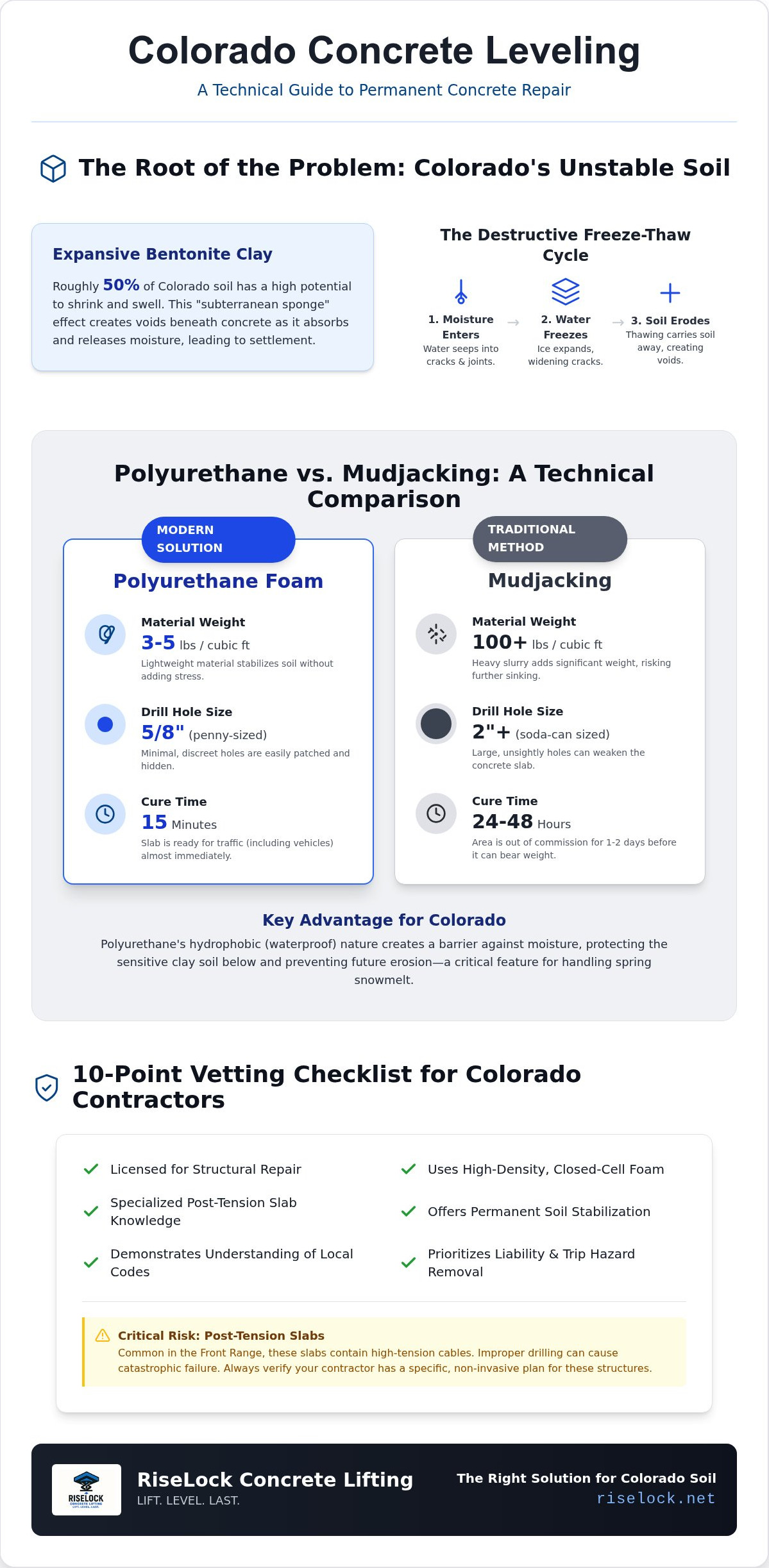
Colorado’s unique geology presents a specific set of challenges for any concrete leveling contractor Colorado residents choose to hire. The primary culprit is bentonite clay, a highly expansive soil that reacts aggressively to moisture changes. In the Front Range, extreme weather patterns and high altitudes accelerate these movements, leading to the cracked driveways and sunken patios common in our neighborhoods. Our intense freeze-thaw cycles further complicate the issue; water enters open joints, freezes, and expands, widening cracks and allowing even more moisture to reach the sensitive clay below. Understanding these technical nuances is the first step toward a permanent repair.
Expansive Clay and Hydrostatic Pressure
Bentonite clay acts like a subterranean sponge. During the spring runoff or heavy rain cycles, these clay particles absorb water and expand significantly. This expansion creates intense hydrostatic pressure that can push concrete slabs upward or outward. When the inevitable dry summer heat arrives, the soil loses that moisture and shrinks, leaving behind hollow spaces known as voids. This constant movement is why many traditional repairs in our state don’t last more than a few seasons.
Without a stable base, the heavy concrete eventually drops into these gaps. It’s a recurring cycle that requires a sophisticated intervention. High-density foam is uniquely qualified for this environment because it fills these voids and stabilizes the soil without adding a heavy load that would trigger further settlement. It provides a waterproof barrier that helps mitigate the “sponge effect” of the underlying clay.
The Problem with Traditional Mudjacking in the Rockies
Traditional mudjacking has been a standard industry practice for decades, but it’s often ill-suited for the specific demands of the Rocky Mountain region. To compare the technical differences, it helps to examine various Concrete leveling methods and their physical properties. When evaluating a concrete leveling contractor Colorado homeowners should prioritize those who understand the physics of soil load-bearing capacity.
The weight difference between materials is the most critical factor for long-term success in our state. Consider these technical benchmarks:
- Mudjacking Slurry: Approximately 100 pounds per cubic foot.
- Polyurethane Foam: Approximately 3 to 5 pounds per cubic foot.
When a contractor pumps hundreds of pounds of heavy limestone slurry onto unstable, expansive clay, they often accelerate the sinking process. The underlying soil is already struggling to support the weight of the concrete slab; adding a massive amount of heavy mud only increases the downward pressure. This leads to a secondary settlement that can be more difficult to fix than the original problem. Lightweight stabilization is the only ethical choice for Colorado homeowners who want to protect their property’s structural integrity.
Polyurethane vs. Mudjacking: A Technical Comparison for 2026
Modern restoration focuses on technical precision rather than brute force. While mudjacking was once the standard, the 2026 market favors materials that adapt to Colorado’s expansive soil without complicating the structural load. A professional concrete leveling contractor Colorado relies on will typically advocate for polyurethane due to its immediate functionality. Polyurethane reaches 90% of its compressive strength within 15 minutes, allowing for immediate traffic. In contrast, traditional mudjacking slurry requires 24 to 48 hours to cure before it can support the weight of a vehicle.
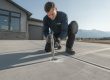
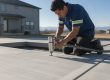
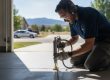
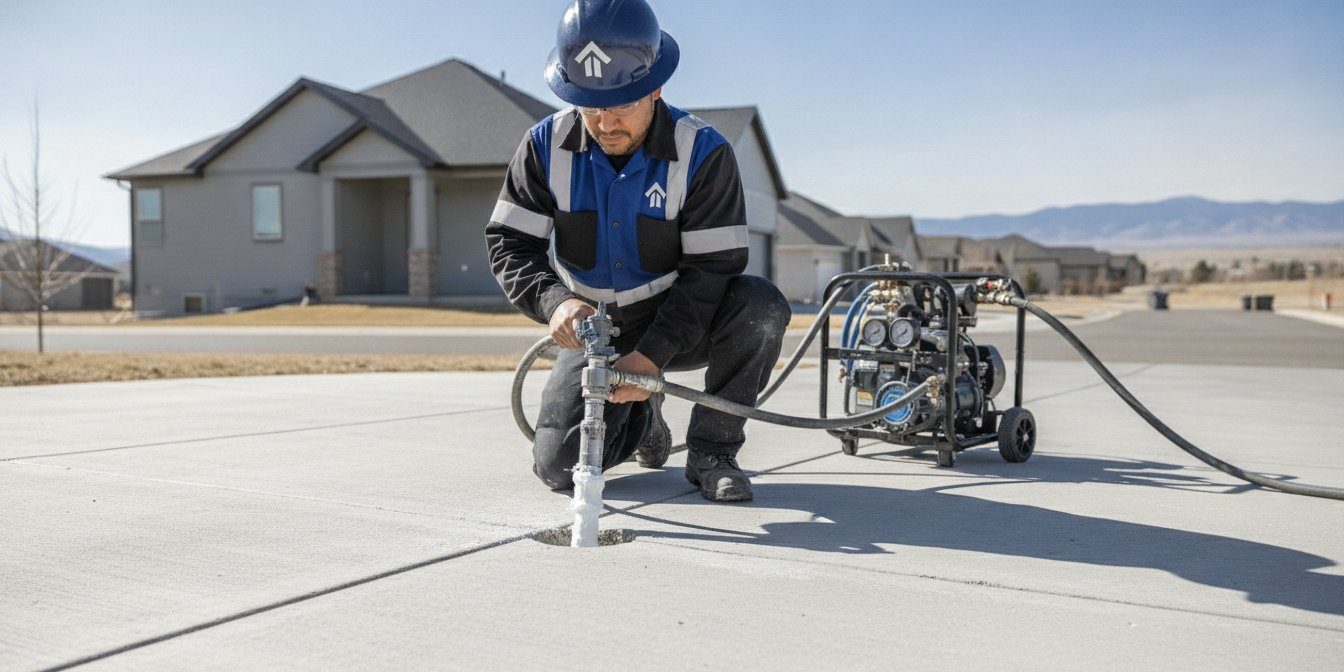
The physical impact on your property is also significantly reduced with modern methods. Polyurethane requires only 5/8-inch precision holes, which are roughly the size of a penny. These are easily patched and blended into the existing texture. Mudjacking necessitates 2-inch holes that can compromise the structural integrity of the slab and leave unsightly scars across your driveway. Beyond aesthetics, the chemical makeup of modern foam provides a hydrophobic barrier. This is vital during the spring thaw, as it prevents Colorado snowmelt from infiltrating the sub-base and washing out the soil that supports your concrete.
Precision Lifting and Structural Integrity
Achieving a perfectly level surface requires more than just upward pressure. High-density foam allows for 1/10th of an inch accuracy during the expansion phase, ensuring that transitions are seamless and trip hazards are entirely eliminated. This level of precision is essential for residential driveways that must support the weight of heavy SUVs and work trucks. For a repair to be permanent, concrete leveling must include thorough void filling. This process replaces air pockets with a high-compressive-strength medium that prevents the slab from cracking under heavy load.
Long-Term Durability and ROI
When evaluating the investment, it’s helpful to look at the “cost per year of life” comparison. While slurry is cheaper upfront, its tendency to erode or settle under its own weight often necessitates a second repair within a few years. Polyurethane foam is an inert material that doesn’t biodegrade or leach chemicals into the ground, making it a stable choice for the 2026 environmental landscape. It effectively seals the underside of the concrete, preventing future erosion from seasonal runoff. Because of this durability, polyurethane concrete lifting has become the preferred method for maintaining high-value real estate across the Front Range. If you’re ready to secure your property’s foundation, exploring precision restoration services is a logical next step for long-term security.
10-Point Checklist for Hiring a Concrete Leveling Contractor in Colorado
Selecting a concrete leveling contractor Colorado property owners can trust requires more than comparing estimates. Because our state faces unique geological pressures, the vetting process must focus on technical competence and material quality. A contractor who treats a Denver driveway the same as one in the Midwest likely doesn’t understand the volatile nature of our expansive soils. Use this 10-point checklist to ensure your chosen partner possesses the specialized knowledge required for a lasting restoration.
- Material Specification: Confirm the use of high-density, closed-cell polyurethane foam. This material is essential for moisture resistance and won’t break down when exposed to Colorado’s heavy snowmelt.
- Licensing and Insurance: Verify they are licensed and insured specifically for structural repair. Standard landscaping insurance often doesn’t cover the complexities of slab stabilization or structural lifting.
- Warranty Terms: Look for a multi-year warranty against further sinking. A confident provider stands by their work because they’ve stabilized the underlying soil, not just lifted the concrete surface.
- Post-Tension Expertise: Ensure they can identify and safely navigate post-tension cables. In many newer Colorado developments, drilling blindly into a slab can cause catastrophic structural failure.
- Local Geological Knowledge: They should explain how they account for the specific clay content in your neighborhood.
- Compressive Strength: Verify the foam used can support the specific load of your driveway or patio.
- Precision Equipment: Confirm the use of laser leveling systems rather than visual estimations.
- Utility Safety: Ensure they follow strict “Call Before You Dig” (811) protocols for every job.
- Site Restoration: Ask for their specific policies regarding clean-up and hole patching.
- Professional Communication: Prioritize contractors who offer technical explanations over high-pressure sales tactics.
Technical Vetting Questions
A qualified professional should welcome technical scrutiny. When interviewing a potential concrete leveling contractor Colorado residents should ask specific questions about local soil conditions. Soil in Parker behaves differently than the clay found in Arvada; your contractor must explain how they account for these neighborhood-specific nuances. Ask about the compressive strength of the foam they use for driveway applications. The material must handle the heavy load of modern SUVs and trucks without compressing over time. Finally, inquire about their measurement tools. Precision restoration requires a laser leveling system to ensure 1/10th of an inch accuracy, providing a level of detail that visual checks simply cannot match.
Operational and Safety Standards
Safety protocols are a non-negotiable aspect of professional restoration. Even for shallow foam injections, a responsible contractor always coordinates 811 protocols to identify underground utilities. Beyond safety, consider the operational footprint. Professionalism is reflected in clear clean-up and site restoration policies that leave your property in better condition than they found it. You should also pay attention to the communication style. A “quiet authority” that focuses on technical solutions is a reliable indicator of expertise. High-pressure sales tactics often mask a lack of technical depth, whereas a focus on structural integrity suggests a partner who views your repair as a long-term priority.
Special Considerations: Post-Tension Slabs and Trip Hazards
In newer Colorado developments, particularly in communities like Castle Rock, Thornton, and Parker, structural engineering often relies on post-tension (PT) technology. These slabs are reinforced with high-strength steel cables that are pulled to extreme tension after the concrete has set. This design allows for thinner slabs that resist cracking on our expansive soils, but it introduces a critical safety variable for any concrete leveling contractor Colorado homeowners might engage. A technician who lacks specific training in PT systems risks more than just a poor repair; they risk a catastrophic structural failure.
RiseLock Concrete Lifting views every leveling project through the lens of structural integrity. We integrate specialized post tension installation knowledge into our restoration process. This expertise ensures that we identify internal reinforcement systems before the first injection hole is drilled. By prioritizing this technical awareness, we provide a level of security that standard contractors simply cannot match, protecting both the property and those who occupy it.
Post-Tension Safety Protocols
Identifying a post-tension slab is a fundamental skill for a qualified restoration expert. Homeowners can often spot these systems by looking for circular plastic “stamps” or grout-filled patches along the edge of the garage floor or the exterior slab perimeter. These marks indicate the anchor points where the cables were stressed during construction. Lifting these slabs requires a sophisticated understanding of how internal tension affects the slab’s response to foam expansion.
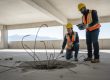
The consequences of drilling into a live cable are severe. A cable blowout involves the sudden, violent release of thousands of pounds of energy. This can send shards of concrete flying and compromise the entire foundation’s load-bearing capacity. Because these cables don’t always run in a perfectly straight line through the concrete, a contractor must have the technical mastery to map out safe zones for injection. Standard repairs become high-risk operations without this specific professional vetting.
Mitigating Liability and Trip Hazards
Structural safety is one half of the equation; the other is premises liability. According to ADA standards, any vertical displacement of 1/4 inch or more is classified as a trip hazard. In Colorado’s volatile climate, these hazards often develop at transition points between driveways and garage floors or along municipal sidewalks. For business owners, these uneven surfaces represent a significant legal risk that can lead to costly personal injury claims.
Restoring a level surface is a proactive step in risk management. Polyurethane concrete lifting is the ideal solution for commercial environments because it eliminates the hazard with minimal downtime. Storefronts and walkways can return to full service in just 15 minutes, ensuring that safe access is maintained for customers and employees alike. If you are concerned about uneven slabs on your property, scheduling a professional structural evaluation is the most effective way to address liability before an accident occurs.
Securing Your Property with RiseLock’s Precision Methods
Restoring a property’s value requires a partner who understands that concrete repair is fundamentally a sub-surface engineering challenge. As a specialized concrete leveling contractor Colorado residents depend on, RiseLock Concrete Lifting focuses on the technical mastery of the Front Range’s unique geography. We recognize that every project from Boulder to Colorado Springs demands a custom approach tailored to local soil behavior. Our commitment to structural integrity means we don’t just lift slabs; we stabilize the foundation of your investment using advanced materials and methodical precision.
We’ve chosen high-density polyurethane as our exclusive lifting medium because it aligns with our high standards for durability and cleanliness. By moving away from traditional, less effective alternatives, we provide a solution that addresses the root cause of settlement without the mess or weight of outdated methods. This technical choice reflects our professional pride and our desire to provide long-term security for every client we serve. Our process is designed to be informative and efficient, ensuring you understand the “why” behind every injection we make.
The RiseLock Concrete Lifting Difference
Professional reliability is the cornerstone of RiseLock Concrete Lifting. We view your structural problems as a personal priority, positioning ourselves as a dependable partner rather than just another service provider. This ethical backbone means we never cut corners with traditional mudjacking, even when it might be the easier path. Our team maintains an authoritative expert status by staying at the forefront of industry technology, ensuring that our methods comply with the most recent building code updates in municipalities like Denver and Aurora. We act as your professional guide, moving you away from the stress of structural damage toward the peace of mind that comes with high-precision intervention.
Next Steps for Your Concrete
Starting your restoration project begins with a precision site assessment. During your first consultation, a RiseLock Concrete Lifting expert will conduct a thorough technical evaluation of your concrete surfaces. We look beyond the visible cracks to identify the underlying voids and soil conditions that caused the initial sinking. You won’t encounter high-pressure sales tactics; instead, you’ll receive a logical explanation of the specialized skills and materials required to stabilize your property permanently. We take the time to answer your questions about post-tension safety or municipal requirements, ensuring you feel confident in the structural integrity of the final result. If you’re ready to restore the safety and aesthetics of your home or business, Schedule your concrete leveling assessment with RiseLock Concrete Lifting today.
Securing Your Property with Technical Precision
Ensuring the longevity of your concrete surfaces requires a strategy that respects Colorado’s volatile geology. We’ve explored how expansive bentonite clay and intense freeze-thaw cycles demand more than a superficial fix. By choosing a concrete leveling contractor Colorado property owners can trust, you prioritize structural integrity over temporary patches. Modern restoration isn’t just about lifting a slab; it’s about stabilizing the soil with high-density polyurethane and protecting complex post-tension systems from unintentional damage.
RiseLock Concrete Lifting remains a dedicated partner for residents across the entire Front Range, specializing in high-density polyurethane and professional post-tension slab management. We believe that technical mastery and ethical service are the only ways to provide lasting peace of mind for your home or business. Our team is ready to guide you through the vetting process and deliver a precise, durable solution that protects your investment for years to come. Don’t let sunken slabs compromise your property’s safety or curb appeal any longer.
Get a Professional Concrete Leveling Estimate from RiseLock Concrete Lifting and take the first step toward a level, secure surface today.
Frequently Asked Questions
Is concrete leveling better than replacing the whole slab in Colorado?
Concrete leveling is often superior to replacement because it addresses the underlying soil voids without the high cost and disruption of a new pour. In Colorado’s expansive clay environments, a new slab will simply sink again if the sub-base isn’t stabilized. Choosing a specialized concrete leveling contractor Colorado property owners trust ensures that the existing concrete is preserved while the foundation is reinforced for long-term durability.
How long does polyurethane concrete leveling last in the Colorado climate?
Polyurethane leveling is designed to be a permanent structural fix. The high-density foam is an inert material that doesn’t biodegrade, leach, or lose its compressive strength over time. It is specifically engineered to withstand the Front Range’s intense freeze-thaw cycles. Because the material is hydrophobic, it remains stable even during periods of high moisture, providing a reliable foundation that outlasts traditional organic fillers.
Can you do concrete leveling in the winter in Denver?
Restoration work can proceed throughout the winter months in the Denver metro area. Our specialized equipment and materials allow for successful injections even in colder temperatures. As long as the slab is clear of heavy ice and the soil isn’t frozen deep below the surface, the foam will expand and cure correctly. This flexibility allows homeowners to address trip hazards and liability concerns before the spring runoff begins.
Will polyurethane foam wash away with heavy Colorado snowmelt?
High-density polyurethane is entirely hydrophobic and won’t wash away. Unlike traditional mudjacking slurry, which can erode when exposed to water, polyurethane creates a waterproof seal beneath your concrete. This barrier is particularly effective during the heavy Colorado snowmelt season. It prevents water from infiltrating the sub-base and creating the new voids that typically lead to secondary settlement.
Is polyurethane foam toxic to my lawn or garden?
Modern structural foams are environmentally responsible and safe for use near residential landscaping. Once the two-part liquid components react and expand into a solid foam, the material becomes inert. It won’t leach harmful chemicals into your lawn, garden, or local groundwater. This makes it a preferred choice for eco-conscious property owners who want to restore their concrete without compromising the health of their surrounding environment.
How much does concrete leveling cost compared to mudjacking in Colorado?
While the initial investment for polyurethane is often higher than traditional mudjacking, the long-term ROI is significantly better. Mudjacking adds roughly 100 pounds per cubic foot to already unstable soil, which frequently leads to recurring settlement. By hiring a professional concrete leveling contractor Colorado residents avoid the hidden cost of repeated repairs. Foam provides a lightweight, permanent stabilization that protects the property’s value over time.
What happens if a contractor hits a post-tension cable while leveling?
Drilling into a post-tension cable is a severe structural emergency that releases immense stored energy. A cable blowout can cause violent concrete fragmentation and compromise the entire slab’s load-bearing capacity. This is why we emphasize the importance of technical vetting. A qualified expert must identify anchor points and use specialized knowledge to map out safe injection zones, ensuring the structural reinforcement remains intact throughout the process.
How soon can I drive my car on the leveled concrete?
You can return your driveway to full service almost immediately after the injection is complete. Polyurethane foam reaches approximately 90% of its full compressive strength within 15 minutes of application. This rapid cure time is a significant advantage over traditional methods that require 24 to 48 hours of downtime. You can drive your vehicle over the restored slabs before our technicians even leave your property.