What if your home’s foundation isn’t just a static block of concrete, but a dynamic mechanical system held together by thousands of pounds of live tension? For homeowners facing structural shifts, the realization that their slab contains active steel cables often brings a mix of confusion and genuine concern. When you’re dealing with the expansive bentonite clay of the Front Range, specialized post tension foundation repair Denver services become a necessity rather than an option. You understand that your home’s stability depends on more than just a surface patch; it requires a deep understanding of how these engineered systems interact with Colorado’s volatile soil.
This guide will help you master the technical requirements and specialized repair methods needed to restore post-tension slabs to their original engineered standards. We’ll walk through the complexities of cable blowout recovery and the critical importance of 2025 Denver Building Code compliance. By the end of this article, you’ll know how to navigate local regulations and utilize precision hydraulic re-tensioning to protect your property’s resale value and your family’s safety.
Restoring a post-tension slab is an exercise in high-precision workmanship. It demands a partner who views structural integrity as a personal priority and possesses the technical mastery to handle specialized hydraulic equipment. We’ll show you how modern, high-density foam and professional re-tensioning provide the long-term security you need.
Key Takeaways
- Understand how Denver’s expansive bentonite clay creates upward pressure on post-tension slabs and why traditional stabilization methods often fall short.
- Learn the specific indicators of cable blowouts and anchor corrosion that necessitate professional post tension foundation repair Denver to restore structural continuity.
- Discover why cable splicing and hydraulic re-tensioning offer a more precise, cost-effective alternative to total foundation replacement.
- Identify the mandatory 2025 Denver Building Code requirements for stamped engineering plans and specific tensioning sequences during restoration.
- Explore how advanced diagnostics, including ground-penetrating radar, ensure the safety and precision of every structural intervention.
The Impact of Denver’s Expansive Soils on Post-Tension Foundations
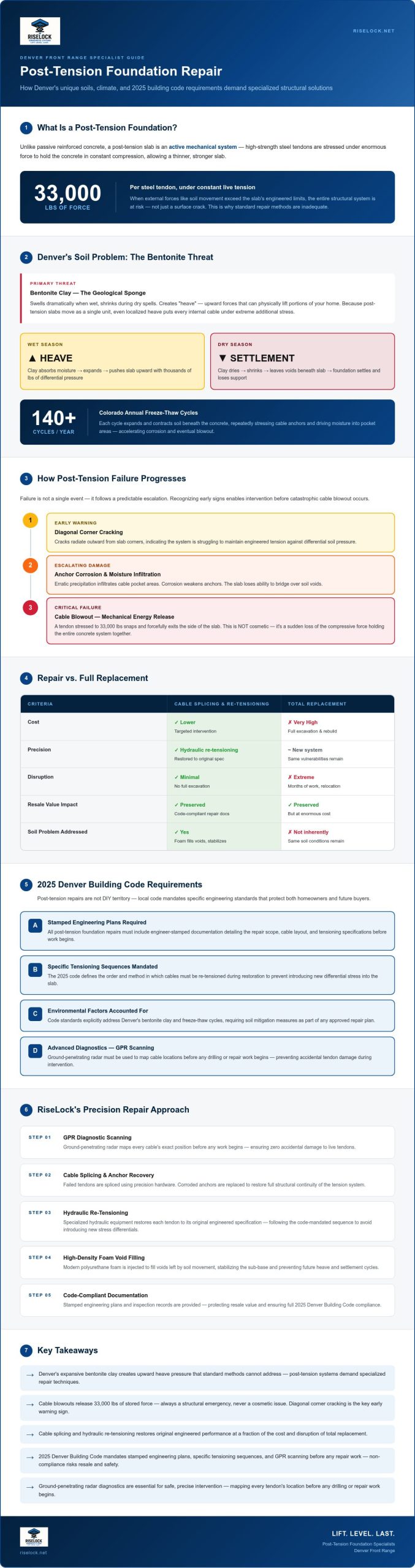
Post-tension foundations aren’t just static concrete pads; they’re active mechanical systems held in a state of constant compression. Unlike traditional reinforced concrete that relies on passive steel bars, a post-tension slab utilizes high-strength steel tendons stressed to approximately 33,000 pounds of force. This internal tension allows the slab to resist significant loads while maintaining a thinner profile. However, this active state means that when external forces like soil movement occur, the structural stakes are much higher. In the Front Range, these systems are under constant pressure from the ground up.
The primary antagonist for foundations in this region is bentonite clay. This mineral acts like a geological sponge, swelling significantly when wet and shrinking during our long dry spells. This cycle creates “heave,” an upward force that can actually lift portions of a home. Because post-tension slabs are designed to move as a single unit, localized heave can create massive stress on the internal cables. When these forces exceed the slab’s engineered limits, specialized post tension foundation repair Denver services become necessary to restore structural equilibrium.
Bentonite Clay and the Physics of Soil Heave
Clay minerals in the Denver metro area expand at the molecular level when moisture levels fluctuate. This expansion exerts differential pressure on a slab, meaning one corner might experience thousands of pounds of upward force while another remains stable. Expansive soil is a geological material that undergoes significant volume changes based on moisture content, creating unpredictable upward forces that can compromise Denver’s post-tension slabs. This uneven pressure can force the concrete to flex beyond its capacity, putting the high-stress anchors and cables at risk of failure.
The Interplay of Climate and Structural Tension
Colorado’s semi-arid climate creates a unique set of challenges for foundation stability. The state experiences over 140 freeze-thaw cycles annually, which creates a rhythmic expansion and contraction of the soil directly beneath the concrete. When moisture freezes, it expands; when it thaws, it leaves behind voids that can lead to soil shrinkage and foundation settlement during the summer months.
- Erratic precipitation patterns can lead to moisture infiltrating the “pocket” area of cable anchors, leading to corrosion.
- Localized soil moisture management, such as proper grading, is essential for maintaining PT integrity.
- The 2025 Denver Building Code accounts for these environmental factors, requiring specific engineering standards to mitigate soil-related failures.
Managing these climate-driven stresses requires more than just cosmetic fixes. When the internal tension of the slab is compromised by soil movement, specialized post tension foundation repair Denver techniques are the only way to restore the slab to its original engineered specifications and ensure long-term security.
Understanding Post-Tension Failure: Cables, Anchors, and Blowouts
A post-tension foundation operates as a dynamic system of internal forces. When a component fails, the result is more than a simple fracture; it’s a mechanical release of stored energy. A cable blowout occurs when a steel tendon, typically stressed to approximately 33,000 pounds, snaps and forcefully exits the side of the slab. This isn’t just a cosmetic issue; it’s a loss of the compressive force that keeps the concrete together, leaving the home vulnerable to the soil pressures discussed earlier.
Specific crack patterns often precede these events. Look for diagonal cracking radiating from the corners of your home, which indicates that the slab is struggling to maintain its engineered tension. When these internal forces are compromised, the foundation loses its ability to bridge over soil voids, leading to a rapid decline in structural integrity.
Identifying the Signs of Tendon Failure
Identifying the need for post tension foundation repair Denver starts with a thorough visual inspection of the slab’s perimeter for protruding cable ends. These “blowouts” are the most obvious sign of failure, but they’re often the final stage of a long-term problem. The sound of a cable snap is unmistakable, often mimicking a gunshot as the high-tension steel recoils and punches through the concrete exterior. If you notice a sudden, loud pop followed by new cracks in the foundation or exterior brickwork, the system’s tension has likely been compromised.
Corrosion Mechanisms in Colorado Foundations
Corrosion is the silent driver of most failures in the Front Range. Denver’s winter weather requires heavy use of de-icing salts, which can leach into the groundwater and migrate toward the anchor pockets. Once moisture enters these pockets, the steel begins to oxidize and expand, eventually cracking the concrete from the inside out. This is particularly problematic for unbonded tendons found in many older Denver homes, where the protective grease may have degraded over time, leaving the steel exposed to the elements.
The anchor point serves as the most critical and vulnerable component of the entire system. It’s the physical junction where the tension of the cable is transferred into the concrete. If the anchor fails due to corrosion or poor initial installation, the entire length of that tendon becomes useless. This loss of tension removes the clamping force that prevents the concrete from cracking under the stress of soil heave.
Delaying post tension foundation repair Denver only increases the risk of secondary structural damage and may lead to non-compliance with the 2025 Denver Building Code during future property inspections. Protecting your home requires a proactive approach to concrete repair and stabilization before a single failure leads to a catastrophic loss of structural security.
Strategic Repair Methods vs. Foundation Replacement
Many homeowners fear that a failed cable requires a complete slab demolition. This is rarely the case. Modern post tension foundation repair Denver techniques allow for localized intervention that restores the original tension without the massive expense and disruption of a full replacement. A complete slab pour involves weeks of labor and significant property damage, whereas a targeted repair addresses the specific point of failure while preserving the surrounding concrete. This surgical approach maintains the home’s structural footprint while correcting the mechanical failure within the slab.
The Precision of Cable Splicing and Re-tensioning
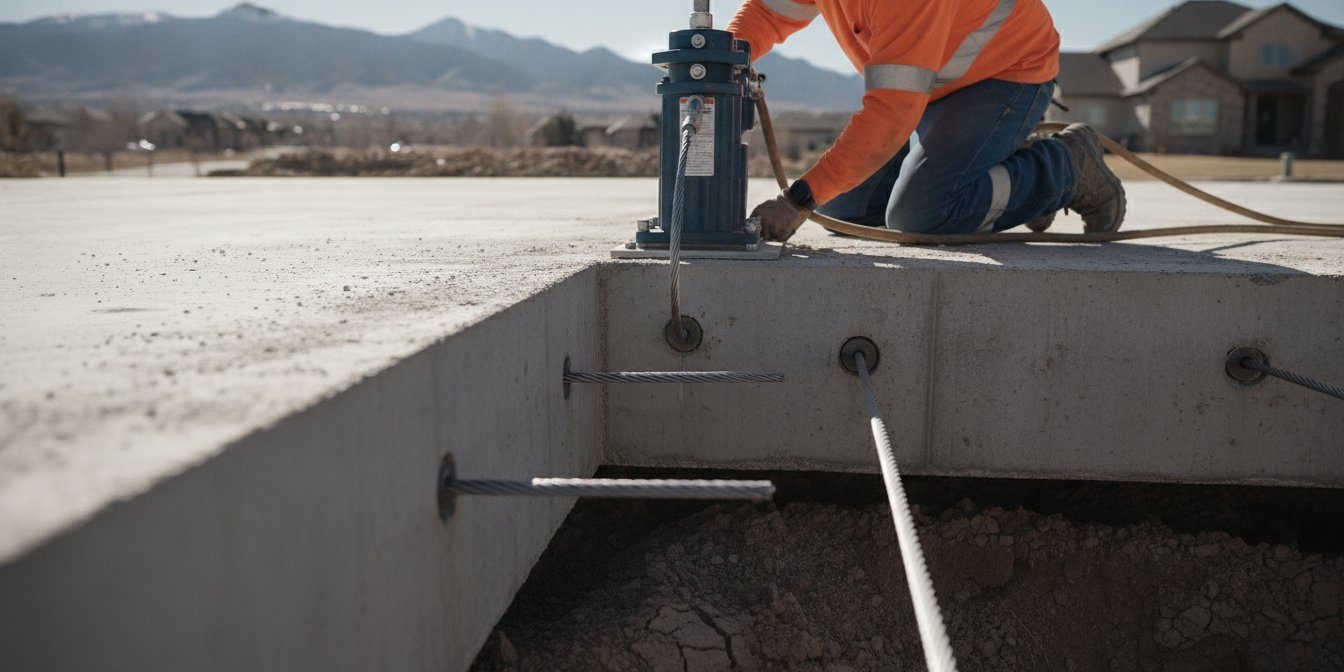
Restoring a snapped tendon begins with locating the precise point of failure. Technicians use specialized equipment to expose the damaged section without extensive excavation. Once the break is identified, a cable splice is performed to join the severed ends. This isn’t a simple patch; it involves a mechanical coupler designed to withstand the same 33,000 pounds of force as the original cable. It’s a high-stakes process that requires specialized hydraulic re-tensioning equipment to ensure the steel is pulled to the exact specifications required by the original engineering plans.
After the splice is secure, the re-tensioning process brings the slab back to its designed state of compression. This isn’t a “one size fits all” application. Every cable must be stressed to a specific poundage to balance the internal forces of the foundation. To ensure long-term durability, the new anchor point is properly grouted and sealed. This protects the high-strength steel from the Colorado soil moisture and de-icing salts that lead to the corrosion mechanisms we see across the Front Range.
In cases where soil heave or settlement has created voids beneath the slab, we often utilize polyurethane concrete lifting as a complementary stabilization method. This high-density foam fills the gaps and provides a stable base, allowing the post-tension system to perform its job effectively. It’s a clean, efficient way to provide a solid foundation for the newly tensioned cables to act upon.
Cost-Efficiency and Property Value Restoration
Choosing a specialized repair over replacement offers a clear return on investment. A localized repair can often be completed in a fraction of the time required for a full slab replacement. This speed minimizes the stress on the household while immediately restoring the structural integrity of the home. It avoids the need for massive landscaping restoration and the logistical nightmare of vacating the premises during a full-scale reconstruction.
Beyond the immediate fix, certified repairs are crucial for protecting property resale value. When you work with post tension installation experts, the work is documented to meet professional standards. This ensures that any existing home warranties remain transferable and that future home inspections don’t uncover unresolved structural issues. It’s about providing peace of mind through technical mastery and long-term security.
Navigating the 2025 Denver Building Code for Foundation Repairs
Compliance with the 2025 Denver Building Code is a non-negotiable requirement for any structural concrete restoration. Because post-tension systems involve significant mechanical energy, the city mandates that all repairs be governed by a stamped engineering plan. This document serves as the technical roadmap for the restoration, ensuring that every cable splice and re-tensioning event aligns with the original structural intent. A structural engineer of record must determine the specific tensioning sequence, as an incorrect order can introduce new stresses into the slab and compromise its overall stability.
The City of Denver requires several inspection milestones throughout the project. These typically include a pre-tensioning inspection to verify the placement of new anchors and a post-tensioning review to document the final elongation of the cables. Navigating these requirements ensures that your post tension foundation repair Denver project remains legally sound and protects your property’s long-term value. It’s a methodical process that prioritizes safety over speed.
Mandatory Engineering and Documentation
Obtaining “as-built” drawings is a critical first step in locating PT cables and identifying the original engineering specifications. These drawings prevent accidental cable strikes during excavation and provide the necessary data for a precise repair. Attempting unpermitted or DIY repairs on a post-tension system is a high-risk endeavor that can lead to severe legal issues or the denial of insurance claims during a home sale. Once hydraulic tensioning is complete, the 2025 code requires specialized testing to verify that each tendon has reached its required load, providing a verifiable record of the home’s restored integrity.
Local Compliance in Aurora and Centennial
While the 2025 Denver Building Code sets a high bar, surrounding municipalities like Aurora and Centennial have their own specific nuances regarding foundation permits. For instance, some areas require updated soil-testing reports to account for the current moisture levels in the bentonite clay before a permit is issued. In Parker and Castle Rock, navigating HOA requirements is often as important as the building permit itself, as structural work may require specific aesthetic or logistical approvals. RiseLock coordinates directly with these local building departments to manage the inspection schedule, keeping a close eye on evolving requirements for 2026 to ensure that every phase of the project meets both city standards and community regulations.
Ensuring your home meets these rigorous standards requires a partner who understands the intersection of engineering and local law. Contact RiseLock today for a professional evaluation of your slab and to begin the process of concrete repair that meets all 2025 regulatory requirements.
RiseLock’s Precision Approach to Post-Tension Restoration
Restoring structural integrity to a post-tension slab requires more than just mechanical skill; it demands a data-driven strategy. At RiseLock, we view every post tension foundation repair Denver project as a high-precision engineering task. We don’t rely on guesswork or surface-level indicators to determine the state of your foundation’s internal tendons. Instead, we utilize advanced diagnostic tools to map the exact location and condition of every cable before a single tool touches the concrete. This methodical approach ensures that our repairs are as durable as the original engineered design.
Our commitment to the ethical standards of Denver’s structural community means we prioritize long-term security over quick fixes. We often integrate concrete repair in Denver with our specialized post-tension stabilization to address both internal mechanical failures and external degradation. This holistic restoration process provides a comprehensive solution that protects your property value and your peace of mind.
Advanced Diagnostics and Cable Mapping
Ground-penetrating radar (GPR) is the cornerstone of our diagnostic process. This technology allows us to see through the slab, identifying the precise layout of the tension grid and any hidden voids or points of corrosion. Guessing cable location is dangerous; it often leads to accidental strikes that can cause immediate structural failure or injury. By mapping the tension grid before any drilling or lifting begins, we ensure that our intervention is surgically precise. This level of detail allows for minimal disruption to your home while providing the technical data necessary for a successful re-tensioning event.
Why Precision Workmanship is Non-Negotiable
Tensioning a cable is a delicate balance of physics and professional pride. Over-tensioning can lead to concrete crushing or anchor failure, while under-tensioning fails to provide the necessary compressive force to resist Denver’s expansive soils. Our technicians maintain the quiet authority of industry experts, using specialized hydraulic equipment to meet the exact poundage specified by the structural engineer of record. This level of technical mastery is what separates a standard repair from a RiseLock restoration.
The RiseLock guarantee is built on a foundation of precision, reliability, and long-term peace of mind. We treat your home’s structural problems as a personal priority, delivering a solution that stands up to the unique geological challenges of the Front Range. Our goal is to lead you away from the stress of structural damage toward the security of a professionally stabilized home. Schedule a structural evaluation with RiseLock today.
Securing Your Home’s Structural Future
Managing a post-tension foundation in the Front Range requires a shift from viewing concrete as a static material to treating it as a dynamic, engineered system. We’ve explored how specialized cable splicing and hydraulic re-tensioning provide a superior, more efficient alternative to the disruption of full slab replacement. By prioritizing precision diagnostics and 2025 Denver Building Code compliance, you’re not just fixing a crack; you’re restoring the mechanical balance necessary to withstand our region’s expansive bentonite clay.
Finding the right partner for post tension foundation repair Denver is the most critical step in protecting your property’s resale value and long-term security. Our certified technicians bring technical mastery and professional pride to every project, ensuring that your home’s structural integrity meets the highest engineered standards. Whether you’re in Aurora, Centennial, or the heart of Denver, we view your foundation’s stability as our personal priority.
Request a Professional Foundation Evaluation from RiseLock today and gain the peace of mind that comes with expert, code-compliant restoration. Your home deserves a foundation that’s as resilient as the Colorado landscape.
Frequently Asked Questions
What is a post-tension foundation and how does it differ from rebar?
A post-tension foundation is an active structural system that uses high-strength steel tendons stressed to thousands of pounds to compress the concrete. Unlike traditional rebar, which is a passive reinforcement that only acts when the concrete begins to crack, post-tensioning keeps the slab in a constant state of compression. This allows the foundation to bridge soil voids and resist the upward pressure of expansive clay more effectively than standard reinforced concrete.
How do I know if a post-tension cable in my Denver foundation has failed?
You can identify a failed cable by looking for visible steel strands protruding from the slab’s edge or noticing a sudden gunshot sound originating from the foundation. Diagonal cracks at the corners of your home or interior drywall shifts also suggest tension loss. If you suspect an issue, professional post tension foundation repair Denver specialists use ground-penetrating radar to confirm the internal state of the cables without invasive digging.
Is a broken post-tension cable considered a structural emergency?
A broken cable is a serious structural concern that requires immediate professional evaluation to prevent secondary damage. When a tendon snaps, the slab loses the internal clamping force designed to keep it unified. This localized loss of tension makes the concrete much more susceptible to the heaving forces of bentonite clay; this can lead to rapid structural shifts and compromised safety for the entire building.
Can you repair a post-tension slab without replacing the entire foundation?
Localized repair is the preferred industry standard and avoids the massive disruption of a full foundation replacement. Technicians utilize cable splicing and hydraulic re-tensioning to join broken tendons and restore the exact engineered poundage required by the original design. This surgical approach preserves the existing structure while correcting the mechanical failure, providing a cost-effective and durable solution for Denver homeowners who want to avoid total demolition.
How much does post-tension foundation repair cost in Denver?
The cost of repairing a post-tension slab depends on the number of failed tendons, the location of the breaks, and the accessibility of the anchor points. Every project is unique; factors such as the degree of soil stabilization required and the complexity of the engineering plan influence the final investment. We recommend a professional evaluation to determine the specific technical requirements and scope of work for your particular property.
Are post-tension cable repairs covered by standard Colorado homeowners insurance?
Standard Colorado homeowners insurance policies typically exclude damage caused by soil movement, heave, or gradual settlement. However, every policy is different, and some may offer coverage if the failure is linked to a specific covered peril. It’s essential to review your individual policy documents or consult with your agent to understand your coverage limits regarding structural concrete repairs and whether your specific cable failure qualifies for a claim.
How long do professional post-tension cable repairs typically last?
Professional repairs are designed to be permanent solutions that last for the remaining life of the structure. By using corrosion-resistant couplers and high-grade grout to seal anchor pockets, technicians ensure the new cable splice is protected from moisture and de-icing salts. When performed to the 2025 Denver Building Code standards, these repairs restore the slab’s integrity and provide long-term security against the stress of Denver’s volatile soil cycles.
Do I need a permit for post-tension foundation repair in Aurora or Centennial?
Yes, structural repairs in Aurora, Centennial, and Denver require building permits and stamped engineering plans to ensure safety and code compliance. These municipalities mandate inspections at specific milestones, such as before and after the re-tensioning process. Working with a professional contractor ensures all local regulations are met; this is vital for maintaining your home’s resale value and ensuring the work is legally documented for future inspections.