
A single snapped tendon in a post-tensioned slab represents more than just a broken wire. It’s a silent shift in the structural integrity of your entire building. You’re likely feeling a mounting sense of anxiety as you encounter specialized terms like unbonded monostrand or tendon severs, especially when you’re trying to calculate the actual cost of post tension cable repair. It’s stressful to face a complex engineering problem without a clear sense of the technical variables or the financial commitment required to fix it properly.
We understand that your property’s safety is a personal priority. This guide provides the professional clarity you need to move from uncertainty toward a stabilized foundation. We’ll break down the specific factors that influence restoration, including corrosion levels, anchor conditions, and modern repair techniques. You’ll gain a technical roadmap that explains how precise intervention today prevents the catastrophic expenses and safety risks of tomorrow. By the end of this guide, the path to structural security will be clear and manageable.
Key Takeaways
- Distinguish between immediate cable blowouts and gradual corrosion to prioritize the necessary level of structural intervention.
- Understand how variables like anchorage accessibility and tendon volume directly influence the professional cost of post tension cable repair.
- Assess the long-term financial benefits of proactive restoration compared to the severe liability and safety risks of a structural collapse.
- Explore the technical precision of splicing and hydraulic re-tensioning used to return compromised slabs to their intended structural capacity.
- Recognize why specialized installation knowledge is the most reliable foundation for diagnosing and executing complex cable repairs in Colorado.
Understanding Post-Tension Cable Failure: Blowouts vs. Corrosion
Post-tension cable repair is the specialized process of restoring active structural tension to a concrete slab. Unlike traditional reinforced concrete, which relies on passive steel bars, What is Post-Tensioned Concrete? explains that these systems use high-strength steel tendons tensioned after the concrete has cured. When these cables fail, the slab loses its internal compression, compromising its ability to support designed loads. Understanding the specific nature of a failure is the first step in determining the eventual cost of post tension cable repair.
The visual appearance of a slab is often a misleading indicator of its safety. A floor can look perfectly level and crack-free while the tendons inside are reaching a critical breaking point. Because these cables are buried deep within the concrete, professional diagnostic tools are required to verify their integrity. Ignoring hidden signs of distress often escalates the final cost of post tension cable repair, as a localized fix can quickly evolve into a full-scale structural stabilization project.
The Mechanics of a Post-Tension Blowout
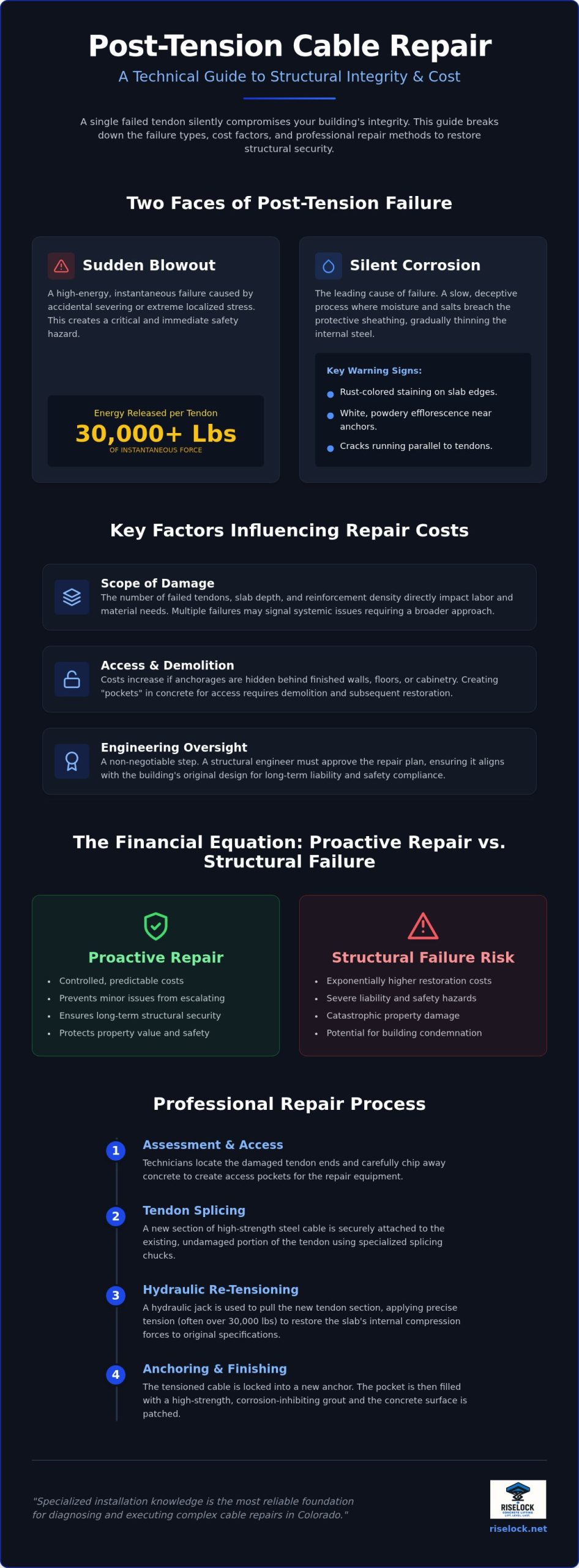
A blowout is a sudden, high-energy event that demands immediate attention. Each half-inch tendon is typically stressed to over 30,000 pounds of force. If a cable is accidentally severed during a renovation or fails due to extreme localized stress, that stored energy is released instantly. The cable can whip through the concrete, often exiting through the slab edge or surface with enough force to cause severe injury or property damage. This immediate loss of load-bearing capacity creates a critical safety hazard. It’s vital to secure the area and restrict access until a specialist can assess the structural stability and secure the loose tendon ends.
Signs of Silent Tendon Corrosion
While blowouts are dramatic, corrosion is a slow, deceptive process. It remains the leading cause of system failure in older structures. In Colorado, our intense freeze-thaw cycles often force moisture and de-icing salts into micro-cracks in the concrete. If the original installation left grout voids or if the protective sheathing is breached, the steel begins to oxidize. Watch for these specific indicators:
- Rust-colored staining leaching from the slab edge or around anchor points.
- White, powdery efflorescence near anchorage zones, suggesting moisture ingress.
- Cracks running parallel to the direction of the tendons, which may indicate internal expansion from rust.
These signs suggest that the internal steel is thinning. This process quietly shifts the burden of support to the surrounding concrete, which is not designed to handle those specific tension forces alone. Early detection through these visual cues can prevent a sudden blowout and keep repair scopes manageable.
Key Factors Influencing the Cost of Post-Tension Cable Repair
Estimating the financial commitment for structural restoration is rarely a matter of a flat fee per cable. Several technical variables dictate the scope of work. First, the number of tendons involved plays a significant role. While economies of scale can apply to larger projects, multiple failures often signal systemic corrosion or installation errors that require a broader approach. Additionally, slab depth and reinforcement density in commercial settings demand more intensive labor and specialized cutting techniques compared to residential foundations.
Engineering oversight is another non-negotiable factor. Most jurisdictions in the Denver area require a structural engineer to sign off on the repair plan. This ensures the Professional Repair Methods used align with the building’s original design specifications. While this adds an initial professional fee, it’s a critical step for liability and long-term security. It validates that the restoration will actually hold the intended load.
Access and Demolition Requirements
Physical accessibility is one of the most significant variables in the final budget. If the anchorage points are buried behind finished drywall, cabinetry, or high-end flooring, the cost of demolition and subsequent restoration will increase. Technicians must create “pockets” in the concrete to access the cable ends for re-tensioning. Surface-level repairs are relatively straightforward. However, repairs requiring deep excavation or work in cramped crawlspaces necessitate more man-hours and specialized debris management. The more obstacles between the technician and the cable, the higher the labor requirements.
Mobilization and Specialized Equipment
Restoring structural integrity isn’t possible with standard construction tools. It requires high-pressure hydraulic jacks and calibrated stressing equipment capable of applying precise force. Because of the weight and sensitivity of this gear, specialized PT contractors typically include mobilization fees. These costs cover the transport of heavy equipment and the setup time required for site-specific safety protocols. Using uncalibrated tools is a risk that compromises the entire slab. If you’re concerned about the stability of your structure, scheduling a professional concrete repair assessment can help identify these variables early. This proactive step ensures the cost of post tension cable repair remains predictable rather than reactive.
The Financial Impact: Repair Costs vs. Structural Failure Risks
Choosing between a proactive repair and deferred maintenance is essentially a choice between a controlled investment and an unpredictable liability. While the immediate cost of post tension cable repair might seem like a significant budgetary line item, it’s a fraction of the expense associated with structural failure. When a single tendon fails, the internal forces of the slab are fundamentally altered. This often leads to a phenomenon known as “unzipping,” where the surrounding concrete begins to spall and crack as it struggles to compensate for the lost tension. This redistribution of stress can trigger a chain reaction, eventually compromising the original slab design and leading to widespread instability.
The Risk of Deferred Maintenance
Neglecting a known structural issue allows corrosion to migrate along the tendon path, infecting adjacent cables. This leads to exponential growth in the eventual cost of post tension cable repair. Beyond the physical work, the financial fallout of structural “red-tagging” can be devastating for property owners. When a building is deemed unsafe by local authorities in cities like Denver or Aurora, property values plummet and occupancy is immediately suspended. The 2021 Surfside tragedy serves as a sobering case study in the high cost of neglect; the ultimate financial and human price far exceeded the cost of the originally recommended repairs. Proactive intervention isn’t just a maintenance task; it’s a critical strategy for asset preservation.
Insurance and Liability Considerations
For property managers and HOA boards, the legal implications of structural integrity are paramount. Documented, professional repairs act as a critical shield against negligence claims. When you hire specialists, you aren’t just paying for the physical labor; you’re securing a structural engineering stamp that satisfies strict insurance requirements. According to research on Structural Failure Risks from NIST, maintaining the resilience of post-tensioned systems is vital for long-term performance and safety. DIY or “handyman” fixes are never an option for PT systems because they lack the precision and documentation required to maintain coverage. A professional repair record proves you’ve met the standard of care required to protect both the residents and the building’s financial future.
Professional Repair Methods: Splicing and Re-tensioning in Colorado Slabs
Restoring a post-tensioned slab requires a surgical approach to structural mechanics. The primary method involves splicing, where technicians use specialized couplers to reconnect a severed or corroded tendon. Once the connection is secure, hydraulic force is applied to re-tension the cable to its original design specifications. This isn’t a surface-level fix; it’s a recalibration of the slab’s internal strength. After tensioning is complete, the anchorage points must be grouted and sealed with high-performance materials to protect the assembly from Colorado’s moisture and salt exposure. This thoroughness is a key factor in the total cost of post tension cable repair, ensuring the fix is permanent rather than a temporary patch.
Splicing vs. Full Tendon Replacement
Determining whether to splice a cable or perform a full replacement depends on the location and extent of the damage. Splicing is often sufficient for localized breaks, but it has technical limits in high-stress zones where the coupler might interfere with the concrete’s cover. In cases of systemic corrosion, the entire tendon might need to be pulled out and a new one “fished” through the existing duct. This labor-intensive process involves navigating the cable through tight turns and internal obstructions, which naturally influences the project budget. For a comprehensive look at slab health beyond the cables, our guide to Concrete Repair in Denver provides a broader perspective on structural restoration.
Colorado Soil and Foundation Stress
Denver’s unique geology, characterized by expansive bentonite soils, places extraordinary pressure on foundations. These soils swell when wet, creating powerful upward forces that can cause unreinforced or compromised slabs to heave. Post-tensioned systems are specifically designed to resist this movement by maintaining high internal compression. When cables fail, the slab loses its ability to fight back against soil-induced stress. To prevent future failures, it’s often necessary to address the soil stability alongside the cable work. We often utilize Polyurethane Concrete Lifting to stabilize the subgrade and fill voids created by soil movement. This dual approach ensures the slab is supported from both the inside and the bottom.
If you’ve noticed signs of slab distress or discovered a broken cable during a renovation, contact our structural specialists for a technical evaluation of your post-tension system. Addressing the cost of post tension cable repair today prevents the soil from winning the battle against your foundation tomorrow.
RiseLock: Precision Post-Tension Repair Solutions in Denver
RiseLock isn’t just a repair contractor; we are specialists with deep roots in post-tension installation. This dual mastery allows us to diagnose failures with a level of precision that general contractors cannot match. By understanding exactly how a system was originally tensioned, we can more effectively restore its intended structural capacity. We utilize modern, high-precision hydraulic equipment specifically calibrated for the unique demands of Colorado’s residential and commercial foundations. This technical rigor ensures that every repair meets strict engineering standards, providing you with long-term security and professional reliability.
Our commitment to safety is absolute. Every project follows engineering-led protocols designed to protect both the structure and its occupants. If you are weighing the long-term value of your property, it’s beneficial to consult with a Concrete Lifting Solution expert who understands how cable integrity and soil stability work in tandem. We view your structural challenges as our personal priority, ensuring that every restoration project is handled with the care and mastery it deserves.
Our Approach to Structural Integrity
The RiseLock methodology is built on a logical, thorough progression: Assessment, Engineering, Execution, and Verification. We start with a technical evaluation to determine the specific scope of work, which helps stabilize the eventual cost of post tension cable repair by preventing mid-project surprises. Our team focuses on minimizing disruption to Denver residential and commercial properties, maintaining efficient and clean job sites. We believe in doing it right the first time. Using inferior materials or rushed techniques only leads to recurring costs and further structural decay. Precision is our standard because your peace of mind depends on the integrity of our work.
Serving the Front Range
Based in Denver, we provide specialized structural services across the entire Front Range, including Aurora, Centennial, Parker, and Colorado Springs. This local focus gives us a distinct advantage. We understand the specific building codes in these jurisdictions and have years of experience dealing with the unique challenges of Colorado’s expansive soils. We don’t just fix symptoms; we solve the underlying structural issues using advanced materials and proven methods. If you have concerns about your building’s foundation or have discovered a broken cable, Contact RiseLock for a Professional Structural Evaluation to ensure your property remains safe and structurally sound.
Securing the Future of Your Structural Foundation
Structural integrity depends on the delicate balance of internal forces. The initial cost of post tension cable repair is a strategic investment that preserves this balance and protects your property from the exponential liabilities of a structural collapse. Whether you’re managing the aftermath of an accidental blowout or addressing the silent progression of tendon corrosion, the path forward requires technical mastery and a clear understanding of Colorado’s unique soil challenges. Precision splicing and hydraulic re-tensioning don’t just fix a broken wire; they restore the safety and longevity of your entire building.
RiseLock serves as your technical partner across the Front Range, from Fort Collins to Colorado Springs. As Denver’s trusted post-tension installation specialists, we combine expertise in high-density polyurethane stabilization with modern structural restoration protocols. We view every slab as a personal priority, ensuring that your foundation remains a secure asset for decades to come. Don’t let structural uncertainty linger when professional intervention is within reach. Secure Your Structure: Schedule a Post-Tension Evaluation with RiseLock today and gain the peace of mind that comes from expert structural care.
Frequently Asked Questions
How do I know if my post-tension cable is broken?
You can identify a broken cable through several physical indicators. A sudden, loud “pop” often signals a blowout. Look for loose cable ends protruding from the slab edge or surface. Other signs include rust-colored staining or cracks running parallel to the tendons. If you suspect a failure in your Denver home, a professional evaluation is the only way to confirm the internal damage and assess the cost of post tension cable repair.
Is a broken post-tension cable an emergency?
A broken cable is a structural priority that requires immediate professional attention. While the building won’t collapse instantly, the loss of tension compromises the slab’s load-bearing capacity. This shift in forces can lead to “unzipping,” where the surrounding concrete begins to fail. Securing the area is essential if a cable has exited the slab. Addressing the issue quickly prevents the damage from spreading to adjacent tendons and escalating the final repair scope.
Can I sell my house with a broken post-tension cable?
Selling a property with known structural damage is challenging and often requires full disclosure to potential buyers. Most lenders won’t approve a mortgage for a home with a compromised post-tension system until repairs are certified by a structural engineer. In the Front Range market, buyers typically expect the seller to address the cost of post tension cable repair before closing. Having documented, professional restoration from a specialist helps preserve your property value and ensures a smoother transaction.
How long does a typical post-tension repair take?
Most localized cable repairs are completed within one to three business days. The timeline depends on the accessibility of the anchorage points and the complexity of the failure. If we need to remove finished flooring or drywall to create access “pockets,” the process takes longer. Our team focuses on efficient execution to minimize disruption to your Denver or Centennial property. We ensure the slab is safely re-tensioned and grouted before finishing the project as planned.
What happens if a post-tension cable is cut during a renovation?
Cutting a cable during a renovation causes an immediate, violent release of tension. This “blowout” can damage the surrounding concrete and poses a significant safety risk to anyone nearby. If this happens, stop all work and clear the area immediately. You’ll need a specialized contractor to assess the damage and install a splice. General contractors aren’t equipped to handle high-pressure re-tensioning, so professional intervention is required to restore the slab’s original design specifications safely.
Does insurance cover the cost of post-tension cable repair?
Insurance coverage typically depends on the cause of the failure. Sudden, accidental damage, such as a cable being cut during a permitted renovation, might be covered under certain property policies. However, failures caused by long-term corrosion or poor maintenance are often excluded as standard wear and tear. We recommend reviewing your policy with your agent. Regardless of coverage, obtaining a structural engineering report is usually necessary to satisfy insurance requirements and prove the building’s safety.
Why is post-tension repair more expensive than standard concrete repair?
Post-tension restoration is more complex than filling a standard crack because it involves active structural forces. It requires specialized hydraulic jacks, calibrated stressing equipment, and the oversight of a structural engineer. Technicians must have specific training to safely handle cables under 30,000 pounds of tension. These technical requirements, combined with the precision needed for splicing and re-anchoring, make the cost of post tension cable repair higher than passive concrete patching or leveling services.
Can any concrete contractor fix a post-tension slab?
Most general concrete contractors lack the specialized equipment and training required to work on post-tensioned systems. Handling high-strength steel under extreme tension is dangerous without proper certification and experience. RiseLock specialists understand the technical mechanics of both installation and repair. Hiring an unqualified contractor can lead to further damage or catastrophic injury. It’s vital to work with a partner who understands Colorado’s building codes and the specific engineering requirements for structural restoration in the Front Range.