
What if the invisible force holding your concrete slab together is slowly becoming its greatest liability? While post-tensioned foundations are engineered for incredible strength, they aren’t invincible. Understanding the specific causes of post tension cable failure is the first step in ensuring your home or commercial building remains stable for decades.
You likely understand that a solid foundation is the bedrock of your property’s value, yet the thought of tendon corrosion or a sudden blowout can feel both technically overwhelming and financially daunting. It’s stressful to manage a structural system you can’t see. This guide simplifies the complex mechanics behind these systems; you’ll learn how to protect your investment. We’ll explore the technical triggers of cable degradation, help you identify early warning signs, and explain how modern stabilization methods restore your property’s long-term security.
Key Takeaways
- Identify how moisture ingress and de-icing salts initiate the oxidation process that compromises high-strength steel tendons.
- Understand why Colorado’s expansive soil conditions and Bentonite deposits are primary causes of post tension cable failure.
- Recognize the critical warning signs of a blowout, from localized “spider web” cracking to the distinctive audible snap of a failing cable.
- Learn about professional repair techniques like splicing and re-tensioning designed to restore the original compression of your concrete slab.
- Explore how high-density polyurethane foam stabilization protects your foundation by mitigating the soil movement that stresses internal cables.
Understanding Post-Tensioned Systems and the Mechanics of Failure
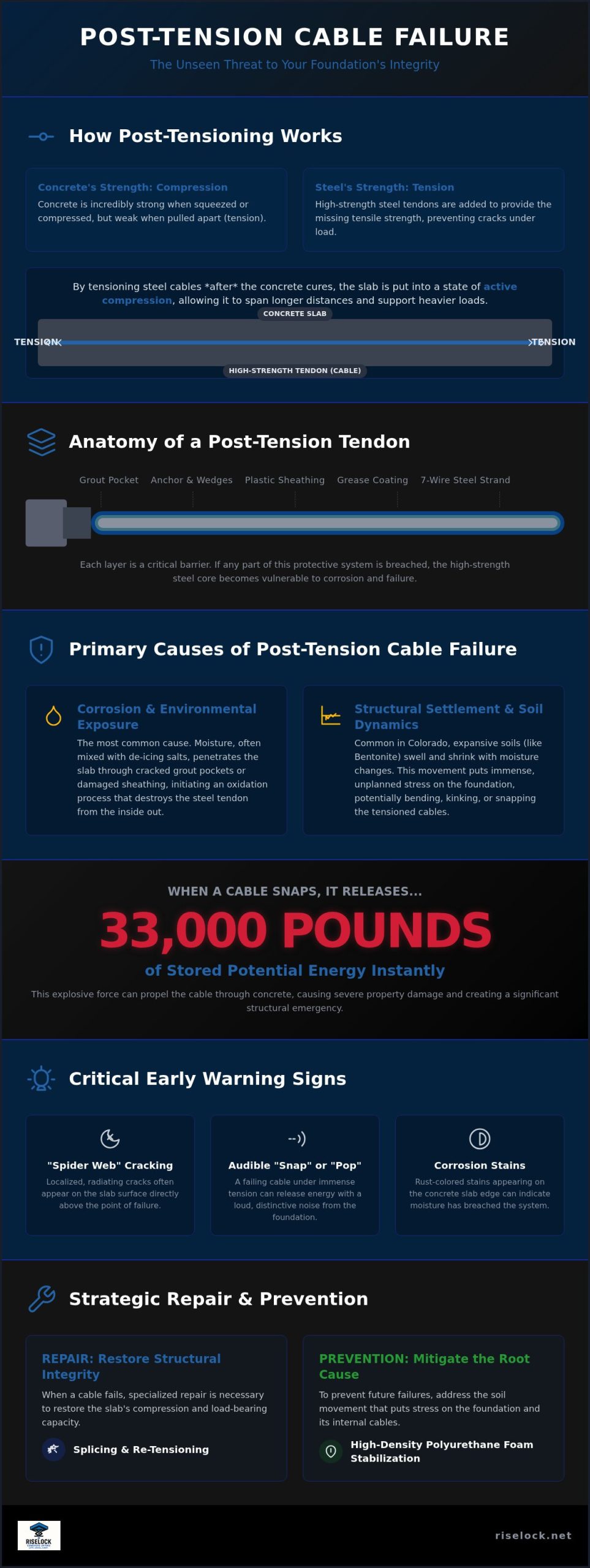
Post-tensioning is a sophisticated engineering method that transforms the inherent properties of concrete. While concrete is exceptionally strong under compression, it lacks significant tensile strength on its own. By embedding high-strength steel tendons and applying tension after the concrete has cured, we create a pre-stressed environment. This active compression allows slabs to support heavier loads and span longer distances with less material than standard reinforced concrete. It’s a modern solution that provides superior durability when maintained correctly.
Unlike passive rebar systems, which only begin to provide support when the concrete flexes or cracks, post-tensioned cables are under constant, massive stress. This internal energy makes them more susceptible to specific types of degradation. Identifying the underlying causes of post tension cable failure requires a look at how this stored energy interacts with environmental variables and structural shifts. When a cable’s integrity is compromised, the slab loses the very force that keeps it stable.
Most residential and commercial foundations in the Colorado region utilize unbonded systems. In these setups, the tendons aren’t bonded to the concrete with grout along their entire length. Instead, they rely on mechanical anchors at the slab edges to maintain tension. This distinction is vital; if an anchor fails or a cable snaps at any point, the entire length of that tendon loses its effectiveness. This differs from bonded systems where a local failure might be contained by the surrounding grout.
The Anatomy of a Post-Tension Tendon
A post-tension tendon is a multi-layered assembly designed for long-term resilience. At the core is a seven-wire high-strength steel strand. To prevent oxidation, this strand is coated in a specialized, moisture-inhibiting grease and encased in a heavy-duty plastic sheathing. The tension force is transferred to the concrete through a cast-iron anchor and steel wedges. Finally, the pocket at the slab edge is filled with grout to seal the tendon end. If any part of this protective barrier is breached, the steel becomes vulnerable to the elements.
Why Tension Matters: The Energy Stored in Your Slab
Each cable in a typical foundation is stressed to approximately 33,000 pounds of force. This isn’t just a physical connection; it’s a significant reservoir of potential energy. When a cable fails, that energy is released instantly. This blowout can propel the cable through the concrete or out the side of the slab with enough force to cause severe property damage. Because the slab relies on this compression for its structural load-bearing capacity, a snap is never just a cosmetic issue. It’s a structural emergency that requires specialized concrete repair to restore the safety and value of the property.
The Role of Corrosion and Environmental Exposure in Tendon Degradation
Corrosion is perhaps the most persistent of the causes of post tension cable failure. While the concrete provides a naturally alkaline environment that protects steel from rusting, this defense is not absolute. When external elements penetrate the slab, they disrupt the chemical balance and initiate a slow, destructive oxidation process. High-strength steel tendons are particularly sensitive to this degradation; even minor surface pitting can significantly reduce their load-bearing capacity under high tension.
Environmental exposure often begins at the anchors. If the grout pockets used to seal the cable ends are not properly installed or have begun to crack, they act as funnels for moisture. Once water reaches the steel strand, it travels along the length of the cable through the interstitial spaces between the wires. This hidden moisture can cause a tendon to fail deep within the slab, far from any visible entry point.
In unbonded systems, the failure of the protective plastic sheathing is a critical vulnerability. Punctures occurring during the initial pour or cracks resulting from long-term structural shifting allow grease to escape and contaminants to enter. In bonded systems, grout voids or air pockets created during installation provide a localized environment where moisture can accumulate, leading to concentrated corrosion that eventually snaps the cable.
Moisture Ingress and the Freeze-Thaw Cycle
Water penetration is exacerbated by the extreme temperature fluctuations common in regions like Colorado. Moisture enters through hairline cracks and, upon freezing, expands with immense pressure. This cycle causes concrete spalling, which further exposes the internal reinforcement to the elements. When oxidation begins, the physical transformation of the metal creates its own internal stress. Corroding steel expands up to six times its original volume, exerting massive internal pressure that can crack the surrounding concrete from the inside out.
Chemical Corrosion: Salts, Soils, and Seepage
Chemical attacks are often more aggressive than simple moisture ingress. In parking structures or slabs near roadways, chloride ions from de-icing salts penetrate the concrete and accelerate the electrochemical reaction of rusting. This “Chlorinated Attack” can bypass the natural protection of the concrete, leading to rapid tendon failure. Additionally, acidic soil conditions can leach through the slab, attacking the tendons from below. If you suspect your foundation has been compromised by environmental factors, consulting an expert in professional concrete repair is the most reliable way to assess the damage. Over time, the specialized grease meant to protect the strands can dry out or become contaminated, leaving the high-strength steel defenseless against these chemical triggers.
Structural Settlement and Soil Dynamics: The Colorado Context
Colorado’s unique geology presents a specific set of challenges for post-tensioned foundations. Unlike regions with stable sand or rock, the Front Range is characterized by highly expansive clay soils. These soils often contain Bentonite, a mineral that expands significantly when moisture is present and shrinks during dry spells. This constant, cyclical movement is one of the primary environmental causes of post tension cable failure in Denver and Colorado Springs. When the ground beneath a slab is in a state of flux, the structural system must work significantly harder to maintain its integrity.
Foundations in this region require specific tensioning considerations to account for these soil dynamics. If the initial installation didn’t properly factor in the potential for soil heaving, the resulting mechanical stress can exceed the design limits of the cables. This isn’t merely a matter of the concrete cracking; it’s a matter of the internal reinforcement being pushed to its breaking point by forces external to the building itself. Understanding how the ground interacts with your foundation is vital for long-term stabilization.
Bentonite and Expansive Soil Challenges
As Bentonite absorbs water, it exerts immense upward pressure on the slab, a phenomenon known as heaving. Conversely, during Colorado’s dry seasons, the soil loses volume and pulls away from the foundation. This creates a “teeter-totter” effect where the slab is unsupported in some areas while being aggressively pushed up in others. For a post-tensioned system, this means the cables are subjected to bending and shear stresses they weren’t designed to accommodate. Identifying this settlement-related stress early is the only way to intervene before the mechanical strain snaps a tendon.
The Link Between Slab Sinking and Cable Failure
When soil settles or washes away, it leaves voids that compromise the slab’s uniform support. Without a solid base, the weight of the concrete causes the slab to sag, which drastically increases the “pull” on the internal cables. This over-extension is a leading precursor to a sudden blowout. To mitigate this risk, polyurethane concrete lifting is used to fill these voids and restore the necessary support. By injecting high-density foam, we stabilize the base and neutralize the uneven tension that threatens the cables. Our experience in local restorations shows that proactive void filling often prevents the need for much more invasive cable splicing later. It’s a precision-based approach that addresses the root cause of the instability rather than just the symptoms.
Identifying Early Warning Signs of Post-Tension Cable Failure
Recognizing the symptoms of a compromised foundation is the only way to prevent a sudden structural release. Because the internal energy within these systems is so high, failures often manifest through distinct physical and audible cues. While the underlying causes of post tension cable failure may remain hidden beneath the surface for years, the transition from gradual degradation to active failure usually leaves visible evidence on the concrete slab.
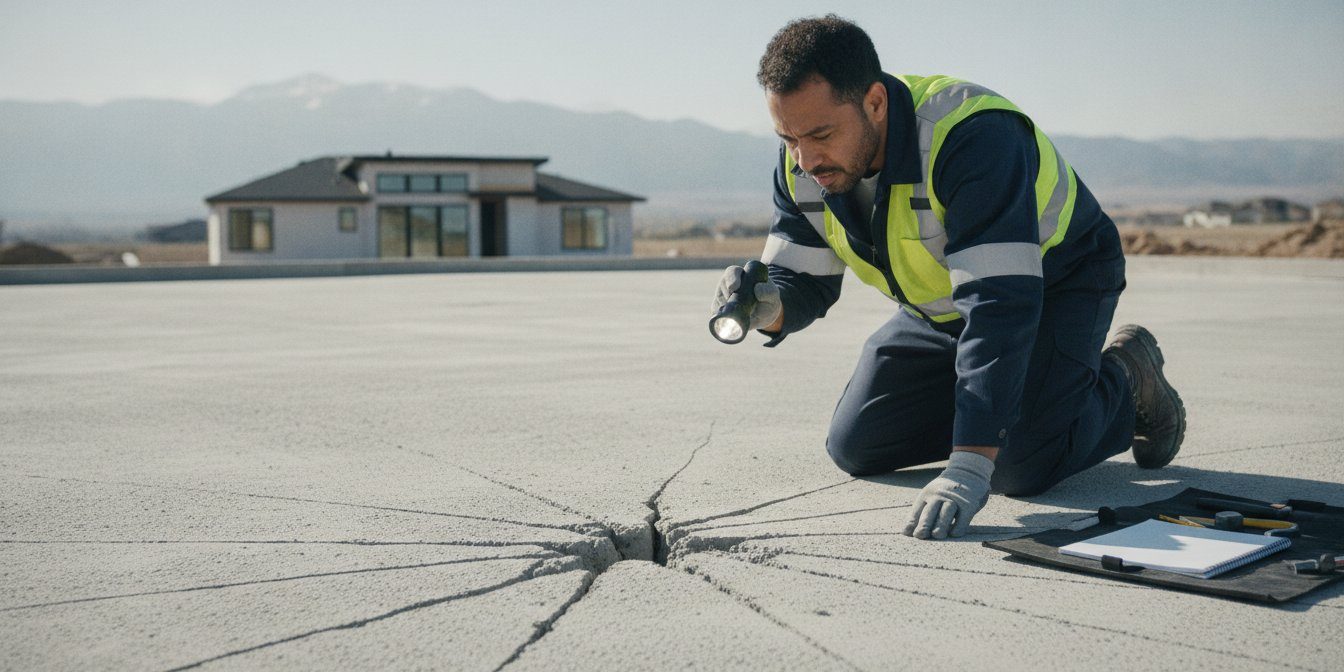
One of the most common visual indicators is the development of “spider web” cracking patterns. These localized, radiating cracks typically appear near the anchor points along the slab’s perimeter. They indicate that the concrete can no longer effectively distribute the massive compressive force of the tendon. Other signs include:
- Audible Snaps: A cable failure often produces a loud, distinctive sound similar to a gunshot or a heavy hammer strike. If you hear this coming from your foundation or garage floor, it’s a definitive sign of a snapped tendon.
- Protruding Tendons: In a “blowout” scenario, the force of the snap can propel the steel strand out of the side of the slab. These “tails” are a clear sign that the system has lost its tension.
- Rust Staining: Red or orange streaks appearing near anchor pockets suggest that the internal steel is oxidizing. This staining often precedes a mechanical failure.
- Efflorescence: The presence of white, powdery salt deposits on the concrete surface indicates chronic moisture ingress, which is a primary precursor to corrosion.
The Danger of Concrete Spalling
Concrete spalling occurs when the surface layer of the slab begins to flake or “pop” off. This isn’t always a cosmetic issue; it’s often caused by internal pressure from expanding rust or the physical movement of a failing tendon. Distinguishing between minor surface wear and structural spalling is critical for property safety. Spalling near an anchor is a high-priority warning because it often indicates that the mechanical force of the tendon is physically pushing the concrete away as the anchor assembly loses its grip.
Inspecting the Slab Edges and Anchors
The perimeter of your foundation, where the tendons are anchored, is the most revealing area for an inspection. You should look closely at the grout “pockets” along the slab edge. If these seals are missing, cracked, or showing signs of loose anchor wedges, the tendon’s integrity is compromised. For commercial property owners, regular professional assessments are vital to ensure these anchors haven’t backed out over time due to vibrations or soil shifts. If you notice any of these red flags, contact our team for a professional concrete repair evaluation to stabilize your structure before a total blowout occurs.
Strategic Repair and Preventive Measures for Compromised Slabs
Restoring a foundation with snapped tendons requires a sophisticated understanding of structural loads. It isn’t enough to simply patch the concrete; the internal tension must be re-established to return the slab to its design specifications. Addressing the primary causes of post tension cable failure, such as corrosion or mechanical stress, demands a combination of surgical repair and long-term environmental protection. By focusing on both the steel reinforcement and the concrete medium, we can restore the structural health of the property.
Beyond the mechanical repair of the steel, we must address the entry points that allowed degradation to occur. Applying high-performance waterproof membranes and industrial-grade sealants to anchor pockets prevents future moisture ingress. This chemical mitigation is a vital step in stopping the cycle of oxidation before it spreads to adjacent tendons. Without these preventive barriers, even a perfectly spliced cable remains vulnerable to the same environmental triggers that caused the initial failure.
Because these systems operate under extreme pressure, all repairs must be handled by technicians with deep expertise in post tension installation. Precision is paramount; an incorrectly tensioned cable can create new stress concentrations that lead to further cracking or secondary blowouts. Our approach prioritizes a logical progression from damage assessment to precise mechanical restoration, ensuring the repair is as durable as the original design.
Tendon Splicing and Re-tensioning
When a cable snaps, technicians must carefully chip away localized sections of concrete to access the broken ends. We use specialized steel couplers to join the existing strand with a new high-strength steel segment. Once the splice is secure, a hydraulic jack applies the exact amount of force required to re-tension the system. This process requires incredible accuracy to ensure the slab regains its original load-bearing capacity without over-stressing the surrounding concrete. It’s a technical mastery that transforms a structural liability back into a stable asset.
Preventive Stabilization with Polyurethane
Many repairs fail because the underlying soil issues aren’t resolved. Effective concrete repair in Denver prioritizes base stabilization through high-density polyurethane injection. By filling the voids created by Colorado’s expansive soils, we ensure the slab is evenly supported across its entire span. This stabilization removes the sagging and heaving forces that are frequent causes of post tension cable failure, effectively extending the life of the reinforcement by neutralizing mechanical strain. It’s a proactive measure that provides the long-term security every property owner deserves.
Protecting Your Property’s Structural Future
Maintaining a post-tensioned foundation requires a proactive approach to structural health. We’ve examined how environmental corrosion and Colorado’s expansive soil dynamics act as primary causes of post tension cable failure. By recognizing early warning signs like localized cracking or audible snaps, you can address vulnerabilities before they lead to a catastrophic blowout. Precision in both mechanical repair and soil stabilization is the only way to ensure the long-term security of your investment.
RiseLock provides the technical mastery needed to manage these complex systems. We specialize in Denver structural repairs and bring decades of combined experience in post-tension systems to every project. Our team utilizes high-density polyurethane stabilization to neutralize the soil movement that threatens your foundation’s integrity. If you suspect your cables are compromised, it’s time to partner with an expert who views your property’s safety as a personal priority. Contact RiseLock for a Professional Post-Tension Inspection today. Restoring your peace of mind starts with a precise, ethical evaluation of your structure’s specific needs.
Frequently Asked Questions
Can you repair a broken post-tension cable?
Yes, broken post-tension cables are repairable through a process called splicing. Technicians excavate a small section of the concrete to access the failed strand, join it with a specialized coupler, and re-tension the system using hydraulic jacks. This restoration returns the necessary compressive force to the slab. In Colorado cities like Denver, it’s equally important to address the soil instability that often triggers these failures to ensure the repair remains durable.
What does a post-tension cable blowout look like?
A blowout often presents as a physical “tail” of steel strand protruding from the side of the concrete slab. You might also notice large chunks of concrete, known as spalling, that have been forcefully ejected from the anchor point. In some cases, the only visual evidence is a localized “spider web” cracking pattern near the foundation edge. These signs indicate that the massive internal energy within the cable has been released suddenly.
Is a house with a broken post-tension cable safe to live in?
While a single broken cable rarely causes an immediate collapse, it significantly compromises the foundation’s load-bearing capacity. The slab is no longer under the active compression required to resist soil movement, which is particularly dangerous in Colorado’s expansive clay environments. Over time, this structural weakness leads to uneven settling and secondary damage. It is vital to have an expert assess the situation to determine the specific risks to your property’s safety.
How much does it cost to repair a post-tension cable in Colorado?
The cost of repairing a post-tension cable depends on several technical variables, including the depth of the cable and the accessibility of the anchor points. Factors such as the number of failed tendons and the need for concurrent soil stabilization with high-density polyurethane foam also influence the final investment. Because each structural challenge is unique, we recommend a professional inspection to provide an accurate scope of work tailored to your building’s specific requirements.
What causes the gunshot sound in a concrete slab?
That distinctive gunshot sound is the result of thousands of pounds of stored energy being released instantly when a steel tendon snaps. This mechanical release is one of the most common causes of post tension cable failure symptoms reported by property owners. The sound occurs as the cable recoils within its protective sheathing; it often strikes the internal concrete or the metal anchors with enough force to resonate through the entire structure.
How do I know if my foundation is post-tensioned?
You can identify a post-tensioned foundation by looking for grout pockets along the exterior edge of the concrete slab. These are small, circular or rectangular patches where the cable ends were sealed after tensioning. Many builders also include a stamp in the concrete, often located in the garage, that explicitly warns against drilling or cutting. If you’re unsure, a structural professional can use specialized equipment to verify the internal reinforcement system.
Can I drill into a post-tensioned slab for repairs?
Drilling into a post-tensioned slab is extremely dangerous and should never be done without professional guidance. Hitting a tensioned cable can cause an immediate blowout, leading to severe injury or significant structural damage. If your project requires floor penetrations, we use Ground Penetrating Radar (GPR) to map the exact location of every tendon. This precision ensures that any necessary repairs or modifications bypass the high-pressure reinforcement zones entirely.
How long do post-tension cables typically last before failing?
Post-tension cables are engineered to last the entire lifespan of the building, often 50 years or more. However, their longevity depends heavily on the integrity of the protective grease and plastic sheathing. Environmental stressors, such as moisture ingress and chemical exposure from road salts, can lead to premature corrosion. In regions with highly active soils, the mechanical strain from foundation shifting can also accelerate failure if the base isn’t properly stabilized.