A foundation is only as reliable as the physics supporting it, yet traditional reinforcement often fails against the relentless movement of Colorado’s expansive bentonite clay. You likely understand the stress of watching a significant investment develop hairline fractures that eventually threaten structural integrity. It’s a common concern for property owners who want to avoid the high costs and unnecessary bulk of traditional thick concrete slabs. Choosing the right system isn’t just about meeting local building codes; it’s about securing peace of mind for the next several decades.
This guide explores the core benefits of post tension slab technology, demonstrating why it’s the superior choice for durability and cost-efficiency in 2026. By utilizing high-strength steel tendons tensioned to 33,000 pounds per square inch, these systems actively compress the concrete to prevent cracks before they start. We’ll examine how the new ACI-PTI 320-25 building code simplifies installation and why these thinner slabs outperform mild-reinforced alternatives in challenging environments. You’ll gain the technical clarity needed to choose a foundation that remains stable, even when the ground beneath it refuses to stay still.
Key Takeaways
- Learn how active reinforcement creates a resilient structural system by compressing concrete to resist environmental shifting.
- Identify how thinner slab designs reduce material volume and lead to more efficient construction schedules without sacrificing strength.
- Discover the specific benefits of post tension slab foundations for mitigating the risks of expansive soils found throughout Colorado.
- Understand why specialized GPR scanning is essential for safety before performing any maintenance or structural modifications.
- Recognize the early indicators of cable distress to ensure your foundation maintains its integrity for decades to come.
What is a Post-Tension Slab? The Mechanics of Modern Strength
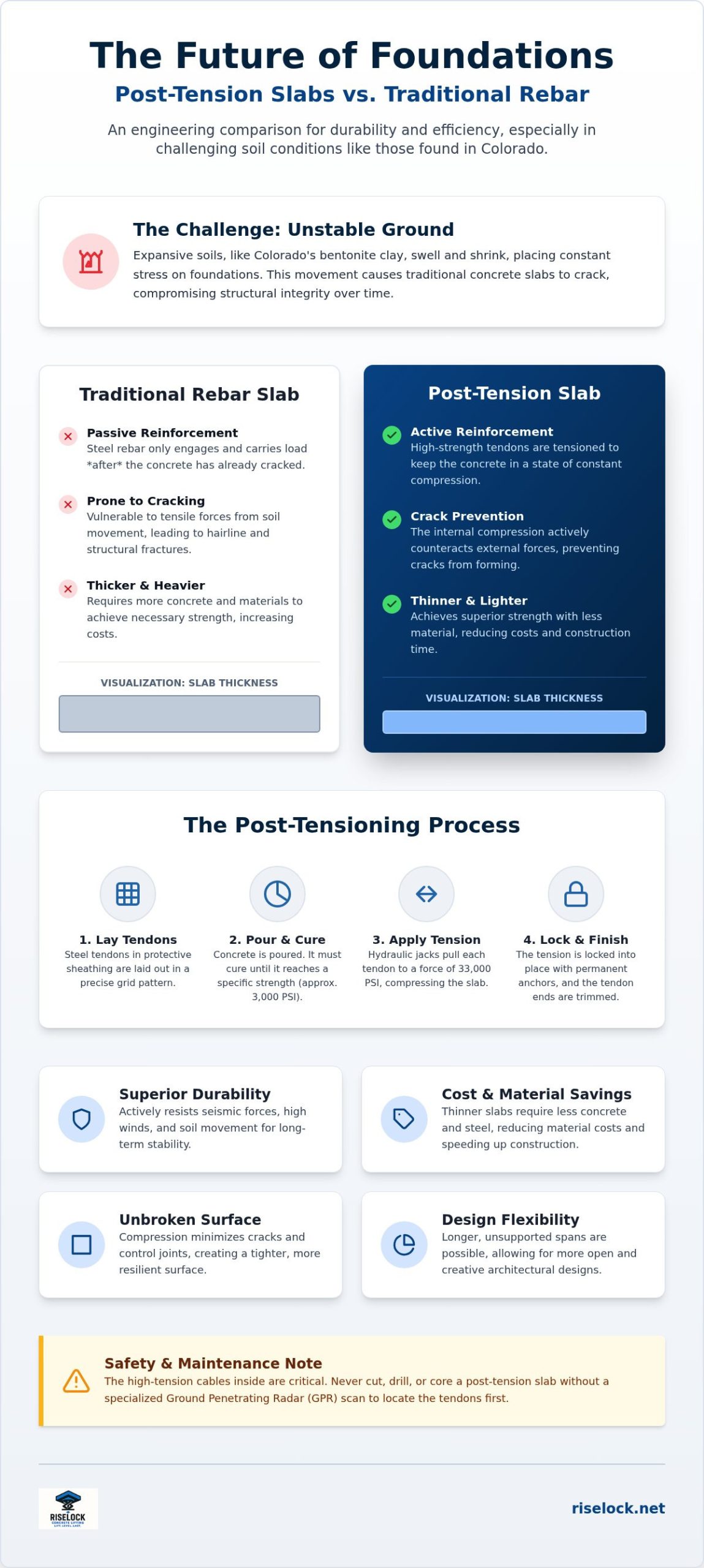
A post-tension slab represents a significant advancement in structural engineering, moving beyond the traditional limitations of standard concrete. While a typical slab relies on the passive strength of steel rebar, a post-tensioned system uses high-strength steel tendons that are pulled to extreme tension after the concrete has reached a specific level of hardness. This process creates a slab that is fundamentally stronger and more flexible. One of the primary benefits of post tension slab construction is the ability to create thinner, more resilient foundations that can withstand the immense pressure of shifting soil or heavy building loads.
At its core, this system belongs to the broader category of prestressed concrete, a technique designed to overcome concrete’s natural weakness in tension. Post-tensioning is the method of introducing internal compressive stress to counteract external loads. By squeezing the slab from the inside out, the system keeps the concrete in a state of compression, which significantly reduces the likelihood of cracking and structural failure.
The Process: From Pouring to Tensioning
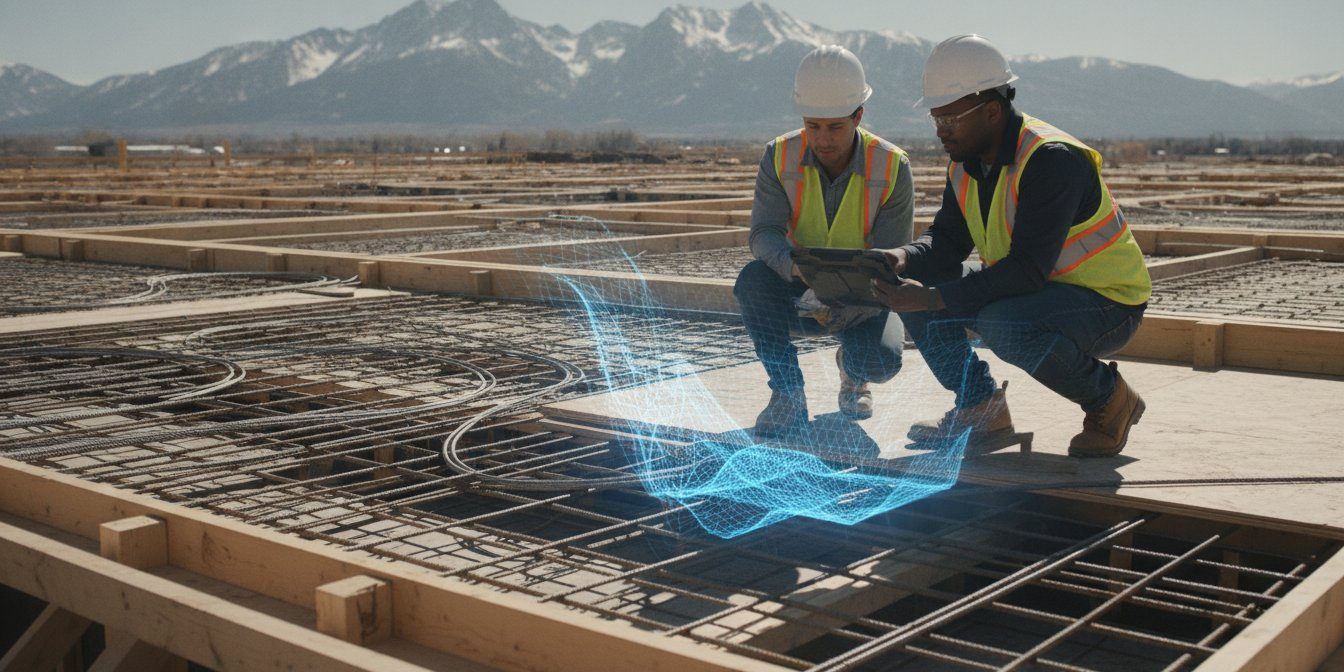
Precision is the hallmark of a successful installation. Before the concrete pour, technicians carefully lay out the tendons in a specific grid, securing them with anchors at the edges of the formwork. These tendons are encased in a protective plastic sheathing to ensure they don’t bond with the wet concrete. Once the pour is complete, the slab must undergo a critical curing phase.
We monitor the concrete’s strength closely. It’s essential to wait until it achieves a specific PSI, usually around 3,000 PSI, before beginning the tensioning phase. At this point, we use specialized hydraulic jacks to pull the steel strands, applying thousands of pounds of force. This tension is then locked into place using permanent anchors, creating a slab that is active and ready to support the structure.
Bonded vs. Unbonded Systems
In the United States, unbonded systems are the standard for residential and commercial projects. These systems rely on a thick layer of high-performance grease and a durable plastic sheathing to protect the steel from corrosion. This design allows the cable to move slightly within the slab during the tensioning process, ensuring the force is distributed evenly across the entire span.
In contrast, bonded systems are typically reserved for heavy civil engineering projects like bridges and dams. In these applications, grout is pumped into the ducts after tensioning to create a permanent bond between the tendon and the concrete. For the majority of modern buildings, the unbonded approach is preferred because it offers the necessary flexibility and speed for fast-paced construction schedules.
Structural Superiority: Why Tensioned Concrete Outperforms Rebar
Traditional rebar is a passive reinforcement system. It essentially waits for the concrete to crack before the steel begins to carry the tensile load. In contrast, post-tensioning is proactive. One of the standout benefits of post tension slab systems is their ability to maintain structural integrity by actively resisting forces before they cause damage. This active state creates a foundation that is significantly more resilient than those using standard rebar, especially when subjected to heavy loads or environmental shifts.
Beyond the immediate benefits of post tension slab technology for load distribution, these systems offer superior resistance to seismic activity and high wind loads. The tendons allow the slab to act as a cohesive, slightly flexible unit. This flexibility prevents the brittle failure often seen in traditional concrete. Because the entire slab is held under constant pressure, it can absorb and dissipate energy more effectively during a seismic event, protecting the rest of the structure from catastrophic failure.
The Science of Compression
Concrete is incredibly strong when compressed but remarkably weak when pulled apart. Standard reinforcement tries to bridge the gaps once tension occurs. Post-tensioning solves this by pre-loading the slab. By using hydraulic jacks to pull internal tendons, we place the entire concrete mass in a permanent state of compression. According to the Post-Tensioning Institute, this active compression is what allows these slabs to perform so effectively in poor soil conditions. It effectively eliminates the weak points and cold joints that typically lead to water intrusion and structural decay.
Spanning Greater Distances
Architects favor post-tensioning because it allows for open-concept designs that are impossible with mild steel reinforcement. Since the slab is stronger and more efficient, it can span much greater distances between supporting columns. For example, on spans of 28 to 32 feet, post-tensioned elevated slabs are typically only 7 to 9 inches thick. A comparable mild-reinforced slab would require a thickness of 9 to 11 inches. This reduction in thickness not only saves material but also reduces the overall weight of the building. For projects requiring this level of technical precision, choosing a partner experienced in post tension installation ensures the system is calibrated correctly from the start.
This efficiency is particularly valuable in parking garages and high-rise floor plates. Fewer columns mean more usable space and better visibility for drivers. In complex building geometries, the tendons can be draped in specific profiles to counteract gravity loads exactly where they are highest. This level of customization ensures that the slab resists sagging or deflection over the long term, maintaining a perfectly level surface for decades.
Economic and Design Advantages for Property Owners
Investing in a foundation is a long-term financial decision that dictates the lifecycle costs of a structure. One of the most quantifiable benefits of post tension slab systems is the direct reduction in material volume. Because active reinforcement allows for thinner concrete sections, developers typically use 20% to 30% less concrete than they would for a traditional rebar-reinforced slab. This reduction doesn’t just lower the bill for raw materials; it fundamentally changes the building’s engineering profile and cost structure.
Lighter slabs mean a lighter overall structure. This reduction in dead weight allows for smaller, less expensive footings and supporting columns. In high-rise construction, the cumulative weight savings are massive. By reducing the load on the foundation, engineers can often design more economical sub-structures, which is a critical advantage in areas with challenging soil conditions. These savings are realized early in the construction phase, providing immediate relief to the project budget.
Thinner slabs also offer a unique design advantage in urban environments with strict height restrictions. By saving two to three inches of thickness per floor, a developer might fit an entire additional level into the same building envelope. This maximizes the net leasable area and significantly boosts the project’s long-term profitability. Construction timelines also accelerate. Post-tensioned slabs allow for earlier formwork removal and faster floor cycles, often trimming weeks off a major build schedule.
Long-Term ROI and Maintenance Savings
Owners prioritize systems that minimize ongoing operational expenses. Post-tensioned concrete is naturally more resistant to the spiderweb cracking seen in traditional pours. This durability is essential in high-traffic environments like warehouses and parking garages where joint wear is a constant issue. Professional post tension installation ensures that the compression remains balanced, which keeps the slab tighter and more water-resistant over its lifecycle. This translates to fewer repairs and a higher resale value for the property.
Sustainability and Environmental Impact
Modern construction demands a focus on sustainability. Reducing the amount of concrete required for a project directly lowers its carbon footprint, as cement production is a major source of industrial CO2 emissions. High-strength steel tendons also minimize raw material waste by replacing larger volumes of lower-grade rebar. These efficiencies help projects qualify for LEED certification, aligning structural excellence with environmental responsibility while meeting the rigorous standards of 2026 building codes.
The Colorado Context: Combatting Expansive Soils in Denver
Denver’s geology is defined by expansive bentonite clay, a “living” soil that undergoes significant volume changes based on moisture levels. In areas like Aurora and Castle Rock, this soil expands when wet and contracts during dry spells, creating immense upward and downward pressure on foundations. Traditional rebar slabs often succumb to differential settlement because they lack the internal force to resist these localized shifts. One of the primary benefits of post tension slab design in this region is the “raft” effect. The entire slab acts as a single, rigid unit that floats on top of moving earth, distributing loads evenly and preventing the localized cracking that ruins standard concrete.
This approach has proven successful in major residential and commercial developments across Parker and Colorado Springs. By maintaining a state of constant compression, the slab remains structurally sound even when the ground beneath it is unstable. This reliability is why post-tensioning has become the preferred standard for new construction along the Front Range. It provides a level of structural insurance that passive reinforcement simply cannot match in volatile soil conditions.
Protecting Foundations from Frost Heave
Colorado’s climate adds another layer of complexity through intense freeze-thaw cycles. When water enters small fissures in standard concrete and freezes, it expands, causing spalling and heaving. The internal tension of a post-tensioned system keeps micro-cracks closed, preventing water from penetrating the surface in the first place. This is a strategic advantage for high-exposure surfaces like driveways and patios in the Rockies. Because the concrete is held so tightly together, it resists the destructive force of frost heave far more effectively than passive reinforcement, maintaining a smooth surface through the harshest winters.
Local Expertise: RiseLock’s Approach to Colorado Concrete
Understanding the specific soil profiles of Arvada and Thornton is critical for a successful installation. We design custom tensioning profiles that account for local climate extremes and soil behavior. Our team often integrates structural reinforcement with concrete repair in Denver to restore integrity to failing traditional systems. By applying these modern techniques, we ensure your foundation is prepared for the unique environmental stresses of the Colorado landscape. If you’re planning a new project or need to stabilize an existing structure, contact RiseLock for a professional consultation today.
Long-Term Integrity: Maintenance and Professional Repair
Maintaining the structural integrity of a post-tensioned system requires a different approach than traditional concrete. While one of the primary benefits of post tension slab technology is its ability to stay tightly compressed for decades, this “bear hug” relies on the continued health of internal tendons. Property owners, particularly those managing commercial parking decks or high-rises, should implement periodic inspections of anchor points. We look for signs of corrosion, grease leakage, or moisture infiltration that could weaken the steel over time. A sudden, loud “pop” or a visible blowout at the slab edge indicates a tendon failure. A broken post-tension cable is a critical structural failure requiring immediate expert intervention.
Safety is paramount when modifying these structures. The “Do Not Drill” rule is non-negotiable for anyone working on a PT slab. Because the cables are under tension exceeding 30,000 pounds per square inch, accidentally severing one with a drill or saw can cause catastrophic injury and compromise the building’s stability. Specialized Ground Penetrating Radar (GPR) scanning is essential to map the exact location and depth of tendons before any penetrations are made. This technical precision prevents costly damage and ensures that the active reinforcement remains undisturbed during renovations or utility installs.
Post-Tension Cable Repair Techniques
When a failure occurs, total slab replacement isn’t usually necessary. We use advanced techniques to perform broken post tension cable repair by splicing the damaged strand and re-tensioning it to its original specifications. This process involves excavating a small pocket around the break, installing a new coupler, and using hydraulic jacks to restore the compressive force. This surgical approach preserves the existing concrete while returning the slab to its full design strength. It’s a highly specialized task that requires an understanding of the original engineering specs to ensure the repaired cable balances the loads correctly.
Leveling PT Slabs with Polyurethane
If a post-tensioned foundation begins to settle due to soil erosion, the method of restoration matters immensely. We exclusively use polyurethane concrete lifting to level these systems. Unlike traditional mudjacking, which adds thousands of pounds of heavy, wet slurry to the soil, high-density foam is lightweight and waterproof. It expands to fill voids and lift the slab without adding unnecessary stress to the tensioned cables. This precision ensures the “raft” foundation is restored to its proper level without the moisture issues that could lead to cable corrosion over time. By choosing a non-invasive lifting method, you preserve the long-term integrity of the entire structural system.
Securing Your Structural Future with Precision Engineering
The evolution of concrete technology has made the benefits of post tension slab systems indispensable for modern construction, particularly across the Rocky Mountain region. Active compression transforms a foundation into a resilient unit that remains stable despite the shifting nature of bentonite clay. By reducing material volume and accelerating project schedules, post-tensioning aligns financial efficiency with technical mastery. It’s a system designed for longevity, provided it’s managed with the precision it demands.
Protecting these specialized systems requires a partner who understands the high stakes of cable tension and the nuances of local geology. RiseLock provides certified expertise for every project, from initial installation to complex blowout restoration. We utilize advanced polyurethane lifting for non-invasive slab leveling, ensuring your foundation remains stable without compromising internal forces. Secure your structure with RiseLock’s professional post-tension services today. Our team is ready to provide the high-precision intervention your project deserves, ensuring structural peace of mind for decades to come.
Frequently Asked Questions
Are post-tension slabs better than regular concrete slabs?
Post-tensioned systems are often superior for structures built on the expansive soils common in Denver and Aurora. Unlike traditional slabs that rely on passive rebar, post-tensioning provides active reinforcement by keeping the concrete in a permanent state of compression. This design significantly reduces the risk of structural cracking and allows for thinner, more flexible foundations that can withstand soil movement better than standard reinforced concrete.
Can you drill into a post-tension slab for renovations?
You should never drill or saw into a post-tensioned slab without professional Ground Penetrating Radar (GPR) scanning. Because the internal tendons are under extreme tension, often exceeding 33,000 pounds per square inch, severing a cable can cause catastrophic structural failure and serious physical injury. We always require a precise map of the tendon layout before any penetrations are made to ensure the ongoing safety of the building.
What happens if a post-tension cable breaks or snaps?
A broken cable is a critical structural issue that requires immediate expert intervention. When a tendon snaps, the slab loses the compressive force necessary to support its design load, which can lead to rapid deflection or cracking. You might hear a loud pop or see a “blowout” where the anchor has shifted. RiseLock specializes in restoring these systems by splicing and re-tensioning cables to return the slab to its original strength.
How do I know if my house has a post-tension foundation?
Most modern homes in Colorado Springs and Parker with this foundation type will have a stamp in the concrete, usually located in the garage, stating “Post-Tensioned Slab — Do Not Drill.” You can also inspect the exterior foundation perimeter for small, circular plastic caps or patched areas. These marks indicate where the tendons were stressed and anchored during construction. If you’re unsure, a professional inspection can verify the system type.
How long do post-tension slabs last compared to rebar?
When installed correctly, post-tensioned slabs are designed to last the entire lifespan of the structure, often exceeding the durability of traditional rebar in volatile environments. One of the primary benefits of post tension slab technology is its ability to keep micro-cracks closed, which prevents moisture from reaching the steel. This superior crack control protects the internal components from corrosion, ensuring the foundation remains stable for many decades.
Is post-tensioning more expensive than traditional reinforcement?
While the specialized hardware and labor for tensioning may have a higher initial cost, the overall project expenses often decrease. These slabs use significantly less concrete and steel, which reduces material costs and the total weight of the structure. Additionally, the faster construction timelines and reduced need for long-term crack maintenance provide a better return on investment for property owners in the Denver metro area compared to traditional thick-slab designs.
Can you repair a post-tension slab that has settled or sunk?
Yes, we can stabilize and level settled post-tensioned slabs using high-density polyurethane concrete lifting. This method is the safest choice for PT systems because the foam is lightweight and doesn’t add the massive weight or moisture associated with traditional mudjacking. By injecting the foam beneath the slab, we restore the “raft” foundation’s level without putting undue stress on the tensioned cables or the surrounding soil structure.
Why is post-tensioning common in Colorado foundations?
The prevalence of expansive bentonite clay along the Front Range makes post-tensioning an essential engineering choice. In cities like Castle Rock and Lakewood, the soil undergoes dramatic volume changes that can easily snap traditional rebar-reinforced concrete. Post-tensioned slabs are designed to move as a single, rigid unit, which prevents the differential settlement that leads to basement flooding and structural failure in less resilient foundation types.