
A single post-tension cable within your foundation can hold up to 40,000 pounds of force, which is a staggering amount of energy stored directly beneath your feet. In the Pikes Peak region, where expansive soils are the rule rather than the exception, this tension is both a structural necessity and a potential liability. If you’re concerned about the long-term stability of your property, you aren’t alone. Most owners recognize that the shifting earth in our area places immense stress on concrete slabs, yet few know how to verify if their reinforcement system is still performing its job safely.
Scheduling a professional post tension cable inspection Colorado Springs ensures that these high-tension systems remain secure and functional. This guide provides a professional framework for identifying structural risks and utilizing Ground Penetrating Radar (GPR) for precise, non-destructive testing. You’ll gain a clear understanding of your foundation’s health and a prioritized list of necessary repairs to protect your equity. We’ll examine the technical indicators of cable distress and the modern methods required to verify structural safety for insurance requirements or a potential property sale.
Key Takeaways
- Learn how the expansive bentonite soils and intense freeze-thaw cycles of the Pikes Peak region specifically threaten the tension and integrity of your concrete foundation.
- Discover why Ground Penetrating Radar (GPR) is the essential tool for a non-destructive post tension cable inspection Colorado Springs, allowing for precise mapping without invasive drilling.
- Master a professional checklist to identify early warning signs of cable distress, such as protruding tendons at the slab perimeter or structural tension cracks.
- Understand the high-stakes risks of cable corrosion and blowouts, including the chemical impact of local de-icing salts on internal steel reinforcement.
- Gain the criteria for vetting structural experts, focusing on PTI certification and specialized knowledge of Front Range soil dynamics to ensure long-term property safety.
The Critical Need for Post-Tension Cable Inspection in Colorado Springs
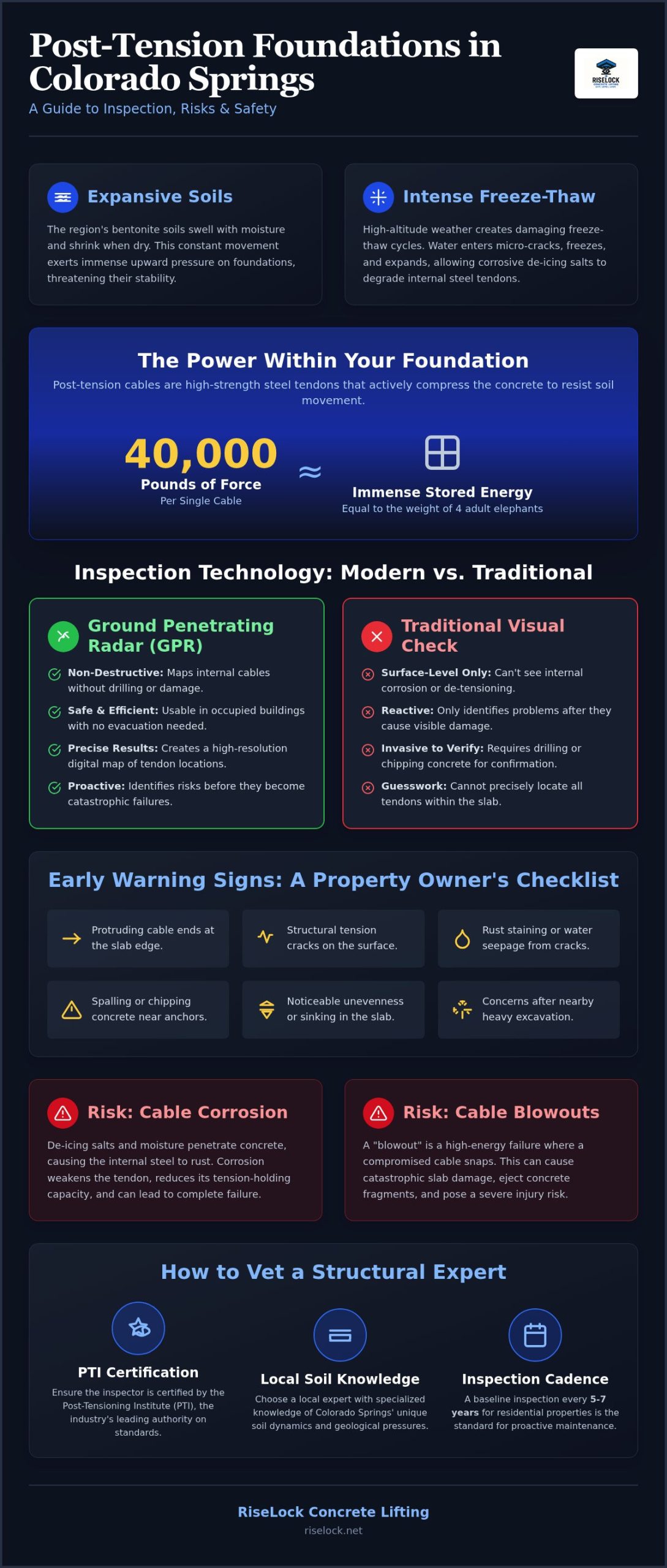
Colorado Springs foundations face a relentless set of environmental pressures. The region is characterized by expansive bentonite soils that swell with moisture and shrink during our frequent dry spells. This constant ground movement places immense stress on any slab-on-grade structure. A professional post tension cable inspection Colorado Springs is not merely a recommendation; it is a technical necessity for maintaining the structural equilibrium of your property. Unlike traditional rebar, which acts as passive reinforcement, post-tensioned concrete is an active system. This method uses high-strength steel tendons to compress the slab, allowing it to “float” over shifting earth. If these cables lose tension or succumb to corrosion, the foundation loses its primary defense against the volatile Front Range geology.
Colorado Springs Geology and Foundation Stress
The local landscape is shaped by Pikes Peak granite runoff, which influences how moisture settles into the sub-strata. In neighborhoods like Banning Lewis Ranch or the Northgate area, the high concentration of expansive clay can exert thousands of pounds of upward pressure. When the soil moisture levels fluctuate, the slab must resist bending forces that exceed the capacity of standard concrete. We often see cables pushed to their stress limits when drainage is poorly managed. The relationship between soil stability and cable health is direct. A compromised tendon cannot counteract soil heave, leading to structural cracks that invite water and accelerate degradation.
When to Schedule a Professional Structural Evaluation
Property owners should establish a predictable monitoring cadence. For residential properties, a baseline inspection every five to seven years is standard. Commercial assets often require more frequent reviews due to higher load requirements. Certain trigger events necessitate an immediate post tension cable inspection Colorado Springs. These include nearby heavy excavation, significant seismic tremors, or the appearance of wide surface cracks. A successful post tension installation is designed for longevity, but it isn’t a “set and forget” solution. Neglecting these systems creates significant legal and safety liabilities. A cable blowout isn’t just a repair issue; it’s a high-energy failure that can cause physical injury and catastrophic slab damage. High-altitude freeze-thaw cycles only worsen the risk, as ice wedges into micro-cracks and brings corrosive de-icing salts into direct contact with the steel tendons.
Modern Inspection Technologies: GPR vs. Traditional Methods
Accurately assessing the condition of steel tendons within a concrete slab requires more than a surface-level survey. Traditional visual inspections are limited because they only reveal distress once it has reached the exterior, often long after internal corrosion has compromised the system’s integrity. For a comprehensive post tension cable inspection Colorado Springs, we utilize Modern Inspection Technologies that provide a transparent view of the slab’s interior. This shift toward non-destructive evaluation (NDE) allows property owners to identify risks before they manifest as costly cable blowouts or structural failures.
The Advantages of Ground Penetrating Radar (GPR)
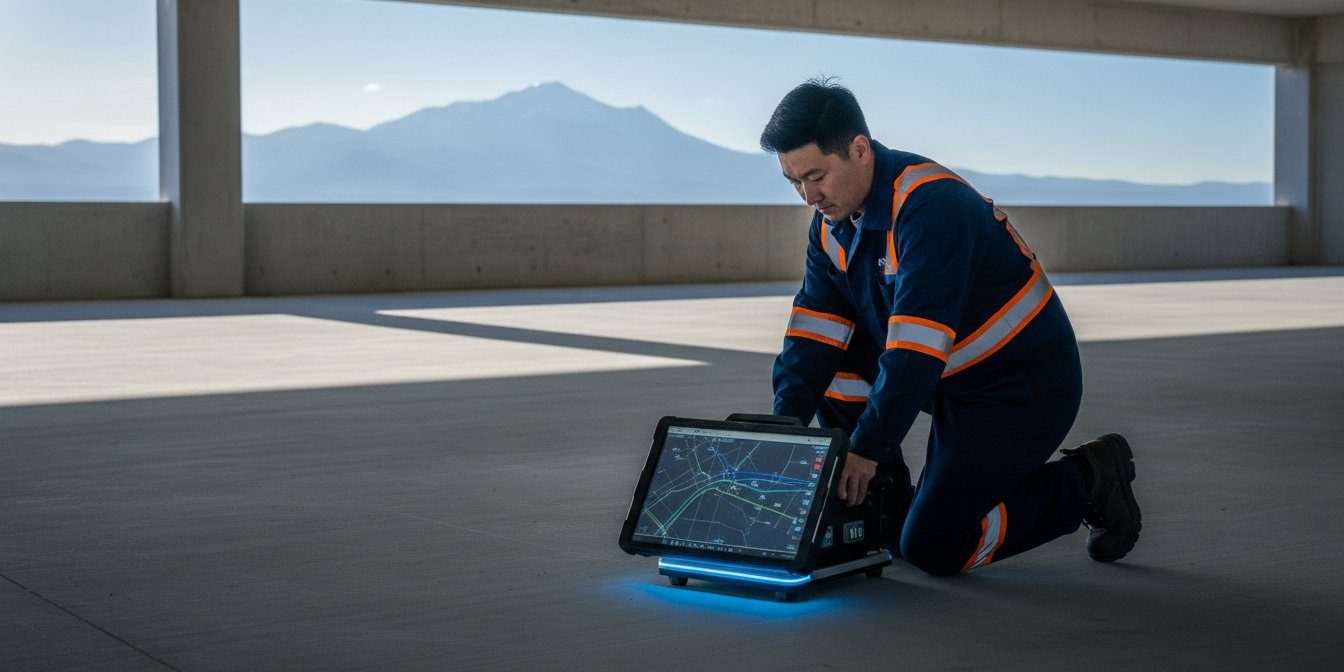
Ground Penetrating Radar has become the industry standard for mapping internal reinforcement in the Front Range. By emitting electromagnetic pulses into the concrete and measuring the reflected signals, GPR identifies the exact depth and trajectory of every cable. This technology creates a high-resolution digital twin of the slab’s internal structure without the need for invasive drilling. One of the most significant benefits for our local commercial clients is safety. Unlike older X-ray methods that use radioactive isotopes and require the complete evacuation of the building, GPR is entirely safe for use in occupied spaces. Our technicians gather real-time data on-site, providing immediate clarity on where cables are located. Whether you are managing a retail center or a residential complex, a routine post tension cable inspection Colorado Springs provides the data necessary to avoid catastrophic failure.
Complementary Diagnostic Tools
While GPR is unmatched for mapping, we often integrate other specialized tools to build a complete diagnostic profile. Ultrasonic pulse velocity (UPV) is used to detect internal concrete voids or areas of low-density concrete that might expose cables to moisture. At the slab’s edge, where anchors are most vulnerable, we may use borescope inspections to look for signs of grease degradation or oxidation on the tendon ends. These detailed insights are particularly critical when we are preparing polyurethane concrete lifting strategies. Knowing exactly where the tension is held ensures that the stabilization process is both safe and effective. Precision in the diagnostic phase eliminates guesswork and protects your long-term investment. If you are noticing signs of movement, an expert structural evaluation is the first step toward a permanent solution.
The Definitive Property Owner’s PT Inspection Checklist
Maintaining a post-tensioned slab requires a systematic approach that balances simple visual monitoring with advanced technical diagnostics. For property managers and owners, a regular post tension cable inspection Colorado Springs provides the necessary data to mitigate risk before a minor issue becomes a structural emergency. This process shouldn’t be reactive. By following a structured checklist, you can identify early warning signs of tendon fatigue or anchor failure that might otherwise go unnoticed until a blowout occurs.
Phase 1: Visual External Assessment
The first stage of any evaluation begins at the perimeter of the structure. You should walk the entire slab edge, looking specifically for “popped” concrete or spalling. This is the most common indicator that a cable has snapped and released its stored energy, forcing the anchor outward. Other critical visual indicators include:
- Rust Staining: Look for reddish-brown streaks leaching through the concrete pores or grout caps. This suggests that moisture has reached the steel tendons and oxidation is active.
- Horizontal Cracking: Identify cracks running along the mid-section of the slab edge. While vertical cracks are often related to shrinkage, horizontal fissures frequently point to tension imbalances.
- Anchor Pocket Integrity: Inspect the grout caps covering the cable ends. If these caps are missing, cracked, or spalling, the metal anchors are exposed to the elements, which significantly accelerates corrosion.
Phase 2: Technical Subsurface Investigation
Because the most dangerous degradation happens where the eye can’t see, a professional post tension cable inspection Colorado Springs must include subsurface mapping. We use Ground Penetrating Radar to verify the cable “drape” and spacing. This ensures the tendons are positioned exactly as specified in the original engineered drawings. Deviations in the cable path can lead to localized stress concentrations that the concrete wasn’t designed to handle.
During this phase, we also look for voids or air pockets beneath the slab. In the Pikes Peak region, soil washouts can leave sections of the foundation unsupported. This creates uneven tensioning across the cable network. We also assess the integrity of the moisture barrier or sheathing surrounding the tendons. If this plastic barrier is compromised, the high-strength steel is vulnerable to groundwater and corrosive soil chemicals. Finally, we recommend a documentation review. Comparing your original stressing records against the current physical state of the slab helps verify that the system is still operating within its intended safety margins. Proper drainage and grading are equally vital; ensure water isn’t pooling against the foundation, as poor moisture management is the leading cause of anchor-point corrosion.
Analyzing the Risks: Corrosion and Cable Blowouts
A post-tensioned cable is essentially a stored energy device. Under normal operating conditions, these tendons are tensioned to between 25,000 and 40,000 pounds of force, creating a structural system that is both efficient and robust. However, when the integrity of the steel is compromised, that energy is released instantly. This “Snap Factor” results in a cable blowout, where the tendon erupts through the slab edge or surface with enough force to cause significant property damage or personal injury. A regular post tension cable inspection Colorado Springs is the only way to verify that this stored energy remains safely contained within the concrete matrix.
In multi-story commercial structures, the risks are even higher. A localized cable failure can trigger a redistribution of loads that the surrounding concrete is not equipped to handle. In extreme cases, this leads to progressive collapse, where the failure of one structural element causes the failure of adjacent components. Understanding the specific environmental threats in the Pikes Peak region is essential for any property owner looking to mitigate these high-stakes liabilities.
Identifying Corrosion Mechanisms
Corrosion is the primary driver of cable failure in the Front Range. During our winters, de-icing salts containing chloride ions are tracked into parking garages and across exterior slabs. These ions penetrate micro-cracks in the concrete and eventually reach the steel tendons. If the grease-filled sheathing is breached or the grout coverage at the anchorage zone is insufficient, oxidation begins to eat away at the metal. We often identify these specific risks during concrete repair Denver Colorado assessments, where salt-heavy runoff has compromised the internal reinforcement of aging structures.
The Danger of Unchecked Slab Settlement
Slab settlement creates a distinct but equally dangerous risk to the tensioning system. When the expansive soils of Colorado Springs shift or wash away, the concrete slab may sink or tilt. This movement creates unintended tension points where the cable is forced to bend at sharp angles, significantly increasing the fatigue on the steel strands. To prevent a rupture, we utilize foam concrete lifting to restore uniform support beneath the foundation and return the slab to its intended elevation. A comprehensive post tension cable inspection Colorado Springs identifies these settlement-induced stress points before they reach a critical failure threshold. Proactive stabilization is always more cost-effective than managing the aftermath of a blowout. If you suspect your foundation is shifting, you should schedule a technical evaluation to ensure your reinforcement system remains stable.
Vetting a Post-Tension Expert in Colorado Springs
Selecting a partner for a post tension cable inspection Colorado Springs requires a focus on technical mastery and local geological expertise. Because these structural systems are under immense internal pressure, the technician must possess more than just basic scanning equipment. You should look for professionals who carry certifications from the Post-Tensioning Institute (PTI). These credentials ensure the inspector understands the specific physics of unbonded tendons and the critical safety protocols required during an evaluation. A qualified expert doesn’t just identify where a cable is; they interpret why a system might be failing based on the unique environmental stressors of the Pikes Peak region.
Experience with Front Range soil dynamics is non-negotiable. Our expansive bentonite clays behave differently than soils in other parts of the country. A contractor who understands local heave and settlement patterns provides a more accurate risk assessment than a generalist. During your initial consultation, ask the following questions to gauge their proficiency:
- Are your technicians PTI-certified for field inspection?
- How do you distinguish between superficial concrete spalling and a high-energy cable blowout?
- Can you provide a digital map of the cable trajectory using GPR technology?
- Do you offer integrated repair solutions, or do you only provide the diagnostic data?
The RiseLock Approach to Structural Integrity
We view the inspection as the first step in a comprehensive stabilization plan. Our methodology combines high-resolution GPR mapping with precision polyurethane leveling to address both the tension within the slab and the soil instability beneath it. Many providers only offer data, leaving property managers to find a separate contractor for the actual restoration. At RiseLock, we provide ethical, authoritative guidance that bridges the gap between diagnosis and repair. By implementing modern concrete lifting solutions, we ensure your foundation is supported by high-density foam that resists the moisture fluctuations common in Colorado Springs.
Next Steps: From Inspection to Restoration
Once the post tension cable inspection Colorado Springs is complete, you’ll receive a detailed report. This document translates complex radar data into actionable insights for your maintenance budget. It’s essential to prioritize repairs based on the severity of the findings. If a cable is found to be unbonded or corroded at an anchor point, immediate intervention is necessary to mitigate safety hazards. We guide you through this process, explaining the technical reasoning behind every recommendation. To protect your property’s structural health and long-term value, you can request a comprehensive site evaluation from our team. We help you move from the stress of structural uncertainty toward the peace of mind offered by a verified, stable foundation.
Ensuring Long-Term Stability for Your Structural Investment
Proactive maintenance is the most effective defense against the volatile geological conditions of the Front Range. By prioritizing a regular post tension cable inspection Colorado Springs, you move beyond guesswork and gain a data-driven understanding of your foundation’s health. We’ve explored how Ground Penetrating Radar identifies internal risks like corrosion or tension imbalances before they escalate into high-energy cable blowouts. Protecting a post-tensioned slab requires a partner who understands the relationship between internal cable physics and external soil dynamics.
RiseLock brings specialized expertise in Front Range soil stabilization and follows PTI-aligned inspection standards to ensure every assessment is technically precise. Our team provides more than just data; we offer comprehensive structural repair and lifting capabilities to address any vulnerabilities found during the diagnostic phase. This integrated approach preserves your property’s equity and ensures the safety of all occupants. Don’t wait for visible signs of distress to compromise your peace of mind. Secure Your Foundation with a Professional PT Inspection and take the first step toward a permanently stabilized future.
Frequently Asked Questions
How often should I have my post-tension cables inspected in Colorado Springs?
Residential property owners should typically schedule a professional post tension cable inspection Colorado Springs every five to seven years. Commercial assets often require more frequent monitoring due to higher load requirements and environmental exposure. If your property experiences significant soil movement or you notice new cracking after a heavy moisture season, an immediate evaluation is recommended. These intervals ensure that minor issues like grout cap degradation don’t evolve into major structural failures.
What are the most common signs of a broken post-tension cable?
The most obvious indicator is a “popped” concrete cone at the slab edge, which occurs when an anchor fails and the cable snaps. You may also notice reddish-brown rust stains leaching through the concrete or grout caps. Horizontal cracks along the mid-section of the slab perimeter are another technical warning sign. If you find missing or cracked grout caps, the internal steel is likely exposed to corrosive elements and requires professional review.
Is a PT cable blowout dangerous to building occupants?
A post-tension cable blowout is a high-energy event that poses a serious safety risk to occupants. Since cables are tensioned to between 25,000 and 40,000 pounds of force, a rupture can cause the tendon to erupt through the concrete with enough velocity to penetrate walls. Beyond the immediate physical danger, a blowout compromises the structural integrity of the entire slab, potentially leading to progressive collapse in certain multi-story commercial building designs.
Can GPR see through thick concrete slabs in commercial buildings?
Modern GPR technology is highly effective at scanning through the thick slabs found in commercial and industrial structures. Depending on the antenna frequency used, we can map internal reinforcement and cable trajectories at significant depths. High-resolution multi-channel arrays allow us to create a digital twin of the slab’s interior. This precision is essential for identifying voids or misaligned cables that are buried deep within the structural matrix of the foundation.
Will I need to vacate my property during a PT cable inspection?
You don’t need to vacate your property during a standard GPR evaluation. Unlike older X-ray imaging methods that utilize radioactive isotopes and require a cleared site, GPR uses safe electromagnetic pulses. This allows us to perform a post tension cable inspection Colorado Springs while your business or home remains fully operational. The process is non-invasive, quiet, and doesn’t require any destructive drilling or site closures to gather accurate internal structural data.
What causes post-tension cables to fail in Colorado foundations?
Failure is typically driven by a combination of chemical corrosion and mechanical fatigue. In our region, expansive bentonite soils create unintended tension points as the slab shifts. High-altitude freeze-thaw cycles also expand micro-cracks, allowing de-icing salts to reach the steel tendons. When chloride ions penetrate the protective sheathing, oxidation weakens the metal strands until they can no longer withstand the internal tension, eventually leading to a high-energy structural rupture.
Can a broken post-tension cable be repaired, or does the slab need replacement?
Most broken cables can be successfully repaired without requiring a full slab replacement. Structural solutions include installing new anchors or splicing damaged tendon segments to restore proper tension. While full foundation replacement is a significant burden, localized repair is a common and effective restoration method. The key is to stabilize the underlying soil first to prevent future stress. This technical approach restores the slab’s integrity while avoiding the disruption of a total rebuild.
How much does a professional PT cable inspection typically cost in Colorado?
Professional inspection costs vary based on the square footage and the structural complexity of the building. While we don’t provide flat-rate pricing without a preliminary site evaluation, this technical assessment is a vital investment for risk mitigation. It’s far more cost-effective to identify a compromised anchor early than to manage the structural damage caused by a blowout. Most owners view the inspection as a necessary protection for their property’s long-term equity and safety.