Replacing a sinking driveway is often a costly mistake that ignores the underlying instability of Denver’s volatile, expansive clay soil. While traditional methods focus on the surface, a truly effective concrete lifting contractor Denver residents rely on must address the structural voids beneath the slab. It’s stressful to manage trip hazards that invite liability or to worry that a growing crack signals a deeper failure of your home’s foundation. You deserve a restoration process that doesn’t involve weeks of dust, noise, and heavy machinery.
Discover how modern polyurethane injection and post-tension reinforcement provide a permanent, non-invasive fix for Colorado’s most challenging settlement issues. We’ll explain how high-density foam restores your property’s value and ensures your post-tension cables remain protected, giving you a level surface that stands the test of time. This methodical approach adheres to the 2024 International Building Code standards while providing the technical precision required for our unique high-altitude environment. By the end of this guide, you’ll understand why stabilization is a superior alternative to the mess of replacement.
Key Takeaways
- Understand how Denver’s expansive bentonite clay creates the “heave and shrink” cycles that lead to structural voids and sinking slabs.
- Learn why a qualified concrete lifting contractor Denver prioritizes high-density polyurethane injection over outdated mudjacking for superior, long-term stability.
- Recognize the critical role of post-tension cable systems and why specialized knowledge is required to lift these slabs without compromising structural safety.
- Discover how non-invasive polyurethane methods use penny-sized access points to restore level surfaces with minimal disruption to your property.
- Identify the five technical criteria used to evaluate a contractor’s mastery of Colorado’s unique soil profiles and drainage challenges.
Why Concrete Sinks in Denver: The Front Range Soil Challenge
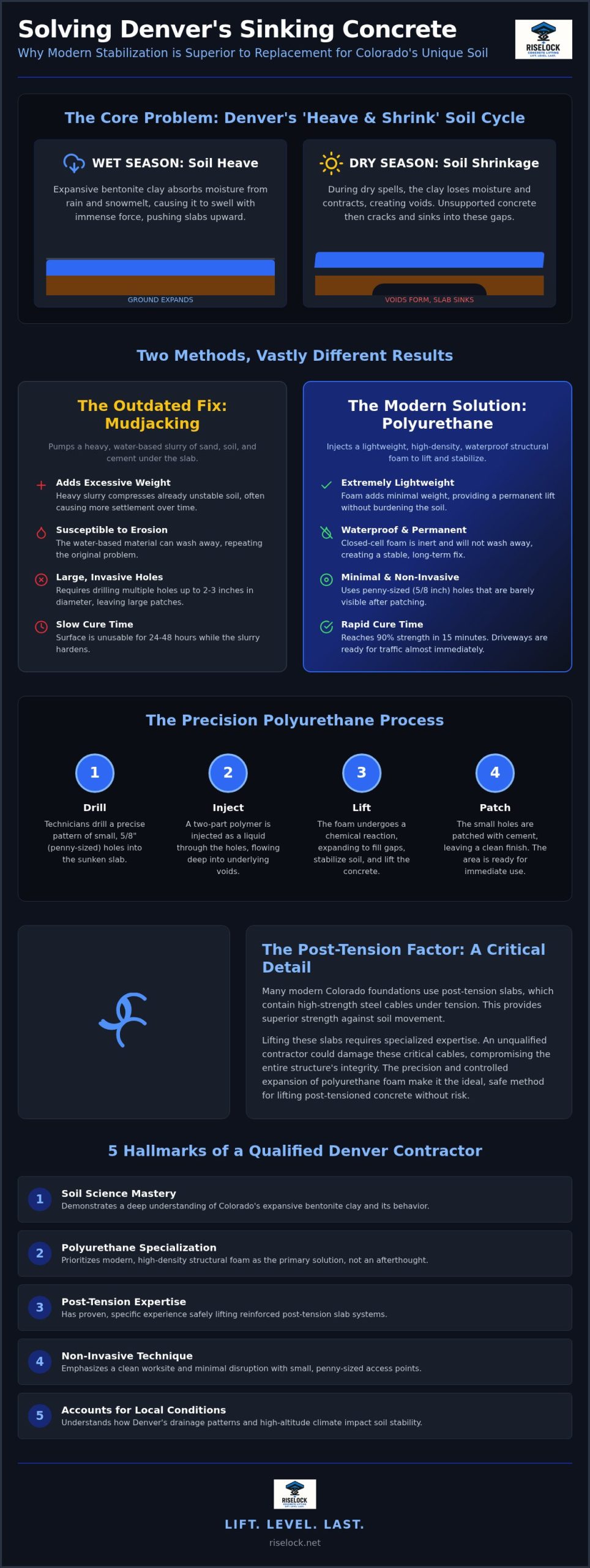
Denver sits on some of the most geologically active soil in the country. The primary culprit is expansive bentonite clay, a material that behaves much like a dense sponge. When it rains or snow melts, this clay absorbs moisture and expands with immense force. During our frequent dry spells, the soil contracts and pulls away from the structures above it. This relentless heave and shrink cycle is the fundamental reason why property owners eventually need a professional concrete lifting contractor Denver residents can rely on to stabilize their property permanently.
Traditional concrete replacement often fails within five years in this climate because it addresses the symptom rather than the source of the problem. Pouring new, heavy concrete over unstable, void-filled soil simply restarts the clock on settlement. Without stabilizing the ground first, the new slab will inevitably crack as the soil continues its natural movement. It’s a cycle of frustration that costs homeowners thousands in recurring repairs.
The Science of Soil Settlement in Colorado
The interaction between Colorado’s semi-arid climate and its clay-rich soil creates a unique engineering hurdle. When moisture levels drop during a “dry-out” period, the soil loses its load-bearing capacity. The concrete slab, no longer supported by a solid base, begins to sink into the resulting gaps. Certain areas along the Front Range are particularly susceptible to these conditions due to their specific geological makeup:
- Highlands Ranch and parts of Douglas County
- Aurora and the eastern plains
- Castle Rock’s hilly terrain
- Boulder’s varied alluvial deposits
Poor drainage patterns, such as downspouts that discharge too close to the foundation, only accelerate this process by concentrating water in specific zones. This creates uneven settlement that leads to the unsightly cracks and trip hazards common in Denver neighborhoods.
Why Mudjacking is a Flawed Solution for Denver
For decades, mudjacking was the standard repair method, but it’s an outdated approach for modern Front Range conditions. Mudjacking involves pumping a heavy slurry of sand, soil, and cement under the slab. This adds significant weight to soil that is already struggling to support the concrete. This additional mass often causes the slab to sink even further over time as the underlying clay compresses under the new load.
Furthermore, because mudjacking slurry is water-based, it remains susceptible to the same erosion and moisture cycles that caused the original failure. Modern Polyurethane Concrete Lifting offers a superior alternative by using lightweight, high-density foam. This material is waterproof and won’t wash away, providing a permanent solution that doesn’t stress the soil. For a more detailed technical breakdown of why this method is preferred, you can review our polyurethane vs mudjacking comparison. Choosing a concrete lifting contractor Denver who understands these geological nuances is the only way to ensure a repair that lasts decades rather than months.
Polyurethane Concrete Lifting: The Precision Alternative
Polyurethane concrete lifting represents the modern evolution of structural repair. Unlike the heavy, invasive methods of the past, this process utilizes a high-density, closed-cell foam that’s injected beneath the slab to restore its original elevation. As a specialized concrete lifting contractor Denver, we prioritize this technology because it addresses underlying instability without adding unnecessary weight to the subgrade. The material is chemically engineered to remain inert. It won’t react with the soil or leach chemicals into the groundwater, making it an environmentally responsible choice for residential neighborhoods.
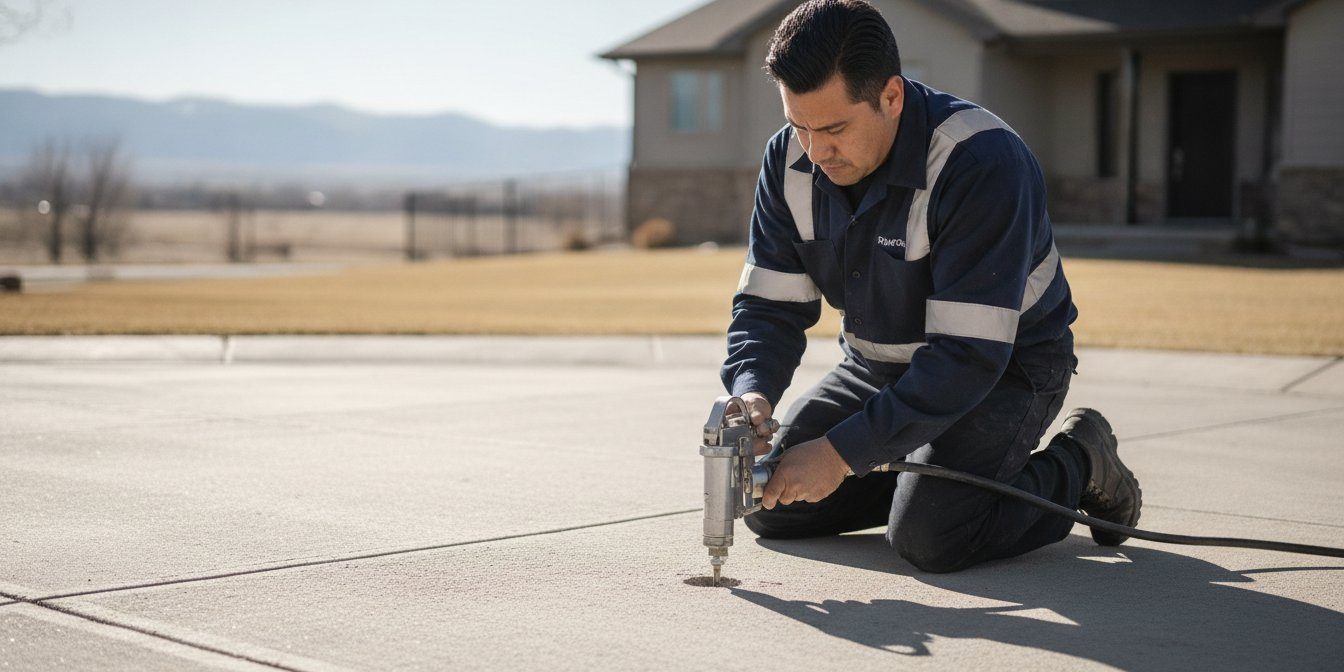
The injection process is remarkably non-invasive. Instead of large, unsightly patches or massive excavations, technicians drill holes no larger than a penny to deliver the material precisely where it’s needed. This allows for a clean finish that preserves the aesthetic of your property. One of the most significant advantages for busy homeowners is the immediate load-bearing capacity of the foam. While traditional concrete replacement takes days to cure, polyurethane reaches 90% of its structural strength within 15 minutes. You can drive your vehicle back into the garage or onto the driveway almost immediately after the crew finishes the work.
How High-Density Foam Stabilizes the Subgrade
When the liquid components are injected, a chemical reaction occurs that causes the foam to expand with thousands of pounds of pressure per square foot. This expansion fills every microscopic void and fissure created by the Front Range Soil Challenge. As the foam expands, it also compacts the loose surrounding soil, creating a denser and more reliable foundation for the slab. Polyurethane lifting is a lightweight, waterproof structural solution that permanently seals the underside of the concrete against future moisture intrusion.
Applications for Denver Residential and Commercial Properties
This technology is versatile enough to handle a wide range of structural issues across the Front Range. In residential settings, it’s the ideal method for restoring sunken driveways, leveling garage floors, and lifting patios that have pulled away from the home foundation. For commercial clients, precision is even more critical. We use high-density foam to level hazardous sidewalks to meet strict ADA compliance standards and to stabilize heavy warehouse floors that must support significant machinery loads. If you’re dealing with uneven surfaces, you can explore our specialized concrete leveling services to see how we restore safety and value to your property.
The Post-Tension Factor: Ensuring Structural Integrity
Post-tensioning is a critical engineering standard in Colorado foundations designed to combat the unique geologic hazards in Colorado. These systems utilize high-strength steel cables that are stressed after the concrete has cured, creating a compressed slab that can better withstand the immense upward pressure of swelling clays. Many property owners don’t realize that their sinking driveway or garage floor might be part of this complex structural system. Hiring a concrete lifting contractor Denver property owners trust means ensuring the team understands how to identify and protect these internal cables during the restoration process.
Attempting to lift a post-tensioned slab without specialized expertise is inherently dangerous. If a technician accidentally drills into a pressurized cable during the foam injection process, the cable can snap and “blow out” with enough force to cause severe structural damage or physical injury. At RiseLock, we integrate our professional knowledge of post tension installation directly into our lifting protocols. We use methodical mapping and scanning where necessary to ensure every injection point is clear of reinforcement, maintaining the safety of your home and our crew.
Repairing Broken Post-Tension Cables
A snapped or corroded cable is more than a minor defect; it’s a significant compromise of the slab’s internal strength. You might identify a broken cable by looking for a protruding cable end at the slab’s edge, a “blowout” hole in the concrete surface, or rust stains leaching from a structural crack. These signs indicate that the slab is no longer functioning as a single, cohesive unit. We utilize specialized hydraulic jacks and anchors for cable blowout repair, restoring the precise tension required to hold the concrete together. This restoration ensures that when we lift the slab, it moves uniformly and remains resilient against future soil movement.
Structural Reinforcement vs. Simple Leveling
While polyurethane foam provides an exceptional base, lifting alone is often insufficient for slabs that serve as a structural foundation. A concrete lifting contractor Denver must evaluate whether the slab’s internal reinforcement is still functional before proceeding. The synergy between high-density foam stabilization and functional cable reinforcement creates a repair that won’t just look level but will remain structurally sound for decades. For more specific details on how we manage these complex foundation issues, you can refer to our Denver concrete repair guide. We view every project through the lens of long-term security, moving beyond surface-level fixes to address the core structural health of your property.
Choosing a Concrete Lifting Contractor in Denver: 5 Critical Criteria
Selecting a concrete lifting contractor Denver residents can trust involves more than just comparing bottom-line costs. Because our regional soil is so geologically active, a surface-level fix is rarely a permanent one. You need a partner who views concrete restoration as a precise engineering task rather than a simple cosmetic patch. To ensure your property receives a solution that lasts decades, evaluate potential contractors against these five technical standards.
- Polyurethane Specialization: Confirm they have extensive experience with high-density foam, not just outdated mudjacking. A contractor still relying on heavy sand-cement slurries doesn’t understand the load-bearing limitations of Denver’s expansive clay.
- Local Geological Literacy: They should be able to discuss the specific moisture cycles of the Front Range and how your property’s drainage impacts soil stability.
- Structural Certifications: Verify they carry comprehensive insurance and have specific training in structural repair, particularly if you have a post-tensioned slab.
- Injection Precision: Ask about their hole-pattern strategy. A professional team uses a calculated grid of penny-sized holes to ensure uniform lift without stressing the concrete.
- Transparent Warranty: Demand a written guarantee that covers both the durability of the material and the stability of the lift against future settlement.
Technical Questions to Ask Your Contractor
Don’t be afraid to dig into the technical details during the bidding process. Ask: “What is the density of the foam you use for driveways versus foundations?” Foundations and heavy commercial slabs require a higher-density formulation to support the increased weight. Next, ask: “How do you handle post-tension cables during the lifting process?” If they don’t have a specific protocol for mapping or scanning for cables, they’re a liability to your home’s structural integrity. Finally, ask if they provide a comprehensive site drainage evaluation. Fixing the concrete without addressing the water flow that caused the void is only a temporary solution.
Red Flags in Concrete Leveling Quotes
Be wary of quotes that suggest “filling the void” with heavy cement or grout. As we established in previous sections, adding weight to failing soil is a recipe for secondary settlement. Another major red flag is a contractor who cannot explain the root cause of your settlement. If they don’t understand why the soil failed, they can’t guarantee the repair will hold. Lastly, exercise caution with “too-good-to-be-true” pricing. High-quality, closed-cell polyurethane is a sophisticated material with fixed costs. Extreme discounts often indicate a contractor is using low-density packaging foam or skipping the critical soil stabilization steps. If you’re ready for a technical assessment that prioritizes long-term stability, request a professional site evaluation from our expert team.
RiseLock’s Precision Approach: Restoring Colorado Properties
RiseLock operates with a philosophy of quiet authority. We don’t rely on hyperbolic marketing; instead, we prioritize technical mastery and the long-term health of your property’s foundation. As a premier concrete lifting contractor Denver property owners rely on, we view ourselves as a dependable partner in structural restoration. We understand that a sinking slab isn’t just an aesthetic issue but a complex engineering challenge that requires a methodical solution. Our team serves the entire Front Range, providing specialized intervention for residential, commercial, and municipal clients from Fort Collins and Boulder down through Aurora and Castle Rock.
Our 3-Step Process ensures that every project moves from a careful diagnosis to a permanent resolution. It begins with a technical evaluation to map voids and identify structural cables. Next, we perform subgrade stabilization using the highest-density polyurethane available to create a waterproof, load-bearing base. Finally, we provide structural reinforcement, which may include post-tensioning to ensure the slab remains cohesive. This logical progression of ideas and actions mirrors the physical work we perform, creating a structure that’s both informative for the client and efficient for our crews.
Why Denver Trusts RiseLock for Structural Restoration
Denver’s unique geological conditions demand more than a simple cosmetic fix. We specialize in complex hybrid projects where we combine polyurethane foam lifting with post-tension cable restoration. This dual-strategy addresses both the hollow voids in the soil and the internal tension of the concrete slab itself. We’ve committed to using high-density materials that far exceed the requirements for standard residential driveways, ensuring our commercial and municipal clients have a surface capable of supporting heavy machinery and high traffic. We don’t take shortcuts; our focus remains on long-term structural security rather than quick, temporary patches.
Get Started with a Professional Evaluation
When you schedule an on-site structural assessment, you’ll receive more than just a quote. Our technicians provide a clear, technical roadmap for your repair, explaining the “why” behind every recommended injection point. We’ll identify the specific cause of your settlement and provide a plan that adheres to the latest 2024 International Building Code standards adopted by the City and County of Denver. This thoroughness ensures you understand the structural health of your property before any work begins. If you’re ready to move away from the stress of structural damage toward the peace of mind offered by high-precision intervention, Schedule your expert concrete evaluation with RiseLock today. Our team is ready to serve as your authoritative guide through the restoration process.
Restoring Long-Term Value and Structural Security
Denver’s expansive clay soils demand a solution that addresses the root cause of settlement without compromising the slab’s internal reinforcement. High-density polyurethane technology provides a lightweight, waterproof base that traditional mudjacking simply cannot match. When combined with professional post-tension cable oversight, these modern methods ensure your property remains stable despite Colorado’s volatile moisture cycles. Choosing a specialized concrete lifting contractor Denver residents trust means prioritizing long-term security over quick cosmetic fixes.
RiseLock serves the entire Front Range, positioning our expertise as a reliable resource for homeowners and commercial managers alike. As post-tension cable repair specialists, we understand the intricate balance of forces within your foundation. We’re committed to restoring safety and value to your property through methodical, high-precision intervention. You deserve a partner that treats your structural health with the seriousness it requires.
Request Your Structural Concrete Evaluation from RiseLock to take the first step toward a permanent solution. Your property is in capable hands.
Frequently Asked Questions
Is polyurethane concrete lifting permanent in Denver’s soil?
Polyurethane lifting is a permanent solution because the high-density foam is waterproof and chemically inert. It doesn’t erode or break down when exposed to Colorado’s moisture cycles. While the material itself is permanent, a professional concrete lifting contractor Denver property owners hire must also ensure that underlying drainage issues are corrected to prevent new soil movement around the stabilized zone.
How much does concrete lifting cost compared to replacement in Colorado?
Concrete lifting typically costs significantly less than a full tear-out and replacement, often saving property owners 50% to 70% on total project expenses. This approach eliminates the high costs associated with demolition, debris hauling, and the labor required for a new pour. It also prevents the hidden costs of downtime since the surface is ready for use in minutes.
Can you lift a concrete slab with broken post-tension cables?
Lifting a slab with compromised post-tension cables is possible, but it requires a specialized repair of the cable system first. Attempting to lift a slab without restoring its internal tension can lead to further cracking or dangerous blowouts. We integrate cable blowout repair with our lifting process to ensure the slab remains a single, reinforced structural unit during and after the restoration.
How long does the concrete lifting process take?
Most residential projects, such as driveways or garage floors, are completed within three to five hours. Because the high-density polyurethane reaches 90% of its structural strength in about 15 minutes, you don’t have to wait days to use your property. This efficiency stands in stark contrast to traditional replacement, which requires a lengthy curing period before it can support vehicle weight.
Will the foam used in concrete raising harm my landscaping?
The polyurethane foam used in the raising process is environmentally inert and will not harm your lawn, trees, or flower beds. The injection process is remarkably clean, utilizing penny-sized holes that don’t require heavy excavation or large machinery. This non-invasive approach preserves your property’s aesthetic and prevents the mess typically associated with traditional mudjacking or full concrete replacement.
How do I know if I need concrete lifting or a full replacement?
Lifting is the appropriate choice if your concrete is structurally sound but has settled or tilted. If the slab is crumbled into small fragments or shows deep structural failure throughout the entire surface, replacement may be the only option. A qualified concrete lifting contractor Denver will evaluate the slab’s condition to confirm if the injection process can safely restore its original elevation.
Do you provide concrete lifting services in Aurora and Centennial?
We serve the entire Front Range urban corridor, providing specialized services in Aurora, Centennial, Littleton, and Highlands Ranch. Our technicians are deeply familiar with the specific soil challenges in these municipalities, such as the highly expansive clays found in eastern Aurora. We tailor our high-density foam applications to meet the unique geological requirements of each specific neighborhood we serve.
What is the difference between polyjacking and mudjacking?
The primary difference is the weight and durability of the materials used. Mudjacking relies on a heavy slurry of sand and cement that can actually cause further soil settlement due to its massive weight. Polyjacking uses a lightweight, high-density foam that expands to fill every void. This foam is waterproof and won’t wash away, providing a more reliable solution for Colorado’s varied climate.