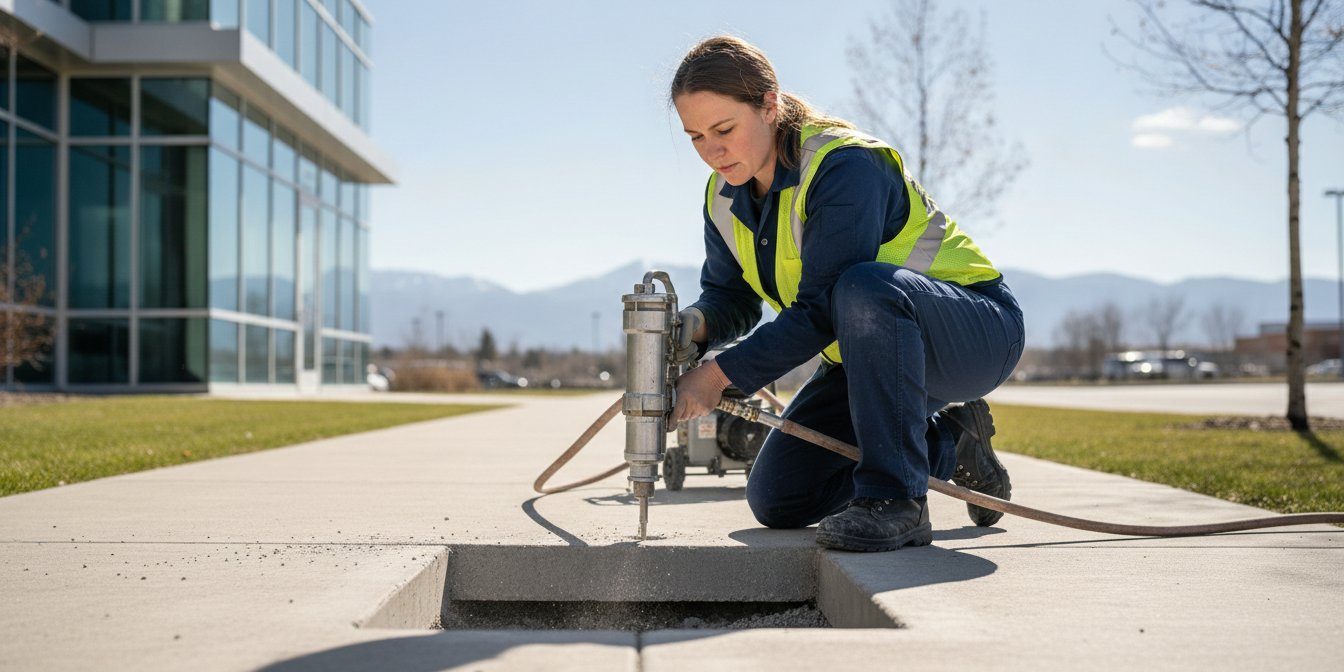
What if the most significant liability on your property is a subtle shift in the concrete leading to your front door? For many property owners in the Denver area, a minor vertical offset is a ticking clock on a potential slip-and-fall claim. You likely understand the necessity of maintaining safe walkways, but you may be hesitant to act due to the anticipated cost of total replacement or the unsightly results of temporary patches. Finding a reliable method for uneven sidewalk trip hazard repair shouldn’t involve choosing between structural failure and an expensive, multi-day construction zone.
The team at RiseLock Concrete Lifting specializes in a non-invasive approach that restores safety without the mess of traditional methods. In this guide, you’ll discover how to identify, evaluate, and permanently repair sidewalk trip hazards to ensure ADA compliance and eliminate long-term liability. We’ll walk you through a professional safety checklist and explain why addressing the soil foundation is the only way to achieve a level walkway that survives the harsh Colorado climate for years to come.
Key Takeaways
- Learn the specific ADA standards that define a legal trip hazard and how to protect your property from costly slip-and-fall litigation.
- Understand why traditional grinding and patching often fail in Colorado’s climate and how to choose a more durable uneven sidewalk trip hazard repair.
- Discover the technical advantages of high-density polyurethane foam for stabilizing soil and preventing future sinking without the excessive weight of mudjacking.
- Follow a professional inspection checklist to document vertical offsets and identify hidden hollow voids beneath your concrete slabs.
- Achieve a level, ADA-compliant walkway with a non-invasive restoration process that allows for immediate foot traffic and minimal business disruption.
Identifying Uneven Sidewalk Trip Hazards & Liability Risks
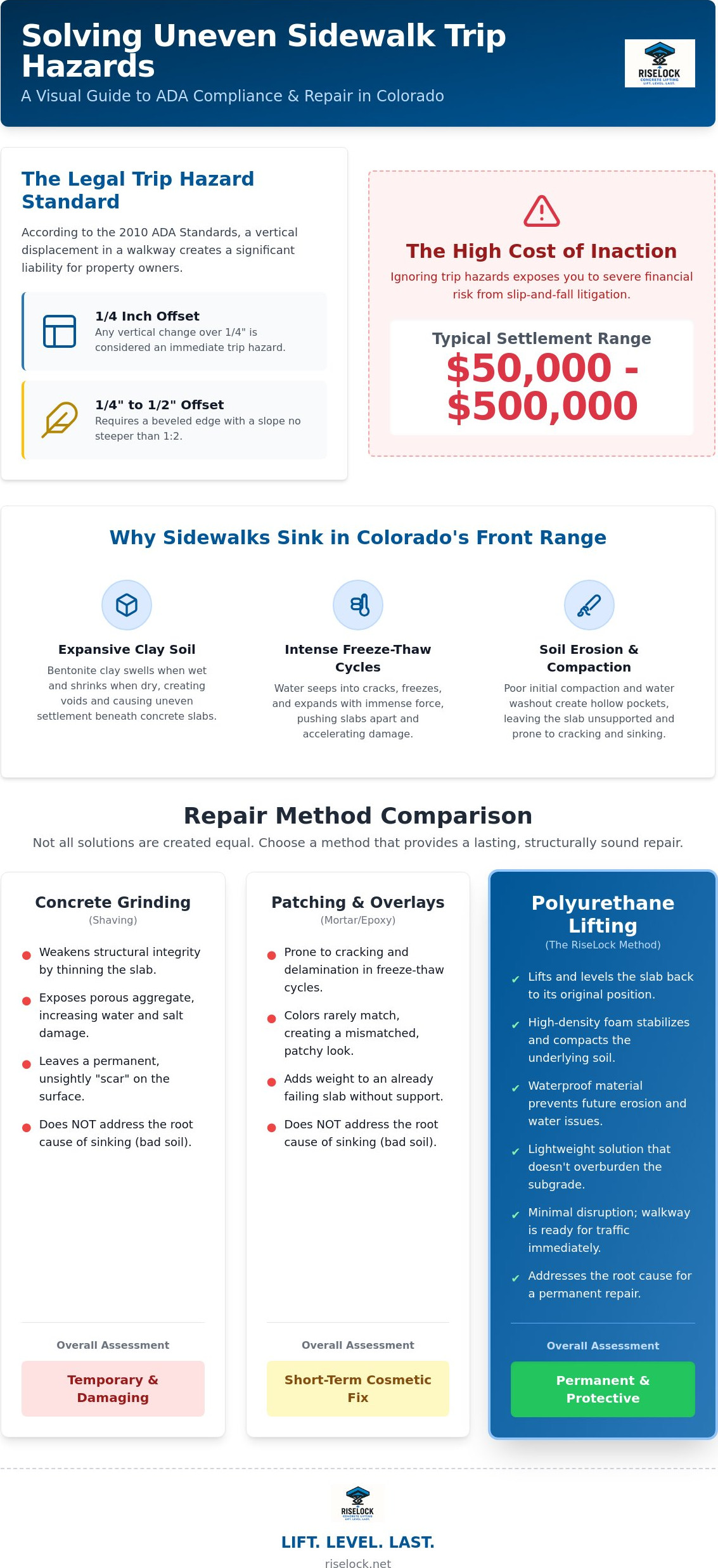
A sidewalk slab that has shifted even slightly is no longer just an aesthetic issue; it’s a legal liability. According to the 2010 ADA Standards for Accessible Design, any vertical displacement exceeding 1/4 inch constitutes a trip hazard. If the offset is between 1/4 and 1/2 inch, the edge must be beveled to a slope no steeper than 1:2. Ignoring these precision measurements puts property owners at risk of significant legal action. In Colorado, municipalities like Centennial and Lakewood are particularly vigilant about enforcing these standards to ensure public safety on commercial and residential walkways.
The financial consequences of a slip and fall incident are severe. Settlements for pedestrian injuries often range from $50,000 to $500,000 when negligence is proven. For a property owner, the cost of an uneven sidewalk trip hazard repair is a fraction of the potential legal fees and insurance premium hikes. Proactive maintenance is an ethical choice that protects both the public and your bottom line. It’s a matter of professional pride to maintain a property that is safe for every visitor.
The ADA Standard for Walkways
A compliant path of travel requires a stable, firm, and slip resistant surface. While a small hairline crack might be considered a nuisance, any change in level that catches a toe or impedes a wheelchair becomes a legal hazard. Inspectors focus on vertical offsets because they are the primary cause of accidental falls. Documenting these gaps with a straightedge is the first step in a professional safety audit. Understanding various concrete leveling methods allows owners to address these violations before a citation is issued or an injury occurs.
Why Sidewalks Sink in the Front Range
Colorado’s unique geology presents specific challenges for concrete longevity. Much of the Front Range sits on expansive bentonite clay, a soil type that swells significantly when wet and shrinks as it dries. This constant movement creates voids beneath the concrete, leading to uneven settlement. Additionally, the Denver area’s intense freeze thaw cycle exacerbates the problem; water enters small cracks, freezes, and expands, forcing slabs apart with immense pressure. Hydrostatic pressure is the force exerted by stagnant or flowing water against the underside of the concrete slab, which often leads to soil erosion and subsequent structural failure. Poor initial compaction during construction also contributes to these issues, as the soil fails to support the weight of the slab over time.
Small cracks are often the entry point for larger structural failures. When water bypasses the surface and reaches the subgrade, it washes away the supporting soil, creating hollow pockets. What begins as a minor 1/8 inch displacement can quickly escalate into a multi inch drop after a single heavy storm or a harsh winter. Delaying an uneven sidewalk trip hazard repair only increases the complexity and cost of the eventual restoration. Addressing these root causes early is the only way to ensure long term structural integrity.
Repair Method Comparison: Grinding, Patching, or Lifting?
Selecting the correct restoration method determines whether a property remains safe for years or requires repeated, costly intervention. While several options exist for uneven sidewalk trip hazard repair, they aren’t created equal in terms of durability or aesthetics. Traditional approaches often prioritize speed over structural integrity, leading to recurring failures that frustrate property managers and tenants alike. Choosing the wrong method doesn’t just waste money; it can leave the slab in a more vulnerable state than before the repair began.
The Problem with Concrete Grinding
Concrete grinding, often referred to as “shaving,” is a common quick fix that involves using a diamond blade to taper down a vertical offset. This process removes the “cream” layer, which is the smooth, dense surface of the concrete that provides its primary protection against the elements. By stripping this layer, you expose the porous aggregate underneath. This makes the slab significantly more susceptible to water penetration and salt damage, which is a major concern during Colorado winters. In high-end commercial districts like Cherry Creek, the resulting “scar” is unsightly and diminishes the property’s professional appearance. More importantly, thinning the slab weakens its structural capacity, often leading to cracks under heavy loads.
Surface patching and mortar overlays suffer from similar longevity issues. In the Front Range, the intense freeze-thaw cycle causes these thin layers to delaminate and pop off within a single season. Because these materials have different expansion rates than the underlying concrete, they rarely maintain a bond for long, eventually leaving the original hazard exposed once again. For those seeking a more reliable intervention, the team at RiseLock Concrete Lifting provides precision concrete leveling that addresses the underlying soil issues rather than just masking the surface.
Lifting vs. Replacement Cost Analysis
A full “tear-out and pour” replacement is frequently the most expensive and disruptive option available. Property owners must account for the labor of demolition, the cost of new materials, and the significant downtime required for the concrete to cure. A new sidewalk can take days to reach a strength where it’s safe for foot traffic, creating a major inconvenience for customers or residents. In contrast, concrete lifting solutions from RiseLock Concrete Lifting provide a permanent fix with almost zero impact on property accessibility.
The price per square foot for a total replacement is substantially higher than the cost of precision leveling. When you factor in the “hidden” costs of business disruption, the value of foam lifting becomes even clearer. High-density polyurethane is walkable in minutes, not days. This speed ensures that your property remains compliant with ADA trip hazard standards without closing down entryways for an entire week. By stabilizing the soil foundation, you’re investing in a solution that prevents the slab from sinking again, providing a level of security that grinding or patching simply can’t match.
The Technical Case for Polyurethane Foam in Colorado
High-density polyurethane foam represents a significant advancement in structural restoration, offering a level of precision that traditional methods cannot match. When performing an uneven sidewalk trip hazard repair, we focus on stabilizing the underlying soil rather than just modifying the concrete surface. The foam is injected as a liquid that quickly expands, filling every void and compacting loose soil to create a stable foundation. This chemical expansion provides a powerful upward force capable of lifting heavy slabs with surgical accuracy.
The “lightweight advantage” is a critical factor in Colorado’s shifting landscapes. Traditional mudjacking relies on a heavy slurry of sand, soil, and cement, which adds significant weight to the subgrade. This extra mass often causes the soil to compress further, leading to a recurring cycle of sinking. Polyurethane weighs only a fraction of traditional fill materials, ensuring that the repair doesn’t contribute to future settlement. It’s an environmentally responsible choice because it preserves the existing concrete, keeping old slabs out of landfills. Once cured, the foam is an inert material that won’t leach chemicals into the surrounding soil.
Precision Leveling for ADA Compliance
The injection process is remarkably non-invasive. We drill small 5/8-inch holes, roughly the size of a penny, which are far less noticeable than the large 2-inch holes required for mudjacking. During the polyurethane concrete lifting process, technicians monitor the movement of the slab in real-time. This allows for adjustments within 1/10th of an inch, ensuring the walkway meets strict ADA standards without the need for aggressive grinding. Unlike cutting, which thins the slab and reduces its load-bearing capacity, lifting restores the concrete to its original height while reinforcing the space beneath it.
Durability in Extreme Weather
Colorado’s climate is notoriously harsh on infrastructure, but polyurethane is built to withstand these conditions. The material is hydrophobic, meaning it repels water and won’t wash away during heavy spring snowmelts or flash floods. It maintains its structural volume despite the rapid temperature swings common in the Front Range, where a 40-degree shift can happen in a single afternoon. Because it bonds directly to the underside of the concrete and provides a stable, cushioned support, foam concrete lifting is the superior choice for high-traffic areas that require a permanent, weather-resistant solution. By addressing the root cause of soil instability, this method provides an uneven sidewalk trip hazard repair that remains reliable under constant use.
The Definitive Sidewalk Safety & Repair Checklist
A methodical inspection is the only way to ensure every liability risk is identified before it results in an accident. Property managers should conduct these audits quarterly, particularly after the heavy snowmelt seasons common in Colorado. By following a structured approach, you can prioritize repairs based on the severity of the hazard and the volume of foot traffic. This systematic evaluation ensures that your uneven sidewalk trip hazard repair strategy is both cost-effective and legally sound.
- Step 1: Visual Inspection: Walk the entire perimeter of your property. Look for vertical offsets, surface spalling, and cracks that indicate shifting. Use a metal rod to gently tap the concrete; a “hollow” sound often reveals a subsurface void where soil has washed away.
- Step 2: Measurement: Use a straightedge and a ruler to measure the height of every vertical displacement. Any gap exceeding 1/4 inch requires immediate attention to remain compliant with federal safety standards.
- Step 3: Root Cause Analysis: Identify why the slab moved. Check for nearby tree roots lifting the concrete or gutter downspouts that are saturating the subgrade. Addressing these issues prevents the repair from failing prematurely.
- Step 4: Method Selection: Determine if the slab is structurally sound enough for lifting. If the concrete is severely crumbled, replacement may be necessary; however, most settled slabs are perfect candidates for polyurethane stabilization.
- Step 5: Contractor Vetting: Verify that your chosen professional uses high-density polyurethane. Avoid contractors who still rely on mudjacking, as the added weight of the slurry often leads to secondary settlement.
How to Document Hazards for Insurance
Insurance providers and legal teams value thorough documentation. Take date-stamped photos of every hazard from multiple angles, using a ruler in the frame to provide scale. For larger commercial properties in cities like Aurora or Thornton, creating a location map of identified hazards helps you track your maintenance progress. This proactive record-keeping demonstrates a commitment to safety and can be vital if a claim is ever filed. When searching for concrete leveling contractors near me, choose a partner who understands the importance of detailed site reporting.
Questions to Ask Your Concrete Repair Contractor
Technical mastery matters when it comes to structural restoration. Inquire about the specific density of the foam they intend to use. While 2lb foam is often sufficient for residential walkways, commercial concrete leveling projects involving heavy equipment or high-volume traffic often require 4lb high-density foam for maximum support. Ask about their warranty periods and ensure they offer a “no-mess” injection process that won’t leave slurry or debris on your landscaping. A reputable contractor should be able to explain the “why” behind their technical choices with confidence and clarity.
Start your safety audit today by reaching out to RiseLock for a professional site assessment to secure your property’s future.
Professional Restoration: The RiseLock Concrete Lifting Precision Approach
At RiseLock Concrete Lifting, we view structural restoration as a high-stakes engineering task rather than a simple cosmetic fix. Every uneven sidewalk trip hazard repair we perform is rooted in technical mastery and a commitment to long-term stability. We avoid the aggressive sales tactics common in the industry, choosing instead to lead with quiet authority and precise execution. Our focus remains on the structural integrity of the subgrade, ensuring that once a slab is lifted, it stays level through Colorado’s challenging seasons. We take professional pride in being a dependable partner that views your structural challenges as our own priority.
Our specialized process is specifically tailored for the unique soil conditions found in the Denver metro area and throughout the Front Range. We understand that expansive bentonite clay and poor initial compaction are the primary drivers of settlement in this region. By utilizing high-density polyurethane foam, RiseLock Concrete Lifting provides a non-invasive solution that reinforces the soil foundation without the destructive impact of heavy machinery or the high cost of total replacement. This approach allows us to serve both residential and commercial clients with the same level of ethical service and technical accuracy.
Serving the Front Range
Our reach extends across the major hubs of the Front Range, covering Denver, Aurora, Centennial, and Boulder, as well as Colorado Springs and Lakewood. We specialize in bringing walkways into 100% ADA compliance, providing property owners with the security of a legally sound environment. Often, we address multiple structural issues during a single visit to maximize efficiency for the owner. For instance, we recently completed a sunken driveway repair in Denver where we stabilized a large residential entrance while simultaneously correcting several hazardous sidewalk offsets that had developed over several winters.
Your Next Steps Toward Safety
Transitioning from a hazardous walkway to a secure, level surface shouldn’t be a source of stress for property managers or homeowners. Our scheduling process is designed for efficiency, and our repair method is entirely non-invasive, leaving no mess behind. Most projects are completed in a single day, and the concrete is ready for foot traffic within minutes of the final injection. This speed eliminates the liability of uneven concrete and restores the professional appearance of your property without the downtime of a traditional “tear-out and pour” project. Taking action now prevents the minor vertical offsets of today from becoming the expensive legal challenges of tomorrow. To secure your property and ensure lasting peace of mind, Get Your Free Sidewalk Precision Estimate from the experts at RiseLock Concrete Lifting today.
Securing Your Property’s Future and Safety
Maintaining a safe walkway is a continuous responsibility that demands technical precision. You’ve seen how identifying vertical offsets early and choosing the right restoration method can eliminate significant legal risks. While grinding or patching might offer a temporary fix, these methods often compromise the concrete’s integrity or fail during the first freeze-thaw cycle. Uneven sidewalk trip hazard repair is most effective when it addresses the underlying soil instability using modern polyurethane injection technology. This approach ensures your property remains ADA-compliant while providing a durable surface that withstands the Front Range’s extreme weather.
Ready to protect your investment? Request a Professional Sidewalk Inspection & Quote from RiseLock to experience our precision ADA-compliant leveling firsthand. We serve Denver, Aurora, and the entire Front Range with a commitment to excellence and high-standard restoration. You can move forward with confidence, knowing your property is on solid ground and your liability is managed by experts who prioritize structural integrity.
Frequently Asked Questions
How much does it cost to repair a sidewalk trip hazard?
The total cost of repair is determined by the size of the affected area and the severity of the vertical displacement. While project totals vary depending on specific site conditions, professional restoration remains a more economical choice than a full tear-out and pour. By opting for a targeted intervention, you avoid the extensive labor and disposal fees associated with traditional concrete replacement.
Is concrete lifting cheaper than replacing the sidewalk?
Yes, concrete lifting is typically a fraction of the cost of a full replacement. Most property owners find that polyurethane stabilization saves them substantial capital by preserving the existing slabs and eliminating the need for new materials. This method also removes the hidden costs of business downtime, as your walkway remains accessible to the public throughout the entire process.
What is the ADA requirement for sidewalk trip hazards?
The Americans with Disabilities Act (ADA) identifies a trip hazard as any vertical change in level greater than 1/4 inch. For offsets between 1/4 inch and 1/2 inch, regulations require the edge to be beveled to a 1:2 slope. Any displacement exceeding 1/2 inch requires a comprehensive uneven sidewalk trip hazard repair to restore a level, compliant path of travel for all pedestrians.
How long does polyurethane concrete leveling last?
Polyurethane concrete leveling is designed to be a permanent structural solution. Because the high-density foam is hydrophobic and chemically inert, it doesn’t wash away or degrade over time like traditional mudjacking slurry. As long as the underlying drainage issues are addressed and the concrete remains structurally sound, the lift will last for the remaining lifespan of the slab itself.
Can I fix an uneven sidewalk myself?
DIY patches or manual grinding are rarely effective long-term solutions for structural settlement. Surface patches frequently delaminate during the first Colorado winter, and grinding thins the concrete, making it prone to cracking under heavy loads. Professional uneven sidewalk trip hazard repair requires specialized injection equipment and high-strength materials to ensure the slab is properly supported from beneath the surface.
How soon can people walk on the sidewalk after a polyurethane repair?
Pedestrians can typically walk on the treated surface within minutes of the final injection. The polyurethane expands and reaches 90% of its full structural strength almost immediately after application. This rapid cure time is a significant advantage for commercial properties and residential complexes that cannot afford to block off entryways or common paths for days at a time.
Does polyurethane foam lifting work for sidewalks with tree root damage?
Foam lifting is highly effective for filling the voids left after tree roots are professionally trimmed or removed. However, if a living root continues to grow and push upward, it will eventually shift the concrete again regardless of the repair method. We recommend addressing the biological cause of the lift before using polyurethane to stabilize and level the affected concrete sections.
Why is my sidewalk sinking in the first place?
Sidewalk settlement in the Front Range is usually caused by soil erosion, poor initial compaction, or the natural movement of expansive bentonite clay. When water penetrates beneath the slab, it can wash away the supporting subgrade and leave a hollow space. The intense freeze-thaw cycle then exacerbates these gaps, causing the heavy concrete to shift and sink into the newly formed voids.