The most common method for lifting a sinking driveway might actually be the very thing that causes it to fail again in less than twenty four months. While it seems logical to fill a void with more concrete, the disadvantages of mudjacking often reveal themselves shortly after the repair crew leaves your property. By pumping hundreds of pounds of heavy cement slurry onto soil that’s already struggling to support a slab, you risk creating a cycle of recurring settlement that compromises your home’s long term structural integrity.
It’s frustrating to invest in a repair only to see the same cracks reappear or find your concrete marred by large, unsightly drill holes. You deserve a solution that addresses the root cause of the shift without damaging your landscaping or adding unnecessary weight to the ground. This guide explains why traditional slurry is often a poor match for the unique soil conditions found across the Front Range. We’ll explore how modern polyurethane lifting offers a more precise, durable alternative that cures in just fifteen minutes and provides a stable foundation for decades to come.
Key Takeaways
- Understand how the significant weight of traditional slurry can actually accelerate concrete sinking by overloading compromised subsoil.
- Identify the critical disadvantages of mudjacking, from the risk of property-damaging blowouts to the use of intrusive, heavy machinery on your lawn.
- Contrast the clean aesthetics of small, penny-sized injection ports against the large, unsightly drill holes required for legacy cement repairs.
- Evaluate the efficiency of polyurethane lifting, which allows for full weight-bearing traffic in as little as fifteen minutes after the application is complete.
- Discover why precision-engineered foam provides a more durable, moisture-resistant foundation for the unique soil challenges found across the Front Range.
What is Mudjacking? Understanding the Legacy Method
Mudjacking is a heavy-fill concrete restoration method developed in the early 20th century. For decades, it stood as the only viable alternative to the costly and disruptive process of full concrete replacement. To truly grasp What is Mudjacking?, you have to view it as a mechanical solution from a different era of engineering. It relies on volume and pressure to lift heavy slabs, a process that was revolutionary at its inception but has since been surpassed by more precise, lightweight technologies. While it served its purpose for nearly a hundred years, the inherent disadvantages of mudjacking stem from its reliance on heavy, unstable materials that don’t always interact well with modern construction standards.
The Composition of Mudjacking Slurry
The “mud” in mudjacking isn’t just dirt. It’s a specific mixture of locally sourced topsoil, sand, and Portland cement. To ensure this thick material can flow through hoses and fill the voids beneath a driveway or patio, crews must add a high volume of water. This creates a heavy, wet substance that provides initial lift but introduces long term instability. Because the slurry contains organic topsoil, it’s prone to the same natural decay as the ground around it. Over time, moisture can wash away the soil components, leading to the return of the very voids the repair was supposed to fix. This reliance on organic material is a primary reason why these repairs often fail in environments with high moisture or shifting soil.
The Traditional Lifting Process
Executing a traditional lift is a labor-intensive task that leaves a lasting footprint on your property. Technicians start by drilling multiple large-diameter holes, often reaching two to three inches in width, across the surface of the sinking slab. These holes are necessary because the thick slurry cannot move through smaller openings. A large pump truck then forces the material into the holes until the concrete rises. Once the slab is level, the crew patches the holes with concrete plugs. Understanding these aesthetic and structural disadvantages of mudjacking is essential for homeowners who value the long term appearance of their property. These circular scars rarely blend in with the surrounding area, often resulting in a “polka dot” appearance that detracts from your home’s curb appeal. The reliance on heavy machinery and large trucks can also lead to secondary damage on lawns and landscaping during the repair process.
The Hidden Disadvantages of Mudjacking Weight
The primary flaw in traditional concrete leveling lies in the sheer mass of the material used. Mudjacking slurry typically weighs between 100 and 150 pounds per cubic foot. This is a staggering amount of weight to place on soil that has already proven it cannot support the original concrete slab. While standard mudjacking procedures focus on the immediate mechanical lift, they often ignore the long term structural burden placed on the subgrade. This added mass creates a phenomenon known as secondary settlement. Essentially, the solution becomes the source of a new problem by overloading the foundation.
Soil Overburden and Compaction
Adding hundreds of pounds of wet, heavy fill to a failing subsoil is fundamentally counterintuitive. Your concrete settled because the ground beneath it was either poorly compacted, eroded by water, or lacked the load bearing capacity to hold the slab. When a repair crew injects a thick mixture of dirt and cement, they’re increasing the pressure on that compromised base. Over time, this overburden forces the underlying soil to compress even further under the new weight. It’s one of the most significant disadvantages of mudjacking that homeowners don’t realize until their driveway begins to sink again a year later. Furthermore, the porous nature of cured slurry allows moisture to migrate through the material, which can lead to “washout” where the repair itself eventually erodes.
Impact on Colorado Foundation Stability
Residents across the Front Range deal with some of the most challenging soil conditions in the country. Much of the Denver metro area sits on expansive clay that reacts violently to changes in moisture. When you introduce a heavy, moisture-retaining fill like mudjacking slurry, you’re providing a reservoir for water right under your slab. During Colorado’s intense freeze-thaw cycles, this heavy material holds onto water, leading to significant ice heaving. This upward pressure can cause the slab to crack or shift in ways that are difficult to correct. Understanding the relationship between soil types and repair longevity is a core part of effective concrete repair Denver Colorado homeowners should prioritize. If you want to break the cycle of sinking and shifting, it’s worth considering how modern concrete leveling techniques utilize lightweight materials to stabilize the ground without adding unnecessary bulk.
By choosing a method that respects the delicate balance of Colorado’s subsoil, you ensure a repair that lasts. Precision is always preferable to brute force when it comes to structural integrity. Modern alternatives provide the lift you need without the crushing weight that traditional slurry inevitably brings to your property.
Aesthetic and Property Impact: The Mess Factor
Beyond the structural concerns of weight and soil overburden, the physical execution of traditional leveling often leaves a lasting, negative impact on your home’s appearance. Mudjacking is inherently a high-volume, invasive process. It requires large pump trucks and heavy equipment to navigate your driveway or lawn to reach the repair site. This heavy machinery can leave deep ruts in soft Colorado turf or even cause secondary cracking in thin asphalt or concrete sections that weren’t originally part of the problem. The sheer scale of the equipment needed for a slurry-based repair is one of the most immediate, visible drawbacks for property owners. For those managing commercial properties, these disruptions carry additional risks around ADA compliance and liability; our Denver commercial concrete lifting checklist outlines how to evaluate repair methods against the specific demands of high-traffic commercial surfaces.
The injection process itself is frequently unpredictable. When technicians pump thick slurry under high pressure, the material doesn’t always stay where it’s intended. Blowouts occur when the slurry finds a path of least resistance, resulting in wet cement seeping out from the sides of the slab or through nearby expansion joints. This seepage creates a significant mess that requires immediate intervention to prevent permanent staining. Once the lifting is finished, the typical cleanup process involves high-pressure hoses to wash away excess mud and debris, which often directs sediment-heavy runoff into your flower beds or local storm drains.
Hole Size and Slab Integrity
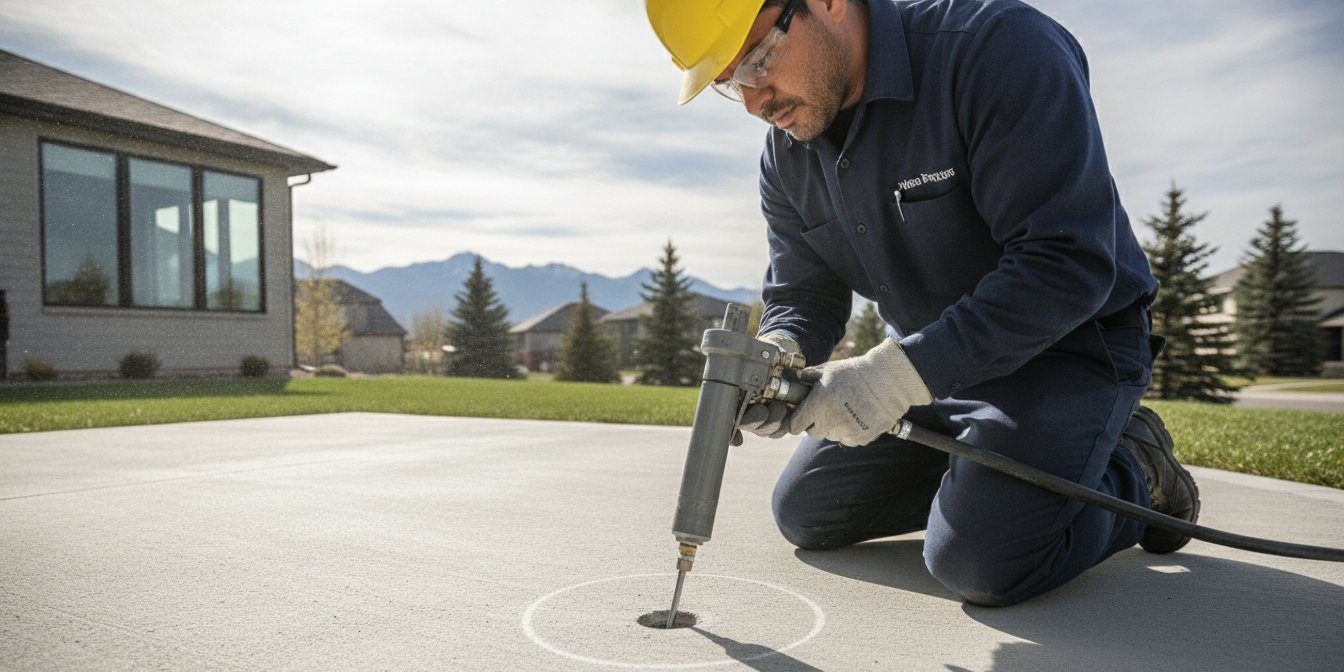
One of the most visible disadvantages of mudjacking is the size of the access points required to deliver the material. Because the slurry is a thick mixture of soil and cement, it cannot pass through small openings. Technicians must drill multiple holes roughly the size of a soda can, typically ranging from two to three inches in diameter. These large penetrations can actually weaken the structural grid of the concrete slab, creating potential failure points for future cracks. Visually, these holes create a “polka-dot” effect across your patio or driveway. Even when patched with fresh concrete, the new plugs rarely match the weathered color of the original surface. In contrast, foam concrete lifting utilizes penny-sized holes that are virtually invisible once the repair is complete.
Landscaping and Environmental Concerns
The environmental footprint of a mudjacking project extends beyond the slab itself. Heavy hoses dragged across your property can crush delicate gardens or leave brown streaks in your grass. If the slurry splashes onto your home’s siding, brickwork, or stone accents, it becomes incredibly difficult to remove once it begins to dry. Because the material is not biodegradable, any runoff that enters the local drainage system contributes to siltation issues. These aesthetic and environmental disadvantages of mudjacking make it a less-than-ideal choice for homeowners who take pride in the meticulous upkeep of their property. Choosing a cleaner, more precise method ensures your home remains as beautiful as it is stable.
Polyurethane vs Mudjacking: A Modern Comparison
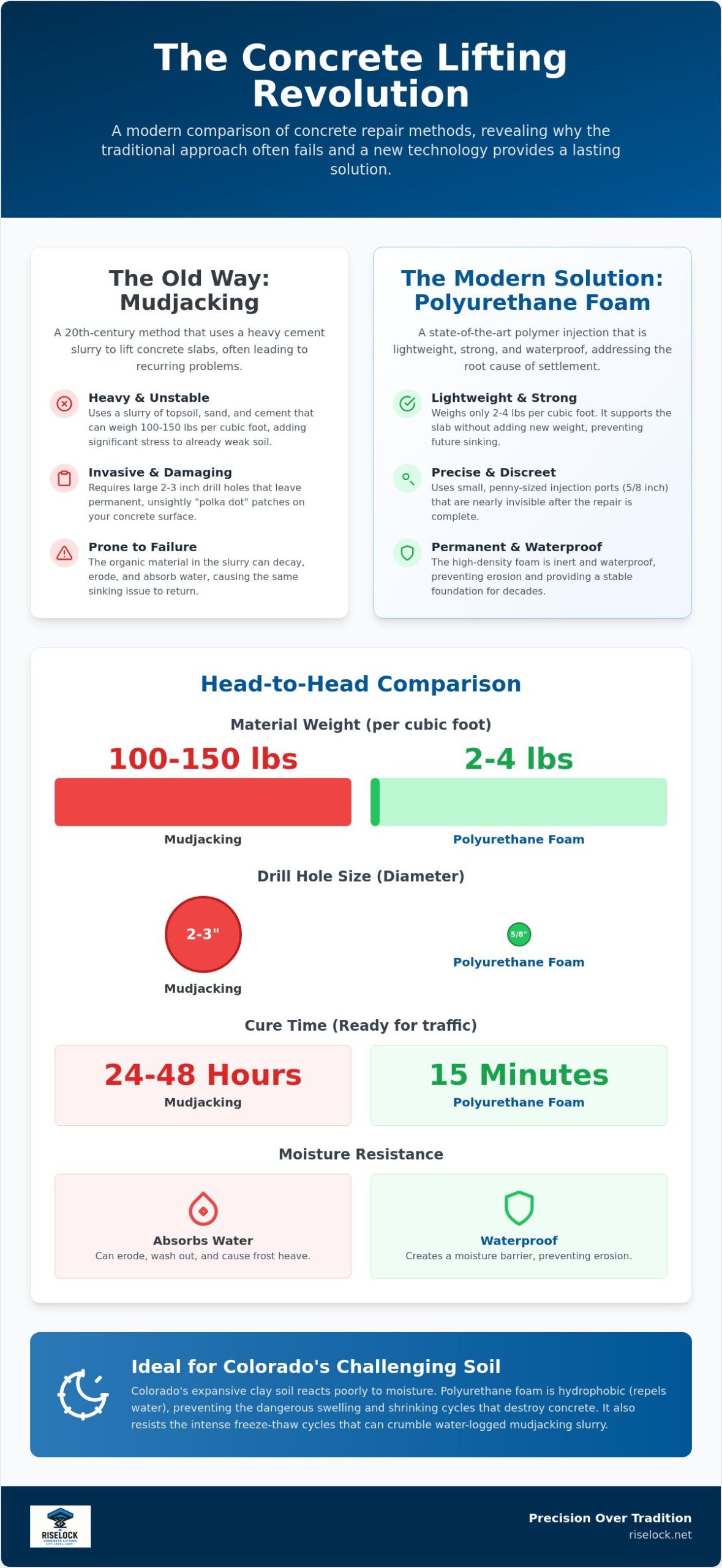
The technical evolution of concrete leveling has shifted away from heavy, aggregate-based fills toward high-density polymers that offer superior precision. When comparing these two methods, the most immediate difference is the physical burden placed on the subgrade. One of the most stark disadvantages of mudjacking is that the slurry weighs upwards of 100 pounds per cubic foot. Polyurethane foam concrete leveling, by contrast, weighs a mere 3 to 5 pounds per cubic foot while providing the same structural lift. This massive reduction in weight prevents the secondary settlement issues that commonly plague traditional repairs.
Operational efficiency is another area where modern techniques outpace legacy methods. While mudjacking requires a curing period of 24 to 72 hours before the surface can support vehicle traffic, polyurethane foam reaches 90% of its full compressive strength in as little as 15 minutes. This allows homeowners to use their driveways or patios almost immediately after the crew finishes. For a busy Denver household, the ability to restore access in less than an hour provides a level of convenience that traditional slurry simply cannot match.
Longevity and Resistance to the Elements
Polyurethane is a closed-cell material, meaning it is completely waterproof and will never wash out or decompose. Unlike mudjacking slurry, which is a porous mixture of organic soil and cement, foam acts as a permanent moisture barrier beneath the slab. It fills the smallest fissures in the soil and binds loose particles together, creating a stable foundation that resists the erosive power of groundwater. Because it does not rely on water for its volume, it won’t shrink or crack over time. You can learn more about these long term performance metrics in our guide on how long does polyurethane concrete lifting last.
The True Cost of Ownership
Homeowners often find that the “cheaper” mudjacking quote is actually more expensive over a five year period. Because traditional slurry is prone to erosion and contributes to soil compaction, these repairs frequently fail within 24 to 36 months. Investing in a “one-and-done” solution is a more ethical and financially sound approach for those living in the Front Range. By addressing the root cause of the settlement with lightweight, waterproof materials, you avoid the cycle of recurring repairs and permanent property damage. Our concrete lifting solutions provide a clear framework for understanding the value of modern restoration over legacy fill methods.
If you are tired of watching your concrete sink year after year, it is time to choose a repair that respects the integrity of your property. You can schedule a professional assessment with our team to see how high-density polymers can stabilize your home for the long term.
Why RiseLock Chooses Precision Over Tradition
RiseLock was founded on the principle that structural repair should be a permanent solution, not a temporary patch. We’ve deliberately moved away from legacy methods because the disadvantages of mudjacking simply don’t align with our commitment to technical mastery and professional reliability. Our focus remains on providing homeowners across the Front Range, from Arvada to Castle Rock, with a restoration that respects the long term health of their property. By rejecting the “quick fix” mentality of heavy slurry, we position ourselves as a dependable partner for those who value precision engineering over outdated brute force.
Our Technical Approach to Denver Slabs
We utilize high-density polymers specifically engineered to withstand Colorado’s extreme temperature swings and volatile soil conditions. This material is injected with surgical precision, allowing us to stabilize slabs without the destructive impact of heavy slurry or intrusive equipment. In some cases, our technical assessment may reveal that a slab requires more than just a lift to remain stable. When structural integrity is severely compromised, we evaluate whether post tension installation is necessary to reinforce the concrete against future movement. This comprehensive approach ensures we aren’t just treating a symptom, but securing the entire structure for decades to come.
The core of our residential service is polyurethane concrete lifting. By choosing this advanced method, we avoid the heavy equipment and massive drill holes that characterize older techniques. Our process is designed to be minimally invasive, protecting your carefully curated landscaping and maintaining the original aesthetics of your home. We view every project as a personal priority, applying the same high standards to a small sidewalk repair as we do to a complex residential foundation project. This dedication to cleanliness and accuracy is what sets a modern restoration apart from traditional construction work.
Getting Started with RiseLock
A successful repair begins with a thorough professional site evaluation. We don’t offer generic estimates because every Colorado property faces unique challenges, from drainage issues to specific soil compositions. During a RiseLock service call, our technicians perform a detailed analysis of the slab’s movement and the underlying void. This ensures that the intervention we provide is exactly what’s needed for a stable, long lasting result. If you’re ready to move past the recurring disadvantages of mudjacking and invest in a modern solution that protects your home’s value, we’re here to guide you through the process.
Request your precision concrete leveling estimate today and discover the peace of mind that comes with a scientifically backed structural repair.
Secure Your Concrete with Modern Precision
Choosing a repair method for your sinking driveway or patio is a decision that impacts the structural health of your property for years to come. As we have explored, the disadvantages of mudjacking, including excessive material weight and invasive property disruption, often lead to a cycle of recurring settlement. By contrast, high-density polyurethane foam offers a lightweight, waterproof alternative that addresses the unique challenges of the Front Range’s expansive clay soils without the mess of traditional slurry. It’s a cleaner, faster, and more durable approach to maintaining your home’s foundation.
RiseLock serves as Denver’s local authority on modern concrete restoration, providing specialized solutions that range from precision leveling to complex structural post-tensioning. We prioritize technical mastery and long-term security in every project we undertake, ensuring your repair stands up to Colorado’s intense climate. If you’re ready to move beyond legacy methods and protect your home’s value with advanced technology, our team is prepared to help. Upgrade to Precision: Get a Free Polyurethane Lifting Quote from RiseLock. You don’t have to settle for temporary fixes when a permanent, professional solution is within reach. We look forward to restoring the stability and beauty of your property.
Frequently Asked Questions
Is mudjacking cheaper than polyurethane foam lifting?
Mudjacking usually costs less upfront, typically ranging from 25% to 50% less than modern foam lifting for the initial service. However, it’s important to view this as a short-term saving. The lower price point doesn’t account for the high likelihood of re-settlement or the property damage caused by heavy equipment. Most homeowners find that the long-term value of a permanent, lightweight solution far outweighs the lower entry price of legacy methods.
Why does mudjacking often fail after a few years?
Most failures occur because the heavy slurry adds too much pressure to already compromised soil. One of the significant disadvantages of mudjacking is that it uses a mixture of soil and cement that can weigh up to 150 pounds per cubic foot. This weight causes the underlying ground to compress further over time. Additionally, the organic materials in the slurry can wash away when exposed to heavy rain or groundwater.
Can mudjacking damage my landscaping?
Yes, the heavy equipment required for traditional repairs can cause significant damage to your lawn and gardens. Large pump trucks must often drive onto your property, leaving deep ruts in the turf. The process also involves thick hoses that can crush plants and a wet injection process that often results in slurry blowouts. These messes require high-pressure washing that can further disturb your carefully maintained landscaping.
Is the cement slurry used in mudjacking environmentally friendly?
The slurry is composed of natural materials like sand and soil, but it’s not considered environmentally friendly in a modern context. It’s not biodegradable. It can alter the local soil’s drainage patterns once it cures into a heavy, solid mass. Runoff from the application process can also carry sediment and cement into local storm drains, making it a less sustainable option than inert, closed-cell polymers used in modern lifting.
How long does it take for mudjacking to dry before I can drive on it?
You must typically wait 24 to 72 hours for the slurry to fully cure before it can support the weight of a vehicle. This extended downtime is a major drawback for homeowners who rely on their driveways for daily access. In contrast, modern foam reaches nearly its full strength in about 15 minutes. This allows you to use your concrete surface almost immediately after the repair team leaves your home.
What happens if the mudjacking slurry washes out?
If the slurry washes out, the slab will lose its support and sink again, often creating a larger void than before. Because the mixture is porous and contains organic soil, it’s highly susceptible to erosion from moving groundwater. Once the material begins to degrade, the structural integrity of the repair is lost. You’ll likely see the return of the same trip hazards and cracks you originally tried to fix.
Are the holes from mudjacking permanent?
The holes drilled for the injection process are permanent and significantly larger than those used in modern lifting. One of the most visible disadvantages of mudjacking is that these ports are usually the size of a soda can, measuring two to three inches in diameter. While they’re patched with concrete after the lift is complete, the new plugs rarely match the color or texture of your weathered slab, hurting curb appeal.
Why is mudjacking weight such a big problem for Colorado soils?
Colorado’s expansive clay is highly sensitive to the massive weight of traditional fill materials. Adding hundreds of pounds to a sinking slab often forces the clay beneath it to compress even further, leading to secondary settlement. The moisture-retaining properties of the slurry also make it vulnerable to our state’s intense freeze-thaw cycles. This can cause the material to expand and heave, creating new structural problems under your concrete.