Most property owners view concrete repair as a temporary patch, a recurring chore that inevitably fails as the soil shifts again. It’s frustrating to invest in a solution only to watch your driveway or patio sink back into the Colorado dirt within a few seasons. You want a repair that respects your time and your budget. You’re likely asking, how long does polyurethane concrete lifting last before the cycle starts over? The answer lies in the chemistry of the material and the precision of the application.
This guide explores the scientific lifespan of high-density geotechnical foam and explains why this modern innovation often outlives the very concrete it supports. We’ll examine the technical factors that influence durability, from soil stabilization to injection precision, so you can secure your property’s structural integrity for decades to come. By understanding the ROI of polyurethane versus traditional replacement, you can move away from the stress of recurring settlement and toward lasting peace of mind. We’ll provide the clarity you need to make an informed decision for your home.
Key Takeaways
- Polyurethane foam is a chemically inert material that does not rot, decompose, or lose its structural shape over time, providing a permanent foundation for your concrete.
- Understand how long does polyurethane concrete lifting last by comparing its lightweight composition to heavy mudjacking slurries that often trigger secondary soil settlement.
- Discover why managing Colorado’s expansive clay soils and maintaining proper property drainage are the most critical factors in ensuring your lifted slabs stay level for decades.
- Learn the essential annual maintenance routines, such as caulking and sealing joints, that protect the soil beneath your concrete from erosion and water infiltration.
- Explore how high-precision injection techniques and high-density geotechnical foams offer a superior, long-term return on investment compared to the high cost of full concrete replacement.
Understanding the Lifespan of Polyurethane Concrete Lifting
Polyurethane concrete lifting isn’t a temporary patch; it’s a permanent structural intervention. When property owners ask how long does polyurethane concrete lifting last, they’re often surprised to learn that the material itself is designed to outlive the concrete it supports. Unlike traditional methods that rely on heavy soil-based mixtures, this process uses a lightweight, high-density polymer to restore the slab’s position and stabilize the foundation below. It’s a precise, technical solution for a complex structural problem.
It’s helpful to distinguish between material life and repair life. The polyurethane material is chemically permanent, meaning it won’t break down or lose its structural volume over time. However, the overall longevity of the repair also depends on external factors like soil drainage and erosion. A properly executed lift should ideally last for the remaining life of the concrete slab. Concrete leveling through foam injection provides a stable, waterproof base that doesn’t wash away or compress under pressure, ensuring the surface stays level for decades.
What is High-Density Polyurethane Foam?
The lifting force comes from a precise two-part chemical reaction. When these components meet beneath the slab, they expand rapidly, filling every void and exerting enough pressure to lift thousands of pounds of concrete. This expansion creates a closed-cell structure, which is essentially a dense network of tiny, sealed air pockets. Because the cells are closed, the foam is completely waterproof and cannot absorb moisture from the surrounding soil. Once the material has cured, it becomes an inert solid that doesn’t leach chemicals or react with the environment.
Why ‘Permanent’ is the Standard for Polyurethane
The primary reason for the material’s longevity is its chemical stability. Most organic materials or soil-based slurries eventually decay or erode when exposed to underground moisture and microbial activity. Polyurethane is different. It’s an inorganic plastic that remains unchanged by water, insects, or rot. It stays exactly where it’s placed, maintaining its shape and density indefinitely.
During the injection process, the foam doesn’t just sit on top of the soil. It expands into the loose areas of the substrate, essentially binding soil particles together in a process called soil densification. This creates a reinforced foundation that is far more resistant to future settlement than the original soil. By addressing the root cause of the sinking, the repair provides a level of security that temporary patches can’t match. You aren’t just filling a hole; you’re re-engineering the ground beneath your feet.
The Science of Polyurethane: Why It Outlasts Traditional Mudjacking
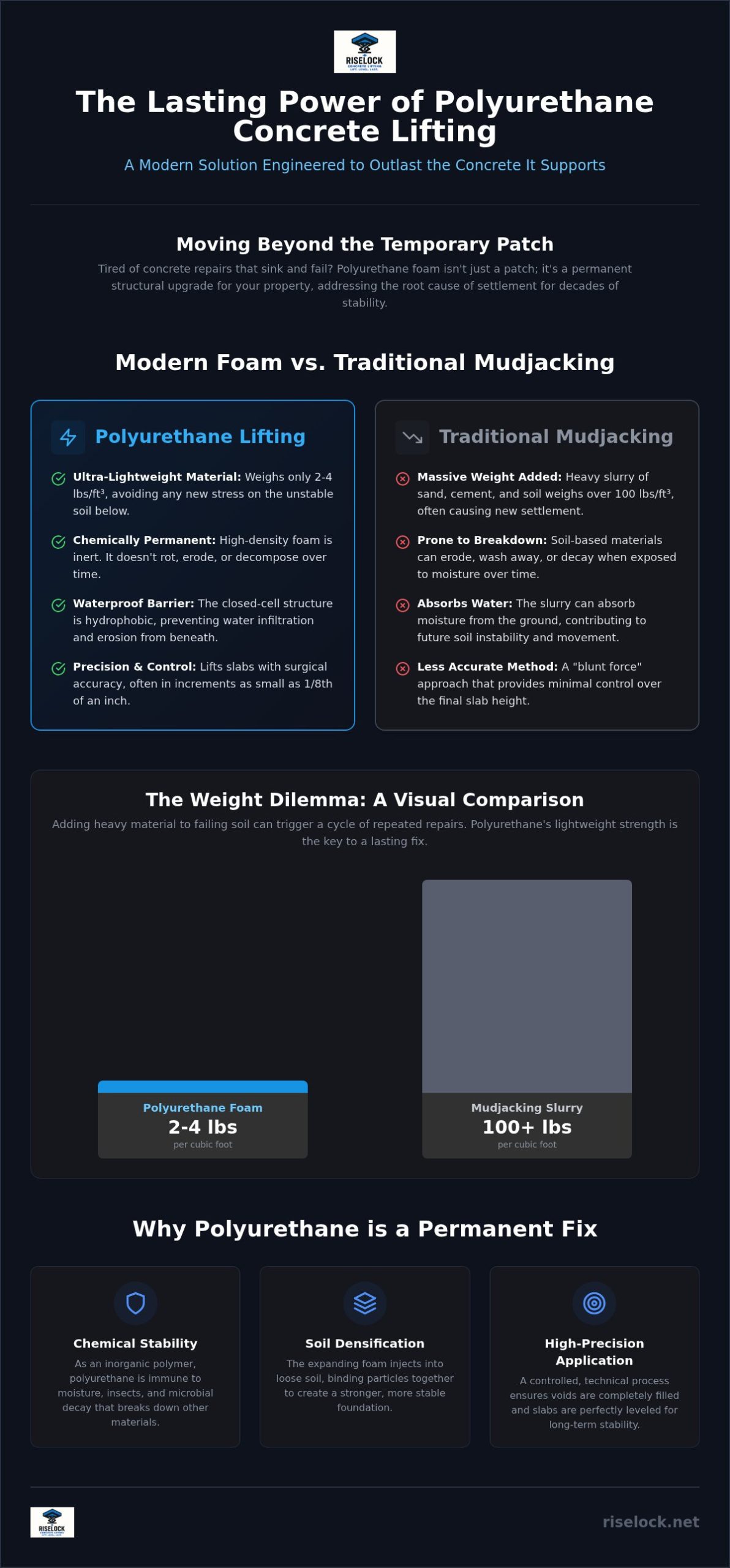
To understand how long does polyurethane concrete lifting last, you must look at the physical burden placed on the underlying soil. Traditional methods utilize a heavy slurry of sand, cement, and soil. This mixture typically weighs upwards of 100 pounds per cubic foot. In many cases, adding this massive weight to already unstable soil triggers secondary settlement, causing the slab to sink again under the pressure of the repair itself. Polyurethane represents a significant technological leap by solving this weight dilemma.
Weight and Soil Stress Factors
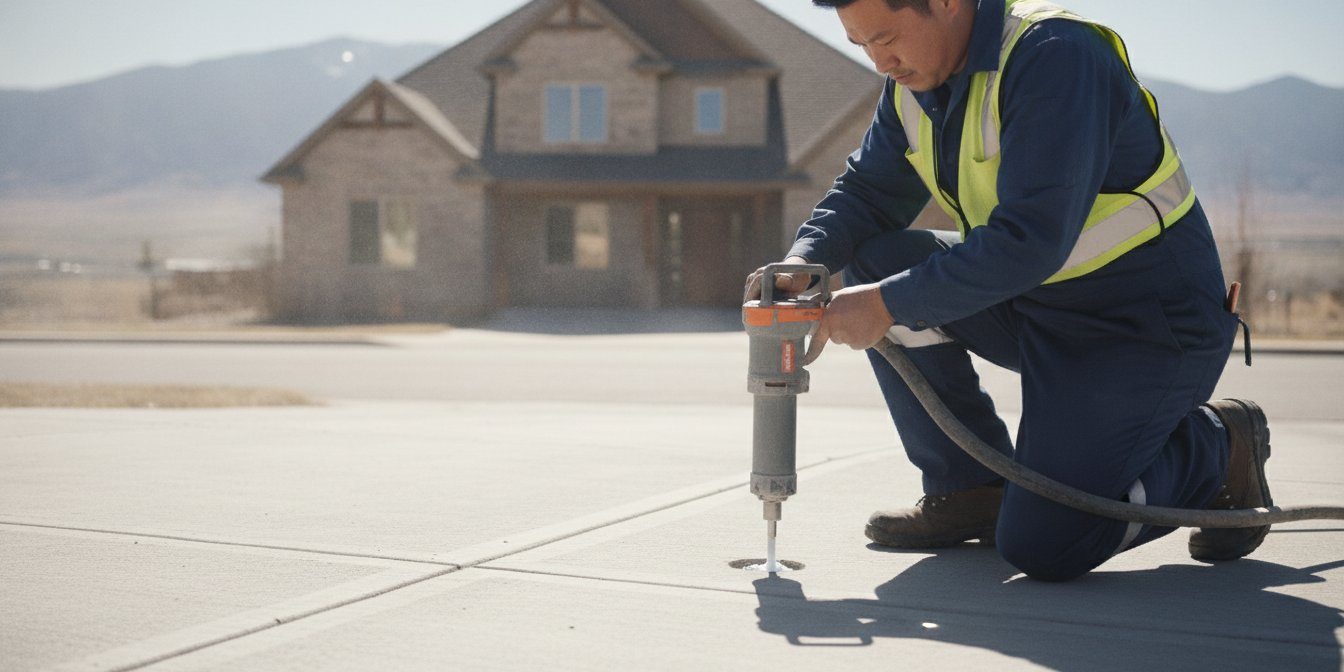
High-density geotechnical foam weighs only 2 to 4 pounds per cubic foot. This lightweight profile allows it to lift and support heavy concrete slabs without overloading the soil structure below. By preserving the existing soil integrity, the foam ensures the repair remains stable for decades. Our technicians achieve remarkable precision during the injection process, lifting slabs in increments as small as 1/8th of an inch. This level of control is impossible with the blunt force of traditional slurries. If you’re dealing with a sinking driveway or patio, choosing a modern restoration approach prevents the cycle of repeated repairs.
The compressive strength of the foam is equally impressive. Despite its light weight, the cured material has a high load-bearing capacity that can easily support residential driveways, commercial garage floors, and even heavy machinery. When evaluating Mudjacking vs. Polyjacking, the technical advantage is clear: polyurethane provides the strength of a solid foundation without the destructive weight of older methods.
Resistance to Environmental Erosion
Colorado’s climate presents unique challenges, particularly during the spring runoff when melting snow saturates the ground. Traditional mudjacking slurries are susceptible to washout because they’re essentially compacted dirt and cement. Over time, water can erode the slurry, creating new voids and leading to slab failure. Polyurethane is naturally hydrophobic, meaning it repels water. It won’t be washed away, nor will it absorb moisture that could lead to freeze-thaw damage.
The injection process effectively fills all voids beneath the concrete, leaving no room for water to pool or flow. This comprehensive coverage protects the soil from further erosion and keeps the slab locked in place. For a deeper look at the technical mastery required for these repairs, see our Polyurethane Concrete Lifting: The Precision Guide. By sealing the underside of the concrete, we create a barrier that ensures the longevity of the repair regardless of seasonal weather patterns.
Key Factors That Influence Your Concrete Leveling Longevity
While the chemical integrity of the material is absolute, the answer to how long does polyurethane concrete lifting last often depends on the ground beneath the foam. In the Denver metro area and Colorado Springs, we deal with unique geological pressures that require more than just a surface-level fix. To ensure a repair lasts for the life of the property, we must account for external variables that threaten soil stability. The foam provides the lift, but environmental management provides the longevity.
Colorado Soils and Bentonite Challenges
Colorado is notorious for expansive clay and bentonite soils. These materials act like a sponge; they swell significantly when wet and shrink as they dry. This constant movement exerts immense pressure on concrete slabs, often leading to the initial settlement issues homeowners face. Unlike rigid mudjacking slurries that can crack or crumble under this stress, polyurethane maintains a degree of structural flexibility. It moves slightly with the soil without losing its bond or volume. This adaptability is rooted in the science of polyurethane foam injection, which allows the material to stabilize the substrate while resisting the seasonal heave-and-settle cycle common in Aurora, Centennial, and Parker.
The Role of Proper Drainage
Water remains the primary catalyst for concrete settlement. When drainage systems fail, water pools around foundations and under slabs, either washing away the supporting soil or causing expansive clays to swell. A successful repair requires a holistic approach to water management. Before we begin the injection process, our team evaluates the surrounding environment to identify potential risks. Homeowners can protect their investment by following these maintenance steps:
- Ensure gutters are clear of debris to prevent overflow.
- Extend downspouts at least five feet away from the concrete edge.
- Maintain a positive grade where the soil slopes away from the slab.
- Seal joints and cracks annually to prevent water from reaching the substrate.
In areas with high water tables or deep-seated instability, we utilize deep soil injection. This technique reaches beyond the immediate void, stabilizing the soil at a deeper level to create a more robust foundation. Combined with professional joint sealing, this multi-layered approach prevents water infiltration and ensures the concrete stays level regardless of the weather. By addressing these environmental factors, we transform a simple lift into a long-term structural solution that respects the specific demands of the Colorado landscape.
Maximizing Results: Maintenance Tips for Your Lifted Concrete
Once the technical work of stabilization is complete, the focus shifts to preservation. One of the most significant advantages of this modern method is the speed of restoration. Unlike traditional concrete work that requires days of curing, high-density foam reaches 90% of its full structural strength within 15 to 30 minutes. You can drive a vehicle over a lifted driveway or walk across a leveled patio almost immediately after our team finishes the injection. This rapid turnaround minimizes disruption, but it doesn’t mean the work of protecting your investment is over.
Homeowners often ask how long does polyurethane concrete lifting last when maintenance is neglected. While the foam itself is a permanent, non-degradable material, the surrounding soil remains subject to environmental forces. Proper upkeep ensures that the stabilized foundation isn’t compromised by external factors. By following a proactive maintenance schedule, you can ensure your concrete remains level for the entire lifespan of the property.
Sealing Joints and Cracks
Sealing the joints and cracks in your concrete is the most effective insurance policy for your lift. Open gaps allow water to bypass the concrete surface and reach the underlying soil. Over time, this moisture can cause the soil to wash away or trigger the expansion of Colorado’s clay-heavy substrates. We recommend an annual inspection of all joints. If you notice the existing sealant is peeling or missing, it’s time to reapply a high-quality, flexible silicone or polyurethane-based caulk. These materials are designed to expand and contract with the slab, maintaining a watertight barrier. For those requiring professional assistance, we offer comprehensive concrete repair in Denver to handle these finishing touches with precision.
Long-Term Monitoring
Effective water management extends beyond the concrete itself. You should monitor your downspouts to ensure they discharge at least 5 feet away from the slab. Water dumping directly next to a patio or sidewalk is the fastest way to undermine a successful lift. Additionally, keep an eye out for early signs of new soil movement. Spotting these issues early allows for minor “tune-up” injections before the settlement becomes a major structural concern. Watch for these indicators in the years following your repair:
- Gaps appearing between the concrete and your home’s foundation.
- New hairline cracks forming near the original injection points.
- Water pooling on the surface rather than draining away.
- Soil erosion or “washouts” visible at the edge of the slab.
If you suspect your property needs a professional assessment to ensure its continued stability, contact the experts at RiseLock to protect your home’s structural integrity.
Why RiseLock’s Precision Injection Ensures a Permanent Fix
RiseLock approaches structural repair as a specialized craft rather than a simple commodity service. While the chemical properties of the material are permanent, the skill of the technician determines the ultimate success of the intervention. When property owners ask how long does polyurethane concrete lifting last, the answer is often found in the quality of the initial assessment and the precision of the injection. We view every project through the lens of long-term structural integrity, ensuring that each lift respects the unique engineering of the property.
Our background in post-tension installation provides a significant advantage in the leveling process. Understanding the internal stresses of post-tensioned slabs allows us to stabilize concrete without compromising the high-strength steel tendons that provide the slab’s structural capacity. This synergy between advanced reinforcement knowledge and modern lifting techniques ensures that your repair is both safe and durable. We don’t just level the surface; we restore the structural harmony of the entire system.
Technical Mastery in Slab Stabilization
The geological diversity of the Denver metro area means that a one-size-fits-all approach to foam density is destined to fail. Soil conditions in Aurora often differ significantly from those in Centennial or Parker, requiring a technician who can adjust material specifications on the fly. RiseLock utilizes high-precision equipment to deliver specific densities of geotechnical foam tailored to the load-bearing requirements of your specific project. This technical mastery prevents the foam from over-expanding or under-supporting, which is critical for maintaining a level surface in Colorado’s volatile environment.
By choosing the correct material for the specific soil profile, we ensure that the foam creates a dense, waterproof foundation that resists the pressures of expansive clay. For a deeper look at how we select these materials, explore our Concrete Lifting Solutions in Colorado. This methodical approach to density and pressure management is what separates a professional restoration from a temporary patch.
The RiseLock Reassurance
We take professional pride in being a dependable partner for homeowners and commercial property managers alike. Our commitment to high standards means we won’t suggest a lift if the underlying structural issues require a different approach. This ethical backbone creates an atmosphere of trust, giving you the peace of mind that your property is in expert hands. We view your structural challenges as our personal priority, delivering solutions that preserve your property’s value for decades.
If you’re tired of recurring settlement issues or safety hazards on your property, it’s time for a professional evaluation. Our team provides the technical mastery required to handle the most complex lifting projects with quiet authority and reliable results. Don’t leave your foundation to chance. Request your precision estimate today and discover how long does polyurethane concrete lifting last when it’s performed by the region’s leading structural experts.
Securing Your Property’s Structural Future
Polyurethane foam represents the pinnacle of modern slab restoration. It’s a chemically stable, lightweight solution that addresses the root cause of settlement without the destructive weight of traditional methods. Understanding how long does polyurethane concrete lifting last allows property owners to move away from temporary patches and toward permanent stabilization. The material itself is engineered to outlive the concrete it supports, provided the underlying environment is managed with precision.
At RiseLock, we combine high-density, eco-friendly geotechnical foams with a mastery of post-tension and structural repair. Our expertise in Denver’s unique soil challenges ensures that every injection is tailored to the specific needs of your property. By prioritizing technical mastery and ethical service, we provide a path toward long-term security and peace of mind. You don’t have to live with recurring settlement or safety hazards. Restore your concrete’s integrity with a RiseLock precision lift. We’re ready to help you stabilize your investment for the years to come.
Frequently Asked Questions
Is polyurethane concrete lifting a permanent solution?
Polyurethane is considered a permanent structural repair because the material itself does not rot, lose volume, or break down over time. Once the two-part chemical reaction is complete, the foam remains an inert solid beneath your slab. While the foam is permanent, the long-term stability of the repair depends on addressing environmental factors like soil erosion and drainage. Properly installed foam should last as long as the concrete surface it supports.
Can polyurethane foam wash away if my yard floods?
No, the high-density foam used by RiseLock is hydrophobic, meaning it repels water rather than absorbing it. Unlike traditional mudjacking slurry, which is composed of soil and cement that can erode during heavy rains or spring runoffs in Denver, cured polyurethane is waterproof. It creates a sealed barrier that prevents water from flowing underneath the slab, effectively protecting the substrate from future washouts even during significant flooding events.
Does the foam lose its lifting power or compress over time?
The foam maintains its structural integrity and lifting power indefinitely once it has reached its full cure. It features a high compressive strength that allows it to support heavy residential and commercial loads without deforming. Because it is a closed-cell material, it doesn’t shrink or compress under the weight of vehicles or equipment. This durability is a primary reason why property owners ask how long does polyurethane concrete lifting last compared to less stable alternatives.
How long after the injection can I drive on my driveway?
One of the greatest benefits of this technology is the immediate return to service. High-density geotechnical foam reaches 90% of its structural capacity within 15 to 30 minutes of the injection. This means you can drive a standard vehicle over your driveway or use your garage floor almost immediately after our technicians finish the work. This speed is a significant advantage for busy households in Aurora and Centennial who cannot wait days for new concrete to cure.
Will the concrete sink again after it is lifted with foam?
The polyurethane material itself will not sink or fail, but the soil beneath the foam must remain stable. If the underlying ground continues to erode due to poor drainage or broken pipes, the entire section, foam and all, could potentially shift. This is why our team focuses on soil stabilization and void filling during the process. By addressing the root cause of the settlement, we ensure the lift remains level for the long term.
Does polyurethane foam react with the soil or groundwater?
Polyurethane is an environmentally safe, inert material once it has cured. It does not react with the soil or leach harmful chemicals into the groundwater, making it a responsible choice for properties across the Colorado Springs area. The material is resistant to microbial growth and underground pests. Its chemical stability ensures that it remains a neutral part of your property’s foundation, providing strength without compromising the health of the local ecosystem.
Is there a warranty on polyurethane concrete lifting?
While specific project details vary, RiseLock stands behind the technical mastery of our work and the durability of our materials. We provide professional evaluations to ensure that polyurethane is the right solution for your specific settlement issues. Our commitment to high standards and ethical service means we prioritize long-term results over quick fixes. We view every client as a long-term partner and take pride in the precision of our structural restoration services.
How does Colorado’s weather affect the lifespan of the foam?
Colorado’s extreme freeze-thaw cycles and expansive clay soils are the primary reasons why property owners want to know how long does polyurethane concrete lifting last. The foam is ideally suited for this climate because it remains flexible enough to handle slight soil movements without cracking. Since it is waterproof, it prevents water from entering the substrate, which reduces the risk of ice expansion beneath your slabs during the cold winter months in Parker and Castle Rock.