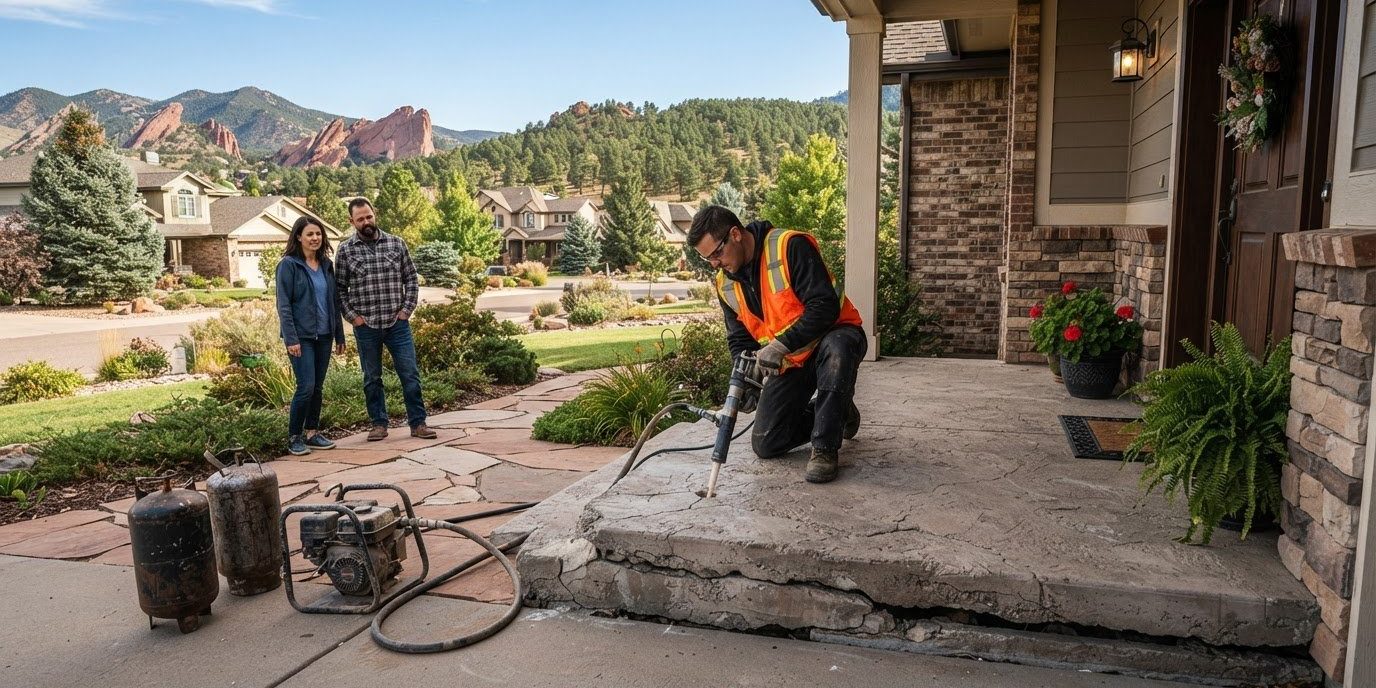
A cracked, uneven porch doesn’t automatically need to be torn out and replaced. If you’re deciding how to repair concrete porch slab Castle Rock, first identify whether the damage is limited to the surface or whether the slab has settled and lost support. The distinction matters: a surface crack and a change in porch level call for different repair approaches.
A safe, comfortable entry doesn’t always require removing the entire slab. This guide explains how to spot common signs of porch damage, compare repair options, and understand when polyurethane concrete lifting may suit a settled slab. Castle Rock’s shifting soils and freeze-thaw cycles can contribute to concrete movement, but lifting isn’t appropriate for every cracked or damaged porch.
You’ll learn what an assessment should consider, how high-density foam can raise and stabilize suitable slabs, and when concrete repair or replacement may be more appropriate. RiseLock provides concrete lifting, leveling, and repair in Castle Rock, with recommendations based on the porch’s condition.
Key Takeaways
- Compare cracks, uneven edges, gaps, and pooling water to distinguish surface wear from a slab that has settled.
- Polyurethane lifting may raise and stabilize a sunken porch when the slab is suitable for repair.
- Choose between lifting, localized concrete repair, and replacement based on slab integrity and whether the problem involves movement.
- Before seeking to repair concrete porch slab Castle Rock, note where the slab is uneven, document visible cracks, and observe drainage.
- RiseLock assesses the porch’s condition to plan an appropriate repair approach.
Repairing a Concrete Porch Slab in Castle Rock: What the Damage Can Tell You
A sloping entry, uneven slab edges, gaps beside the steps or home, visible cracks, and new pooling water can all point to a porch problem. These signs deserve attention, but they don’t all mean the same thing. A crack may affect only the surface, while settlement means the slab has moved downward. Identifying which pattern you’re seeing helps guide the next step.
Appearance alone can be misleading. A porch may look worn but remain level and stable; another may have modest cracking alongside a noticeable change in height. When deciding how to repair concrete porch slab Castle Rock, consider the slab’s overall condition and whether it has moved, not just how prominent a crack looks.
How to recognize a settled or uneven porch slab
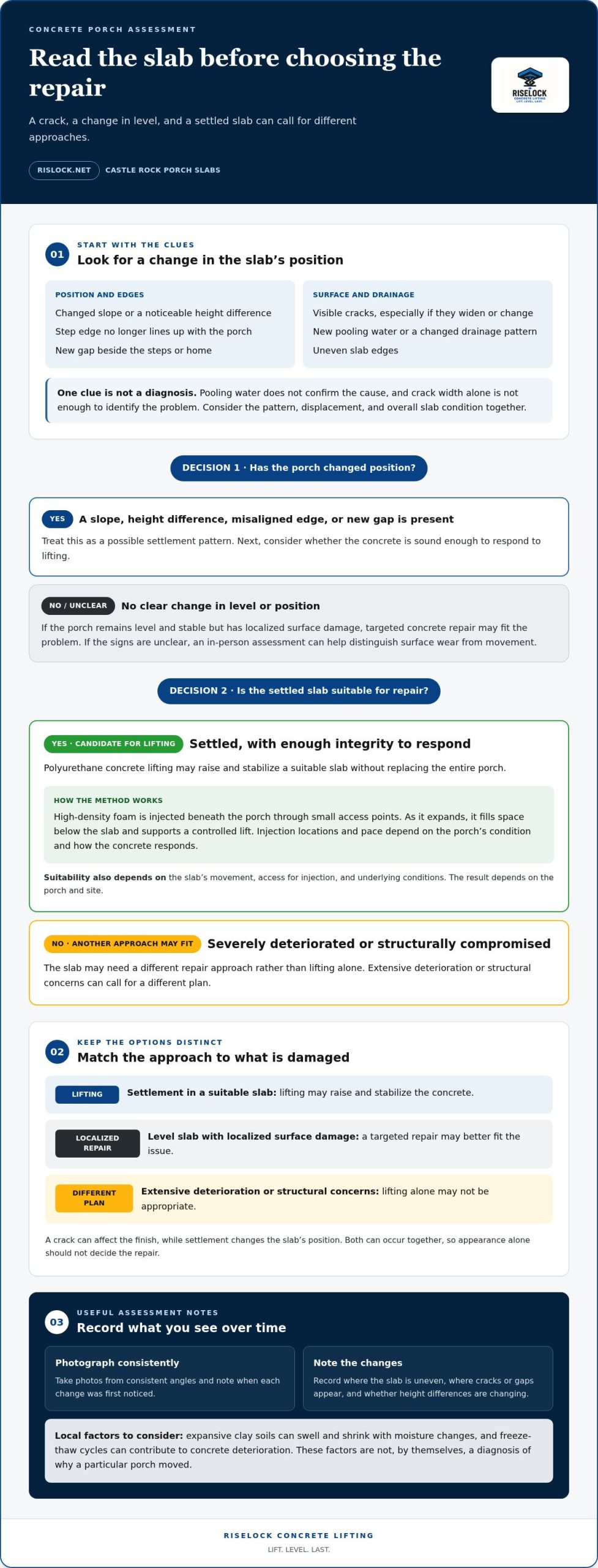
Check how the porch meets the steps and the home. A changed slope, a step edge that no longer lines up, or a new gap along an adjoining surface may indicate movement. Pooling water can also signal a change in the surface’s drainage pattern, though it doesn’t confirm the cause by itself.
Take photographs from consistent angles and note when you first noticed each change. Record whether a gap or height difference appears to be changing over time. This history gives an in-person assessment useful context without relying on a guess from photos alone.
When cracks signal more than surface wear
Narrow cracks can be surface-level, while cracks that widen, change, or appear alongside a height difference may warrant closer evaluation. Width alone isn’t enough to identify the problem. Crack location, pattern, displacement, and the slab’s overall condition all matter. Several symptoms together provide more useful context than one crack viewed in isolation.
Surface cracking affects the concrete’s finish; settlement changes the slab’s position. The two can occur together, so an assessment should consider both visible damage and whether the porch remains level and supported.
Castle Rock’s Front Range setting is relevant to the assessment. Expansive clay soils can swell and shrink with moisture changes, and freeze-thaw cycles can contribute to concrete deterioration. These are factors to consider, not a diagnosis of what caused a particular porch to move. For background on concrete leveling techniques like slabjacking, see this overview of approaches used to address settled concrete.
Understanding the difference helps narrow the repair question: is the concern a surface defect, a change in slab position, or both? That distinction informs whether lifting, localized concrete repair, or another approach deserves consideration.
How Polyurethane Concrete Lifting Can Restore a Sunken Porch Slab
For a porch slab that has settled but remains suitable for repair, polyurethane concrete lifting can raise and stabilize the concrete without replacing the entire slab. The process uses high-density foam injected beneath the porch through small access points. As the foam expands, it fills space below the slab and supports a controlled lift.
The work begins with an assessment of the slab and its movement. Injection locations are planned to support an even lift. During the work, the crew monitors the porch’s position and adjusts the process based on how the concrete responds. The result is reviewed against the repair objective. The specific result depends on the porch’s condition and site factors.
What happens during foam lifting
Small injection points give the foam access beneath the slab. The material expands in the space below, helping raise the concrete gradually rather than relying on a surface patch to conceal a level change. Expanding foam fills voids beneath suitable concrete and supports the slab as it’s lifted. The injection plan and pace depend on the porch’s condition and response during the work.
For a broader overview of the method, read RiseLock’s polyurethane concrete lifting guide. Homeowners can also consult the U.S. Bureau of Reclamation’s guide to concrete repair for background on concrete deterioration and repair principles.
Which porch slabs may be candidates for lifting
Suitability depends on more than whether a porch is low. The slab needs enough integrity to respond to lifting; its movement, access for injection, and underlying conditions also inform the plan. Concrete that’s severely deteriorated or structurally compromised may need a different repair approach rather than lifting alone. An on-site assessment helps determine which approach fits the specific porch.
That distinction matters when deciding how to repair concrete porch slab Castle Rock. Polyurethane lifting addresses settlement in suitable slabs, but it isn’t a universal fix for cracks, surface wear, or extensive concrete damage. RiseLock assesses the concrete before recommending lifting, leveling, or repair. To explore the approach for a settled porch, review RiseLock’s concrete lifting services.
Repair or Replace a Castle Rock Porch Slab? How to Compare the Options
A cracked porch doesn’t automatically need to be removed and repoured. The right choice depends on what’s damaged and what the repair needs to accomplish. If a slab is mostly intact but has settled, lifting may be appropriate. If the concrete is level but has localized surface damage, a targeted repair may better fit the problem. Extensive deterioration or structural concerns can call for a different plan.
Use this comparison as a starting point, not a remote diagnosis. The slab’s integrity and the cause of its movement matter alongside the visible damage.
| Option | Settlement | Slab integrity | Disruption | Addresses movement? |
|---|---|---|---|---|
| Polyurethane lifting | For suitable settled slabs | Concrete must be suitable for lifting | Avoids full slab removal | Raises and stabilizes the slab |
| Localized concrete repair | Doesn’t correct a settled slab by itself | Best considered for localized damage | Focused on the affected area | No, not on its own |
| Replacement | May be considered if damage or displacement is extensive | Removes and replaces the existing slab | More involved because removal and new concrete are required | Not necessarily; underlying conditions still matter |
When lifting may make more sense than replacement
If the porch has settled but the concrete remains intact enough to be lifted, polyurethane foam lifting may let you retain the existing slab while raising and stabilizing it. This approach avoids removing and repouring the concrete, though suitability depends on the slab and conditions beneath it. It isn’t a guaranteed outcome or a universal cost advantage. RiseLock’s concrete repair guide for Denver offers broader context on repair approaches.
When the slab may need a different repair approach
Extensive deterioration, significant displacement, or signs of structural compromise call for careful evaluation. Lifting can address settlement in a suitable slab, but it won’t resolve damage unrelated to movement. A localized repair may address a limited defect, while replacement may be considered when the existing concrete can’t be effectively restored. The Federal Highway Administration’s insights on concrete pavement rehabilitation also illustrate why repair choices depend on the condition and purpose of the concrete.
When weighing how to repair concrete porch slab Castle Rock, RiseLock bases its recommendation on the observed condition rather than treating every crack the same way. Explore RiseLock’s concrete repair and lifting services to learn about condition-based repair options.
What to Expect Before Porch Slab Repair in Castle Rock
A useful assessment starts with clear observations, not a guess about which repair method to use. Before planning to repair concrete porch slab Castle Rock, gather details about what has changed and where. This helps connect the visible symptoms to the porch’s condition and identify an approach suited to the site.
Information that helps assess a porch slab
Make a brief record of when you first noticed the slope, gaps, cracks, or pooling water, and whether those signs have changed. Photos can show details that are hard to describe from memory. Capture the full porch, close views of visible cracks and edges, and how the slab meets nearby steps, the home, or other surfaces.
Note the approximate slab dimensions and the access around it. Mention where water appears to flow or collect after rain, based on what you can safely observe. Don’t step onto unstable areas or move anything heavy to inspect underneath. A few straightforward observations are more useful than taking risks or trying to diagnose the cause yourself.
- Record when symptoms appeared and any changes you’ve noticed.
- Photograph the slab as a whole and its visible cracks, edges, and transitions.
- Share approximate dimensions, access conditions, and drainage observations.
For broader context on approaches to raising and stabilizing concrete, read RiseLock’s concrete lifting solutions guide.
Questions the repair assessment should resolve
The assessment should establish whether the main concern is settlement, surface deterioration, or a combination. It should also consider the slab’s integrity: concrete that can support lifting may be approached differently from a slab with extensive deterioration or other structural concerns. That evaluation helps determine whether lifting, localized repair, or another plan best matches the observed condition.
A clear recommendation explains how the proposed work addresses the identified problem. If the issue is settlement, the plan should address the slab’s position and support rather than only its appearance. If damage is limited to the surface, the assessment should distinguish that from movement. Timing and cost depend on site conditions and the work involved, so they should be discussed based on the evaluated porch.
RiseLock assesses concrete condition before recommending a repair approach for suitable porch slabs. Connect with RiseLock about a porch slab assessment to discuss the changes you’ve observed and the next steps.
Restore Your Castle Rock Porch Slab with a Repair Plan Built Around Its Condition
A sound plan to repair concrete porch slab Castle Rock homes starts with the slab itself, not an assumption that every crack calls for the same fix. The right recommendation depends on whether the porch has settled, whether the concrete remains suitable for repair, and what the site reveals about the problem. An assessment helps distinguish a repair that addresses movement from one that treats only visible damage.
How RiseLock approaches concrete lifting and repair
RiseLock evaluates the concrete’s condition before recommending a repair approach. For a suitable settled slab, polyurethane lifting uses injected high-density foam to raise and stabilize the porch. Concrete leveling and repair may also be considered based on what the slab needs. The objective is to address the condition beneath or within the concrete, rather than treating appearance as the only concern.
RiseLock serves residential customers in Castle Rock and nearby Colorado communities with polyurethane concrete lifting, leveling, and repair. Each porch is different. A slab that has settled but remains suitable for lifting presents a different repair question from one with extensive deterioration or damage unrelated to movement. Recommendations are based on the observed slab and site conditions, not a one-size-fits-all promise.
Take the next step toward a more even porch
When describing the porch, include its location, the symptoms you’ve observed, and when those changes appeared. Mention any visible slope, cracks, gaps, or drainage changes, along with whether the condition seems to have progressed. Photos and approximate slab dimensions can also help explain what you’re seeing.
That information supports a focused assessment, but the repair plan depends on the porch itself. RiseLock considers slab integrity and site conditions before determining whether polyurethane lifting and leveling, concrete repair, or another approach is appropriate. The goal is a clear explanation of the recommended work and how it relates to the observed problem.
Ready to discuss your porch? Contact RiseLock about porch slab repair and share the changes you’ve noticed.
Choose the Right Next Step for Your Castle Rock Porch
A dependable repair plan starts by distinguishing surface wear from a slab that has shifted. Cracks, changes in level, gaps, and drainage patterns all help show what may be happening, but the concrete’s overall condition determines which repair approach makes sense. A settled slab that remains suitable for lifting may be raised and stabilized with polyurethane foam, while other damage may call for a different kind of concrete repair.
If you’re weighing how to repair concrete porch slab Castle Rock, focus on the cause and condition, not appearance alone. Documenting changes and having the porch assessed can help clarify whether lifting, leveling, or another repair is appropriate.
RiseLock provides polyurethane concrete lifting and leveling in Castle Rock and communities across Colorado, including Denver, Aurora, Centennial, Parker, Colorado Springs, Englewood, Littleton, Lakewood, Arvada, Thornton, Wheatridge, Castle Pines, and Boulder. Recommendations are guided by the slab and site conditions. Contact RiseLock to discuss your Castle Rock porch slab and the symptoms you’ve noticed. A clear assessment can help you take a practical step toward a more usable, even entry.
Frequently Asked Questions
Can a sunken concrete porch slab be lifted instead of replaced?
Yes, a sunken porch slab may be lifted instead of replaced if the concrete remains sound enough and site conditions support the method. Polyurethane lifting injects high-density foam beneath the slab to raise and stabilize it. An assessment should consider cracking, displacement, access, and slab integrity. Severely deteriorated or structurally compromised concrete may need another repair plan, so replacement decisions should depend on the slab’s condition, not settlement alone.
How does polyurethane foam repair a settled porch slab?
Polyurethane foam lifting raises and stabilizes suitable settled concrete by injecting high-density foam beneath the slab. Small access points let the foam reach the space below; as it expands, it fills voids and supports a controlled lift. The crew assesses the porch, plans injection locations, monitors the slab’s response, and reviews the result. The method addresses settlement, but it doesn’t repair every type of crack or concrete deterioration.
Is a cracked concrete porch slab always a sign it needs replacement?
No. A crack alone doesn’t automatically mean the porch must be replaced. Some cracks are limited to surface wear, while cracks that change or appear with displacement, gaps, or a sloping slab may call for closer evaluation. The decision depends on the concrete’s overall integrity and whether it has moved. An assessment can help determine whether localized concrete repair, lifting, or replacement better addresses the observed condition.
How do I know if my porch slab is sinking or just cracked?
A crack without a change in level may be surface damage, but a sinking slab has moved downward. Look for a changed slope, uneven edges, gaps beside steps or the home, or water collecting in a new spot. These signs can help you describe the problem, but they don’t confirm its cause. Photograph the porch and note changes over time; an in-person assessment can distinguish cracking from settlement or identify both.
How long does concrete porch slab lifting take?
The time required depends on the porch, access, slab condition, and work involved. Polyurethane lifting uses injection points to raise suitable concrete rather than removing and repouring the entire slab, but the project duration depends on the specific site and repair needs. RiseLock evaluates the porch and the work involved to set expectations for the project.
Will polyurethane lifting fix drainage problems around a porch?
It may improve drainage if pooling is caused by the settled slab’s changed slope and the slab is suitable for lifting. However, lifting won’t necessarily resolve water issues caused by surrounding grades, downspouts, or other site conditions. Describe where water collects and how it flows during an assessment. The repair plan should match the source of the problem, rather than assume that raising the porch will correct every drainage concern.
Does RiseLock repair concrete porch slabs in Castle Rock, Colorado?
Yes. RiseLock provides concrete repair, polyurethane concrete lifting, and leveling for residential customers in Castle Rock. The company also serves Denver, Aurora, Centennial, Parker, Colorado Springs, Englewood, Littleton, Lakewood, Arvada, Thornton, Wheatridge, Castle Pines, and Boulder. For a porch slab, RiseLock assesses the concrete’s condition and site factors before recommending an approach. Polyurethane lifting is suitable for some settled slabs, not every cracked or damaged porch.