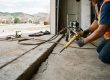


What if an elongation reading looks wrong, but the tendon was stressed correctly? The number alone can’t answer that. For post tension cable elongation measurement Wheatridge project teams need to compare the field result with the engineered expectation and stressing record, rather than treat one reading as a verdict.
A difference between expected and measured elongation deserves a careful review. Elongation helps verify the force applied to a tendon, and it is evaluated alongside the calibrated jack gauge reading and project-specific assumptions in the approved plans. Measurement methods, field conditions, or the project’s design assumptions may help explain a variance, but the result must be assessed against the project’s criteria, not dismissed or overread.
This guide explains when elongation is measured, how readings are evaluated, and which plans, stressing details, and field records make the comparison meaningful. It also covers what Wheat Ridge teams should document and when an unexpected result needs review by the responsible engineer or a qualified post-tension professional. Clear records support sound decisions and keep installation review focused on the design intent.
Key Takeaways
- Understand what tendon elongation measures during stressing and why it must be compared with the project’s calculated expectation.
- Learn how post tension cable elongation measurement Wheatridge teams rely on fits into the stressing and recordkeeping process.
- Organize expected values, field readings, and follow-up actions so differences are easier to review.
- Identify the project documents and Wheat Ridge requirements to review before measurement begins.
- Know when a discrepancy needs review by the responsible engineer or a qualified post-tension professional.
What Post-Tension Cable Elongation Measurement Means in Wheat Ridge Projects
During post-tensioning, elongation is the measured extension of a tendon as it is stressed. It describes how far the steel tendon stretches during that operation, not the general condition of a cable or a verdict on the slab. In post-tensioned concrete, tendons are stressed after concrete is placed and has reached the strength required by the project. The overview of Prestressed concrete explains how this method differs from pre-tensioning.
The field measurement is compared with a calculated elongation in the project documents. That expected value is based on design information and assumptions about the tendon and its path. Comparing the calculated and measured extensions helps the project team verify stressing in the field. A single reading cannot establish whether the entire slab is structurally safe. Conclusions depend on the approved plans, specifications, stressing records, and qualified interpretation.
What does an elongation reading tell the project team?
An elongation reading provides a field check on tendon behavior during stressing. It is useful when paired with the engineered baseline for that specific tendon, not when viewed as an isolated number. For post tension cable elongation measurement Wheatridge teams should use the approved project criteria. Acceptable results and any required response are specific to the project.
A difference between the expected and recorded extension calls for review in context. The responsible engineer or a qualified post-tension professional can consider the design basis and stressing records before determining appropriate follow-up. The measurement is one part of verification, not proof by itself of overall slab performance.
When is post-tension cable elongation measured?
Elongation is recorded during the stressing operation specified for the project, while the tendon is being tensioned with the stressing equipment. The field team follows the project sequence and records observations at the required points. Anchor seating and stressing order can affect what is observed and how the result is recorded, so the measurement needs to be considered alongside the procedure and tendon details.
Timing matters. Once a tendon has been anchored and stressing is complete, its original stressing-stage extension cannot simply be measured again in the same way. If a concern arises later, the installed tendon needs a different assessment based on its observed condition, available installation records, and engineering judgment. A later visual check is not a substitute for the original elongation record.
For Wheat Ridge projects, project-specific post-tension work depends on keeping the design baseline, stressing sequence, and field observations connected. RiseLock Concrete Lifting provides post-tension installation in Wheat Ridge and surrounding Colorado communities, with clear documentation supporting responsible installation and review.
How Post-Tension Cable Elongation Is Measured and Recorded
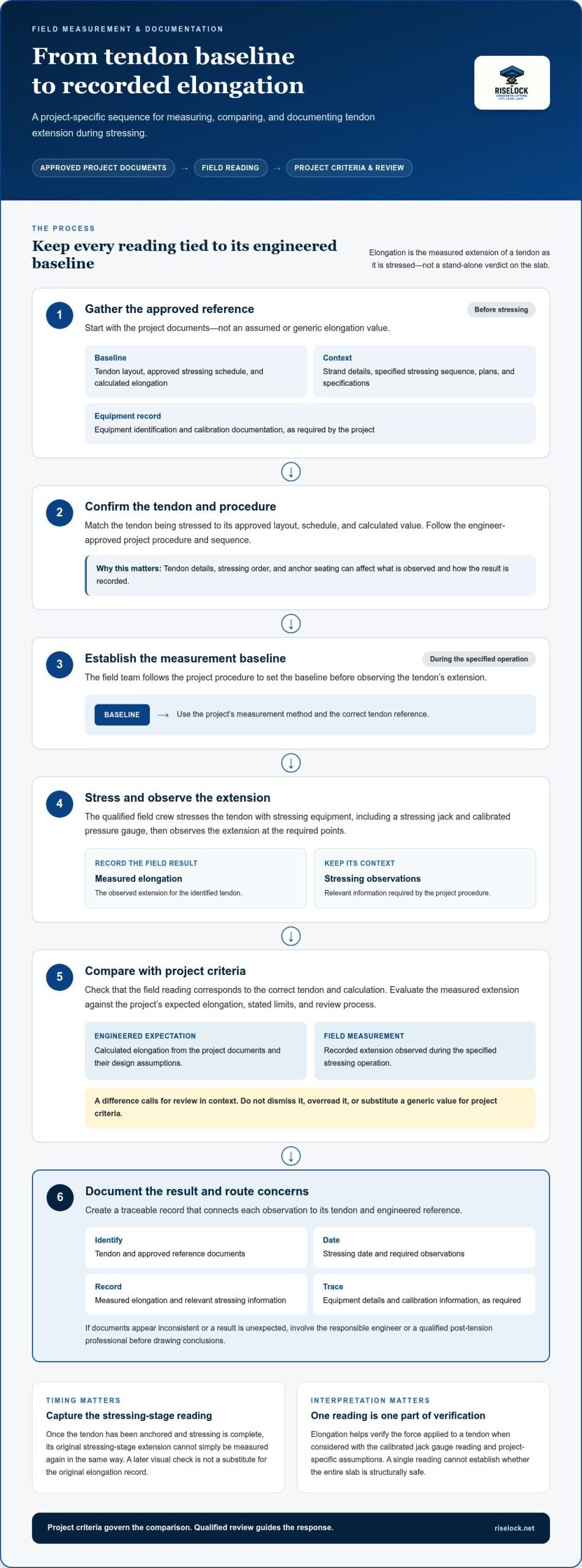
A useful elongation record starts with the project documents, not the stressing equipment. The approved tendon layout and stressing schedule identify which tendon is being stressed, its sequence, and its calculated elongation. The field team then follows the project procedure to establish the measurement baseline, stress the tendon with a stressing jack and calibrated pressure gauge, observe and record the extension, and compare the result with the project criteria.
This is a controlled construction operation, not a do-it-yourself measurement. Qualified crews follow the engineer-approved documents and established stressing procedures because tendon details, equipment, sequence, and recording requirements vary by project. The Federal Highway Administration Installation Manual provides broader reference material on post-tensioning construction and inspection practices, while the approved project documents govern the specific work.
Which project records support a meaningful measurement?
Before stressing, teams need records that connect a field reading to its engineered baseline. These typically include the tendon layout, approved stressing schedule, and calculated elongation. Strand details and the specified stressing sequence add context, while equipment identification and calibration documentation help establish what tools were used. The engineer-approved plans and specifications define the criteria for interpreting the reading.
For post tension cable elongation measurement Wheatridge projects, avoid comparing a field result with an assumed or generic value. Confirm that the reading corresponds to the correct tendon and calculation, then apply the project’s stated limits and review process. If documents appear inconsistent, resolve the discrepancy through the responsible project team before drawing conclusions.
What should a stressing record include?
A clear record lets a reviewer trace each observation back to its tendon and design basis. Include the tendon identification, stressing date, measured elongation, and relevant stressing information required by the project. Record equipment identification and calibration status according to project requirements, and reference the applicable plan, schedule, and calculation revision.
- Identify: the tendon and the approved documents used for reference.
- Record: the date, measured extension, and relevant stressing observations.
- Trace: equipment details and calibration information required by the project.
Complete, traceable documentation makes review more reliable, especially when a result needs follow-up. RiseLock provides post-tension installation in Wheat Ridge and surrounding Colorado communities. Learn more about post-tension installation support.
How to Interpret Measured and Theoretical Elongation Without Guesswork
Start with a direct comparison: place the measured extension beside the calculated value for the same tendon, then apply the acceptance criteria in the approved project documents. Don’t substitute a generic rule or compare against a value from a different tendon or plan revision. An elongation reading is only as useful as its design baseline.
A result is not automatically acceptable or unacceptable just because it differs from the calculation. The size and significance of the difference depend on the project’s specified criteria and the information behind both values. For post tension cable elongation measurement Wheatridge teams should preserve the reading and its context, then have any discrepancy reviewed rather than making an assumption in the field.
| Comparison point | What to review | Follow-up |
|---|---|---|
| Expected reading | Calculated elongation for the identified tendon in the approved documents | Confirm the correct plan revision and project criteria. |
| Recorded reading | Field measurement and related stressing record | Check that the tendon, sequence, and recorded conditions match the documentation. |
| Difference requiring review | Any variance that meets the project’s threshold for review, or an unclear result | Document it and refer it to the responsible project professional. |
Why might a field reading differ from the calculation?
Calculated elongation relies on design inputs and assumptions. Field results may be affected by tendon length, strand properties, friction along the tendon path, anchorage seating, or measurement conditions. The stressing sequence can also matter when observations are compared. These are possible factors to investigate, not a checklist that identifies the cause by itself. A qualified review must relate the actual records and conditions to the specific tendon and design.
What should happen when readings do not align?
Record the measured result clearly and flag the difference for the responsible engineer or a qualified post-tension professional. Don’t silently change a value, treat a discrepancy as proof of a defect, or proceed as if it has been resolved. The reviewer can compare the approved plans and calculations with equipment and calibration records, the stressing sequence, and field observations.
Further stressing or other corrective action should follow the project procedures and engineering direction. The goal is to determine whether the difference is explained by documented conditions, a recording or measurement issue, or something that needs correction. Precise interpretation protects the integrity of the installation record and supports a sound project decision.
Wheat Ridge Project Checks Before and After Post-Tension Measurement
Measurement records are most useful when they’re planned into the project workflow. Before stressing, confirm that the approved plans and specifications identify the tendon layout, stressing sequence, calculated elongations, acceptance criteria, responsible engineer, and required inspection and reporting steps. Make sure the field team and project reviewers know how readings will be documented and routed for review.
Local requirements also matter. As of January 1, 2026, new permit applications submitted to the City of Wheat Ridge must follow the 2024 International Codes. The requirements for a particular post-tension project depend on its scope and approved documents, so review the current City permitting and code requirements for that project rather than assuming every site follows identical conditions.
What should Wheat Ridge teams verify in project documents?
Start with the engineer-approved stressing sequence and the calculation basis for the specific tendon layout. Confirm which records must be submitted, what inspections are required, and how acceptance or discrepancies will be handled. For post tension cable elongation measurement Wheatridge teams should also make sure the field record can be matched to the correct plans and calculation revision.
Coordinate this review before concrete placement where practical, and establish how measurement records will be shared and reviewed before subsequent work proceeds. Planning helps prevent missing documentation from disrupting inspections or construction sequencing. Keep observations factual, noting what was measured and when, and distinguish them from conclusions about structural performance.
- Before stressing: Check approved plans, specifications, tendon information, the responsible engineer, and inspection requirements.
- During and after stressing: Record results against the correct calculation and route required reports for review.
- Before subsequent work: Confirm required reviews and project approvals are complete.
When does a measurement concern need professional review?
Escalate unexplained differences, damaged anchorage, or incomplete stressing records to the responsible engineer or a qualified post-tension professional. Don’t cut, expose, or restress a tendon without qualified direction. Those actions can affect structural elements and should follow project requirements and engineering guidance.
For project teams, careful documentation connects installation planning with later concrete repair decisions. RiseLock provides post-tension installation in Wheat Ridge and surrounding Colorado communities. Discuss post-tension installation for your project.
Post-Tension Installation Support for Wheat Ridge Projects
Reliable project decisions follow a clear process: compare each elongation reading with its approved design baseline, keep the stressing record traceable to the correct tendon, and refer unexplained differences for professional review. This helps the team assess installation information responsibly. One reading does not guarantee structural performance, but a clear record gives the engineer and project team useful evidence for evaluating the work.
How does sound installation practice support reliable records?
Following approved plans, specifications, and stressing procedures during installation helps connect field observations to the intended tendon layout and calculation. Coordinated communication among installation crews, the responsible engineer, and other project professionals can clarify who records readings, who reviews them, and how unresolved questions are handled before subsequent work proceeds.
For post tension cable elongation measurement Wheatridge projects, accurate records are part of responsible delivery. A clearly identified tendon, documented reading, and reference to the applicable project documents make later review more meaningful. RiseLock provides post-tension installation in Wheat Ridge and surrounding Colorado communities, with attention to project-specific work.
What is a practical next step for a Wheat Ridge project?
Before discussing an upcoming project or an existing concern, gather the information that explains the work. Useful items include approved plans, tendon schedules, stressing calculations, and available measurement or inspection records. Also clarify whether the need involves a planned installation or a condition observed in an existing structure. That distinction helps direct the discussion; an existing concern may need assessment by the responsible engineer or another qualified post-tension professional.
Keep observations factual. Note what was seen, which records are available, and which tendon or area is involved. Avoid cutting, exposing, or restressing a tendon without qualified direction. Clear information supports a focused conversation about project needs and appropriate next steps.
For post-tension installation planning in Wheat Ridge, discuss post-tension installation for your project with RiseLock. Bring the relevant project documents so the conversation can begin with the design intent and the work ahead.
Move Forward With a Clear Post-Tension Plan
Elongation readings make sense only when matched to the correct design calculation and project criteria. Keep each result traceable to the tendon, stressing sequence, and approved documents, and treat unexplained differences as a reason for professional review, not an automatic pass or failure. Clear records help project teams make informed decisions and support responsible delivery.
For post tension cable elongation measurement Wheatridge teams should focus on three steps: establish the engineered baseline, document stressing observations carefully, and refer discrepancies to the responsible engineer or a qualified post-tension professional. These practices connect field work with the structural design intent.
RiseLock provides post-tension installation for projects in Wheat Ridge and communities across the Denver area. If you’re planning an installation, gather your project plans and tendon schedules, then discuss post-tension installation for your Wheat Ridge project.
With clear project information and precise installation planning, you can take the next step with confidence.
Frequently Asked Questions
What is post-tension cable elongation measurement?
Post-tension cable elongation measurement records how far a tendon extends during stressing. The field reading is compared with the calculated value for that tendon in the project documents, providing a check on the stressing operation. For post tension cable elongation measurement Wheatridge project teams should use the approved design baseline and project criteria, not a generic reference value. Interpret the reading alongside stressing records and other relevant project information.
When is elongation measured in a post-tension slab?
Elongation is generally recorded during the stressing operation specified for the project. The crew documents the tendon’s extension as it is stressed and follows the project sequence and recording requirements. That stressing-stage measurement differs from a later inspection of an anchored tendon. Once stressing is complete, the original extension cannot simply be remeasured in the same way; a later concern needs assessment using appropriate methods and structural context.
How is theoretical elongation calculated for a post-tension cable?
Theoretical elongation is calculated from project-specific tendon and material information, the stressing force, and design assumptions. Inputs can include tendon length, strand properties, and assumptions about friction along the tendon path. Because these factors vary by project and tendon, a generic estimate is not a substitute for the engineered value. Refer to the approved calculations and plans for the baseline used to assess the field measurement.
What does it mean if measured elongation differs from the expected value?
A difference means the measured result needs documented, project-specific review. It does not automatically prove an error or establish that the result is acceptable. Potential factors include tendon length, strand properties, friction, anchorage seating, stressing sequence, or measurement conditions. These possibilities are not a diagnosis. Compare the field record with the approved calculation and project criteria, then refer an unexplained discrepancy to the responsible project professional.
Can post-tension cable elongation be measured after the cable is anchored?
The original elongation measurement is taken during stressing, before the tendon is fully anchored as required by the stressing procedure. After anchorage, the tendon cannot be evaluated by simply repeating that same measurement. If a concern arises later, assessment requires qualified methods and context such as installation records, observed condition, and structural design. Don’t cut, expose, or restress a tendon without direction from the responsible project professional.
Who can interpret post-tension cable elongation readings in Wheat Ridge?
The responsible engineer and qualified post-tension professionals can interpret readings using approved plans, calculations, stressing records, and project criteria. Their review can put a result in context and determine appropriate follow-up; a homeowner shouldn’t stress or alter tendons. RiseLock provides post-tension installation in Wheat Ridge and serves Denver, Aurora, Centennial, Parker, Colorado Springs, Englewood, Littleton, Lakewood, Arvada, Thornton, Wheatridge, Castle Rock, Castle Pines, and Boulder.
What records should be kept for post-tension elongation measurements?
Keep the tendon identification and its design baseline, including applicable plan and calculation references, alongside the recorded extension. Retain relevant stressing information, such as the date, sequence, and equipment identification, plus calibration records when required by the project. Include inspection and reporting documents required by the approved plans and specifications. These records help reviewers connect each field result to the correct tendon and assess any difference accurately.