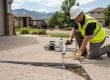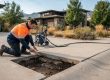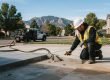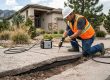


What if the gap beside your concrete steps is a sign of movement, not simply a joint that needs filling? It’s understandable to worry when the separation widens or the steps feel less stable. If you’re researching “repair concrete steps pulling away from house Castle Rock,” start by identifying what has shifted before choosing a fix.
This article explains how to distinguish an ordinary joint gap from movement-related separation, why the steps, landing, or nearby foundation may need separate assessment, and what a contractor should inspect before recommending work. In Castle Rock, changing soil moisture can contribute to ground movement, but the visible gap alone can’t confirm the cause.
You’ll learn what signs to look for, what questions to ask during an evaluation, and how the condition of the concrete affects your options. Depending on the assessment, concrete repair or polyurethane lifting and leveling may be worth discussing, but not every stair configuration is suitable for lifting. A cause-focused inspection can help you consider practical next steps without replacing sound concrete or overlooking the source of movement.
Key Takeaways
- A visible gap between steps and a house doesn’t reveal the cause by itself or confirm foundation damage.
- Compare the steps, landing, and adjoining surfaces. Note cracks, elevation changes, and drainage conditions.
- For repair concrete steps pulling away from house Castle Rock, the right option depends on the cause and the concrete’s condition.
- Joint repair may address a gap, while polyurethane lifting may suit some stable, liftable sections. Severely damaged concrete may require replacement.
- Document changes, manage access risks, and seek a site-specific assessment before choosing a repair. A cosmetic patch alone doesn’t prove movement has stopped.
Repair concrete steps pulling away from house Castle Rock: what the gap can mean
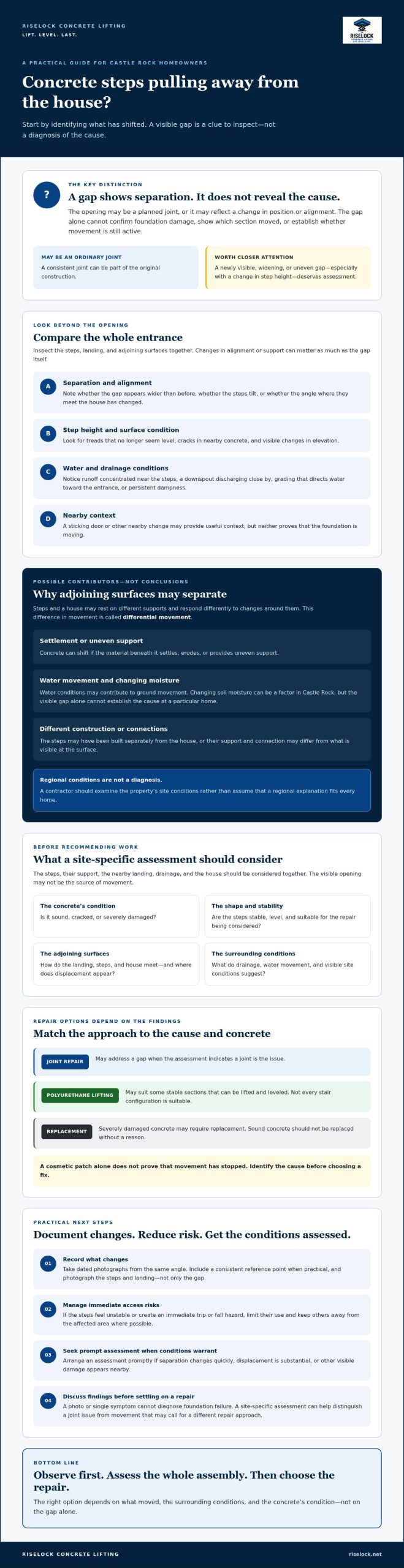
A gap between concrete steps and a house or landing means the adjoining surfaces no longer meet as they once did, or one surface appears displaced relative to the other. That observation matters, but it doesn’t explain why it happened. The gap alone can’t confirm foundation damage, identify which section moved, or show whether the cause is still active.
Some entrances have a planned joint between the concrete and the house. A consistent joint may be part of the original construction. A gap that’s newly visible, widening, uneven, or paired with a change in step height deserves closer attention. Movement-related separation is a change in the position or alignment of adjoining surfaces over time. Assessment comes before repair because the visible opening may not be the source of movement.
Soil conditions are one factor a professional may consider when evaluating settlement. Soil consolidation describes how soil can lose volume under pressure, but that concept alone doesn’t establish what’s happening beneath a particular set of steps. The steps, nearby landing, drainage, and house should be considered together.
Which changes suggest the steps may be moving?
Look for changes in the whole assembly, not just the gap. Clues can include separation that appears wider than before, treads that no longer look level, steps that tilt, or a changed angle where the steps meet the house. Cracks in nearby concrete or changes such as a sticking door can provide useful context, but neither proves that the foundation is moving.
Take dated photographs from the same angle and, if practical, include a consistent reference point. Photograph the steps and landing as well as the gap. This record can show whether the gap or alignment has changed and give a contractor clearer context than memory alone.
When does a separating step need prompt professional attention?
If the steps feel unstable or create an immediate trip or fall hazard, limit their use and keep others away from the affected area where possible. Arrange an assessment promptly if the separation changes quickly, displacement is substantial, or other visible damage appears nearby.
A photo or single symptom can’t diagnose foundation failure. For homeowners considering how to repair concrete steps pulling away from house Castle Rock, the next step is a site-specific assessment of the steps and adjoining surfaces. That can help distinguish a joint that needs attention from movement that may call for a different repair approach, without assuming that sound concrete must be replaced.
Why concrete steps separate from a house in Castle Rock
Steps and a house can move by different amounts because they may rest on different supports and respond differently to changes around them. This is called differential movement. A stair section may settle while the house remains relatively stable, or movement in the adjoining structure may affect how the two surfaces meet. A gap is an observable symptom. The cause can be confirmed only after the steps, their support, and nearby conditions are assessed.
How settlement, water, and support conditions can contribute
Concrete can shift if the material beneath it settles, erodes, or provides uneven support. Water movement may be one factor. Runoff concentrated near the steps, a downspout discharging close by, grading that directs water toward the entrance, or persistent dampness can warrant attention during an inspection. These are possible contributors, not proof of a specific cause.
Soil behavior can also affect support. Soil consolidation describes how soil may lose volume under pressure, but it doesn’t establish what is happening at a particular home. Castle Rock or Colorado-specific claims about soil, seasonal conditions, and their effects should be supported by local evidence. A contractor should examine site conditions rather than assume a regional explanation fits every property.
Construction details matter, too. The steps may have been built separately from the house, or their support and connection may differ from what’s visible at the surface. A site assessment can consider the steps’ elevation and stability alongside drainage features and the condition of the adjoining landing.
Why the connection between steps and the house matters
A stair assembly may sit next to the house or be connected in a way that affects how movement appears at the joint. Don’t automatically fill the gap rigidly before its purpose and any movement are understood. If the surfaces continue to shift, a cosmetic seal or patch may not address the underlying issue. It could also obscure changes that help guide an assessment.
Repair needs may be limited to the concrete steps, particularly if the house and landing show no related movement. Broader or changing cracks, displacement in adjoining surfaces, or other signs of movement in the house call for careful evaluation. A concrete contractor can assess concrete repair or lifting options when the section is suitable. Concerns about the structure itself may warrant review by a qualified structural professional. A general reference such as the Texas Department of Transportation’s Concrete Repair Manual describes concrete repair procedures, but it isn’t a diagnosis of a residential stair assembly.
For homeowners weighing how to repair concrete steps pulling away from house Castle Rock, the practical first move is to establish what has moved and why. RiseLock provides concrete lifting, leveling, and repair in Castle Rock. Review concrete lifting and repair options and discuss whether an assessment may fit your situation.
How contractors assess and compare repair options for separating concrete steps
A useful repair recommendation should explain both what’s visible and what may be causing it. A contractor can check whether the steps feel stable, compare tread elevations, document cracks and surface condition, and examine how the steps meet the house and any adjoining landing. Nearby drainage and water exposure also matter because they can affect the support beneath concrete.
Ask what evidence supports the suspected cause. The assessment should distinguish a surface joint that needs attention from a step section that has lost support or changed level. If the house itself appears to be moving, a lifting-only recommendation may not address the concern. Further evaluation by an appropriate structural professional may be warranted.
Compare the repair options against the observed problem
No single method suits every stair assembly. Use this comparison to discuss whether a recommendation matches the condition found on site.
| Option | What it may address | Limitations and questions to ask |
|---|---|---|
| Joint or surface repair | A gap or localized concrete damage when the steps are otherwise stable. | Will this address only the visible opening, or has movement also been assessed? |
| Polyurethane concrete lifting | Support or level correction for a concrete section that is suitable to lift and stabilize. | Is this stair configuration appropriate, and what evidence shows the support or level issue can be addressed this way? |
| Replacement | Concrete that is too deteriorated or unsuitable for the proposed repair. | What condition makes repair impractical, and how will the replacement relate to adjoining surfaces? |
When polyurethane concrete lifting may or may not fit
Polyurethane lifting may be considered when the concrete remains suitable and the issue involves support or level correction. Suitability depends on the site, access, slab condition, and stair configuration. Lifting can correct the position of an eligible concrete section, but it doesn’t resolve every possible cause of separation or address movement in the house itself. In cases where entrance issues prompt a broader exterior overhaul or a complete redesign of the entryway, design-build specialists like Elite Contractor Services can coordinate comprehensive home remodeling projects that incorporate structural updates seamlessly.
For homeowners looking to repair concrete steps pulling away from house Castle Rock, the goal is a recommendation tied to the specific assembly, not a method chosen from the gap alone. RiseLock’s guides, Concrete Lifting Solutions: A Buyer’s Guide to Structural Restoration in Colorado and Polyurethane Concrete Lifting: The Precision Guide to Modern Slab Restoration, offer additional background on lifting approaches. Discuss site conditions and the limits of each proposed repair before deciding.
Concrete steps pulling away from your Castle Rock home
A widening gap can be unsettling, but you can take practical steps before choosing a repair. Document what you see, reduce any immediate access risk, arrange a site assessment, and then compare recommendations based on the condition of the steps and adjoining surfaces. This process helps prevent a cosmetic fix from being mistaken for a solution to ongoing movement.
What homeowners can safely document before an assessment
Take clear photographs of the gap, each step, the landing, and nearby drainage features. Use the same angle for later photos, and record when you first noticed the separation and whether it appears to be changing. Don’t dig beneath, pry at, or otherwise disturb the concrete to investigate. If the steps feel unstable or unsafe, keep people off them and use another entrance if possible. Don’t try to lift the steps yourself.
How to compare contractor recommendations
Ask each contractor to explain the suspected cause, what observations support it, and which concrete sections the proposed work would address. A recommendation should clarify whether it concerns the steps, an adjoining slab, or another identified area. If the explanation doesn’t account for the visible movement, consider seeking another qualified opinion.
Before agreeing to work, ask:
- What do you believe is causing the separation, and what evidence points to that cause?
- Why is this repair method appropriate for the condition and configuration of my steps?
- What are the method’s limitations, and what conditions could affect the result?
- What site preparation is needed, and how will the work affect access to the entrance?
- What should I watch for afterward, and what follow-up is included?
Be cautious if a filler or surface patch is presented as proof that movement has stopped. Sealing may improve the appearance of a joint, but it doesn’t establish that support or alignment issues have been corrected. The proposal should distinguish cosmetic work from measures intended to address a diagnosed concrete problem.
For repair concrete steps pulling away from house Castle Rock, recommendations should be specific to the property rather than based on the gap alone. RiseLock serves Castle Rock with polyurethane concrete lifting and leveling, foam concrete lifting, and concrete repair. Whether an approach fits depends on the site and the condition of the steps, so confirm the scope of the assessment and the available work for your stair configuration.
Share your observations and discuss the site with RiseLock’s concrete repair team to explore whether its services may suit the issue.
Choosing a concrete step repair professional in Castle Rock
A reliable contractor should explain the reasoning behind a repair recommendation, not just offer a quick fix for the visible gap. If you’re deciding how to repair concrete steps pulling away from house Castle Rock, look for experience with concrete movement and repair, clear communication about the limits of proposed work, and an assessment based on the actual steps and surrounding surfaces.
Questions to ask before approving concrete step repair
Before authorizing work, ask the contractor to describe the suspected cause and the observations that support it. A diagnosis made from a brief description or photograph may be incomplete. The recommendation should follow an assessment of the property and account for the step configuration, adjoining concrete, access, and relevant site conditions.
- What do you believe caused the separation? Ask how the assessment supports that conclusion and whether other causes remain possible.
- What exactly does the proposed work include? Confirm whether it addresses the steps, landing, or another identified concrete area, and what it leaves untouched.
- How do access and configuration affect the method? Ask whether the layout or condition of the steps changes the options.
- What are the limitations? A clear explanation should distinguish what the work is intended to address from issues outside its scope.
Be cautious of guaranteed conclusions offered before the contractor has seen the site. If the explanation doesn’t fit the visible movement, or the proposal doesn’t clarify which adjacent areas are included, consider another qualified opinion before committing.
How RiseLock may help with suitable concrete movement issues
RiseLock serves Castle Rock and provides polyurethane concrete lifting, concrete leveling, foam concrete lifting, and concrete repair. These services may be options when an assessment indicates that the concrete is suitable for the proposed work. Lifting isn’t appropriate for every separating stair configuration, and no method should be presented as a solution to movement in the house or foundation itself.
The assessment should establish whether the steps and nearby concrete can be addressed within the recommended scope. Ask how the proposed method relates to the condition of your specific stair assembly, what it is intended to correct, and what it won’t address. That conversation helps set clear expectations without promising a particular outcome before the site has been evaluated.
If you’re weighing your next step, discuss your separating concrete steps with RiseLock. Share what you’ve observed at your Castle Rock property and request an assessment to learn whether its concrete lifting, leveling, or repair services may be suitable.
Take the next step toward a stable entrance
A gap is a reason to investigate, not a diagnosis. The right repair depends on what has moved, the condition of the steps and adjoining concrete, and whether the proposed work addresses the cause rather than only the visible opening. A site-specific assessment can help you compare practical options and avoid replacing concrete that may still be suitable for repair.
If you’re considering how to repair concrete steps pulling away from house Castle Rock, RiseLock serves Castle Rock with polyurethane concrete lifting and leveling, as well as concrete repair. Lifting may be an option when an assessment finds the concrete suitable, but no method fits every stair configuration. Discussing the details of your entrance can help clarify what should be evaluated and which services may be relevant.
Discuss your separating concrete steps with RiseLock and share what you’ve noticed. A careful assessment is a constructive first move toward safer, more dependable access to your home.
Frequently Asked Questions
Why are my concrete steps pulling away from my house?
Concrete steps may separate because they and the house or landing have moved differently. Changes in support beneath the steps, water movement, drainage conditions, or construction details can contribute, but the visible gap alone can’t confirm which factor is responsible. A contractor should inspect the steps, adjoining concrete, elevations, and nearby water conditions before recommending a repair. If the house itself appears to be moving, further structural evaluation may be appropriate.
Can concrete steps that have separated from a house be repaired without replacement?
Yes, repair may be possible if the steps remain in suitable condition, but the right approach depends on what moved and how sound the concrete is. A stable stair assembly with a joint issue may need a different repair from a section that has lost support or become uneven. For repair concrete steps pulling away from house Castle Rock, a site assessment can help determine whether concrete repair, lifting, or replacement is appropriate. If the structure is too damaged to salvage and requires complete entrance rebuilding, exploring residential building specialists such as strotherbuiltconstruction.com can help you understand the full replacement and construction process.
Is polyurethane concrete lifting suitable for steps pulling away from a house?
Polyurethane concrete lifting may suit some steps when the concrete is in appropriate condition and the issue involves support or level correction. It isn’t a fit for every stair configuration, and lifting doesn’t address every possible cause of separation, including movement in the house itself. A contractor should evaluate the step condition, access, adjoining surfaces, and site conditions before deciding whether lifting is suitable.
How do I know whether a gap between my steps and house is getting worse?
Look for a gap that appears wider, a change in how the steps meet the house, uneven treads, tilting, or new displacement. Take dated photographs from the same angle and include the landing and nearby concrete for context. Cracks or sticking doors can add useful information, but they don’t establish the cause by themselves. Share your photo record with a contractor during a site assessment.
Should I fill the gap between concrete steps and my house?
Don’t treat filling the gap as a complete repair before the joint and any movement have been assessed. The opening may be a planned joint, or it may reflect a change in alignment. A filler or cosmetic patch can cover the visible gap without correcting a support or level issue. Ask a contractor to determine what the gap represents and whether surface repair is appropriate for the condition.
When should I stop using concrete steps that are pulling away?
Stop using the steps if they feel unstable or create an immediate trip or fall hazard. Keep others away from the affected area and use another entrance if possible. Arrange prompt professional assessment if the separation is changing quickly, displacement is substantial, or related damage is visible. A photograph or single symptom can’t diagnose the problem, so avoid attempting to lift or adjust the steps yourself.
Does RiseLock Concrete Lifting serve Castle Rock, Colorado?
Yes. Castle Rock is within RiseLock Concrete Lifting’s stated service area. The company also serves Denver, Aurora, Centennial, Parker, Colorado Springs, Englewood, Littleton, Lakewood, Arvada, Thornton, Wheatridge, Castle Pines, and Boulder. RiseLock provides polyurethane concrete lifting and leveling, foam concrete lifting, and concrete repair. Whether a particular stair configuration is suitable for assessment or repair depends on the site and the condition of the steps.