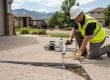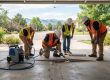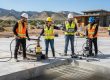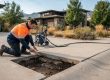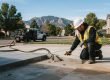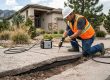

A raised edge at an expansion joint can look like a simple joint-material problem, but the concrete slabs on either side may sit at different heights. Before deciding how to fix uneven concrete expansion joints in Littleton, identify what has moved. The joint filler may be worn or displaced, or one slab may have settled or lifted, creating a trip concern.
You can often narrow down the issue by looking at both the joint material and the concrete edges. This article explains how to distinguish joint damage from uneven slabs, what an assessment and repair may involve, and when concrete leveling could be appropriate. RiseLock provides polyurethane concrete lifting in Littleton, using high-density foam to raise and stabilize suitable sunken slabs. The evaluation focuses on the slab’s condition and the cause of the uneven transition, so the repair can address the concrete rather than just its appearance.
Key Takeaways
- Check whether worn joint material or a height difference between slabs is causing the uneven edge.
- Water and drainage patterns can contribute to changes in slab support, but they do not confirm the cause at a particular property.
- Joint maintenance addresses the joint material; it won’t correct the elevation of a settled slab.
- Fixing uneven concrete expansion joints in Littleton starts with assessing the slab’s condition and movement, then considering leveling or a broader repair.
- RiseLock uses polyurethane concrete lifting and leveling to raise and stabilize suitable uneven slabs in Littleton.
Uneven Concrete Expansion Joints in Littleton: What Is Actually Out of Level?
A lip, dip, or abrupt height change where two concrete sections meet can disrupt a walkway, driveway, patio, or entrance. The joint may look like the obvious problem, but the unevenness can come from a change in slab elevation rather than from the material between the sections. Before choosing how to fix uneven concrete expansion joints in Littleton, identify what has changed: the joint itself, one or both slab edges, or both.
An expansion joint is a separation designed to accommodate movement between concrete sections. Depending on the installation, it may contain flexible filler or sealant. That material helps maintain the separation while allowing movement; it doesn’t hold a settled slab at the same height as its neighbor.
How to tell a slab-height difference from a worn expansion joint
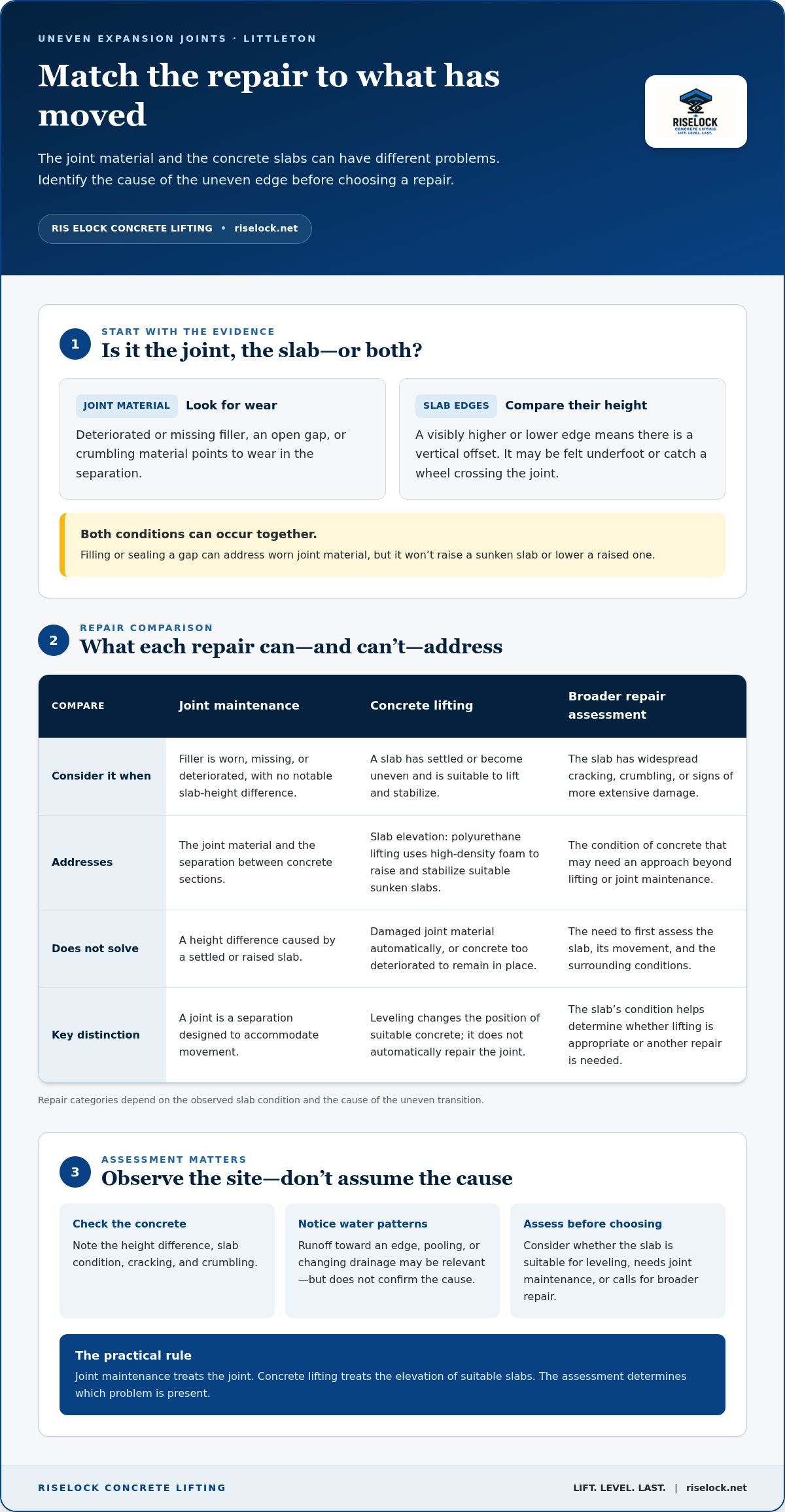
Look at the concrete edges as well as the joint material. If one edge sits visibly higher or lower than the other, there’s a vertical offset between the slabs. You may feel the change underfoot or notice a wheel catching as it crosses the joint. By contrast, deteriorated filler, an open gap, or crumbling material along the joint points to wear in the separation itself.
Both conditions can occur together. A joint may be open or damaged while a slab has also shifted, so appearance alone may not reveal the full cause. Filling or sealing a gap can address worn joint material, but it won’t raise a sunken slab or lower a raised one. The repair depends on the slab’s condition and whether its elevation has changed.
Why uneven joint edges matter to Littleton property owners
A sudden change in height can make a walking route less predictable and create a trip concern. The same lip can catch a bin or wheeled equipment crossing a driveway, or make the approach to a patio or entrance feel uneven. For Littleton property owners, distinguishing the joint’s condition from the slab’s position helps avoid choosing a repair that addresses only part of the problem.
A joint is the separation between concrete sections; slab displacement is a change in their relative height. The next step is to assess whether the concrete has moved and whether the slab remains suitable for repair. That assessment helps determine whether the issue calls for joint maintenance, concrete leveling, or a broader repair, rather than assuming every uneven joint needs the same fix.
Why Concrete Becomes Uneven at Expansion Joints in Littleton
A height difference at a joint often develops because the concrete no longer has consistent support beneath it. If the material under one slab shifts or compresses, that section may settle while the neighboring slab stays in place. The result can be a lower edge, a raised edge, or an abrupt offset where the two sections meet. The joint may still function as a separation even when the slabs end up at different elevations.
Settlement, drainage, and changing support beneath slabs
Water exposure is one factor to consider, not a diagnosis by itself. Runoff that repeatedly flows toward an edge, pooling near a slab, or drainage patterns that change over time may affect the support beneath the concrete. Other site conditions can also contribute to movement. An assessment considers the height difference, slab condition, and surrounding area instead of assuming a cause based on location alone.
Littleton properties can differ in grading, drainage, and slab history, so local soil or weather conditions shouldn’t be treated as a confirmed explanation for every uneven joint. Notice where water travels after rain and whether the offset appears to be changing. Those observations can inform an assessment, but the concrete and its support still need to be examined to determine what repair makes sense.
Movement at the joint versus damage to the slab
An expansion joint separates adjacent concrete sections so they can move independently. The separation can remain visible and intact even if one adjoining slab settles. Conversely, filler or joint edges may deteriorate without a meaningful change in slab height. These conditions can occur together, but they call for different repair considerations: worn joint material doesn’t by itself explain a vertical offset, and leveling a slab doesn’t automatically address damaged joint material.
Cracking can provide additional clues, but it needs context. Limited cracking doesn’t necessarily mean the slab must be replaced; widespread cracking, crumbling, or other signs of more extensive damage may call for a broader concrete repair assessment. The goal is to determine whether the slab is sound enough to lift and stabilize or whether its condition points to another approach.
That distinction guides whether to fix uneven concrete expansion joints in Littleton through slab leveling, joint maintenance, or a more extensive repair. RiseLock assesses existing concrete and provides polyurethane lifting and leveling for suitable slabs, using high-density foam to raise and stabilize them. Learn more about RiseLock’s polyurethane concrete lifting and leveling.
Joint Sealing, Concrete Lifting, or Replacement: Which Fix Fits?
The right repair depends on whether the problem is in the joint material, the height of the slabs, or the condition of the concrete itself. Joint maintenance won’t correct a change in slab elevation, and lifting won’t restore concrete that’s too deteriorated to remain in place. If you’re researching how to fix uneven concrete expansion joints in Littleton, start by identifying which part has changed.
| Symptom | Likely repair category | What it addresses |
|---|---|---|
| Worn, missing, or deteriorated joint filler, with no notable height difference | Joint maintenance | The condition of the joint material, not slab elevation |
| One sound slab sits higher or lower than the adjacent section | Concrete lifting and leveling, if suitable | The slab’s position and support beneath it |
| Extensive cracking, crumbling, or concrete too damaged to lift | Concrete repair or replacement assessment | The broader condition and usability of the slab |
When joint maintenance addresses the visible problem
If the concrete edges remain close to level but filler is cracked, missing, or deteriorated, the joint itself may need attention. Maintenance can address the material and the open separation. It won’t raise a settled slab or correct a vertical lip. If filler damage and a height difference are both present, consider each issue separately so the visible gap doesn’t distract from movement in the concrete.
When polyurethane concrete lifting may be appropriate
For an existing slab that’s uneven but remains suitable for lifting, polyurethane concrete lifting can offer an alternative to removing and replacing it. The process uses injection points to place high-density foam beneath the slab, with the aim of raising and stabilizing the concrete. Suitability depends on the slab’s condition and the site assessment. Learn more in this guide to polyurethane concrete lifting.
Replacement may be considered when the concrete is too damaged or otherwise unsuitable for lifting. The decision should follow an assessment of the slab, not just the presence of a joint or a height difference. To fix uneven concrete expansion joints in Littleton, first establish whether the elevation has changed, then match the repair to the material or structure that needs attention.
How to Fix Uneven Concrete Expansion Joints in Littleton: The Repair Process
To fix uneven concrete expansion joints in Littleton, first determine whether a slab has moved and whether it’s suitable for lifting. The repair process generally moves from assessment to planning, lifting where appropriate, and a final review. This sequence matches the work to the concrete instead of treating every uneven edge as a joint-material problem.
Assessment and repair planning for a Littleton concrete joint
The assessment considers how the uneven transition affects the area’s use, such as a walking route, driveway, or entrance. It includes the height difference between slab edges, visible cracks and overall concrete condition, the joint itself, access, and signs of movement. Nearby water patterns may offer useful context, but they don’t confirm a specific cause.
These findings guide the repair plan. If the slab is suitable for lifting, polyurethane leveling may be appropriate. If it’s too damaged or otherwise unsuitable, a different repair assessment may be needed. The goal is to address slab position and support, not to assume joint filler will be replaced as part of leveling. A project-specific assessment helps determine how to fix uneven concrete expansion joints in Littleton without choosing a method before evaluating the slab.
Polyurethane lifting, stabilization, and final review
For a suitable slab, high-density polyurethane foam is injected beneath the concrete. As the foam expands, it can raise and stabilize the slab. The lift is controlled with the aim of reducing the abrupt height difference at the joint and improving the transition between sections. The appropriate adjustment depends on the concrete’s condition and movement, so a specific result shouldn’t be assumed in advance.
After lifting, the repaired area is reviewed to evaluate the slab’s alignment and surface transition. The review considers how the treated section sits relative to the neighboring concrete. If joint material is also worn or missing, that remains a separate repair consideration.
For broader context on restoring uneven slabs, read RiseLock’s concrete leveling guide. It explains the leveling approach and how it may apply to uneven concrete.
Get Uneven Expansion-Joint Concrete Assessed by RiseLock in Littleton
The right repair begins with a clear diagnosis: determine whether the slab edge has shifted, the joint material has deteriorated, or both conditions are present. Then assess the concrete itself before choosing between joint maintenance, leveling, or a broader repair. This helps avoid treating a height difference as a filler problem or assuming replacement is necessary before understanding the slab’s condition.
What a focused concrete assessment should clarify
RiseLock’s assessment considers the relative height of adjoining slab edges, visible cracking and overall concrete condition, the state of the joint, and the surrounding area. These details help establish whether an existing slab may be suitable for lifting or whether another repair approach is more appropriate. The goal is to match the work to the issue rather than assume every uneven section can be lifted.
For a suitable uneven slab, RiseLock’s polyurethane concrete lifting and leveling uses high-density foam to raise and stabilize existing concrete. The aim is a more even transition between slabs while preserving concrete that remains appropriate to lift. The method is project-specific, and the assessment informs what can reasonably be addressed. For more help weighing repair approaches, see the concrete lifting solutions buyer’s guide.
Arrange concrete lifting in Littleton
RiseLock provides concrete lifting, leveling, and repair in Littleton and serves Denver, Aurora, Centennial, Parker, Colorado Springs, Englewood, Littleton, Lakewood, Arvada, Thornton, Wheatridge, Castle Rock, Castle Pines, and Boulder. When describing an uneven area, note where the height difference appears, how the area is used, and any visible damage or joint wear. Those details help frame an assessment of the slab and guide a suitable repair plan. Polyurethane lifting is an option for existing concrete when its condition supports that approach; it raises and stabilizes the slab, but doesn’t automatically replace joint material.
For a project-specific assessment, review RiseLock’s concrete lifting and leveling services.
Choose the Right Repair for a More Even Surface
A height difference at an expansion joint doesn’t always mean the joint filler is the problem, and it doesn’t automatically mean the concrete needs replacement. First determine whether a slab has shifted, then consider its condition and the surrounding area to identify a suitable repair.
For suitable uneven slabs, RiseLock provides polyurethane concrete lifting and leveling in Littleton and surrounding Colorado communities. High-density foam is used to raise and stabilize existing concrete, with the aim of improving alignment without assuming removal is necessary. The appropriate approach depends on the slab and project assessment.
If you’re ready to fix uneven concrete expansion joints in Littleton, take the next step with a focused evaluation of the slab and joint. Request a concrete assessment from RiseLock to discuss the uneven area and possible repair options.
Frequently Asked Questions
Can uneven concrete at an expansion joint be lifted instead of replaced?
Yes. An existing slab may be lifted instead of replaced if its condition makes it suitable for leveling. Polyurethane concrete lifting uses high-density foam beneath the slab to raise and stabilize it. An assessment helps determine whether the concrete is sound enough for this approach or whether damage calls for another repair. The height difference alone doesn’t decide the method; the slab’s overall condition matters too.
Is a damaged expansion joint the same problem as an uneven concrete slab?
No. A damaged expansion joint usually means the filler or edges of the separation are worn, missing, or deteriorated. An uneven slab has a height difference between adjoining concrete sections. Both problems can appear at the same location, but they don’t necessarily need the same repair. Joint maintenance addresses the joint material, while slab leveling addresses a change in the concrete’s elevation.
How does polyurethane foam fix uneven concrete expansion joints?
Polyurethane lifting places high-density foam beneath a suitable slab through injection points. The foam expands beneath the concrete, helping raise and stabilize it. The aim is to reduce the abrupt height difference between adjoining slab edges, though the adjustment depends on the slab and site conditions. Similar foam-raising methods are widely utilized by regional specialists such as Airlift Concrete Experts to restore settled slabs. This approach works on existing concrete when an assessment finds it suitable; it doesn’t automatically repair or replace joint filler.
What causes concrete to become uneven at an expansion joint in Littleton?
A slab can become uneven when support beneath it changes, allowing one section to settle or shift relative to its neighbor. Water exposure and drainage patterns may contribute, but they aren’t confirmed causes at every property. The joint can remain in place even as one slab moves. An assessment considers the concrete, visible movement, and surrounding conditions rather than assuming a single cause based only on location.
Can sealing an expansion joint fix a height difference between slabs?
No. Sealing or maintaining joint material may address a worn or open separation, but it won’t raise a lower slab or correct a vertical offset. If filler damage and slab displacement occur together, they should be treated as separate concerns. First determine whether the adjoining concrete edges sit at different elevations. That helps clarify whether the issue is joint maintenance, slab leveling, or both.
How do I know whether concrete lifting is suitable for my uneven slab?
Suitability depends on the slab’s condition, not just the visible height difference. An assessment considers cracking, crumbling or other deterioration, the amount of displacement, access, and signs of movement around the area. If the concrete can be lifted, polyurethane foam may raise and stabilize the existing slab. If it’s too damaged or otherwise unsuitable, a broader concrete repair assessment can help guide the next step.
What should I expect during an uneven concrete assessment in Littleton?
Expect the assessment to clarify whether the issue is slab elevation, joint deterioration, or a combination. It considers the relative height of the concrete edges, slab condition, visible cracks, joint condition, access, and possible water patterns nearby. RiseLock serves Littleton and communities including Denver, Aurora, Centennial, Parker, Colorado Springs, Englewood, Lakewood, Arvada, Thornton, Wheatridge, Castle Rock, Castle Pines, and Boulder. The findings inform a suitable repair approach.