
Does a visible crack mean a post-tension cable needs replacement? Not necessarily. A crack can raise important questions, but deciding whether a tendon is damaged and what work is appropriate takes more than a visual check. If you’re considering post tension cable replacement Parker, an engineering report can help connect the evidence to a safe, documented repair decision.
It’s understandable to want a clear answer before anyone drills, cuts, or otherwise disturbs the slab. A report may document observed distress, assess the slab and available tendon information, and recommend a repair scope. Its conclusions depend on the investigation and information available, and it doesn’t replace precise tendon locating before repair work.
This article explains what a post-tension slab engineering report can and can’t tell you, which findings may shape repair-versus-replacement decisions, and why the next steps matter. You’ll also learn how to organize records and prepare for site-specific work. RiseLock Concrete Lifting serves Parker with post-tension installation, as well as polyurethane concrete lifting and leveling for sunken or uneven surfaces.
Key Takeaways
- A crack alone doesn’t confirm tendon failure or mean cable replacement is necessary; decisions should reflect documented site findings.
- A useful engineering report records its inspection scope, observations, relevant records, limitations, and recommendations where applicable.
- For post tension cable replacement Parker, the report’s findings help clarify whether repair, replacement, or further evaluation may be appropriate.
- Keep plans, photographs, inspection notes, and records of previous tendon work together to support a clear repair scope.
- RiseLock provides post-tension installation in Parker, along with polyurethane concrete lifting and leveling for residential and commercial applications.
Parker Post-Tension Slab Reports: Problems Addressed
A post-tension slab engineering report records technical findings and recommendations for a particular structure. It helps translate visible conditions and inspection evidence into a reasoned assessment, so property owners can understand what may need attention before deciding on structural work. A crack may be concerning, but it does not, by itself, establish tendon failure or show that replacement is required.
Post-tensioned concrete uses tensioned steel tendons within the slab to help the concrete resist structural demands. For a concise overview of how the system works, see this explanation of post-tensioned concrete. Because tendons are embedded in the slab, symptoms at the surface can’t reliably reveal their condition or the cause of cracking.
What can trigger a post-tension slab assessment?
Cracks, exposed tendon hardware, or signs of a tendon-related event may prompt an assessment. These observations are useful clues, not a diagnosis: a crack’s appearance alone can’t show whether a tendon has failed, what caused the condition, or what repair is appropriate. Avoid cutting, drilling, or disturbing a suspected tendon. An assessment can help establish what the available evidence supports.
What does a report establish, and what does it not?
Depending on the project, a report may document site observations, the inspection scope, relevant records reviewed, findings, limitations, conclusions, and recommendations. Its format and level of detail depend on the structure and the responsible professional. The report describes conditions within the scope of the investigation; it isn’t a guarantee of future performance or a substitute for a site-specific inspection.
This distinction matters when considering post tension cable replacement Parker property owners may be evaluating. An engineer’s assessment documents findings and may recommend a repair approach or further investigation. Specialized tendon work is a separate part of the project, informed by the site conditions and repair plan. RiseLock Concrete Lifting provides post-tension installation, a service focused on reinforcing concrete structures and supporting the stability of foundations and slabs.
Clear documentation gives owners a basis for understanding the concern, discussing the recommended scope, and organizing the next step. It can also help prevent a visible symptom from being treated as proof of a specific failure before the slab and tendon conditions have been properly evaluated.
What a Parker Post-Tension Slab Engineering Report Should Document
A useful report makes the path from observed condition to recommended action clear. It should identify the structure and assessment scope, describe the evidence reviewed, and distinguish direct observations from interpretations about what caused a crack or other distress. There’s no single format that fits every slab, so the appropriate level of detail depends on the structure, available records, and professional assessment.
Which records and observations help explain the slab condition?
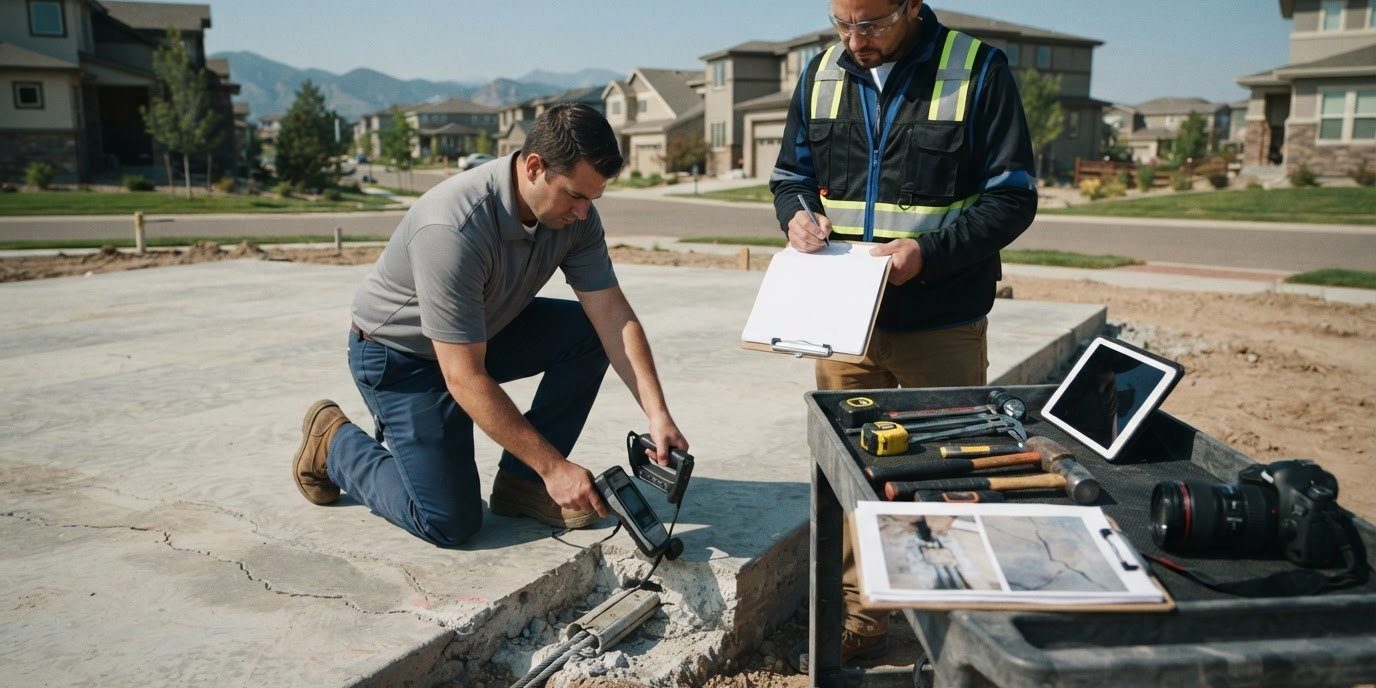
Original plans, known construction details, and records of previous repairs can help provide context when they’re available. The report may also identify inspected areas and describe visible conditions, such as crack locations or exposed hardware. Photographs, marked-up plans, and location notes make those observations easier to trace and discuss.
Clear documentation separates what was seen from what is inferred. For example, a report can record a crack at a specific location without treating the crack alone as proof that a tendon has failed. This distinction helps keep repair decisions grounded in evidence.
How should recommendations and limitations be presented?
Recommendations should identify a next step and explain which findings support it, where applicable. The report should also state relevant limits, such as areas that weren’t inspected or conditions that couldn’t be evaluated within its scope. A general inspection note isn’t automatically a stamped engineering conclusion; owners should understand what kind of document they have before relying on it to define structural work.
Before authorizing work, review whether the report addresses the project’s relevant design standards and local requirements. These can depend on the structure and location, so they should be verified for the specific project rather than assumed. The Post-Tensioning Institute (PTI) provides post-tensioning technical resources, while project-specific conclusions belong to the responsible professional.
For decisions about post tension cable replacement Parker property owners should be able to connect the recommended scope to documented findings, not just a surface symptom. Keep the report with plans, photographs, and records of prior tendon work so the information remains available as repair planning moves forward.
Once findings are understood, precise tendon locating can help inform repair work and protect the surrounding slab. Keep the assessment and location information available as the project scope takes shape. Learn more about RiseLock’s post-tension installation and concrete services.
How Report Findings Guide Post-Tension Cable Replacement in Parker
An engineering report helps connect what was observed, what the evidence supports, and what action may be appropriate. It doesn’t make every crack a tendon problem, and it can’t determine the repair scope without considering the specific slab. The next step may be tendon repair, replacement, or further evaluation, depending on site findings and the responsible professional’s recommendations.
Tendon condition is only one part of the decision. Its location, the slab’s design, and access to the affected area can also shape how work is planned. The distinctions below are examples, not a remote diagnosis or a universal decision rule.
Observed condition: Surface cracking with no documented tendon damage.
Report guidance: Findings may describe the crack and state whether its cause was determined within the assessment scope.
Appropriate follow-up: Use the report’s recommendation. Don’t assume cable replacement is needed based on cracking alone.
Observed condition: Evidence indicates a tendon may be damaged.
Report guidance: The assessment may identify the evidence, affected area, and recommended next action, or call for additional evaluation.
Appropriate follow-up: Plan work around the documented findings and site-specific professional recommendations.
Observed condition: The tendon’s condition or the extent of the issue remains uncertain.
Report guidance: Limitations or unanswered questions may be recorded.
Appropriate follow-up: Resolve the stated uncertainty before treating a repair or replacement scope as established.
When might a report recommend repair or replacement?
A recommendation should reflect the confirmed tendon condition and the structure’s requirements. If damage is documented, the report may guide a repair or replacement decision. If cracking hasn’t been attributed to tendon damage, it shouldn’t be treated as proof that a tendon needs replacement. There’s no single symptom or universal threshold that determines the answer for every slab.
What should owners understand before work proceeds?
Compare the proposed work area and scope with the report’s relevant findings. If the recommendation identifies a specific location, the planned work should address that documented area; questions or differences in scope deserve clarification before work begins. Accurate tendon locating and controlled procedures matter because post-tension components are embedded in the slab. Avoid cutting or drilling into a suspected tendon.
The report documents assessment evidence; specialized tendon work carries out the repair plan. For post tension cable replacement Parker projects, this distinction helps keep the decision grounded in findings while ensuring the work plan reflects the slab and site conditions.
What Parker Property Owners Can Do After Receiving the Report
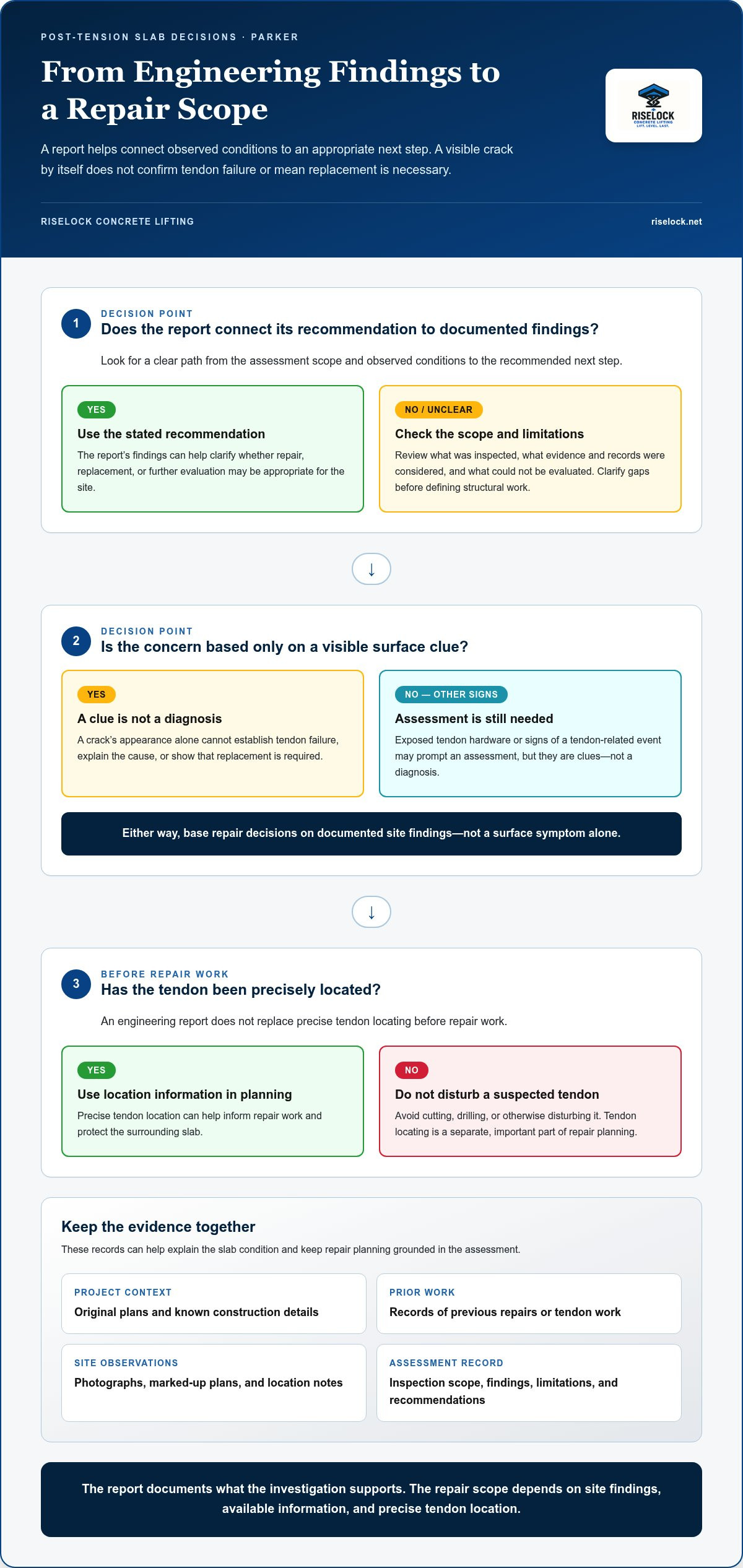
A report is most useful when its findings are carried forward accurately into repair planning. Use a deliberate sequence: understand the recommendation, preserve the supporting information, resolve unanswered questions, and prepare the site without disturbing suspected tendon damage.
How to review findings and organize project records
Start by matching each recommendation to the location, evidence, and inspection scope described in the report. If it calls for work in a particular area, note how that area is identified and whether any limitations affect the recommendation. Keep questions about unclear findings or scope together for the responsible professional, rather than filling gaps with assumptions.
- 1. Read the report’s conclusions and limitations. Note the recommended next action and what the assessment did or didn’t cover.
- 2. Assemble the records. Keep the report with original plans, photographs, inspection notes, known construction details, and records of prior tendon work.
- 3. List open questions. Record anything that needs clarification about the evidence, work area, or recommended scope.
- 4. Verify project requirements. Parker and Douglas County requirements can vary based on the project and location. Confirm which local rules apply before work proceeds.
- 5. Prepare a clear repair scope. Share relevant records and the report’s findings as repair planning moves forward.
Keep these documents together and accessible. A dated photograph or marked-up plan can help distinguish the reported location from other visible conditions and reduce confusion during project coordination.
How to prepare for tendon repair or replacement
Until a suspected tendon condition has been assessed and direction is clear, restrict disturbance around the affected area. Don’t cut, drill, or make changes that could interfere with the slab or tendon. Site coordination can also account for access to the work area, how the slab is being used, and known utilities that may affect planning.
Repair details should follow the documented findings and applicable professional direction. For a Parker property, keep the report, site photographs, and relevant plans together so the information can inform the work scope. RiseLock Concrete Lifting provides post-tension installation and polyurethane concrete lifting and leveling, services for concrete structures and slabs.
For post tension cable replacement Parker property owners can move from report to repair planning with a clear record of findings, questions, and site considerations. Discuss post-tension installation and concrete services with RiseLock Concrete Lifting.
Post-Tension Tendon Repair and Replacement Support in Parker
Once an engineering report’s findings are understood, the next step is to shape a site-specific work plan around the documented concern. For post-tension cable replacement in Parker, the assessment can help identify the affected area and explain what evidence supports the recommendation. RiseLock Concrete Lifting provides post-tension installation to reinforce concrete structures and support the stability of foundations and slabs.
How specialized tendon work supports informed repair planning
Post-tension tendons are embedded in the slab, so careful location work matters before repair or replacement begins. Precise detection can identify where a tendon lies in relation to a planned work area and support a more deliberate approach to protecting slab integrity. The assessment report and construction work serve different roles: the responsible professional documents findings and recommendations, while the project team carries out work based on the approved scope.
There isn’t one repair approach for every reported concern. The tendon’s condition, its location, and the slab’s specific requirements inform the scope. A report can help property owners understand whether further evaluation or tendon work is recommended, without assuming that every visible crack requires cable replacement.
For post tension cable replacement Parker property owners can bring report information into a discussion of the affected area and project needs. This helps keep planning connected to the documented concern rather than relying on symptoms alone.
What to expect when discussing a Parker project with RiseLock
Relevant information can make the conversation more focused. Have available report excerpts that describe the findings and recommended scope, along with photographs, slab plans, prior repair records, or notes about known construction details. These materials provide useful context; they don’t replace project-specific review of actual site conditions.
RiseLock serves Parker and communities across the Denver area with post-tension installation, polyurethane concrete lifting and leveling, and concrete repair. For a post-tension project, discussions can focus on the slab, the intended installation, and relevant project requirements. Engineering recommendations remain distinct from installation work.
If you’re ready to discuss post-tension installation or concrete services for your Parker property, Discuss your post-tension project with RiseLock.
Move From Report Findings to a Clear Repair Plan
A visible crack alone doesn’t establish tendon failure or mean replacement is necessary. A post-tension slab engineering report helps connect documented observations and inspection limits to professional recommendations, while tendon locating and repair work address the site-specific scope. Keeping plans, photos, and prior repair records organized can make the handoff from assessment to project planning clearer.
For post tension cable replacement Parker property owners should base next steps on the report’s findings and the conditions at the slab, not assumptions about what a symptom means. RiseLock serves Parker and communities across the Denver area with post-tension installation, concrete repair, and polyurethane concrete lifting and leveling.
Share the relevant report excerpts and project records to start a focused conversation about your concrete or post-tension installation project. Discuss your post-tension project with RiseLock. With clear documentation and a scope informed by the site, you can take the next step with greater confidence.
Frequently Asked Questions
What is a post-tension slab engineering report?
A post-tension slab engineering report is a documented assessment of a specific structure. It may describe inspected conditions, records reviewed, findings, limitations, and recommendations, depending on the investigation’s scope. The report helps explain what the available evidence supports and what next steps may be appropriate. It isn’t a repair itself, and its conclusions apply to the conditions and areas considered during the assessment.
Does a cracked post-tension slab mean a cable needs replacement?
No. A crack alone doesn’t establish that a tendon has failed or that replacement is required. Cracking is an observable condition, but its cause needs to be evaluated in context with the slab and other available evidence. A site-specific assessment can help determine whether tendon damage is indicated, whether more evaluation is needed, or whether another response is recommended.
What should a post-tension cable replacement report include?
A report used to guide cable work should clearly identify the structure and assessment scope, relevant observations, records reviewed, findings, and limitations. Where applicable, it should connect its recommendation to the evidence and identify the affected area or next action. Photographs, marked-up plans, or location notes can make findings easier to understand. Report format and detail vary by project and the responsible professional.
Can damaged post-tension cables be repaired or replaced in Parker?
Repair or replacement may be appropriate depending on the documented tendon condition, slab design, and project requirements. A site-specific assessment helps establish what work is recommended. RiseLock Concrete Lifting provides post-tension installation and concrete services in Parker. The company also serves Denver, Aurora, Centennial, Colorado Springs, Englewood, Littleton, Lakewood, Arvada, Thornton, Wheatridge, Castle Rock, Castle Pines, and Boulder. For an existing tendon concern, keep the assessment findings and project scope clear as the work is planned.
Who prepares a post-tension slab engineering report?
A structural engineer prepares an engineering assessment and report for the specific slab conditions within the investigation scope. The report’s findings and recommendations are distinct from construction work. A project team may carry out specialized work based on the project findings, but that doesn’t make the construction team the report’s author or substitute for an engineering assessment.
What should I do if I suspect a post-tension cable is damaged?
Don’t cut, drill, or disturb the suspected tendon or nearby slab area. Keep photographs, plans, prior repair records, and any inspection notes together, and arrange for the concern to be professionally evaluated. If you already have a report, review its identified location, findings, and limitations before organizing repair work. Those records can help keep follow-up planning connected to the documented condition.
Do Parker permits or codes affect post-tension cable replacement?
They may, depending on the project and location, so verify applicable requirements before work proceeds. As of June 30, 2026, the Town of Parker adopted the 2024 International Building Codes. Douglas County’s 2024 International Building Code and International Residential Code amendments took effect July 1, 2026. These code dates don’t determine permit requirements for every tendon project; confirm which local rules apply to the specific property and scope.