A sinking sidewalk or a tilting driveway is more than a cosmetic nuisance; it’s a structural warning sign that impacts your property’s safety and value. You’ve likely noticed the pooling water near your foundation or felt the jolt of a tripping hazard underfoot, and the thought of a full slab replacement feels like an expensive, disruptive headache. It’s a common concern for property owners who want to protect their investment without the high costs and labor of demolition.
Modern concrete leveling through high-density polyurethane injection offers a surgical, non-invasive alternative that restores your surfaces to their original grade with lasting precision. By using advanced geotechnical polymers, technicians can stabilize the underlying soil and lift the concrete back into place in a matter of minutes. This guide explores the technical advantages of modern restoration and why choosing a high-density foam solution is the most reliable way to achieve long-term structural security for your property.
Key Takeaways
- Identify the primary causes of slab settlement, including the specific impact of Colorado’s expansive bentonite soils and seasonal freeze-thaw cycles.
- Understand the technical precision of modern concrete leveling, which utilizes high-density geotechnical polymers to lift and stabilize surfaces with minimal disruption.
- Evaluate the advantages of polyurethane foam over traditional mudjacking, focusing on its lightweight properties and the use of small, 5/8-inch injection ports.
- Recognize how specialized knowledge of post-tension reinforcement and structural integrity ensures a more durable and reliable restoration for your property.
Understanding Concrete Leveling: Why Slabs Sink and Shift
Concrete leveling is the technical process of restoring sunken or misaligned concrete slabs to their original elevation and stability. While many property owners view a cracked driveway or a dipping sidewalk as a surface-level problem, these issues almost always originate in the soil profile beneath the concrete. By injecting specialized materials into the empty spaces that have formed under the slab, technicians can achieve precise lift and long-term support. Understanding Concrete Leveling requires a grasp of how these voids develop and how filling them addresses the root cause of structural failure.
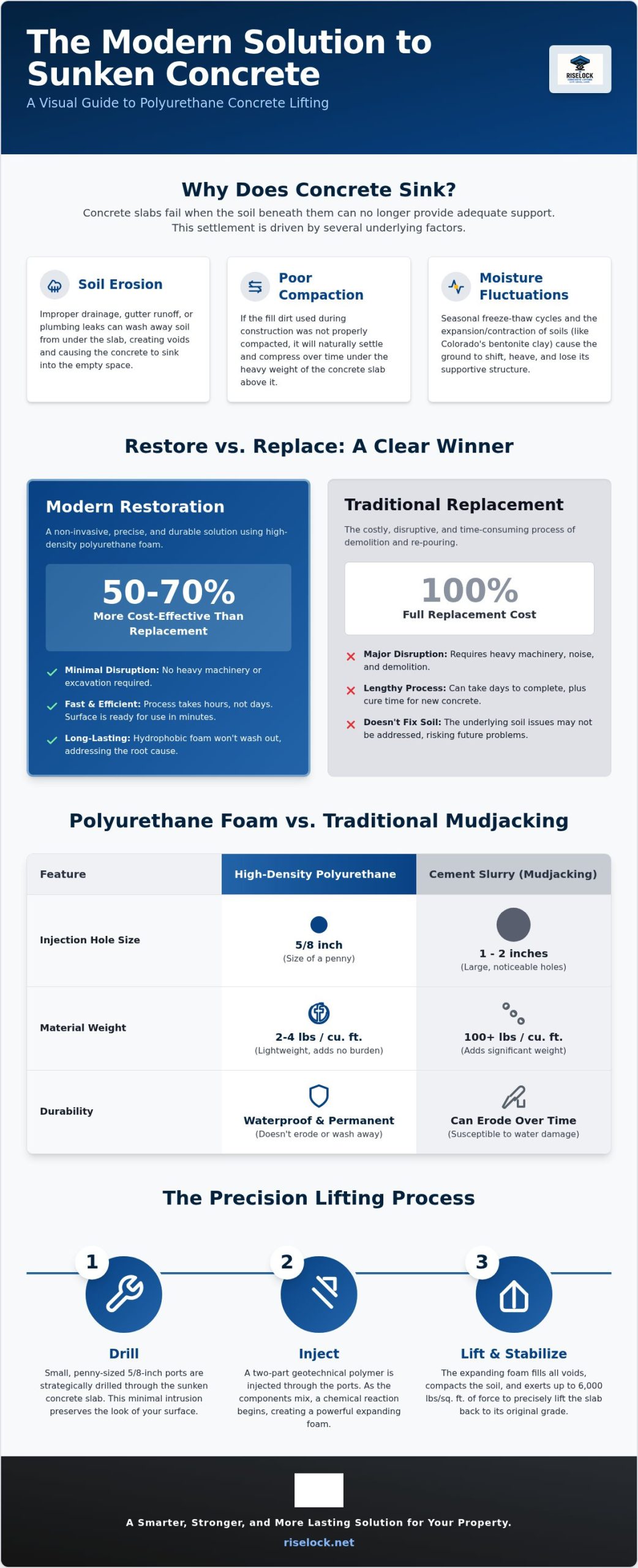
The physics of settlement is driven by three primary factors: soil erosion, compaction, and moisture fluctuations. When the ground beneath a slab can no longer support its weight, the concrete begins to shift or sink. This instability is frequently observed in several high-traffic areas, including:
- Driveways: Heavy vehicle weight accelerates sinking in areas with poor soil support.
- Pool Decks: Constant moisture exposure and drainage issues often lead to significant soil washout.
- Garage Floors: Settlement here can compromise the structural alignment of the entire building.
- Sidewalks: Tree roots and changing moisture levels create dangerous tripping hazards.
The primary mechanism of restoration is “void filling.” By identifying and filling the gaps between the concrete and the soil, we create a solid foundation that prevents further movement and restores the slab’s structural integrity.
The Role of Soil Instability in Concrete Failure
Soil instability is the hidden catalyst for most concrete damage. During initial construction, fill dirt is often moved to level a site; if this soil isn’t compacted with professional precision, it will naturally settle over time under the weight of the concrete. Additionally, “washout” occurs when improper drainage or a leaking pipe carries soil away from beneath the slab. Simply patching the surface with a topical filler does nothing to stabilize the ground. It’s a temporary cosmetic fix that will inevitably fail as the slab continues to settle into the existing void.
The “Replace vs. Restore” Dilemma
When faced with sunken concrete, many owners assume a total replacement is the only solution. However, tearing out old concrete is an intensive process that involves heavy machinery, significant debris, and a high environmental cost. Choosing to restore existing slabs through concrete leveling is often 50-70% more cost-effective than a full replacement. This modern approach saves time and reduces waste while providing a result that is just as durable as new pour. For a deeper look at the financial benefits, see our Concrete Leveling Cost vs. Replacement: A 2026 Homeowner’s Guide.
The Science of Modern Slab Restoration: Polyurethane Foam Injection
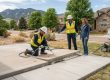
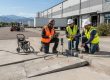
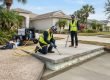
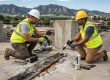
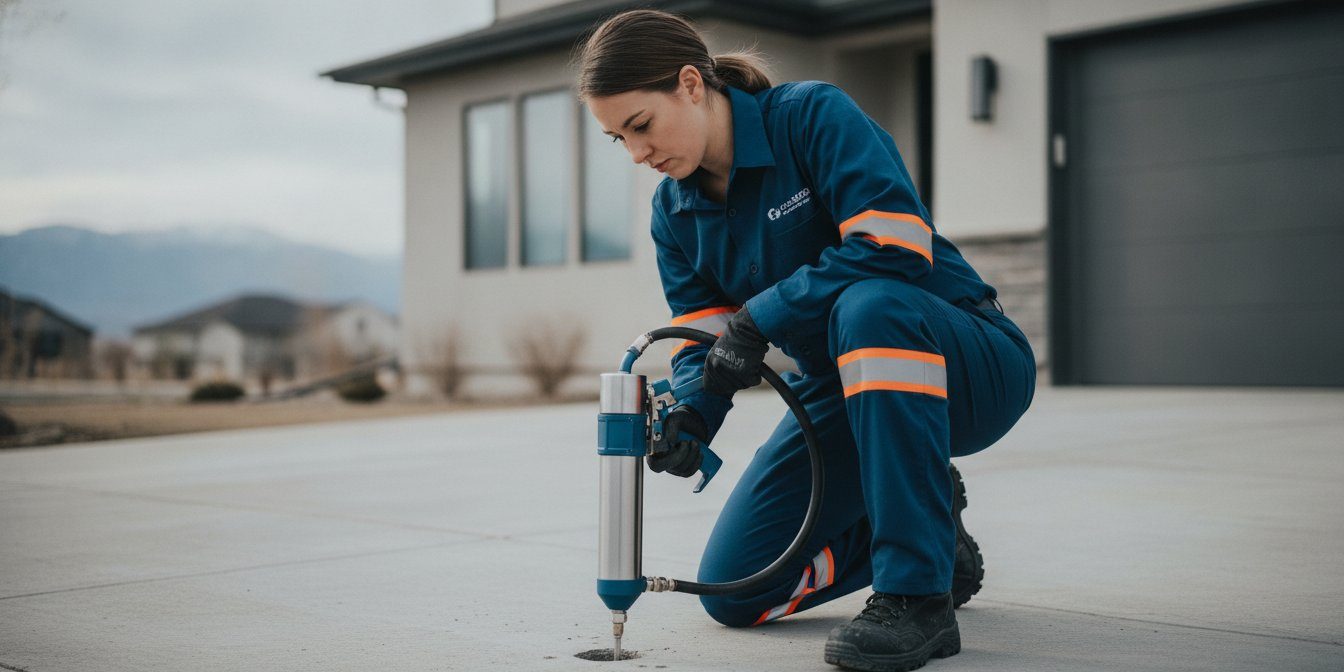
Modern structural repair has evolved beyond the need for heavy machinery and invasive excavation. The process of concrete leveling now relies on polyjacking, a sophisticated method that utilizes high-density geotechnical polymers to lift and stabilize sunken slabs. Technicians begin by drilling small 5/8-inch injection ports through the concrete surface. These holes are roughly the size of a penny, ensuring the aesthetic integrity of the driveway or patio remains intact while allowing for deep structural intervention.
Once the ports are prepared, a two-part polymer is injected beneath the slab. A precise chemical reaction occurs as the components mix, causing the liquid to expand into a rigid, high-density foam. This expansion is powerful enough to exert up to 6,000 lbs of lifting force per square foot, making it capable of raising even the heaviest industrial slabs. Detailed technical evaluations, such as those exploring The Science of Modern Slab Restoration, highlight how this expansion fills every void in the soil profile, creating a uniform foundation that prevents future shifting.
One of the most significant advantages of this material is its hydrophobic nature. Polyurethane is moisture-resistant, meaning it won’t wash away or erode when exposed to groundwater or heavy rain. This creates a permanent barrier that protects the soil from further washout, addressing the root cause of the initial settlement. If you’re concerned about recurring sinking, choosing a specialized approach to concrete leveling can provide the long-term security your property needs. Many homeowners find that partnering with RiseLock for these repairs offers the peace of mind that comes with precision engineering.
High-Density Foam vs. Standard Polymers
Not all polymers are created equal. Professional-grade foam features a closed-cell structure, which is essential for load-bearing applications. Unlike open-cell foams used in insulation, closed-cell geotechnical foam is incredibly dense and does not absorb water. It integrates with the existing soil, binding loose particles together to form a stable, composite base that can withstand decades of traffic and environmental stress.
The Precision Advantage
The speed and accuracy of polyurethane injection are unmatched by older restoration methods. Technicians monitor the lift in real-time, controlling the expansion to within 1/10th of an inch. This level of precision ensures that slabs are perfectly flush, eliminating tripping hazards and improving drainage. Because the foam reaches 90% of its full strength within 15 to 20 minutes, the concrete can be returned to service almost immediately. For a comprehensive look at how this technology is applied, see our Polyurethane Concrete Lifting: The Precision Guide to Modern Slab Restoration.
Polyurethane vs. Traditional Mudjacking: A Comparison of Methods
Choosing between traditional mudjacking and modern polyurethane injection is a decision that dictates the longevity and aesthetic quality of your repair. Mudjacking, a method that has remained largely unchanged for decades, involves pumping a thick slurry of sand, cement, and soil beneath the concrete. This process requires drilling 2-inch holes, which can be visually jarring and may weaken the slab’s structural integrity. In contrast, concrete leveling with polyurethane uses 5/8-inch ports. These smaller entry points are significantly less invasive and much easier to patch discreetly once the lift is complete.
The technical differences extend to the weight and composition of the materials used. Mudjacking slurry is incredibly heavy, typically weighing between 100 and 140 pounds per cubic foot. This adds a massive amount of stress to soil that has already proven it cannot support the weight of the concrete alone. High-density foam weighs only 2 to 4 pounds per cubic foot. By choosing a lightweight material, we avoid the risk of secondary settlement where the repair itself causes the ground to sink further. RiseLock Concrete Lifting exclusively utilizes these modern foam solutions because they offer a permanent, scientifically superior result that protects the client’s property from recurring issues.
Time is another critical factor in the restoration process. Mudjacking requires a cure time of 24 to 72 hours before the surface can withstand traffic. Polyurethane reaches nearly its full strength in 15 to 30 minutes. This efficiency allows homeowners to use their driveways or sidewalks almost immediately after the technicians depart, minimizing the disruption to daily life.
Why Weight Matters for Sunken Slabs
In areas like Aurora and Parker, where soil composition can be unpredictable, the load-bearing capacity of the ground is a primary concern. Adding a heavy cementitious slurry often backfires by compressing the underlying earth even further. Academic research into the performance of polyurethane foams confirms that synthetic polymers provide excellent support without the detrimental weight of organic fill. These polymers don’t break down or erode like the soil-based mixtures used in mudjacking, resulting in a much lower failure rate over the lifespan of the structure.
Cleanliness and Non-Invasive Procedures
The physical footprint of a polyjacking job is remarkably small. While mudjacking often requires large trucks and heavy hoses that can leave slurry splatter on siding or landscaping, polyurethane equipment is contained and precise. The “no mess” benefit makes it the ideal choice for residential concrete leveling. It allows us to work in tight spaces, such as narrow walkways or pool decks, without risking damage to the surrounding environment. This clean, surgical approach reflects our commitment to professional standards and technical mastery.
Identifying Settlement in Colorado: When to Seek Professional Intervention
Colorado’s geology presents a specific set of challenges for structural concrete that property owners in other regions rarely face. The Front Range is characterized by expansive soils, most notably bentonite clay. This soil behaves like a sponge, swelling with significant force when wet and shrinking dramatically during dry spells. This constant subterranean movement creates the voids that lead to sinking slabs, making concrete leveling a necessary maintenance task for many local properties. When the ground beneath a driveway or patio loses its load-bearing capacity, the concrete has no choice but to follow the path of the receding soil.
The climate in Denver and Colorado Springs further complicates this issue through the freeze-thaw cycle. When moisture enters the soil or existing cracks in the concrete, it expands as it freezes. This expansion exerts outward pressure that can heave slabs upward or widen existing fissures. As the ice melts, the concrete often fails to return to its original position, resulting in permanent misalignment. Property owners should monitor their surfaces for specific “Red Flag” symptoms. These include uneven steps that no longer meet the porch flush, visible gaps between garage floors and walls, and exterior doors that stick or fail to latch because the threshold has shifted.
The Denver Metro Soil Challenge
High-alkali soils and clay-heavy ground in Thornton and Arvada are particularly prone to seasonal shifting. Unlike the more stable soils found in the Midwest or Southeast, the High Plains geology is volatile. This volatility often manifests first in transitional areas like garage thresholds or patio joints. If you’ve noticed the floor of your garage dipping away from the stem wall, it’s a clear indicator that the underlying soil has failed. You can find detailed strategies for these specific interior repairs in our guide on Concrete Garage Floor Leveling in Denver: A Guide to Modern Solutions.
Trip Hazard Liability for Property Owners
Beyond the aesthetic decline of your property, uneven concrete poses a genuine safety risk. A vertical displacement of as little as 1/4 inch can be classified as a trip hazard, creating a significant legal liability for both residential and commercial owners. Sidewalks, entryways, and common areas must remain level to ensure safe passage and compliance with local safety standards. Utilizing professional concrete leveling provides a documented fix that insurance providers often recognize as a necessary risk mitigation step. Early intervention is always the most cost-effective path. Addressing a minor settlement today prevents the slab from cracking under its own weight, which would eventually necessitate a far more expensive and disruptive replacement. If you’re concerned about the safety or stability of your concrete, schedule a technical assessment with RiseLock to explore your restoration options.
Choosing a Precision Leveling Partner: The RiseLock Concrete Lifting Standards
Selecting a contractor for structural repair requires more than just comparing estimates. It requires a partner who treats your property’s integrity as a primary priority. At RiseLock Concrete Lifting, we approach every project with a commitment to technical mastery and quiet authority. We avoid hyperbolic claims in favor of grounded, professional reliability. Our team provides comprehensive coverage across the entire Front Range, providing expert intervention for property owners from Boulder to Castle Rock and everywhere between. When you choose a specialist for concrete leveling, you are investing in the long-term security of your home or business.
A professional consultation begins with a methodical site assessment. We don’t simply look at the surface cracks; we analyze drainage patterns, soil conditions, and the specific degree of settlement. This thoroughness allows us to provide a logical, incremental plan for restoration that addresses the root cause of the instability. By understanding the “why” behind the settlement, we ensure that our high-density foam injection provides a permanent solution rather than a temporary fix.
Mastery Beyond Lifting
Many modern foundations and slabs in Colorado utilize specialized reinforcement that requires advanced knowledge to navigate safely. Hiring a professional concrete leveling service means choosing a team that understands the underlying mechanics of your specific slab. This expertise is critical when dealing with post tension installation. If a technician drills into a slab without understanding the location and tension of internal cables, they risk catastrophic structural failure. RiseLock Concrete Lifting brings deep expertise in both lifting and reinforcement to ensure that we protect the integrity of the entire structure during the repair process.
Next Steps for Your Property
Taking action to secure your property is a straightforward and efficient process. Once you request a structural assessment, our experts visit your site to determine the precise volume of polyurethane required and the optimal placement for injection ports. Preparing your property is simple. We only ask that the work area be cleared of debris or movable furniture to allow our technicians full access to the affected slabs. Because our high-density foam reaches 90% of its full strength in roughly 15 to 30 minutes, you won’t have to worry about long-term closures of your driveway or sidewalk. You’ll gain the peace of mind that comes from a RiseLock Concrete Lifting restoration, knowing your property is safe, level, and structurally sound for years to come.
Securing Your Property’s Structural Future
Restoring the safety and alignment of your property doesn’t require the disruption of a full demolition. Modern concrete leveling provides a surgical, long-term solution that addresses the root cause of soil instability without adding unnecessary weight to the foundation. By partnering with RiseLock Concrete Lifting, you ensure a durable repair that withstands Colorado’s unique soil conditions while maintaining the aesthetic value of your home or business.
Early intervention is the most effective way to prevent minor settlement from evolving into a significant structural failure. Our team brings specialized expertise in polyurethane injection and post-tension reinforcement to every project we undertake across the Front Range. We view your structural challenges as our personal priority, offering the technical mastery required for a precise and lasting restoration.
Don’t let sunken slabs compromise your property’s safety or value any longer. Request a Professional Structural Assessment from RiseLock Concrete Lifting today. We’re ready to help you achieve the peace of mind that comes with a stable, level, and secure foundation.
Frequently Asked Questions
Is concrete leveling permanent?
The polyurethane material used in the process is a permanent, non-biodegradable substance that won’t wash away or erode over time. While the foam itself remains stable indefinitely, the longevity of the repair depends on the surrounding soil conditions. By filling voids and stabilizing the ground, we address the primary causes of settlement to ensure the slab remains level for years to come.
How much does concrete leveling cost compared to replacement?
Choosing to restore your surfaces is significantly more cost-effective than a full replacement, often saving property owners between 50% and 70% of the total project cost. Because concrete leveling eliminates the need for demolition, debris removal, and new concrete pours, it reduces both labor and material expenses. This makes it an efficient alternative for those looking to regain structural stability without the high price of a total rebuild.
Can you level concrete in the winter in Colorado?
Yes, we can perform repairs throughout the winter months as long as the ground isn’t frozen deep enough to prevent access to the voids beneath the slab. The chemical reaction that creates high-density foam generates its own heat, allowing it to expand and cure properly even in the cold temperatures typical of Denver and Colorado Springs. This ensures year-round protection for your property.
Will the foam used in concrete leveling harm my landscaping or soil?
The high-density polyurethane we utilize is an environmentally inert material that won’t leach harmful chemicals into your soil or groundwater. Once the foam has cured, it becomes a stable solid that does not react with the environment. The process is also far less invasive than traditional methods, requiring only small injection ports that protect your lawn and landscaping from heavy machinery damage.
How long does the concrete leveling process take from start to finish?
Most residential concrete leveling projects are completed in just a few hours, with even large driveways rarely taking more than a single day. One of the primary advantages of polyurethane is its rapid cure time. Because the material reaches structural strength within 15 to 30 minutes, you can return your driveway or sidewalk to full service almost immediately after our technicians depart.
Can you level a concrete slab that has a post-tension foundation?
Yes, but this specific task requires a contractor with technical mastery of post-tension systems to avoid damaging internal cables. At RiseLock, our background in post-tension installation allows us to locate and avoid these critical structural components during the drilling process. This ensures that the slab is lifted safely without compromising the tensioned cables that provide its internal strength.
What happens if the soil sinks again after the concrete is leveled?
While polyurethane is incredibly durable, it cannot stop the earth from shifting deep beneath the repair site if extreme environmental changes occur. However, because our foam is lightweight, it doesn’t contribute to secondary settlement like heavy mudjacking slurry does. We focus on filling the entire void to create a stable, composite foundation that minimizes the risk of future movement.
Is there a limit to how high a concrete slab can be lifted?
There isn’t a strict physical limit to the height we can achieve, but the condition of the concrete itself often dictates the maximum lift. If a slab is heavily fractured, lifting it several inches may cause additional stress on the cracks. Our technicians monitor the lift in real-time to ensure the slab returns to its original grade while maintaining its structural integrity.