Your concrete isn’t just settling; it’s reacting to the volatile chemistry of Colorado’s expansive soils. When homeowners begin researching concrete slab lifting colorado, they’re usually dealing with the physical evidence of this underground movement. You’ve likely noticed the uneven seams on your driveway or the way water now pools against your foundation after a heavy afternoon storm. It’s frustrating to watch your property’s curb appeal decline while worrying that an expensive total replacement is the only way to eliminate these dangerous trip hazards.
We understand that your home represents both a significant financial investment and a place of safety. This guide demonstrates how modern polyurethane technology provides a surgical, permanent alternative to the disruptive process of tearing out and pouring new slabs. We’ll examine the specific soil mechanics of the Front Range and explain why high-density, hydro-insensitive foam is the most reliable method for restoring long-term structural integrity. You’ll discover how to achieve a level, safe surface and lasting stability without the high costs or the ruined yard associated with traditional construction.
Key Takeaways
- Identify how Colorado’s expansive clay and bentonite soils create subsurface instability that leads to slab settlement.
- Learn why lightweight polyurethane is the superior choice for concrete slab lifting colorado compared to the excessive weight of traditional mudjacking.
- Explore the precision lifting process that utilizes high-density foam and strategic port placement to restore structural integrity.
- Understand the unique risks associated with post-tension slabs and the importance of professional expertise when working near internal cables.
- Determine whether your concrete is a candidate for stabilization using the 80/20 rule for assessing structural soundness.
Why Concrete Slabs Settle in Colorado: The Role of Expansive Soils
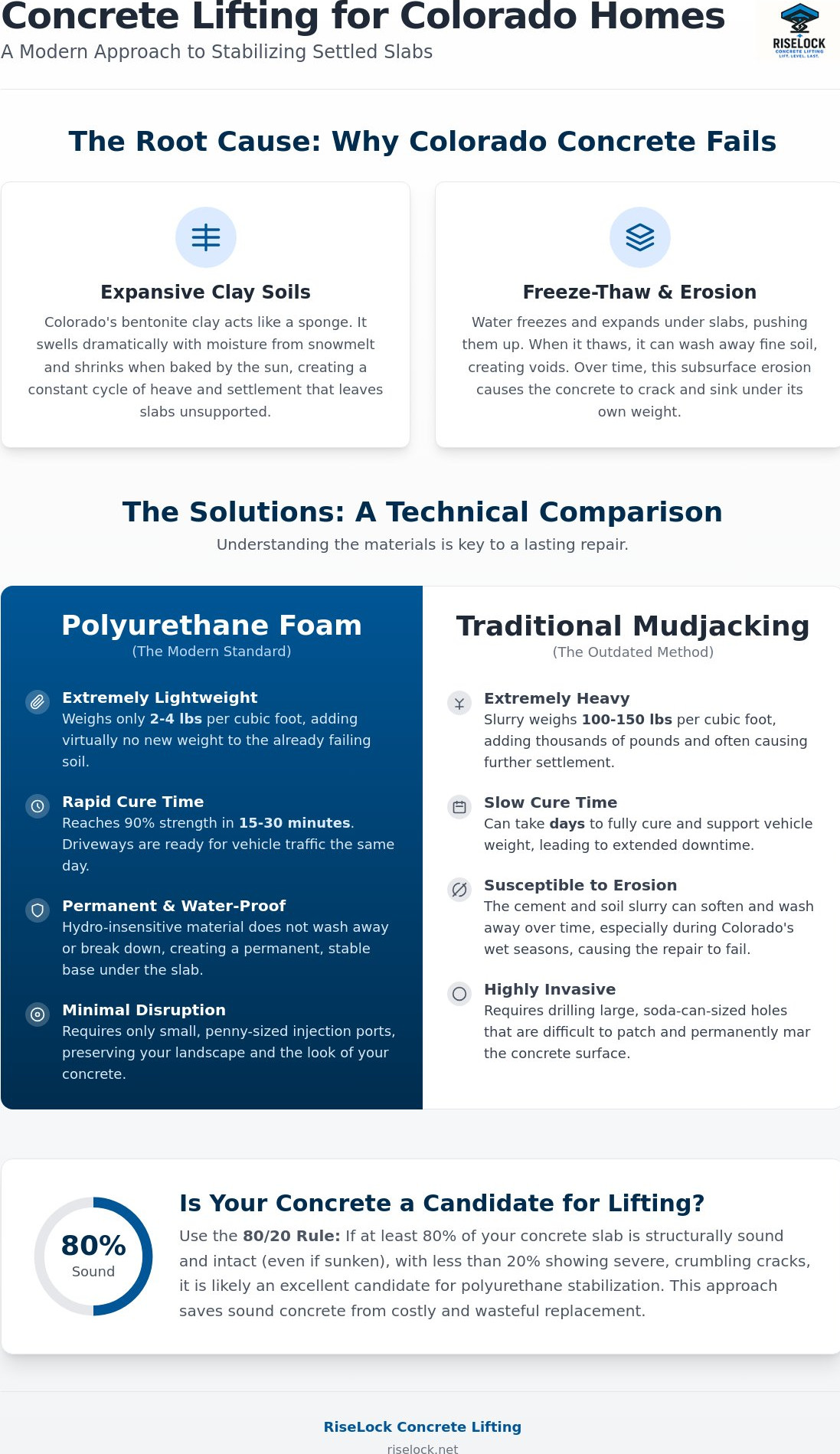
Concrete settlement is rarely a material defect. It’s a subsurface failure where the ground can no longer provide the uniform support required to hold the weight of the slab. In the Rocky Mountain region, this instability is almost always driven by the “Colorado Factor,” which refers to the heavy presence of bentonite and other expansive clay soils. When homeowners search for concrete slab lifting colorado, they’re reacting to a geological process that began long before their home was built. Understanding concrete leveling techniques starts with understanding the volatile earth beneath our feet.
The 300 plus days of annual sunshine in the Front Range play a critical role in this cycle. Intense solar exposure bakes the ground, drawing moisture out of the clay and causing it to contract. When rapid snowmelt occurs, the water finds its way into the resulting gaps, causing the soil to swell with immense force. This “sponge effect” creates a cycle of heave and settlement. Over time, the constant movement leaves the slab suspended over a void or pushed into a position where it can no longer remain level. It’s this specific environmental pressure that makes concrete slab lifting colorado a necessity for maintaining property safety.
The Bentonite Clay Challenge in the Front Range
Bentonite clay is the primary culprit behind structural shifts in our region. This mineral expands significantly when saturated and shrinks as it dries, creating a cycle of instability. New developments in areas like Castle Rock and Aurora are particularly susceptible. When land is graded for new construction, the natural soil structure is disturbed, which allows water to penetrate deeper into the clay layers. In Colorado civil engineering, expansive soil refers to clay-based earth that undergoes dramatic volume shifts through saturation and dehydration, creating enough vertical pressure to displace rigid concrete structures. These shifts eventually create large voids that leave driveways and sidewalks without a foundation.
Freeze-Thaw Cycles and Subsurface Erosion
Colorado’s extreme temperature swings further complicate the issue. When water enters the soil beneath a slab and freezes, it expands, pushing the concrete upward. When it melts, it often carries fine sediment away, especially if the property has poor drainage. This subsurface erosion gradually hollows out the base material. As the supporting earth washes away, the slab eventually cracks under its own weight. This combination of clay movement and erosion requires a specialized response, such as high density foam concrete lifting. This method doesn’t just raise the slab; it fills the voids and stabilizes the soil to prevent the cycle from repeating.
Polyurethane vs. Mudjacking: The Modern Standard for Slab Restoration
Choosing the right restoration method requires a technical understanding of how different materials interact with the ground. Traditional mudjacking relies on a heavy slurry of sand, cement, and soil, a mixture that typically weighs between 100 and 150 pounds per cubic foot. In contrast, the high-density polymers used in concrete slab lifting colorado weigh only 2 to 4 pounds per cubic foot. When you add thousands of pounds of heavy slurry to Colorado’s expansive soils, you often trigger secondary settlement. The already failing soil collapses further under the new weight, which causes the repair to fail within a few seasons.
The chemical properties of polyurethane offer a distinct advantage during Colorado’s wet seasons. Polyurethane is hydro-insensitive, meaning it won’t wash away or lose its structural integrity when the water table rises during spring snowmelt. Unlike mudjacking slurry, which can erode or soften over time, cured foam remains a permanent part of the subsurface. The speed of the process is another technical highlight. While mudjacking requires days to cure before it can support a vehicle, polyurethane reaches nearly 90% of its full compressive strength in about 15 to 30 minutes.
Weight and Load-Bearing Capacity
High-density foam provides impressive load-bearing capacity, frequently exceeding 100 PSI in specialized applications. This strength ensures the material can support heavy vehicles or structural loads without compressing. Because the foam expands up to 20 times its liquid volume, it flows into every crevice of a subsurface void before hardening into a rigid structure. This comprehensive coverage is why it’s the professional choice for sunken driveway repair. It addresses the root cause of the failure without adding unnecessary mass to the foundation.
Non-Invasive Installation: Small Ports vs. Large Holes
Precision is a hallmark of modern restoration. Mudjacking involves drilling 2-inch holes, which are roughly the size of a soda can, into your concrete. These large patches are often visible and can ruin the look of decorative or stamped surfaces. Polyurethane injection uses ports that are only 5/8 of an inch, about the size of a penny. This non-invasive approach preserves the aesthetic value of your property while providing a more durable result. If you’re concerned about the long-term stability of your investment, exploring modern restoration options is a logical next step toward a permanent solution.
The Precision Lifting Process: How High-Density Foam Restores Your Property
Precision in concrete slab lifting colorado isn’t achieved by chance. It’s the result of a methodical, engineering-based approach that prioritizes the structural integrity of the entire property. Unlike traditional methods that focus solely on the visible height of the slab, modern restoration begins with a comprehensive site inspection. This initial step is vital for identifying the root cause of the settlement, whether it’s a localized void or a broader soil failure. Without this diagnostic phase, any repair is merely a temporary fix for a deeper problem.
Once the subsurface conditions are understood, the restoration follows a disciplined four-step protocol:
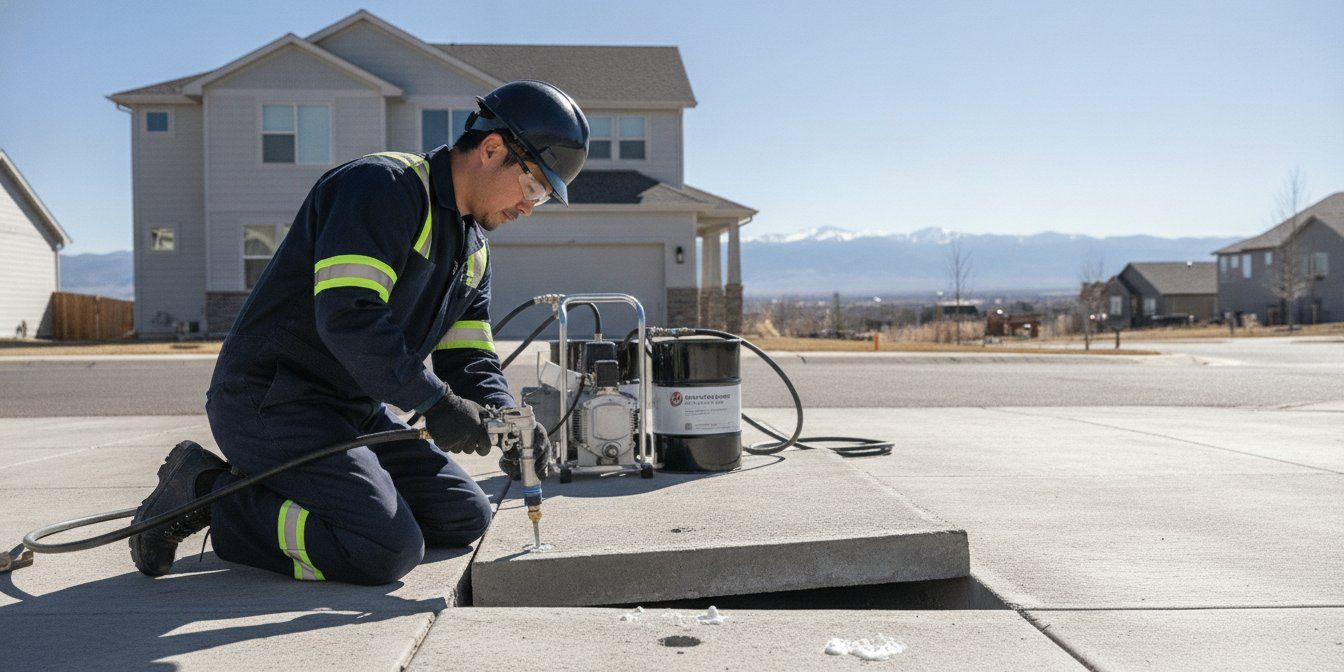
- Strategic Port Placement: Technicians drill penny-sized holes at calculated intervals. These locations are chosen based on the slab’s weight distribution and internal reinforcement to ensure uniform pressure.
- Controlled Injection: A two-part polymer is injected as a liquid. It flows into the smallest crevices before expanding into a rigid, structural foam that provides immediate support.
- Real-Time Monitoring: The lift is monitored constantly. Technicians use laser levels and dial indicators to manage the elevation changes in real time, ensuring a perfectly level finish.
- Joint Stabilization: The final phase involves sealing the injection ports and stabilizing joints to prevent future water intrusion and subsurface erosion.
The Science of Controlled Expansion
The transition from a liquid to a structural solid is a sophisticated chemical reaction. As the two-part polyurethane mixture combines, it expands with enough force to lift thousands of pounds of concrete. This expansion is predictable and controllable, allowing technicians to achieve a lift accurate to within 1/10th of an inch. This level of accuracy is why foam injection concrete leveling is considered the modern standard. It’s especially critical when working with Post-tensioned slabs-on-ground, where the precise placement of injection ports is necessary to avoid damaging the high-tension cables that provide the slab’s internal strength.
Post-Injection Sealing and Aesthetics
A professional repair should be felt, not seen. After the lifting is complete, the injection ports are sealed with a specialized grout that’s color-matched to your existing concrete. This attention to detail ensures the repair is virtually invisible to the naked eye. We also emphasize sealing any existing cracks as a mandatory final step. This prevents the “sponge effect” mentioned earlier by keeping water from reaching the soil. By closing these entry points, we protect the new foundation and extend the lifespan of your concrete for years to come.
Beyond the Surface: Post-Tension Slabs and Structural Integrity
Post-tension (PT) slabs are a standard foundation choice across the Front Range because of their ability to withstand the soil volatility discussed earlier. These slabs use high-strength steel cables, or tendons, that are tensioned to thousands of pounds of pressure after the concrete cures. This internal compression allows the slab to act as a single, rigid unit that resists the heave and shrink of expansive clay. However, this specialized design introduces significant complexity when performing concrete slab lifting colorado. A standard lifting procedure that ignores the presence of these cables can lead to catastrophic structural failure.
Drilling into a post-tension cable is one of the most dangerous errors a contractor can make. If a tendon is severed or nicked, the stored energy is released instantly, which can cause the cable to “blow out” through the surface of the concrete or the edge of the foundation. This doesn’t just ruin the slab; it compromises the safety of the entire structure. Identifying signs of PT cable failure is essential during the initial inspection. We look for “popped” anchor covers, grease weeping from cracks, or localized heaving, which may indicate that a cable has already lost its tension alongside the visible settlement.
Safe Drilling Practices for Reinforced Concrete
Precision is mandatory when working with reinforced foundations. To maintain safety, we utilize Ground Penetrating Radar (GPR) to map the exact location of internal tendons before a single hole is drilled. This technology allows our technicians to see through the concrete, ensuring that injection ports are placed safely between the cable runs. Our deep background in post tension installation provides a unique advantage here. We don’t just lift the concrete; we understand the internal physics of the slab and how to preserve the tension health of the reinforcement system during the restoration.
When Leveling Becomes a Structural Necessity
While some homeowners view leveling as an aesthetic choice, it’s often a structural requirement for PT slabs. When a foundation settles unevenly, the slab begins to bend. This creates shear forces that the internal cables were not designed to handle. Over time, this stress can lead to fractures that allow moisture to reach the tendons, causing corrosion and eventual failure. Preventative lifting using professional polyurethane concrete lifting restores the uniform support the slab needs. By returning the concrete to its original grade, we eliminate the torque on the post-tension system and secure the long-term stability of the home.
If you suspect your post-tension foundation is settling, it’s critical to partner with a specialist who understands the risks of reinforced concrete. Contact our structural team for an expert assessment of your slab’s integrity and a precision restoration plan.
Evaluating Your Concrete: Repair, Stabilize, or Replace?
Determining whether to restore or replace a sinking slab is a critical decision for any property owner. We often apply the 80/20 rule in our assessments: if 80% of the concrete surface remains structurally sound and free of major fractures, concrete slab lifting colorado is typically the most efficient and cost-effective path. When the underlying issue is poor soil support rather than a material failure of the concrete itself, lifting provides a permanent correction without the disruption of a full demolition and pour.
Restoration also offers a significant return on investment by extending the lifespan of existing infrastructure. Replacing a driveway or patio involves heavy machinery, high labor costs, and significant downtime. In contrast, polyurethane stabilization allows for immediate use of the surface. From an environmental perspective, lifting is the responsible choice. It prevents tons of reusable concrete from ending up in local landfills and avoids the high carbon footprint associated with the production and transport of new cement.
The “Is It Worth It?” Checklist
Before committing to a project, it’s helpful to gauge the physical state of the slab. Consider these criteria to determine the viability of restoration:
- Slab Integrity: If the concrete is in one or two large pieces that have simply tilted or sunk, it’s an ideal candidate for lifting.
- Surface Condition: If you see “alligatoring,” which is a network of small, deep cracks, or severe spalling where the top layer is crumbling away, the concrete has likely reached the end of its service life.
- Structural Impact: If the settlement is causing secondary damage to your home’s foundation or framing, you should prioritize concrete slab lifting colorado to stabilize the structure immediately.
Long-Term Maintenance After Lifting
A successful lift is only the first step in a long-term stabilization strategy. Because water is the primary driver of soil movement in the Front Range, managing drainage is essential. Ensuring that gutters have proper extensions and that the soil grades away from the slab will protect the new polyurethane foundation. Polyurethane lifting is a permanent solution because the material doesn’t degrade or wash away, but keeping the surrounding environment stable ensures the best results. If you’re unsure about the condition of your slabs, a technical assessment is the most reliable way to move forward. Request a professional evaluation from RiseLock to determine the best solution for your property.
Securing Your Property’s Structural Future
Addressing slab settlement is about more than aesthetics; it’s a necessary investment in the safety and longevity of your home. We’ve explored how Colorado’s volatile soils necessitate a specialized approach that prioritizes lightweight, high-density materials over traditional, heavy slurry. By choosing modern polyurethane systems, you bypass the secondary settlement issues common with older methods and ensure your post-tension slabs remain structurally sound. This precision-based restoration stops the cycle of erosion and provides a foundation that can withstand the Front Range’s unique environmental pressures.
RiseLock brings quiet authority and technical mastery to every restoration project. As specialists in both post-tension and polyurethane systems, we serve the entire Front Range from Fort Collins to Colorado Springs. We view your structural challenges as our personal priority, providing the precision required to restore your property’s value and your peace of mind. Don’t let subsurface voids compromise your investment. Get Your Free Precision Concrete Evaluation today to see how concrete slab lifting colorado can provide the permanent security your property deserves. We look forward to helping you restore a level, safe surface to your home.
Frequently Asked Questions
How much does concrete slab lifting cost in Colorado?
The cost of concrete restoration is determined by the size of the slab, the volume of the subsurface void, and the complexity of the site’s geological conditions. Every project requires a unique technical approach based on the extent of the settlement and the weight of the concrete structure. While lifting is consistently more economical than a full tear-out and replacement, we recommend a professional site evaluation to provide an accurate assessment based on your property’s specific structural needs.
Is polyurethane foam concrete lifting permanent?
Polyurethane foam lifting is a permanent solution because the high-density polymer is hydro-insensitive and does not degrade over time. Unlike traditional slurry mixtures that can erode or shrink when exposed to moisture, cured foam remains a stable, rigid part of the subsurface foundation. Its ability to bond with the soil and fill every crevice ensures that the slab remains supported even when subjected to the Front Range’s significant temperature swings and moisture cycles.
How long does the concrete lifting process take?
Most residential concrete slab lifting colorado projects are completed within a few hours. A standard driveway or patio restoration typically takes between two and four hours from the initial site preparation to the final sealing of the injection ports. This efficiency is a hallmark of modern restoration technology. It allows homeowners to avoid the lengthy timelines and significant property disruption associated with traditional construction or mudjacking methods.
Can you lift a concrete slab in the winter in Colorado?
Restoration can be performed during the winter months provided the ground is not deeply frozen and the subsurface is accessible. Our technicians utilize specialized heating equipment to maintain the proper chemical temperature of the polymers during the injection process. While extreme weather may occasionally require rescheduling, the controlled expansion of polyurethane makes it a viable option for year-round stabilization in many Colorado environments.
What is the difference between mudjacking and polyjacking?
The primary distinction is the weight of the material and the impact on the underlying soil. Mudjacking uses a heavy mixture of sand and cement that can weigh over 100 pounds per cubic foot, which often causes secondary settlement in weak soils. Polyjacking, or foam lifting, uses a lightweight material weighing only 2 to 4 pounds per cubic foot. Polyjacking also requires significantly smaller injection holes, preserving the aesthetic quality of your concrete.
Will concrete lifting fix the cracks in my driveway?
Lifting restores the level of the slab and often brings fractured pieces closer together, but it does not remove the physical cracks. The process focuses on stabilizing the foundation rather than resurfacing the material. After the lift is complete, we emphasize the importance of sealing all cracks. This final step is essential for preventing water from reaching the soil and causing the “sponge effect” that leads to future instability.
Can you drive on the concrete immediately after it is lifted?
You can typically return the surface to vehicle traffic within 15 to 30 minutes of the completed injection. High-density polyurethane reaches nearly 90% of its full structural compressive strength almost instantly. This rapid cure time is one of the most practical advantages of the system. It eliminates the long waiting periods required for new concrete pours, ensuring that your driveway or garage remains accessible throughout the day.
Does concrete lifting work on all types of soil?
High-density foam is effective in a wide range of geological conditions, including the expansive clay and bentonite soils prevalent in Colorado. The liquid polymer expands to fill the specific geometry of any subsurface void, consolidating loose soil and creating a stable, lightweight base. This versatility makes it an ideal solution for the diverse and often volatile soil chemistries found across the Front Range and mountain communities.