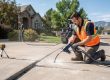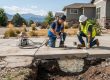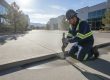
A sinking garage floor isn’t just a cosmetic annoyance; it’s a structural warning sign that could compromise your home’s integrity and safety. When homeowners begin researching the cost to level a garage floor Castle Rock, they often find that the price of delay is far higher than the price of professional intervention. You’ve likely noticed your garage door no longer seals against the pavement or a growing trip hazard has appeared at the driveway seam. It’s frustrating to watch a major part of your home settle, especially when you’re worried about the underlying foundation or the weight of your vehicles on a hollow slab.
We understand that structural issues feel personal and urgent. This guide provides clarity on the variables that dictate repair costs in Douglas County and explains why modern polyurethane injection is the most resilient choice for our region’s unique geological challenges. We’ll examine the impact of the Palmer Divide’s expansive soils, compare the long term value of stabilization versus replacement, and help you navigate the 2026 building code updates. By the end, you’ll have the technical insight needed to secure your property for the long term.
Key Takeaways
- Understand how the unique geology of the Palmer Divide and expansive clay soils specifically contribute to garage floor settlement in Castle Rock homes.
- Learn why high-density polyurethane foam is the technically superior choice for Colorado’s climate, offering a lightweight alternative that won’t further compress unstable subsoils.
- Identify the specific variables that influence the total cost to level a garage floor Castle Rock, including the degree of the slab drop and the volume of void filling required.
- Compare the long-term ROI of precision leveling against the high expense and lengthy downtime associated with full concrete demolition and replacement.
- Discover the importance of professional stabilization that accounts for post-tension cable systems and modern 2026 building code requirements.
Understanding Garage Floor Settlement in Castle Rock
Garage floors in Castle Rock face a specific set of environmental pressures that differ from the rest of the Front Range. The town’s location at an elevation of over 6,200 feet puts it directly on the Palmer Divide, a geological ridge that influences local weather and soil composition. This positioning results in a high concentration of bentonite clay, a material notorious for its expansive properties. Expansive soil is the primary cause of slab settlement in Castle Rock.
The Palmer Divide Effect on Douglas County Slabs
The Palmer Divide acts as a weather breaker, often trapping moisture and causing more frequent precipitation than in nearby Denver. When the local bentonite clay absorbs this moisture, it expands with immense hydraulic pressure, pushing upward on concrete. Conversely, during dry spells, the soil shrinks away, leaving the slab unsupported. This constant movement makes concrete leveling a technical necessity rather than a cosmetic luxury. Because these soils are so reactive, any stabilization method must be lightweight and high-density to ensure it doesn’t add more weight to the already stressed sub-grade.
Castle Rock experiences over 100 freeze-thaw cycles annually. When water enters the soil through cracks or poor perimeter drainage, it freezes and expands, physically lifting the concrete. When it melts, the soil often washes away or settles further, creating voids. Over time, the cumulative impact of these cycles, combined with the weight of heavy vehicles, causes the floor to drop. This is why understanding the factors behind the cost to level a garage floor Castle Rock starts with a thorough soil and site analysis.
Early Warning Signs of Garage Floor Failure
Identifying settlement early can prevent more significant structural damage to the garage’s framing. Homeowners should look for these indicators of sub-grade erosion or soil movement:
- Wall Gaps: Visible separation between the concrete floor and the bottom of the drywall or framing.
- Door Misalignment: A garage door that no longer creates a tight seal against the floor, allowing light or drafts into the space.
- Spiderweb Cracking: Patterns that indicate the slab is bending over a hollow void rather than sitting on solid earth.
- Water Pooling: Moisture that collects in the center of the garage rather than draining toward the driveway.
If you notice water pooling or cracks widening after a heavy rain, it’s a sign that the drainage around your garage perimeter is likely failing. Addressing these issues before the next winter cycle is critical to maintaining the structural integrity of your home.
Polyurethane Foam vs. Mudjacking for Garage Slabs
Choosing the right restoration method is the most critical decision affecting the long term cost to level a garage floor Castle Rock. While traditional mudjacking has been used for decades, it’s often a poor match for the geological realities of Douglas County. Polyurethane concrete lifting, often called polyjacking, represents a structural grade evolution in slab repair. This method utilizes a high density expanding foam that targets the root cause of settlement without adding unnecessary burden to the sub-soil.
Precision is one of the primary technical advantages of foam. Because the material expands chemically and sets rapidly, technicians can lift a slab to within 1/10th of an inch. This level of accuracy is vital for garages where a fraction of an inch determines whether a garage door seals properly against the weather or leaves a gap for pests and moisture. Additionally, polyurethane is naturally hydrophobic. It won’t wash away during heavy Colorado snowmelts, and it actually displaces standing water in the voids beneath your floor.
Why Weight Matters in Garage Leveling
The weight of the repair material significantly impacts the stability of the repair. Traditional mudjacking uses a heavy slurry of sand, cement, and soil that can weigh over 100 pounds per cubic foot. In the expansive clay soils identified by the Web Soil Survey as prevalent in Castle Rock, adding this much weight often causes the soil to compress further, leading to secondary settlement. It’s a counterproductive cycle that often leads to the same structural failure within a few years.
In contrast, high density polyurethane concrete lifting material weighs only 2 to 4 pounds per cubic foot. Despite its light weight, it possesses the compressive strength required to support heavy modern vehicles, such as full sized SUVs and trucks, without re-settling. This makes it a superior investment for homeowners who prioritize structural longevity and technical mastery over temporary fixes.
The “Cure Time” Advantage for Homeowners
Efficiency is a hallmark of modern restoration. Mudjacking requires several days of drying time before you can park on the surface, creating a significant disruption to your daily routine. Polyurethane foam cures almost instantly. Most garage floors are ready for full vehicle traffic within 15 to 30 minutes after the injection is complete. You don’t have to leave your cars on the street for a week waiting for the slurry to harden.
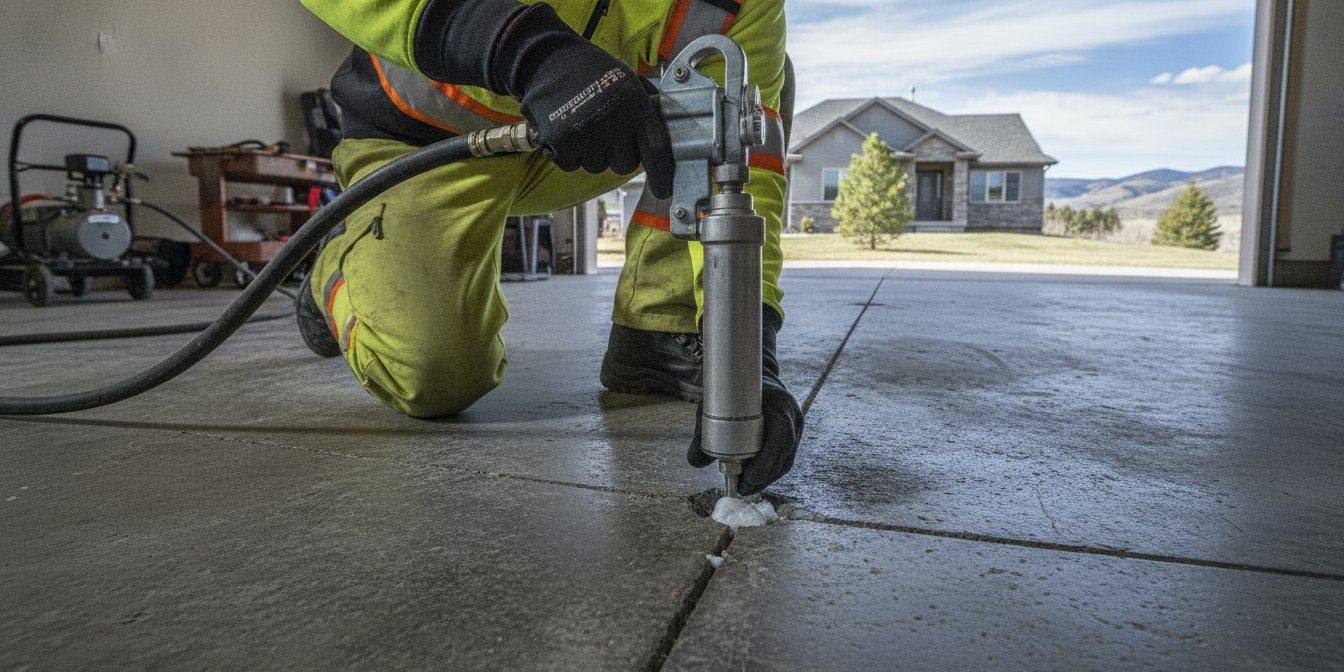
The installation process is also far less invasive. We utilize small 5/8-inch holes, roughly the size of a penny, to inject the foam. This contrasts with the large, unsightly 2-inch holes required for mudjacking slurry. Because the equipment is contained and the material is injected directly, there is no messy cleanup or heavy machinery tracks left on your driveway. If you’re ready to restore your garage with professional reliability, consult with a specialist to evaluate your slab’s unique needs.
Factors Influencing the Cost to Level a Garage Floor
Determining the cost to level a garage floor Castle Rock requires a detailed analysis of both visible damage and hidden geological variables. Unlike a simple driveway repair, garage slabs often support significant structural weight and are tied into the home’s foundation or post-tension systems. The total investment for a project is rarely a fixed fee; instead, it’s calculated based on the technical requirements of the specific site. Factors such as the degree of the slab drop, the accessibility of the injection points, and the condition of the underlying soil all play a role in the final project scope.
Accessibility is a frequently overlooked variable. If a garage is cluttered or has built-in cabinetry that obstructs the perimeter where the slab has settled, the time required for equipment setup increases. Furthermore, if the sub-grade soil is exceptionally “weak” or saturated, we may need to perform deep-soil stabilization before the actual lift can occur. This ensures that the newly leveled floor has a solid, compacted base that won’t immediately fail when a heavy vehicle is parked on it.
Estimating Material Usage and Void Volume
The most significant cost driver in polyurethane concrete lifting is the volume of material required. There is a technical distinction between “lifting” and “void filling” that homeowners should understand. Lifting uses the expansive pressure of the foam to move the slab back to its original position. Void filling, however, involves pumping material into the hollow spaces created by soil erosion or shrinkage. A slab that has dropped only two inches might still have a massive eight-inch deep void beneath it. Professional site assessments use specialized tools to detect these hollows, as failing to fill them completely leads to structural instability.
Material density also changes based on the required lift. In the high-altitude environment of Douglas County, we use specific structural-grade foams that maintain their integrity despite temperature fluctuations. While a deeper drop naturally requires more material, it also requires a more methodical injection pattern to prevent the slab from cracking under the pressure of the lift. This precision engineering ensures a uniform result that protects the floor’s long-term durability.
Typical ROI and Value in Castle Rock (2026)
When evaluating the financial side of concrete repair, it’s helpful to look at the long-term return on investment. Industry data indicates that professional concrete leveling cost vs replacement analysis typically shows leveling to be up to 70% more affordable than a full tear-out. Polyjacking often carries a higher upfront cost than mudjacking due to the sophisticated nature of the polyurethane polymers. However, the durability of foam in Castle Rock’s expansive clay means you aren’t paying for the same repair again in three years.
For homeowners with three-car garages or complex drainage issues, the value of polyurethane becomes even clearer. It provides a permanent solution that addresses the root cause of the settlement. By choosing a high-precision method, you’re investing in the structural security of your home and avoiding the messy, expensive, and time-consuming process of concrete demolition.
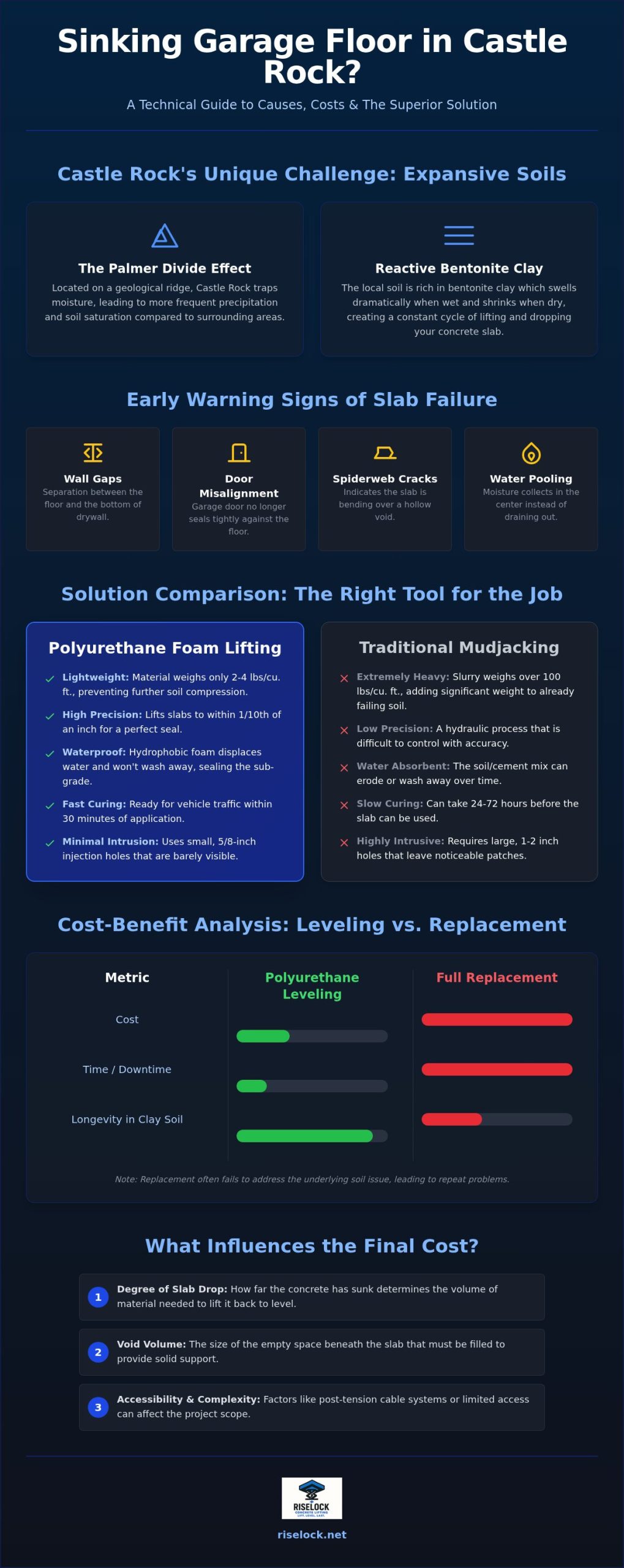
Leveling vs. Replacement: A Cost-Benefit Analysis
Choosing between restoration and replacement requires an honest assessment of the slab’s structural health. While the initial cost to level a garage floor Castle Rock is significantly lower than a full tear-out, the decision shouldn’t be based on price alone. Replacement involves hidden expenses that many contractors fail to mention during the initial quote. You aren’t just paying for new concrete; you’re paying for the demolition of the old slab, the hauling of heavy debris to local landfills, and the installation of new reinforcement such as rebar or wire mesh. These logistical hurdles can easily triple the total project budget.
Time is another critical factor. A professional polyurethane leveling project typically takes about four hours from setup to completion. In contrast, a full replacement requires a minimum of seven to ten days for the new concrete to cure sufficiently to support a vehicle. Perhaps most importantly, pouring new concrete does not solve the underlying soil issues discussed in previous sections. If the expansive clay remains unstable, the new, heavier slab will likely begin to sink within a few years, forcing you to repeat the entire expensive process. Restoration via high-density foam addresses the soil voids directly, providing a much more sustainable solution.
When is a Garage Floor Too Far Gone?
There are technical limits to what leveling can achieve. If your garage floor exhibits “spiderweb” cracking, where the concrete has disintegrated into small, disconnected pieces, the structural integrity of the slab is likely lost. In these cases, the concrete lacks the strength to be lifted as a single unit. We generally advise replacement if the cost of professional leveling approaches 70% of the cost of a new slab. However, many modern homes in Douglas County utilize post-tension cable systems within the garage floor. Cutting into these slabs for a replacement is a high-risk, high-cost operation that requires specialized engineering, making precision leveling an even more attractive alternative for these specific properties.
Long-Term ROI: Stabilization is Key
Investing in stabilization protects more than just your garage floor. A sinking slab often pulls on the home’s foundation or creates stress on the framing of the garage walls. By restoring the floor to its original height, you prevent secondary structural damage that could cost tens of thousands of dollars to remediate. For homeowners looking to sell, a level and stable garage floor is a significant asset in the Castle Rock real estate market, as it signals to buyers that the home has been meticulously maintained. High-density polyurethane acts as a permanent moisture barrier that prevents future soil erosion beneath the concrete. If you are unsure whether your slab can be saved, schedule a professional structural assessment to determine the most reliable path forward.
The RiseLock Approach: Precision Engineering for Slabs
RiseLock Concrete Lifting views every restoration project as a precision engineering mission rather than a simple repair. We don’t just pump material under a slab; we restore the structural balance of your home’s entry point. Our commitment to technical mastery means we prioritize long-term stability over the quick, temporary fixes often found in the industry. This is why we refuse to utilize outdated mudjacking methods. The heavy slurry used in mudjacking is fundamentally incompatible with the expansive clay soils of Douglas County, and we believe it’s ethical to provide a service that we know is likely to fail as the sub-grade compresses under the extra weight.
Our process is methodical and data-driven. We begin with professional laser leveling to identify the exact degree of the drop and the location of underlying voids. This accuracy ensures that the cost to level a garage floor Castle Rock reflects a solution tailored to your home’s specific geography. Once the injection points are mapped, our technicians use high-density polyurethane to lift the slab with surgical precision. The project concludes with a thorough cleanup, leaving your garage floor stable, level, and ready for use in minutes.
Structural Mastery and Post-Tension Integrity
Many modern homes in Castle Rock are constructed with post-tension slabs, which contain high-strength steel cables under immense tension. Drilling into these slabs without specialized knowledge is extremely dangerous and could compromise the entire structural reinforcement of your floor. Because RiseLock Concrete Lifting also specializes in post tension installation, our team possesses a deep understanding of the internal anatomy of these systems. We ensure that every injection hole is placed with absolute awareness of the cable layouts, protecting your home’s foundation while we restore the surface.
This level of expertise is what separates a professional restoration from a standard concrete patch. We understand how the slab interacts with the perimeter footings and the garage walls. By maintaining the integrity of the reinforcement while we lift, we provide a repair that respects the original engineering of your home. It’s a sophisticated approach that prioritizes safety and structural longevity above all else.
The Peace of Mind Warranty
A professional warranty in an expansive soil region like the Palmer Divide must be more than just a piece of paper. It should be a reflection of the contractor’s confidence in their technical execution. Our authoritative approach and use of structural-grade polymers result in significantly fewer call-backs compared to traditional methods. We don’t just aim to fix the floor for today; we aim to stabilize it against the environmental pressures of high-altitude freeze-thaw cycles and soil movement. This commitment to quality gives our clients the long-term security they deserve when investing in their property’s infrastructure.
If you’ve noticed your garage floor beginning to settle or pull away from the walls, don’t wait for the damage to spread to your home’s foundation. Taking action now can prevent the need for a full, expensive replacement. Schedule your professional garage floor assessment with RiseLock Concrete Lifting today to receive a precise evaluation of your slab’s needs.
Protecting Your Property with Precision Stabilization
Addressing a sinking garage slab is a critical step in maintaining your home’s structural integrity against the unique pressures of the Palmer Divide. We’ve examined why the cost to level a garage floor Castle Rock represents a strategic investment in long-term stability, particularly when compared to the high expense and disruption of full concrete replacement. By choosing high-density polyurethane, you aren’t just lifting a slab; you’re installing a lightweight, hydrophobic barrier that actively resists the expansive clay soils common in Douglas County.
RiseLock brings a high level of technical mastery to every project, serving as specialists in both polyurethane concrete lifting and post-tension cable systems. Our expertise ensures that your repair is handled with the precision required for modern Colorado homes, providing a level of reliability that traditional mudjacking simply cannot match. We’re proud to serve Castle Rock and the broader Front Range with solutions that prioritize your peace of mind and your home’s security. Don’t let minor settlement turn into a major foundation issue. Get a Professional Concrete Leveling Estimate in Castle Rock today and restore the safety and function of your garage floor.
Frequently Asked Questions
How much does it typically cost to level a garage floor in Castle Rock?
The cost to level a garage floor Castle Rock is determined by the size of the area and the depth of the voids beneath the concrete. Every project is unique; some require minimal material for a slight lift, while others need significant void filling to stabilize the sub-grade. We focus on providing a thorough site assessment to identify these variables, ensuring the solution addresses the specific geological challenges of your property.
Is polyurethane concrete leveling better than mudjacking for heavy vehicles?
Polyurethane is far more effective than mudjacking for supporting heavy vehicles like trucks and SUVs. It offers high compressive strength while remaining incredibly lightweight, so it doesn’t add extra weight to the expansive clay soils in Douglas County. This prevents the secondary settlement often caused by heavy mudjacking slurries. The material is also hydrophobic, meaning it won’t wash away or degrade when exposed to moisture beneath your garage floor.
How long does the garage leveling process take?
Most garage leveling projects are completed in roughly four hours. Our technicians use a methodical process to drill small ports, inject the foam, and monitor the lift with laser precision. Unlike new concrete, which takes over a week to cure, polyurethane is ready for vehicle traffic in just 15 to 30 minutes. This speed allows you to regain full use of your garage on the same day the repair is performed.
Will my garage floor sink again after being leveled?
Our leveling process is designed for long-term stability by targeting the root cause of the drop. We use high-density foam to fill voids and compact the soil, creating a solid base that resists future movement. While the Palmer Divide’s intense freeze-thaw cycles are a constant factor, polyurethane is a permanent material that doesn’t shrink or erode. Maintaining proper drainage around your garage perimeter further ensures the slab stays level for years to come.
Can you fix a garage floor if it has a post-tension slab?
Yes, we can safely fix post-tension slabs because of our specialized expertise in their installation and maintenance. These slabs contain high-tension cables that must not be damaged during the repair process. Our team understands the internal anatomy of these systems, allowing us to place injection ports with absolute precision. We ensure your garage floor’s structural integrity remains intact while we restore it to its original, level height.
Do I need to move everything out of my garage before you level the floor?
You don’t need to empty the entire garage, but we do require access to the areas where the slab has settled. We recommend moving vehicles and clearing items from the perimeter or any cracks where we may need to drill injection ports. If you have heavy built-in cabinets or machinery on the sinking section, we’ll discuss the best approach during your assessment to ensure a safe and thorough restoration.
Is a permit required for concrete leveling in Castle Rock or Douglas County?
Standard concrete leveling projects usually don’t require a permit in Castle Rock or Douglas County. However, for significant structural work, it’s important to adhere to the building code amendments that took effect on June 30, 2026. We always operate with professional reliability and can guide you on whether your specific stabilization project needs to be coordinated with the local building department or your neighborhood’s HOA regulations.
What happens if I don’t fix my sinking garage floor?
Delaying a repair can lead to more serious foundation damage and higher restoration costs. A sinking floor often creates gaps that allow water to pool against your home’s structure, which accelerates soil erosion and settlement. You might also notice your garage door failing to seal, creating a security risk and allowing pests to enter. Addressing the issue early prevents the slab from disintegrating to a point where replacement becomes the only option.