A sinking garage floor is rarely just a cosmetic inconvenience; it’s a structural warning sign that the expansive clay soils beneath your home are shifting. You’ve likely noticed the telltale cracks, the pooling water after a storm, or a growing gap where the slab meets the wall. These tripping hazards create genuine anxiety about the long-term safety of your foundation. If you’re searching for concrete garage floor leveling denver, you probably want a solution that doesn’t involve weeks of dust and heavy machinery. It’s frustrating to watch your property value dip because of a problem hidden deep underground.
We understand that your home is your most significant investment, and structural repairs should be handled with surgical precision rather than brute force. This guide explains why Denver’s unique geology causes slabs to settle and how modern high-density polyurethane provides a permanent, non-invasive remedy. You’ll discover how we address the root cause by filling soil voids to ensure long-term stability. We’ll also walk through the technical advantages of foam concrete lifting, a process that leaves your floor ready for use in hours, not days, while complying with the latest 2025 Denver Building and Fire Codes.
Key Takeaways
- Understand how Denver’s expansive bentonite clay and seasonal moisture cycles create the underground voids responsible for sinking slabs.
- Compare the technical advantages of high-density polyurethane against traditional methods for concrete garage floor leveling denver.
- Learn why identifying post-tension slabs is vital for safety and structural integrity during any restoration project.
- Explore the non-invasive injection method that stabilizes your foundation without the mess or downtime of major construction.
- Discover how modern solutions address root-cause soil issues to provide long-term security for your home’s structure.
Understanding Why Denver Garage Floors Sink and Settle
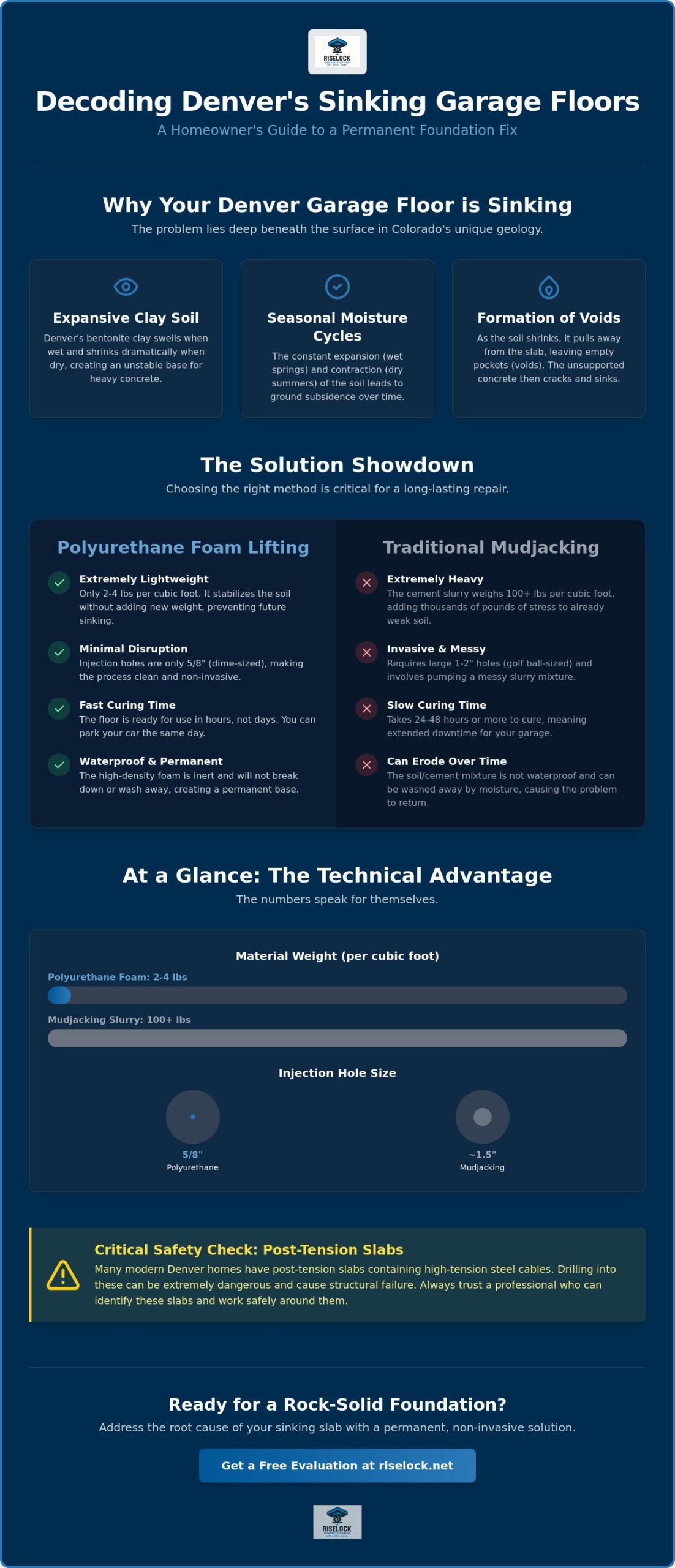
Denver’s geological profile presents unique challenges for residential construction. The region sits atop the Denver Basin, an area characterized by high concentrations of bentonite clay. This specific type of soil is highly expansive, meaning it undergoes significant volume changes based on moisture content. When the clay absorbs water during Colorado’s wet spring seasons, it swells with immense pressure. Conversely, during dry summer months or periods of drought, the soil shrinks and pulls away from the concrete. This constant movement destabilizes the foundation of your home, eventually leading to the need for professional concrete garage floor leveling denver.
The Impact of Colorado Soil on Concrete Longevity
Homeowners in Aurora and Centennial often notice the first signs of settlement as small gaps between the garage floor and the stem wall. These aren’t just cosmetic flaws; they are indicators of soil subsidence. In the context of Colorado residential garages, soil subsidence is the downward shifting of the ground surface caused by the contraction of underlying clay layers or the erosion of poorly compacted fill. As the soil retreats, it leaves behind empty pockets or “voids.” Without the support of the earth beneath it, the heavy concrete slab inevitably cracks under its own weight or the weight of your vehicles.
The cycle of expansion and contraction doesn’t just move the slab; it weakens the entire structural ecosystem of the garage. You might see:
- Cracks that widen during the winter and narrow in the summer.
- A “hollow” sound when you walk over certain sections of the floor.
- The slab pulling away from the interior threshold of the house.
These symptoms confirm that the soil can no longer support the load it was designed to carry.
Surface Leveling vs. Structural Lifting
Many people attempt to fix these issues with self-leveling overlays or “patches” applied to the top of the concrete. While these products might temporarily hide a crack, they fail to address the root cause. Adding a layer of heavy material on top of a sinking slab actually increases the load on the already compromised soil, often accelerating the rate of settlement. True restoration requires a bottom-up approach that stabilizes the foundation rather than just masking the damage.
Effective repairs must focus on filling the subterranean voids to re-establish a stable base. Understanding different Concrete leveling methods is essential for choosing a solution that lasts. When a floor is unlevel, it does more than just look bad. It compromises the seal of your garage door, allowing pests and debris inside, and disrupts the planned drainage patterns. If water pools against your home’s foundation instead of flowing toward the driveway, it creates a feedback loop that further saturates the clay and worsens the structural failure. Stabilizing the slab from beneath is the only way to ensure long-term security.
Polyurethane Foam vs. Mudjacking: Choosing the Right Method
Choosing the right restoration method for your garage depends on understanding the relationship between the slab and the subgrade. While traditional methods have existed for decades, modern high-density polyurethane foam injection offers a level of precision and longevity that older techniques just can’t match. If you’re evaluating options for concrete garage floor leveling denver, the technical superiority of foam becomes clear when you look at the physical impact on your property’s foundation.
The most critical difference lies in weight. Traditional mudjacking relies on a slurry of water, soil, and cement that weighs upwards of 100 pounds per cubic foot. In contrast, high-density polyurethane foam weighs only 2 to 4 pounds per cubic foot. This weight difference is vital when dealing with Denver’s expansive soils. Adding thousands of pounds of heavy grout on top of already unstable clay often triggers a second round of sinking, as the soil beneath the repair simply gives way under the new load.
The Advantages of Lightweight Foam Injection
Polyurethane foam is engineered to expand immediately upon injection. This chemical reaction allows technicians to fill voids and lift the concrete to within a fraction of an inch of its original position. Because the material is waterproof and chemically inert, it won’t wash away or erode during heavy rain or snowmelt. It provides a permanent base that remains stable regardless of moisture changes. One of the most practical benefits is the speed of stabilization. Polyurethane reaches 90% of its structural strength within minutes. Unlike wet grout, which requires days to cure, foam allows you to return your vehicles to the garage the same afternoon the work is completed.
The installation process is significantly less invasive than older methods:
- Minimal Footprint: Injection ports are only dime-sized, requiring much smaller drill holes than mudjacking.
- Precision Control: The expansion rate is predictable, allowing for surgical accuracy during the lift.
- Clean Application: There’s no wet slurry to spill or track through your home or driveway.
Why Traditional Mudjacking Often Fails in Denver
Mudjacking is often marketed as a natural solution, but its weight is its greatest weakness. When heavy slurry is pumped beneath a slab in a region with soft topsoils, it often compresses the ground further, leading to “secondary settlement.” The process is also inherently messy. It requires large, two-inch holes to be drilled into your floor and involves pumping wet material that can spill into finished areas. If you’re comparing options for concrete leveling, prioritizing a lightweight material is the most ethical choice for your home’s foundation. Choosing a modern approach ensures that you don’t have to repeat the repair in a few years when the heavy grout causes the soil to fail again.
The Post-Tension Factor in Denver Garage Leveling
Modern residential construction in the Denver metro area, particularly in newer developments across Parker and Castle Rock, frequently utilizes post-tension (PT) slabs. These systems are engineered specifically to withstand the pressures of expansive or swelling soil. While these slabs are incredibly strong, they present a unique challenge for concrete garage floor leveling denver. A PT slab isn’t just a block of concrete; it’s a structural system held together by steel cables under thousands of pounds of tension. Severing one of these cables during a repair isn’t just a mistake; it’s a catastrophic structural failure that can cause explosive damage to the slab and nearby property.
What Homeowners Need to Know About PT Slabs
Identifying a post-tension slab is the first step in a safe restoration project. Most builders leave a permanent stamp in the concrete, often near the garage door or in a corner, that clearly states “Post-Tension Slab – Do Not Drill.” You might also see plastic or grout-filled pockets along the exterior edge of the foundation where the cables were anchored and stressed. Because these slabs are under internal pressure, they behave differently than traditional rebar-reinforced concrete. They require a more delicate, incremental lifting approach. If a technician lifts one section too aggressively, it can create internal stresses that the tensioned cables weren’t designed to handle. A uniform, slow-expansion process is vital to maintaining the slab’s integrity.
Expert Handling of Specialized Structural Systems
Many general contractors and standard mudjacking companies refuse to touch PT slabs because the liability is simply too high. At RiseLock, we view these systems with the respect they deserve. Our background in post tension installation gives us a distinct advantage. We don’t just guess where it’s safe to drill. We follow strict safety protocols that include mapping the slab and utilizing non-invasive injection ports that avoid critical cable paths. Our technical mastery allows us to provide concrete garage floor leveling denver services that others shy away from. We prioritize the structural health of the entire system, ensuring that the lift stabilizes the floor without compromising the tension that keeps your foundation secure. This specialized knowledge transforms a high-risk project into a controlled, professional restoration.
Evaluation and Preparation: What to Expect During the Process
A successful restoration begins with a comprehensive technical evaluation. We don’t simply look at a crack and provide a quote; we analyze the geometry of the settlement. Our technicians use precision laser levels to measure current elevations across the slab, identifying the exact locations of subterranean voids. This data-driven approach allows us to develop a customized injection map, ensuring the concrete garage floor leveling denver project is executed with surgical accuracy. We identify the pivot points of the slab to ensure the lift doesn’t put unnecessary stress on structural joints.
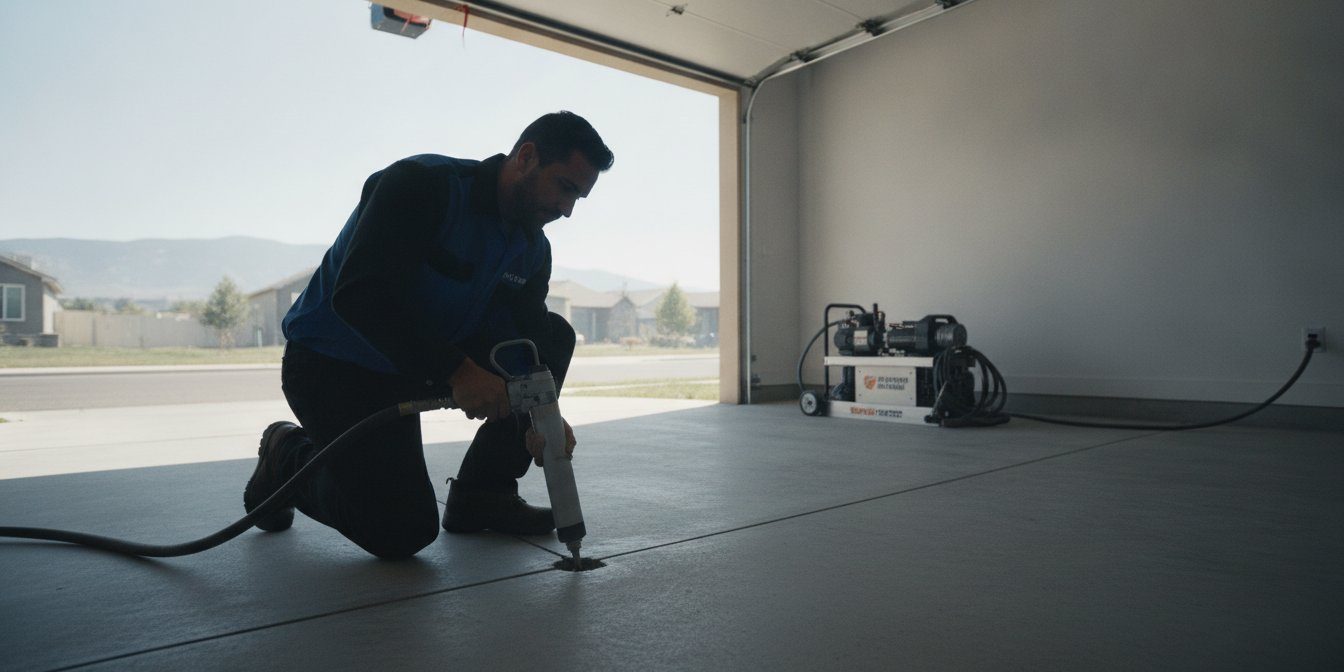
The physical work starts with the placement of strategic, non-invasive injection ports. These holes are roughly the size of a dime, which is a significant departure from the large, unsightly ports required by mudjacking. Once the ports are set, we begin the injection phase. During this time, we monitor the slab’s movement in real-time. The high-density polyurethane expands rapidly, filling the voids first before providing the upward pressure needed to restore the floor to its original grade. The cleanup process is equally methodical, as we remove the ports and seal the holes with a color-matched grout to maintain your garage’s aesthetic.
Step-by-Step: The Day of the Repair
We prioritize the protection of your property from the moment we arrive. Our team prepares the garage surface by clearing specific work zones and covering nearby belongings to prevent dust accumulation. The injection process itself is a “controlled expansion.” We inject the foam in small, calculated increments, allowing it to stabilize the subgrade before applying the final lift. This methodical pace ensures we achieve a level surface that restores proper drainage toward the driveway, preventing future water pooling against your foundation walls.
Post-Leveling Maintenance and Longevity
The polyurethane material is chemically inert and permanent, meaning it won’t wash away or decay over time. However, the long-term success of any structural repair depends on environmental management. Properly directing your downspouts at least five feet away from the garage foundation is the most critical step you can take to prevent future soil saturation and subsequent sinking. We also recommend sealing any remaining surface cracks to prevent water from reaching the subgrade. If you’re ready to secure your foundation, you can schedule a professional structural assessment to begin the restoration process.
Why Denver Homeowners Trust RiseLock for Garage Restoration
Choosing a partner for your home’s structural health requires more than just a contractor; it requires a specialist who understands the intricate relationship between Colorado’s geology and modern engineering. RiseLock Concrete Lifting provides concrete garage floor leveling denver with a commitment to technical mastery and ethical service. We view every sinking slab as a unique structural challenge that deserves a high-precision solution. Our team serves homeowners across the Front Range, providing reliable intervention from the Denver Metro area down to Colorado Springs for anyone needing concrete garage floor leveling denver.
One of the most significant decisions a homeowner faces is whether to replace or repair. While a full replacement is often disruptive and costly, polyurethane concrete lifting offers a sophisticated alternative that addresses the root cause of the problem. By filling the voids beneath the concrete, we restore the slab’s integrity without the need for heavy demolition. This method is not only cleaner and faster but also ensures that the new support system won’t wash away or erode. It provides a level of longevity that traditional replacement often lacks unless the underlying soil issues are also addressed. Homeowners who want to understand how this approach compares across different property areas can explore what a professional concrete leveling service delivers for driveways, walkways, and other sunken slabs beyond the garage.
The RiseLock Difference: Precision and Reliability
Our approach is rooted in the belief that structural repair should be efficient and non-invasive. We’ve moved away from outdated mudjacking techniques in favor of advanced foam technology because it offers superior control and durability. Our technicians maintain clear communication throughout every project, ensuring you understand the reasons behind our methods. We take professional pride in our work, operating with a quiet authority that prioritizes results over hyperbolic marketing. When we leave a job site, your garage floor isn’t just level; it’s stabilized for the long term.
Ready to Restore Your Garage Floor?
Structural issues don’t resolve themselves; they typically worsen as seasonal moisture cycles continue to expand and contract the soil. Acting early can prevent a simple leveling project from turning into a total slab failure. If you’ve noticed cracks, pooling water, or unlevel sections, it’s time to seek a professional evaluation. We offer specialized assessments throughout the Denver Metro area to help you understand the current state of your foundation and provide a clear path toward restoration. Request a professional concrete leveling estimate from RiseLock Concrete Lifting today.
Securing Your Home’s Structural Integrity
Choosing a partner with specialized expertise in both polyurethane lifting and post-tension repair ensures your project is handled with the care it deserves. Our team combines localized geological knowledge with non-invasive techniques to provide a durable solution with minimal downtime. If you’re ready to address settlement issues before they lead to total slab failure, we’re here to act as your dependable partner. You can Get a Professional Concrete Leveling Estimate to begin your home’s restoration today. Taking this proactive step protects your property value and restores your peace of mind.
Frequently Asked Questions
Is concrete leveling cheaper than replacing my garage floor?
Yes, concrete leveling is a much more cost-effective alternative to a full tear-out and replacement. Industry data suggests that leveling can cost up to 70% less than pouring a new slab. This price difference stems from reduced material costs and the elimination of heavy demolition labor. It’s a financially prudent way to restore structural integrity without the expense of a massive construction project.
How long does polyurethane garage floor leveling take?
Most polyurethane garage floor leveling projects are completed within a single morning or afternoon. The injection process itself is efficient, as the high-density foam expands and hardens almost instantly. Unlike traditional methods that require extensive site preparation, our streamlined approach allows us to stabilize your floor and finish the cleanup in just a few hours.
Will the foam injection process make a mess in my garage?
No, the foam injection process is remarkably clean compared to traditional mudjacking. We only need to drill small, dime-sized holes to insert the injection ports. There is no wet slurry or heavy equipment involved that might track dirt through your home. Once the lift is complete, we remove the ports and seal the holes with a color-matched grout, leaving your garage looking professional and tidy.
Can you level a garage floor that has post-tension cables?
Yes, we can level post-tension slabs, but it requires specialized technical knowledge that many general contractors lack. Because these slabs contain steel cables under immense tension, we use non-invasive mapping and strategic port placement to avoid any structural damage. Our background in post-tension installation ensures that we maintain the integrity of the tensioned system throughout the lifting process.
How soon can I park my car on the floor after it is leveled?
You can typically return your vehicle to the garage just a few hours after the leveling is finished. High-density polyurethane reaches its full structural strength very quickly, often achieving 90% of its load-bearing capacity within minutes of injection. This rapid cure time is one of the primary reasons homeowners choose this modern solution over traditional grout-based methods that take days to dry.
Does concrete leveling work on extremely large cracks?
Concrete leveling is designed to restore the elevation of sunken slabs, but it doesn’t fuse cracks back together. While the process will align the edges of a large crack to eliminate tripping hazards, the crack itself will still be visible. We recommend sealing these cracks after the slab is stabilized to prevent moisture from reaching the subgrade and causing future settlement.
What happens if I don’t fix my sunken garage floor?
Ignoring a sunken garage floor often leads to more severe structural complications and property value loss. Over time, unlevel slabs can cause water to pool against your home’s foundation, potentially leading to basement leaks or wall failure. Tripping hazards also create a significant liability risk. Addressing the issue early with concrete garage floor leveling denver prevents a simple settlement from turning into a total foundation failure.
Is polyurethane foam environmentally safe for Colorado soil?
Yes, the high-density polyurethane foam used in our process is environmentally stable and safe for Colorado’s unique soil chemistry. Once the material cures, it becomes chemically inert and won’t leach harmful substances into the surrounding earth. It’s also resistant to moisture and decay, ensuring it doesn’t break down or erode even when exposed to the Front Range’s seasonal moisture cycles. Homeowners looking for a broader overview of how these techniques apply throughout their property can explore our complete guide to residential concrete leveling for driveways, walkways, and other slabs beyond the garage.