The most expensive concrete repair you’ll ever pay for is the one that has to be done twice. In Littleton, where expansive clay soils constantly shift beneath our feet, a sinking driveway or uneven patio is more than a cosmetic nuisance; it’s a structural challenge that requires a precise, technical solution. When you begin investigating the residential foam jacking cost in Littleton, it’s natural to feel a sense of hesitation. You want to protect your property value without falling victim to hidden fees or temporary fixes that fail after the next heavy snowmelt.
We recognize that your home is your most significant asset, and seeing its foundation settle can be deeply unsettling. This guide provides a transparent look at the variables that influence your project’s total price, including the technical precision of polyurethane injection and the long-term ROI of soil stabilization. You’ll learn why high-density foam stands up to Colorado’s unique environment better than traditional alternatives. By the end, you’ll have a clear framework to evaluate quotes and the confidence to choose a permanent, surgical repair that secures your home for years to come.
Key Takeaways
- Learn why the residential foam jacking cost in Littleton is determined more by subsurface void volume and settlement depth than by simple surface area.
- Understand the impact of Littleton’s expansive bentonite clay and how high-density polyurethane provides a water-resistant, stable base that resists shifting.
- Discover the long-term ROI of polyurethane injection, which avoids the recurring maintenance costs and environmental mess associated with traditional mudjacking.
- Gain a framework for evaluating professional quotes based on material density and the technical precision required for a non-invasive, surgical repair.
- Identify how structural expertise in areas like post-tension installation translates to more durable and precise concrete restoration results.
Factors Influencing Residential Foam Jacking Cost in Littleton
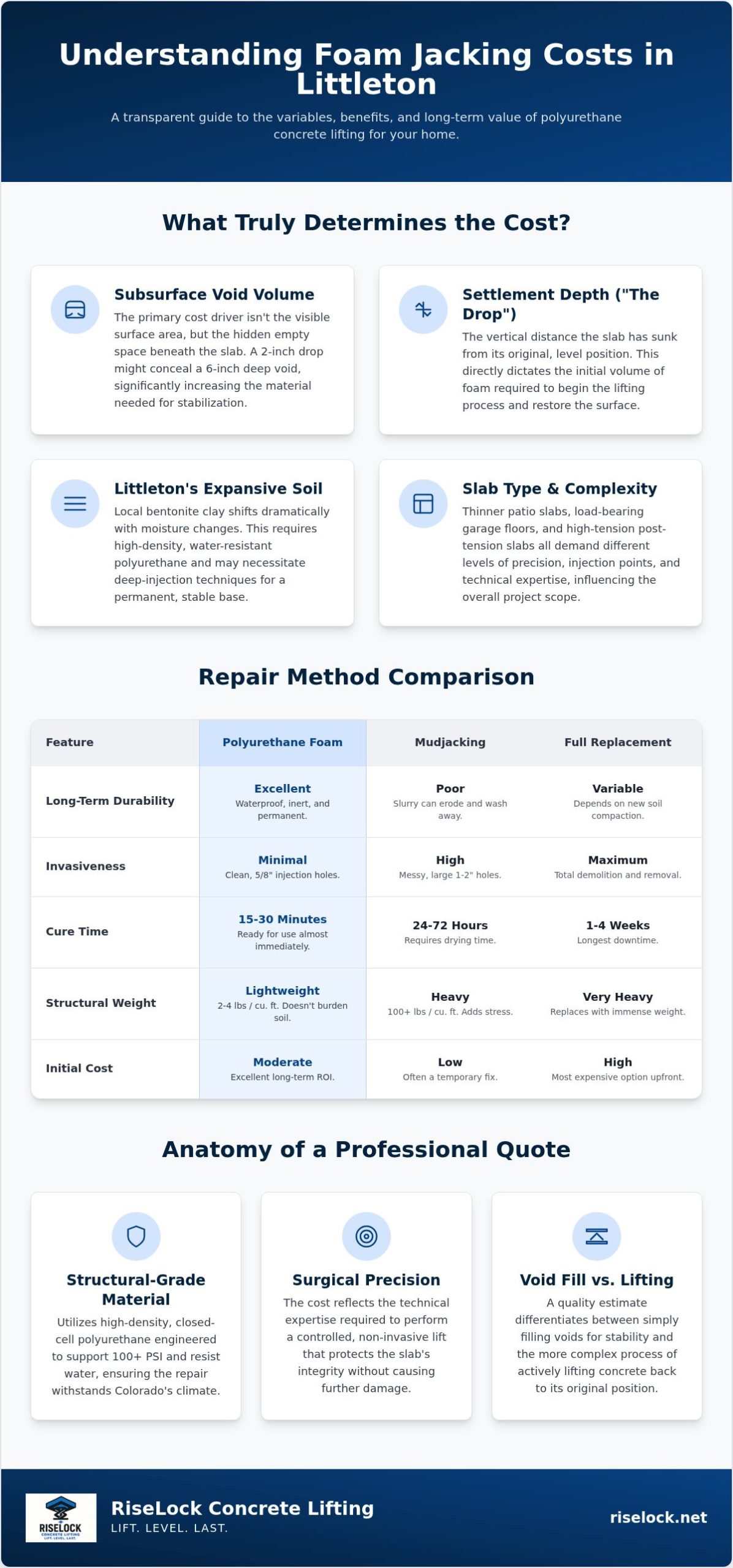
Determining the residential foam jacking cost in Littleton requires a technical assessment that goes far beyond measuring the length and width of a sunken slab. While surface area provides a starting point, our technicians focus on the three-dimensional reality beneath the concrete. The “drop” height, or the distance the slab has migrated from its original position, dictates the initial volume of material required to restore a level surface. However, the presence of subsurface voids often presents a more significant variable. These hollow pockets, created by soil erosion or poor compaction, must be fully consolidated before the lifting process can begin. If a slab has dropped two inches but sits atop a six-inch deep void, the material requirements triple instantly.
Site accessibility also plays a role in the final project scope. Modern polyurethane equipment is significantly more mobile than traditional machinery, yet the distance from the rig to the injection point can influence labor efficiency. In Littleton, we frequently encounter expansive clay soils that demand more than a simple surface lift. When soil conditions are particularly unstable, deep-injection stabilization may be necessary to create a “bulb” of high-density foam that supports the slab from deeper, more competent soil layers.
The Impact of Slab Type on Pricing
The thickness and reinforcement of the concrete determine how it responds to lifting pressure. A standard four-inch driveway slab behaves differently than a thinner, more decorative patio. Thinner slabs require a more deliberate touch and a higher frequency of injection points to prevent cracking during the lift. Garage floor lifts present a unique challenge; the technician must account for the static load of the structure and any stored vehicles. Beyond this, homes with post-tensioned slabs require extreme precision. Because these slabs are under high tension from internal cables, the injection process must be carefully monitored to maintain structural integrity. This technical requirement is a significant factor in the overall complexity of the project.
Void Filling vs. Structural Lifting
Distinguishing between basic void filling and active structural lifting is essential for understanding project estimates. Void filling focuses on replacing lost soil to prevent future sinking, while lifting uses the expansive force of the foam to move the concrete upward. Concrete leveling techniques have evolved to utilize the high-density properties of polyurethane to overcome the weight of the slab and any hydrostatic pressure from trapped groundwater. In Littleton’s climate, soil moisture levels fluctuate significantly, which can increase the volume of foam needed to displace water and secure a firm foundation. Calculating the residential foam jacking cost in Littleton involves balancing these material needs with the technical mastery required to execute a precise, surgical lift.
The Anatomy of a Professional Polyurethane Injection Quote
A transparent quote for concrete restoration is a detailed breakdown of technical requirements rather than a vague estimate. When evaluating the residential foam jacking cost in Littleton, homeowners must look beyond the bottom line to understand the components of professional intervention. A legitimate proposal reflects the cost of high-grade chemical components, the operation of specialized equipment, and the precision of a master technician. These elements ensure that the repair isn’t merely a temporary lift but a permanent stabilization of the structural environment.
Why Material Quality Dictates Price
The primary driver of project durability is the chemical composition of the injection material. We utilize high-density, closed-cell polyurethane specifically engineered to withstand the pressures of Colorado’s expansive soils. Unlike generic or low-density foams, structural-grade polyurethane maintains a high compressive strength, which is defined as the ability of the foam to support 100+ PSI without deformation. This material property is critical for Littleton homes, where soil moisture can fluctuate rapidly. The foam must set quickly and resist water absorption to prevent future settlement. While high-quality chemicals represent a larger portion of the quote, they eliminate the need for repeat repairs.
The Cost of Precision: Drill Holes and Injection Ports
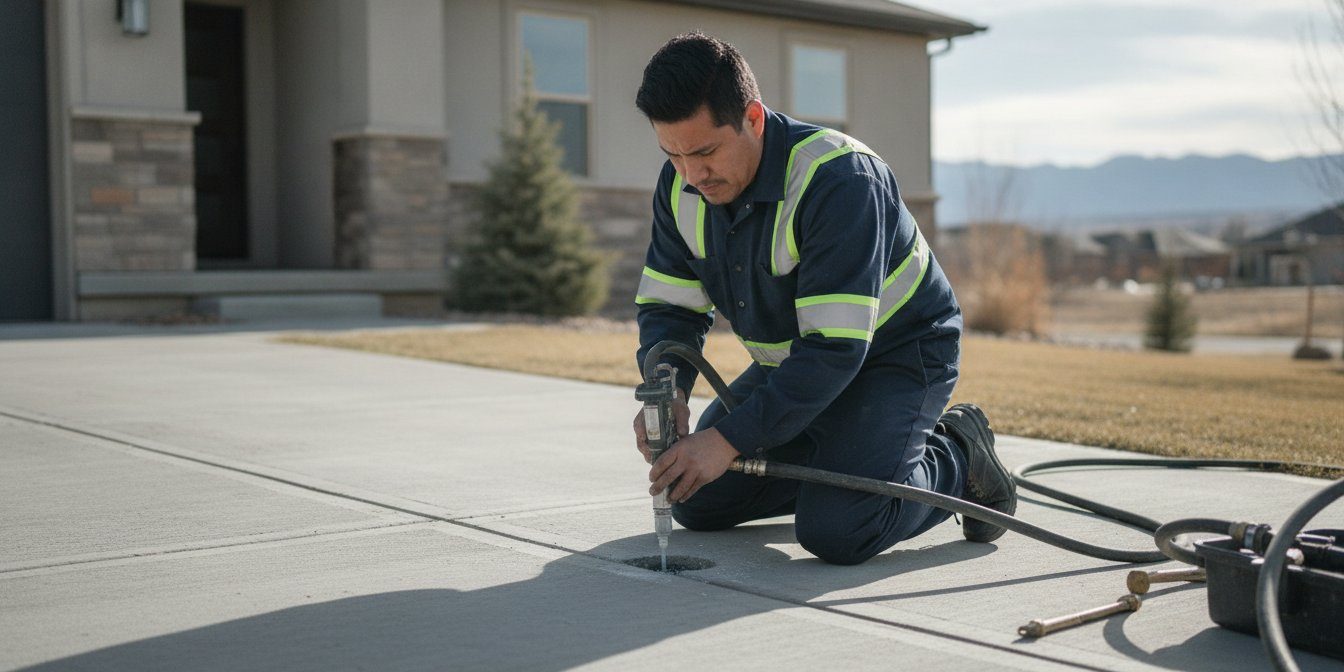
Precision is a core component of our technical approach. One of the most visible advantages of foam jacking is the use of 5/8-inch injection holes. These small, penny-sized entries are significantly less invasive than the large two-inch holes required for traditional methods. The number of injection points is determined by the complexity of the lift and the weight of the concrete slab. Each port represents a point of control, allowing the technician to guide the foam with surgical accuracy. Once the lift is complete, these holes are patched with a custom-mixed concrete grout to match your existing surface. This meticulous restoration process ensures the repair is nearly invisible once the material cures.
A professional quote also includes the overhead of temperature-controlled injection rigs. Polyurethane requires precise heat and pressure to react correctly and achieve its intended density. Our technicians are trained to manage these variables in real-time, ensuring the material performs exactly as engineered. If you’re ready to see how these technical factors apply to your property, you can request a professional assessment to receive a detailed breakdown tailored to your home’s needs. This level of transparency ensures you’re investing in a long-term solution backed by structural expertise and a commitment to high standards.
Foam Jacking vs. Mudjacking vs. Replacement: A Cost-Benefit Analysis
Selecting the right restoration method requires a calculation that extends far beyond the immediate invoice. While traditional mudjacking may appear cost-effective at first glance, its reliance on heavy cementitious slurry often leads to secondary settlement in Littleton’s shifting terrain. This weight adds significant stress to already compromised subsoils. In contrast, the residential foam jacking cost in Littleton should be viewed as a long-term structural investment that addresses the root cause of instability without adding unnecessary mass. Complete slab replacement represents the most expensive and disruptive path. It involves demolition labor, debris disposal fees, and the navigation of municipal permit requirements for new concrete work.
Cure time is another critical factor in the value equation. A new concrete pour can leave a driveway unusable for seven to ten days, creating significant logistical hurdles for your household. Polyurethane foam achieves 90% of its structural integrity within minutes. Most homeowners find they can resume normal use of their garage or driveway in as little as 30 minutes after the technician finishes the injection. This speed eliminates the opportunity cost of restricted access and the potential for neighborhood disruption.
The 10-Year ROI of Polyurethane
In the Front Range environment, mudjacking often requires a re-lift within two to three years because the organic materials in the slurry can erode or shrink. Polyurethane is an inert, closed-cell material that won’t wash away or degrade over time. By sealing the underside of the concrete and consolidating the soil, foam prevents the water infiltration that causes future erosion. You can find more technical data on these longevity factors in our guide on Concrete Leveling: The Definitive Guide to Modern Slab Restoration. Investing in a durable material today saves you from the recurring costs of secondary repairs later this decade.
Environmental and Aesthetic Costs
Preserving your home’s curb appeal is often a primary motivation for repair. A leveled driveway looks significantly better than a patched replacement that rarely matches the color or texture of your existing concrete. Beyond aesthetics, foam jacking is an environmentally responsible choice. It keeps thousands of pounds of old concrete out of local landfills by restoring what you already have. From a practical standpoint, foam jacking preserves your existing mature landscaping because the equipment is minimally invasive. Our technicians use small-diameter hoses that reach your project site without the need for heavy trucks to drive across your lawn or disturb established flower beds.
Littleton Specifics: Soil, Climate, and Local Pricing Variables
In Littleton, the geography of your property dictates the engineering requirements of the repair. The residential foam jacking cost Littleton homeowners encounter is fundamentally shaped by the presence of bentonite, a highly expansive clay prevalent across the Front Range. This soil type undergoes significant volume changes based on moisture content, swelling when wet and shrinking during our dry spells. This constant movement creates the subsurface instability that leads to slab failure. Because of these volatile conditions, a standard surface lift isn’t always sufficient; we must often account for the depth of the active soil zone to ensure the repair remains stable through Colorado’s seasonal shifts.
Our local climate adds another layer of complexity. The intense freeze-thaw cycles common in neighborhoods near Heritage High or Ken Caryl can exacerbate existing concrete damage. When water infiltrates the soil beneath a driveway and freezes, it exerts upward pressure. As it melts, it can wash away fines in the soil, leaving behind the voids we discussed earlier. Furthermore, municipal requirements in Littleton often mandate the mitigation of trip hazards on public-facing sidewalks. Addressing these hazards with polyurethane injection is a precise way to meet local codes without the disruption of a full municipal-permitted replacement.
Expansive Soils and Deep Injection
Many Littleton properties require more than just filling a void directly beneath the concrete. To achieve permanent results in bentonite-heavy areas, we often utilize deep-injection techniques. This process involves sending polyurethane into deeper soil strata to consolidate loose material and create a stable “bulb” of support. While this increases the material volume, it’s the only way to counteract the lifting and settling caused by moisture fluctuations. Our specialized approach to polyurethane concrete lifting is designed specifically to address these Colorado soil challenges, ensuring your residential foam jacking cost Littleton investment provides lasting structural security.
Neighborhood-Specific Challenges
The age and layout of your neighborhood also influence the technical approach. In established areas like the 80120 zip code, mature tree roots often interfere with concrete slabs, requiring careful injection to avoid damaging the landscape while still achieving a level surface. In contrast, newer developments in 80127 may face issues related to rapid soil settlement in recently graded lots. Accessing tight residential spaces, such as those found in established Littleton cul-de-sacs, requires the compact, high-reach equipment we maintain. If you’ve noticed uneven slabs on your property, you can schedule a local site evaluation to determine the specific soil and access factors affecting your home.
Choosing RiseLock: Precision Concrete Restoration in Littleton
Selecting a partner for structural repair is a decision that impacts the long-term security of your home. At RiseLock, we view the residential foam jacking cost Littleton homeowners pay as an investment in technical mastery. Our approach differs from standard contractors because we specialize in both lifting and structural reinforcement. This dual expertise allows us to evaluate a sunken slab not just as a surface to be raised, but as a structural component that interacts with the soil and the home’s foundation. By prioritizing precision over speed, we ensure that every injection contributes to a stable, lasting result.
Our background in post tension installation provides a unique advantage in the field of polyurethane lifting. Understanding the internal mechanics of stressed concrete slabs allows our technicians to navigate complex repairs with a level of safety that others might overlook. We know how to manage the pressure and lift points to protect the integrity of your concrete, especially in modern Littleton homes where post-tensioned slabs are common. This technical foundation allows us to act as a professional guide, leading you away from the stress of structural damage toward the peace of mind offered by specialized intervention.
Our Technical Mastery in the Field
We believe that a proper estimate should be an engineering assessment, not a sales pitch. When you request a quote from RiseLock, you’re meeting with a technician who understands the physics of soil stabilization. This technician-led approach ensures that the residential foam jacking cost Littleton residents receive is based on actual site conditions and void volumes, rather than generic square footage estimates. In a recent project in the Heritage neighborhood, we restored a severely settled driveway where traditional methods would have risked cracking the adjacent garage floor. By using a surgical, non-invasive injection pattern, we achieved a level finish without disturbing the surrounding mature landscaping.
Alex Mon, the lead at RiseLock, summarizes our commitment to this craft: “Precision isn’t just about the equipment we use; it’s about the ethical responsibility we have to the homeowner. We don’t just lift concrete; we restore the structural confidence of the person living above it.” This philosophy of quiet authority means we provide honest assessments, even if the best solution is a more conservative intervention than initially expected.
Next Steps for Littleton Homeowners
Preparing for an on-site evaluation is straightforward. We ask that you clear the area of any vehicles or debris so we can inspect the full extent of the settlement and identify drainage patterns that may be contributing to soil erosion. Once our technician completes the assessment, you’ll receive a detailed breakdown of the stabilization plan. After quote approval, the timeline to a stabilized slab is remarkably efficient; most projects are completed in a single day, and the material cures within minutes. If you’re ready to secure your property’s foundation with a partner who views your structural problems as a personal priority, you can request your precision quote from RiseLock today. We look forward to providing the technical expertise your Littleton home deserves.
Securing Your Home’s Structural Future
The decision to repair your concrete is fundamentally about protecting your property’s long-term value. By understanding the residential foam jacking cost Littleton homeowners face, you can move past the anxiety of temporary fixes and invest in a permanent solution. This guide has detailed how high-density polyurethane addresses the specific challenges of Colorado’s expansive soils while offering a cleaner, faster alternative to traditional methods. You’ve seen that the true value of foam jacking lies in its surgical precision and the technical mastery required to execute a lift safely without compromising your home’s integrity.
RiseLock provides the expert-led guidance you need to navigate these structural challenges with confidence. Our specialized focus on Littleton’s unique soil conditions, combined with our technical background in post-tension reinforcement, allows us to deliver non-invasive repairs with minimal downtime. We view your home’s stability as our personal priority and remain committed to the highest standards of professional reliability and ethical service. If you’re ready to restore your concrete with a partner you can trust, we invite you to Request Your Precision Concrete Lifting Quote today. Let’s work together to secure your home’s foundation for the years ahead.
Frequently Asked Questions
Is residential foam jacking more expensive than mudjacking in Littleton?
Foam jacking generally has a higher initial price point than traditional mudjacking. However, the residential foam jacking cost in Littleton reflects the use of advanced, structural-grade materials that resist the erosion common in our local clay soils. Mudjacking relies on heavy, organic slurries that frequently require re-application within a few years. Choosing polyurethane ensures a lighter, more durable repair that protects your property value over the long term without the need for recurring maintenance.
How long does a typical foam jacking project take to complete?
A standard residential project is typically completed within two to five hours. This efficient timeline includes the technical setup, drilling of 5/8-inch injection ports, the lifting process itself, and the final patching of the holes. Because the equipment is compact and mobile, we can finish most driveways or patios in a single morning. This speed minimizes disruption to your daily routine while providing an immediate structural solution for your settled concrete.
Can polyurethane foam lift a slab that has sunken more than 4 inches?
High-density polyurethane foam can successfully lift slabs that have settled significantly, including drops exceeding four inches. The material exerts enough expansive force to raise heavy concrete sections back to their original grade with surgical precision. While a deeper drop requires a higher volume of material, the technical process remains the same. Our technicians carefully monitor the lift in real-time to ensure the slab is supported evenly across its entire subsurface area.
Will the foam jacking process damage my lawn or landscaping?
The injection process is designed to be non-invasive and protective of your landscaping. We utilize small-diameter hoses that extend from our temperature-controlled rig directly to the injection site, eliminating the need for heavy trucks to drive across your lawn. This method avoids the soil compaction and turf damage associated with heavier repair machinery. Your flower beds and established greenery remain undisturbed while we perform the precision work required to stabilize your concrete.
How soon can I drive my car on the concrete after it has been lifted?
You can resume normal use of your driveway or garage floor in as little as 30 minutes after the injection is complete. Polyurethane foam undergoes a rapid chemical reaction that allows it to reach 90% of its full compressive strength almost immediately. This stands in stark contrast to traditional concrete replacement, which often requires a seven-day waiting period. The speed of the cure ensures that your residential foam jacking cost in Littleton provides nearly instant ROI.
Does Littleton require a permit for residential concrete leveling?
Most residential concrete leveling projects in Littleton do not require a formal building permit. Because the work is classified as a repair rather than new construction, it typically falls outside the scope of major municipal inspections. However, if the repair involves a public-facing sidewalk or is part of a larger structural foundation project, we recommend verifying specific requirements with the City of Littleton Building Division to ensure full compliance with local codes and safety standards.
Is foam jacking a permanent solution for Colorado’s expansive clay soils?
Polyurethane injection is the most effective long-term solution for stabilizing slabs atop Colorado’s expansive bentonite clay. Unlike natural slurries that can wash away or shrink, high-density foam is an inert, water-resistant material that maintains its volume indefinitely. It consolidates the loose soil and fills the voids that contribute to settlement. While no method can stop the earth from moving, foam provides a stable, lightweight base that resists the effects of moisture fluctuations.
What is the difference between void filling and concrete raising?
Void filling is the process of pumping material beneath a slab to occupy hollow spaces and prevent future sinking without necessarily changing the slab’s height. Concrete raising, or lifting, uses the expansive pressure of the foam to actively move the sunken slab back to its original position. Both techniques are essential for a complete repair; we first fill the voids to create a solid foundation before applying the pressure needed for a precise lift.