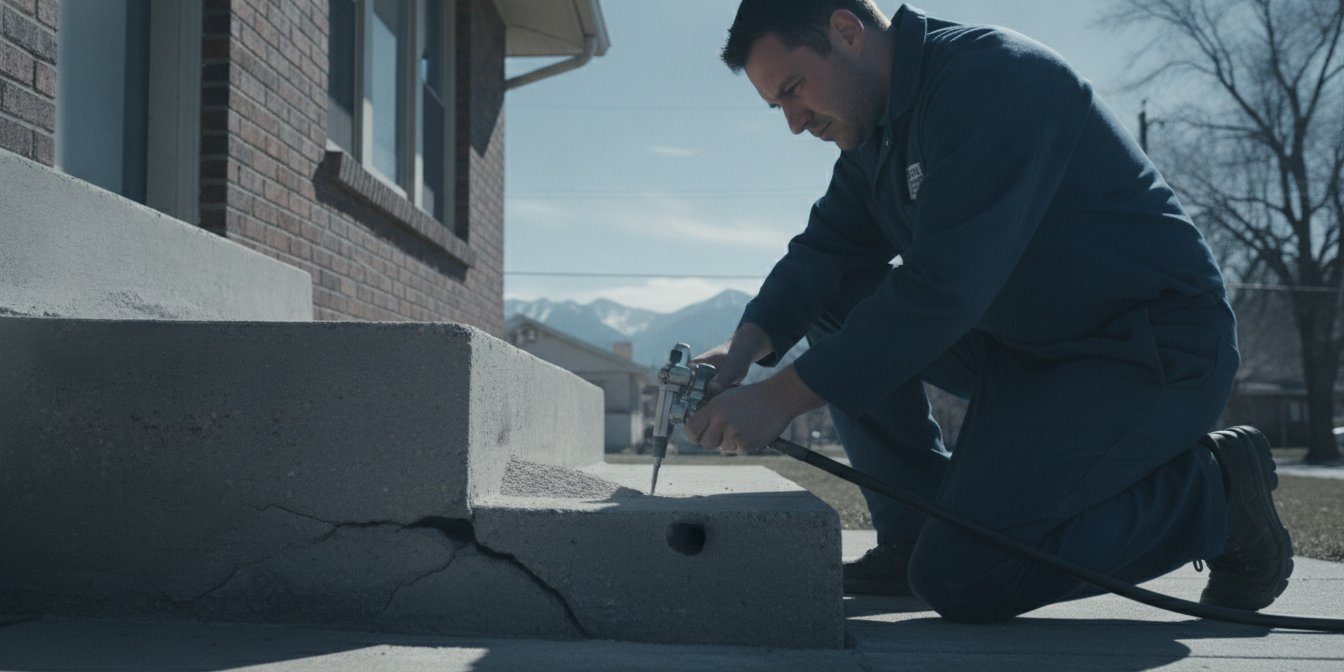
A single sunken step is more than a minor eyesore; it’s a significant liability that can compromise your home’s structural integrity and your guests’ safety. When seeking concrete step leveling Denver homeowners often face the reality of the region’s notorious expansive clay soil, which shifts and settles with every season. You’ve likely noticed your entryway pulling away or tilting, creating a lopsided look that triggers concerns about trip-and-fall accidents or foundation damage. It’s frustrating to watch a solid concrete structure succumb to the earth beneath it, especially when traditional replacement seems like an invasive and expensive ordeal.
Fortunately, you don’t have to tear out your porch to fix the problem. This guide details how advanced polyurethane injection permanently restores sunken stairs by stabilizing the underlying soil and lifting the slabs with surgical accuracy. We’ll examine why this modern method outperforms old-fashioned slurry techniques and how it provides a durable, immediate solution for Denver’s unique geological challenges. You’ll learn how to achieve a level, safe entryway with minimal downtime while ensuring long-term stability against the Front Range’s volatile soil cycles.
Key Takeaways
- Understand how Denver’s expansive bentonite clay and extreme freeze-thaw cycles create the specific soil instability that causes concrete stairs to settle and pull away.
- Discover why concrete step leveling Denver specialists favor high-density polyurethane injection for its precision, lightweight properties, and ability to stabilize soil without adding excessive weight.
- Learn why modern polyurethane lifting is a superior, “no-mess” alternative to traditional mudjacking and the high costs associated with full concrete demolition and replacement.
- Identify the critical safety thresholds and structural risks that make sunken steps a liability for homeowners and a threat to the attached porch foundation.
- See how precision restoration allows for immediate use of your entryway, with the injection material curing rapidly to provide long-term support against shifting Front Range soils.
Why Concrete Steps Sink in the Denver Metro Area
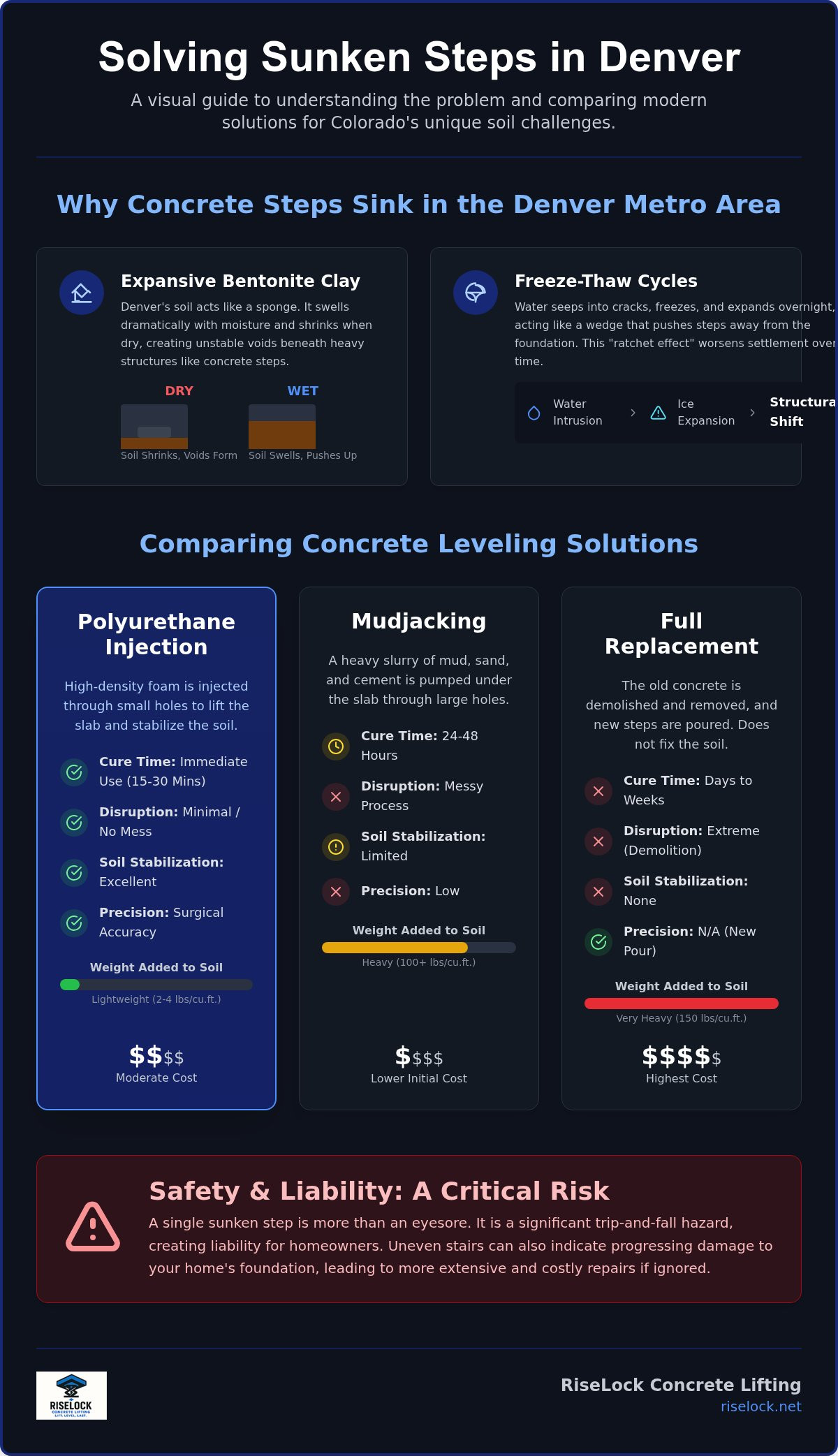
Denver’s architectural landscape faces a persistent subterranean challenge: the prevalence of expansive bentonite clay. This specific soil type acts like a sponge, swelling significantly when saturated and shrinking as it dehydrates. For homeowners seeking concrete step leveling Denver services, understanding this geological behavior is the first step toward a permanent solution. Concrete steps are unique because they concentrate immense weight into a small, vertical footprint. While a flat sidewalk distributes its load across a wide area, stairs exert high downward pressure on the soil directly beneath the entryway. This concentrated weight, combined with poor drainage that often directs gutter runoff toward the foundation, causes steps to sink faster than surrounding walkways.
Concrete leveling in our region isn’t just about aesthetics; it’s a technical response to the Front Range’s volatile environment. When the soil fails to support the vertical load, the stairs begin to tilt, creating gaps that invite further water intrusion and soil erosion. Without professional intervention, these stairs eventually pull away from the main structure, leaving the entryway vulnerable to deeper damage.
The Impact of Colorado’s Expansive Soils
Colorado’s semi-arid climate creates a cycle of extreme wet and dry spells. When bentonite clay absorbs moisture, it expands with enough force to lift heavy masonry. Conversely, during Denver’s dry periods, the soil retracts and leaves behind air pockets or “voids.” These voids cannot support the weight of the stairs, leading to gradual settlement. Many homeowners attempt to fix these gaps with DIY surface patching or mortar. These cosmetic fixes don’t work because they add more weight without filling the underlying void. This usually accelerates the sinking process rather than stopping it, as the new material simply pushes the stairs further into the unstable ground.
Freeze-Thaw Cycles and Structural Shift
The Front Range is famous for rapid temperature swings that happen in hours. During a typical winter day, snow melts and trickles into the gaps between your steps and the foundation. When temperatures plummet at night, that water freezes and expands, physically prying the stairs away from the house. This freeze-thaw cycle creates a “ratchet” effect, where the steps move slightly with every frost. Over time, this doesn’t just create a trip hazard. It can cause structural damage to the porch or foundation where the steps are anchored. Early warning signs include hairline fractures where the steps meet the siding or a noticeable tilt in the top tread. Investing in concrete step leveling Denver at the first sign of movement prevents a total collapse and protects the home’s primary structural integrity.
The Polyurethane Injection Process for Precision Step Leveling
Polyurethane injection provides the technical precision required to restore heavy vertical structures like entryway stairs. While flat slabs are relatively simple to lift, steps demand a more calculated approach due to their concentrated weight and small footprint. This method is often referred to as “surgical” because it requires minimal disruption to your property while delivering maximum structural impact. By injecting high-density foam directly beneath the sunken areas, we address the root cause of the settlement. This process doesn’t just lift the concrete; it stabilizes the underlying soil, creating a solid foundation that resists future shifting. Homeowners choosing concrete step leveling Denver benefit from a solution that’s ready for foot traffic within minutes of completion, avoiding the days of downtime associated with traditional concrete work.
The effectiveness of this method relies on understanding the geological context of the Front Range. Data from the Colorado Geological Survey highlights how specific soil profiles in the Denver metro area contribute to foundation and slab movement. Polyurethane’s ability to expand and fill the voids created by these soils makes it a superior choice for long-term restoration. If you’ve noticed your steps pulling away, a professional concrete repair assessment can determine the exact injection points needed to restore safety and alignment.
Step-by-Step: How We Level Your Stairs
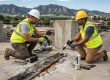
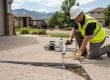
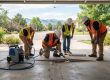
The restoration begins with drilling penny-sized holes in strategic, load-bearing locations across the steps. These holes act as entry points for the injection equipment. We then initiate the injection phase, where high-density foam is pumped under the slab in controlled bursts. We monitor the lift with laser precision, ensuring the steps return to their original height without over-lifting or causing stress fractures. The final stage involves comprehensive void filling. We ensure 100% contact between the concrete and the soil, eliminating the air pockets that caused the initial sinking.
The Science of High-Density Foam
The material used in this process is a two-part polymer that undergoes a chemical reaction upon injection. This reaction causes the liquid to expand rapidly into a rigid, high-density foam that hardens in seconds. Unlike organic fill materials, this foam is entirely impervious to water. It won’t wash away during heavy spring rains or degrade over time. One of the most significant advantages for concrete step leveling Denver is the material’s weight. Polyurethane provides immense lifting power while adding negligible weight to the soil, ensuring we don’t inadvertently trigger further settlement by overloading the already sensitive Denver clay.
Comparing Solutions: Polyjacking vs. Mudjacking vs. Replacement
Homeowners facing sunken stairs usually weigh three primary options: mudjacking, full replacement, or polyurethane injection. While each claims to solve the problem, the technical reality of Colorado’s geography makes the choice clearer. For concrete step leveling Denver residents, the goal is to provide a permanent lift without exacerbating the very soil conditions that caused the initial failure. Replacement is often an over-engineered and unnecessarily expensive response to what is essentially a soil stabilization issue.
Traditional mudjacking relies on a heavy slurry of sand and cement. This mixture adds significant mass, often exceeding 100 lbs per cubic foot. In the context of the Official Soil Series Description for the region, adding this much weight to expansive clay is a fundamental engineering error. The heavy “mud” compresses the loose soil further, causing the stairs to settle again shortly after the repair. Beyond the structural flaws, mudjacking requires large, two-inch injection holes that are difficult to hide on high-visibility entryways. When evaluating concrete step leveling Denver services, the mess factor is also a concern; slurry splatter can easily stain adjacent brickwork or siding.
Replacement vs. Restoration
Choosing between replacement and restoration is a matter of both time and budget. A full tear-out requires heavy machinery, demolition noise, and at least three days of curing time before the steps are usable. In contrast, concrete leveling with high-density foam allows you to use your stairs within minutes. From a financial perspective, restoration typically costs 50-70% less than a full replacement. You also avoid the aesthetic “patchwork” look. New concrete is bright and rarely matches the aged patina of your existing porch or walkway, whereas leveling preserves the original materials and visual harmony of your home.
Modern polyurethane is an inert material that won’t leach into your landscaping or groundwater. It provides a clean, surgical alternative that respects both your property’s value and the local environment. By selecting a lightweight, waterproof material, you ensure that the repair remains stable regardless of how much moisture the local soil absorbs. This method offers the best balance of cost-efficiency and technical performance for the Front Range.
Safety and Liability: When Sunken Steps Become a Risk
Sinking concrete isn’t just a visual flaw; it’s a legal and structural liability. In the context of concrete step leveling Denver property owners must recognize that uneven surfaces are often classified as trip hazards long before they look “broken.” The industry standard, frequently cited by insurance adjusters and local building inspectors, is the “Quarter-Inch Rule.” Any vertical change in level of 1/4 inch or more is considered a significant trip hazard. The maximum allowable vertical deviation for residential and commercial steps is typically 1/4 inch before the surface is legally classified as a hazard. If a visitor or tenant falls due to this deviation, the property owner may be held liable for negligence, especially if the hazard was known but left unaddressed.
Insurance companies are increasingly proactive about these risks. During routine property inspections or policy renewals, adjusters look for sunken slabs that could lead to costly claims. A lopsided entryway can result in premium hikes or even policy cancellation if the risk isn’t mitigated. For landlords and business owners, the stakes are even higher, as code compliance is strictly enforced to ensure public safety. Addressing these issues early demonstrates a commitment to property maintenance and risk management.
Protecting the Main Foundation
When concrete steps sink, they don’t just move downward; they often tilt away from the house. This creates a lever effect that puts immense pressure on the home’s main foundation. In many Denver neighborhoods, homes are built with post-tensioned slabs. It’s vital to check for broken post tension cables near the entryway if the steps have pulled away significantly. The tension in these cables is critical for the home’s structural integrity, and a shifting concrete mass can compromise the anchors or lead to moisture-driven corrosion of the steel strands.
Beyond the foundation, the gap between the steps and the house serves as a funnel for rainwater. Instead of shedding away from the building, water is directed straight toward the basement or crawlspace walls. This leads to soil saturation, which accelerates the “sink and heave” cycle previously discussed. Utilizing professional concrete repair in Denver, Colorado ensures these gaps are sealed, preventing both water intrusion and pest infestations. If you’re concerned about the safety of your entryway, request a structural evaluation to identify hidden risks before they become emergency foundation repairs.
The RiseLock Approach to Denver Concrete Step Leveling
RiseLock Concrete Lifting provides a specialized solution for concrete step leveling Denver that centers on technical mastery and geological awareness. We approach every project with the understanding that an entryway is the most visible and frequently used part of your home’s exterior. Unlike general contractors who might treat a set of stairs like any other flat slab, we tailor our injection patterns to the specific load-bearing requirements of vertical concrete structures. Our regional expertise extends across the Front Range, providing dedicated service to homeowners in Aurora, Centennial, Boulder, Castle Rock, and Parker. This broad footprint allows us to understand the nuances of local soil behavior, ensuring the lift we provide remains secure against the specific environmental pressures of your neighborhood.
Our method goes beyond simple lifting; we focus on the total structural health of the entrance. By combining high-precision leveling with the stabilization of the underlying soil, we address the root cause of the settlement. This technical edge ensures that once your steps are restored, they have the support necessary to resist the “sink and heave” cycles common in Colorado. We view our work as a partnership with the homeowner, transforming a stressful structural liability into a source of long-term security and pride.
Quiet Authority and Professional Reliability
Our technicians are trained to prioritize precision over speed, reflecting a commitment to high standards that defines the RiseLock Concrete Lifting brand. We utilize high-density polyurethane concrete lifting materials that are specifically engineered to withstand the hydrostatic pressure of expanding clay. This material is not only durable but also incredibly lightweight, preventing the secondary settlement often caused by heavier repair methods. We pair this technical mastery with a strict “no-mess” policy. Every worksite is treated with professional respect, ensuring that injection holes are meticulously patched to match the surrounding texture and that your entryway is ready for use immediately upon our departure.
Your Local Partner in Structural Health
Trust is built through transparency and verifiable results. RiseLock Concrete Lifting provides documented restoration for every project, giving you the peace of mind that comes from knowing the voids beneath your stairs are 100% filled and the soil is stabilized. Denver property owners trust us for complex concrete step leveling Denver projects because we understand the critical interplay between heavy stairs and the home’s main foundation. We act as your professional guide, moving you away from the risks of trip hazards and water intrusion toward a permanently restored entryway. The next step in securing your home’s entrance is a precision assessment, where we can identify the specific needs of your property and provide a clear path toward structural stability.
Restoring Safety and Stability to Your Entryway
The decision to address sunken stairs is an investment in both your home’s curb appeal and its long-term structural integrity. Throughout this guide, we have examined why Denver’s volatile soils demand a specialized, lightweight solution rather than the heavy burden of traditional mudjacking. By opting for precision concrete step leveling Denver homeowners can eliminate trip hazards and prevent the dangerous lever effect that sinking stairs exert on the main foundation. This modern restoration process provides a durable, waterproof barrier that protects your property value without the disruption of a full concrete demolition.
RiseLock Concrete Lifting serves as your dedicated partner in maintaining structural health, bringing technical mastery to every project from Castle Rock to Boulder. Our expertise in high-density polyurethane injection and post-tensioned slab safety ensures that your repair is handled with the highest professional standards. We invite you to move past the stress of a lopsided entryway and toward the security of a permanently stabilized home. Get a free estimate for concrete step leveling in Denver and discover how our precision-engineered approach can restore your stairs in a single afternoon.
Frequently Asked Questions
How much does it cost to level concrete steps in Denver?
Cost is determined by the specific volume of material required and the complexity of the staircase structure. While each project is unique, leveling is far more cost-effective than a total replacement. We provide a transparent estimate after evaluating the soil condition and the degree of settlement. Our goal is to provide a long-term solution that addresses the root cause of the sinking rather than offering a temporary patch.
How long does the polyurethane foam last for stairs?
High-density polyurethane is engineered to withstand the extreme moisture cycles of the Front Range without degrading. Unlike organic fill or cement-based slurries, this material is waterproof and won’t wash away or lose its shape. Once injected, it creates a rigid, permanent support structure beneath the concrete. It’s an inert substance that maintains its structural integrity for decades, providing a foundation that resists the natural movement of the soil.
Can you level steps that are attached to the house foundation?
We frequently restore stairs that have pulled away from the main structure. This requires a methodical injection process to ensure the steps are lifted evenly without creating stress points at the foundation wall. Our team is specifically trained to monitor the lift near post-tension anchors, protecting the home’s primary reinforcement while closing the gap. This prevents water from funneling toward the basement or crawlspace and stabilizes the entire entryway system.
Is polyurethane concrete leveling better than mudjacking for steps?
Polyurethane is the superior choice for concrete step leveling Denver because it avoids the massive weight of traditional mudjacking. Slurry mixtures can add thousands of pounds to already failing soil, which often causes the steps to sink again. Foam is lightweight but provides immense lifting force, stabilizing the ground without overloading it. Additionally, the small, penny-sized injection holes are far less intrusive on high-visibility front steps than larger mudjacking ports.
What happens if my concrete steps are too cracked to lift?
Steps with significant structural damage or crumbling sections may not be suitable for lifting. However, minor surface cracks or clean breaks between slabs can often be stabilized and leveled effectively. During the inspection, we determine if the concrete can safely distribute the lifting pressure. If the stairs are too fractured to maintain their shape during the injection phase, we’ll provide an honest assessment and discuss whether replacement is the more ethical and safe path.
How long do I have to wait to walk on my steps after leveling?
You don’t have to wait days for the material to set. One of the primary advantages of our high-density foam is its rapid curing time, which allows the material to reach structural capacity in about 15 minutes. You can walk on the stairs immediately after our technicians finish the work and pack up their equipment. This minimal downtime is ideal for front entryways where maintaining safe and consistent access for residents and guests is a priority.
Will the foam injection holes be visible on my front stairs?
We prioritize the aesthetic finish of your home’s entrance by using the smallest injection points possible. These penny-sized holes are strategically placed in inconspicuous locations when possible. After the lifting is complete, we fill each hole with a custom-mixed grout that matches the color and texture of your existing concrete. Most homeowners find that the patches are difficult to see from a standing distance, maintaining the clean, professional look of the restored masonry.
Does RiseLock Concrete Lifting provide residential step leveling in Aurora and Centennial?
RiseLock Concrete Lifting provides professional residential services across the entire Denver metro area, including Aurora, Centennial, and Boulder. We also frequently work with homeowners in Castle Rock, Parker, and Littleton who are struggling with expansive clay soils. Our team is intimately familiar with the local building codes and soil profiles in these specific communities. We focus on providing a localized, authoritative service that ensures your entryway remains safe and structurally sound for years.