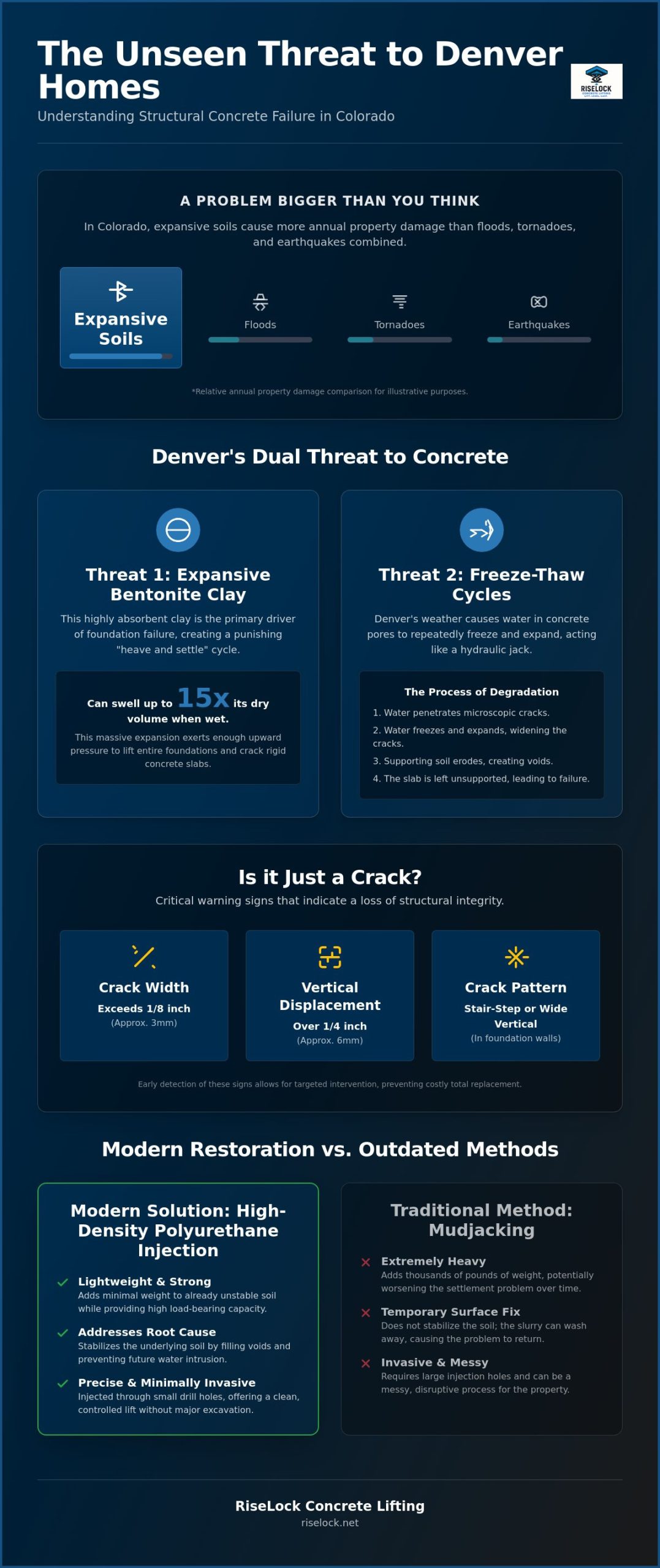
Did you know that expansive soils cause more property damage in Colorado annually than floods, tornadoes, and earthquakes combined? In a city where bentonite clay can swell up to 15 times its dry volume, the need for specialized structural concrete repair denver residents can trust has never been more critical. You’ve likely felt the weight of uncertainty as foundation cracks appear, wondering if a total replacement is your only option or if the next heavy snow will worsen the damage. It’s a common fear, especially since over 60% of Denver homes were built before modern foundation engineering standards were established.
This guide clarifies the technical requirements for modern restoration, from stabilizing expansive soils to the high-precision work of post-tension cable restoration. We’ll move past the conflicting advice of the past to look at code-compliant solutions that align with the 2024 International Building Code updates adopted by the City and County of Denver. By the end of this article, you’ll understand how advanced materials like high-density polyurethane and specialized PT systems provide a durable, engineered alternative to traditional methods, restoring both your property’s integrity and your peace of mind.
Key Takeaways
- Identify the critical difference between cosmetic settlement and structural distress caused by the unique expansion cycles of Denver’s bentonite clay soils.
- Understand why high-density polyurethane injection provides a superior, lightweight alternative to traditional mudjacking for stabilizing load-bearing concrete slabs.
- Master the technical requirements for structural concrete repair denver projects, specifically the precision re-tensioning and anchoring of failed post-tension cables.
- Learn how to navigate the 2024 Denver building code updates to ensure all foundation restorations meet the latest engineering and permit requirements.
- Discover how modern restoration techniques can prevent the high cost of total concrete replacement by addressing the root cause of soil instability.
Denver’s Geological Challenge: Why Structural Concrete Fails in Colorado
Structural concrete repair denver is defined by the technical restoration of a structure’s load-bearing capacity and long-term stability. It is a precise intervention. This process becomes necessary when the original engineering can no longer support the intended weight of the building or infrastructure. In the Denver Basin, this failure is rarely a result of poor concrete quality alone. Instead, it’s a direct consequence of the region’s volatile geology. The presence of Pierre Shale and Denver Formation clays creates a foundation environment that is constantly in motion, necessitating a more sophisticated approach than simple surface patching.
The primary driver of this instability is bentonite clay. This mineral is highly expansive, which means it undergoes significant volume changes based on moisture content. Colorado’s semi-arid climate creates a punishing “heave and settle” cycle; the soil swells during spring snowmelts and shrinks during late-summer droughts. Because concrete is a rigid material with low tensile strength, it can’t flex with these shifts. Consequently, traditional slabs without modern reinforcement often reach a point of critical failure within 10 years of installation.
The Impact of Bentonite and Expansive Soils
When bentonite clay absorbs water, it exerts immense upward pressure known as swelling pressure. This force is often strong enough to lift entire residential foundations or commercial floor slabs. It’s a phenomenon frequently observed in the expansive soil zones of Aurora and Centennial. This upheaval creates differential movement, where one part of the structure rises while another remains stationary. To be successful, structural concrete repair denver must stabilize the soil or bypass it entirely to ensure the concrete remains level and supported. Professionals don’t just fix the crack; they address the ground movement that caused it.
Frost Heave and Denver’s Freeze-Thaw Cycles
Denver’s weather patterns introduce another layer of complexity through frequent freeze-thaw cycles. As snow melts during the day and refreezes at night, water finds its way into microscopic pores and cracks in the concrete. The expansion of freezing water acts as a hydraulic jack, widening cracks and allowing even more water to penetrate during the next cycle. This leads to sub-grade erosion, where the supporting soil is washed away, leaving the slab bridging over a void. Implementing professional concrete repair in Denver Colorado is the only way to arrest this degradation. By integrating advanced concrete pavement restoration techniques, specialists can seal these entry points and reinforce the slab against future environmental stress.
Identifying Critical Warning Signs of Structural Distress
Early detection is the most effective way to manage the costs of structural concrete repair denver property owners face. While cosmetic hairline cracks are common in Colorado’s dry climate, certain patterns signal a loss of load-bearing integrity. Stair-step cracking in foundation walls or wide vertical separations indicate that the soil beneath has shifted beyond the concrete’s ability to span the gap. In commercial warehouses, “slab-on-grade” separation often manifests as a widening gap between the floor and the wall, which can compromise the building’s envelope and structural stability. These symptoms aren’t just aesthetic flaws; they’re indicators of a foundation in transition.
Ignoring these signs, particularly uneven sidewalks in Boulder or Arvada, creates a significant liability for property owners. Beyond the risk of structural collapse, trip hazards caused by differential settlement can lead to costly legal disputes and non-compliance with local safety ordinances. Identifying these issues early allows for targeted intervention before the damage requires a total tear-out and replacement.
Cracks vs. Structural Settlement
Distinguishing between minor shrinkage and active settlement requires a methodical approach. Engineers often look for crack widths exceeding one-eighth of an inch as a threshold for concern. However, the “quarter-inch rule” for vertical displacement is even more telling. If one side of a crack is a quarter-inch higher than the other, it indicates a sub-grade failure that simple patching won’t fix. Addressing these symptoms through sunken concrete repair in Denver before the displacement worsens can prevent the need for more invasive underpinning. For a deeper technical understanding of these benchmarks, the U.S. Bureau of Reclamation’s Guide to Concrete Repair provides standardized criteria for assessing damage in various structural environments.
Post-Tension Cable Blowouts and Exposed Tendons
In many modern Denver developments, post-tensioned slabs are the standard. These systems rely on steel tendons stressed to high levels of tension. A cable blowout is a critical structural failure that presents specific visual cues. You might notice “popped” chunks of concrete at the edge of the slab or a small hole where the plastic anchor cap has been forced out. A failure often sounds like a loud metallic snap. If you suspect a blowout, it’s vital to stay clear of the area. The energy released by a broken tendon can be dangerous. Immediate containment involves marking the area and ensuring no further load is placed on that section of the slab until a specialist can perform an assessment. If you’re concerned about the integrity of your slab, seeking a professional structural evaluation is the safest course of action.
Stabilizing Foundations with High-Density Polyurethane Injection
Modern structural concrete repair denver relies on advanced material science to solve the age-old problem of soil instability. High-density polyurethane injection has transitioned from a simple leveling technique to a sophisticated structural tool. Unlike surface-level patches, polyurethane concrete lifting addresses the root cause of settlement by filling sub-grade voids and densifying the underlying Denver soil. This “lift and lock” capability ensures that once a slab is restored to its original elevation, it remains supported by a stable, non-biodegradable foundation that resists future shifts in the bentonite clay layers described earlier.
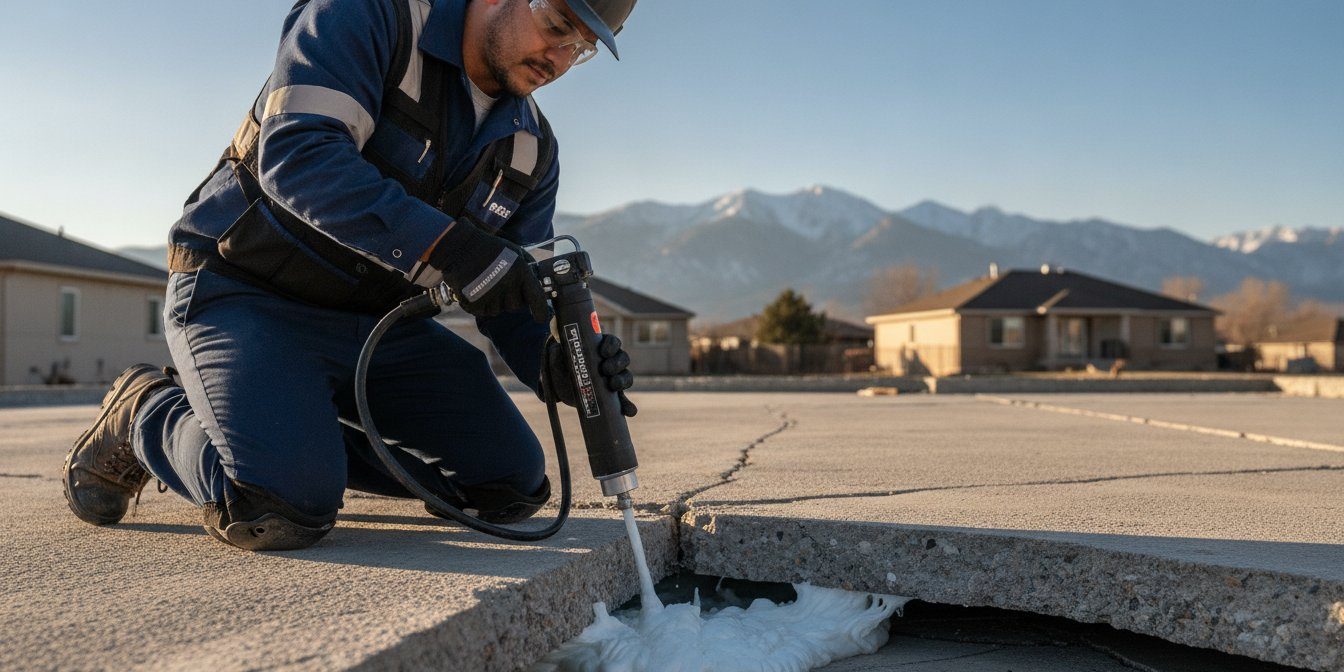
The mechanics of this process involve a two-part polymer that expands upon injection. As the foam reaches its target density, it exerts enough controlled pressure to lift massive concrete sections, including load-bearing warehouse floors and residential foundations. This method aligns with current research on effective structural concrete repair, which emphasizes the importance of using materials that provide long-term durability without adding excessive weight to the soil profile.
Why Foam Beats Traditional Mudjacking
Traditional mudjacking utilizes a heavy slurry of sand, cement, and water that can weigh upwards of 100 pounds per cubic foot. In the Denver metro area, adding this much mass to already failing expansive soil often accelerates secondary settlement. Polyurethane is significantly lighter, adding only about 3 to 5 pounds per cubic foot while offering superior compressive strength. It is also hydrophobic. It won’t wash away during intense Colorado spring rains or snowmelt cycles. For commercial operations in Lakewood or Thornton, the rapid cure time is a primary advantage. Most slabs are ready for full structural loads within 15 to 30 minutes, compared to the days of downtime required for cementitious grouts to reach full strength.
The Precision of Structural Foam Injection
Precision is the hallmark of modern restoration. Technicians use small, 5/8-inch injection ports, which allows for minimal site disturbance and maintains the aesthetic integrity of the concrete. This level of control enables a “lift-to-level” accuracy within fractions of an inch, which is critical for maintaining the drainage slopes and door alignments of heavy-load slabs. Utilizing foam concrete lifting for these high-stakes environments provides a cleaner, faster, and more reliable alternative to total demolition. It is a methodical approach that prioritizes technical mastery over brute-force replacement.
Restoring Reinforcement: Post-Tension Cable Repair Strategies
Post-tensioned slabs act as the structural backbone for many modern developments across the Front Range. While the soil stabilization discussed in the previous section addresses the ground, post tension installation provides the internal tensile strength required for a slab to resist the bending forces of Denver’s expansive clay. When a tendon fails, the slab loses its ability to distribute loads effectively. This is why structural concrete repair denver must often include specialized cable restoration to maintain the building’s original engineering intent.
Modern systems typically utilize greased and sheathed tendons, which allow the steel to move freely within the concrete. Older unbonded systems, however, are more prone to corrosion if moisture penetrates the slab. Restoring these systems isn’t a task for general contractors. It requires specialized certification and precision equipment to handle the immense energy stored within the cables.
The Anatomy of a Post-Tension Repair
A successful repair begins with locating the failure point and creating an access pocket at the anchor end. Once the damaged section is exposed, technicians remove the failed anchor and prepare the cable for re-tensioning. Using calibrated hydraulic jacks, we restore the specified tension, which typically reaches approximately 33,000 pounds of force for a standard half-inch diameter tendon. This level of technical mastery is what separates high-quality structural concrete repair denver from temporary patches. Finally, the new anchors receive a high-performance corrosion-inhibiting coating to ensure the repair lasts for the life of the structure.
When to Choose Repair Over Total Slab Replacement
The decision to repair rather than replace a failed slab is often driven by a clear return on investment. Demolishing a post-tensioned slab and re-pouring it can cost ten times more than a targeted structural restoration. Choosing concrete slab repair without replacement also preserves the original structural design without the logistical nightmare of a full-scale construction site. Beyond the financial savings, restoration has a significantly lower environmental footprint, as it reduces the amount of concrete waste sent to local landfills.
If you’ve identified signs of cable distress or a recent blowout, consult with the post-tension specialists at RiseLock Concrete Lifting to evaluate your restoration options. Maintaining the tension in your foundation is the most effective way to protect your long-term property value.
Selecting a Structural Concrete Contractor in the Denver Metro Area
Choosing a partner for structural concrete repair denver is a decision that directly impacts the long-term safety and financial value of your property. In a region where soil movement is a constant variable, generic solutions often fail to address the underlying engineering challenges. A qualified contractor must possess a deep understanding of the 2024 building code updates and the specific permitting requirements for foundation stabilization in the Front Range. This requires more than just mechanical skill; it demands a commitment to technical mastery and ethical service.
Local experience isn’t a luxury in Colorado; it’s a technical necessity. A contractor who has worked extensively with the Denver Formation clays knows that a “quick quote” based on a few photos is rarely accurate. A professional firm will always insist on a comprehensive site assessment to measure floor elevations, identify crack patterns, and determine if the issue stems from soil upheaval or sub-grade erosion. This methodical approach ensures the proposed solution restores the load-bearing capacity of the structure rather than just masking the symptoms for a few months.
Key Questions for Your Structural Contractor
Before signing a contract, it’s essential to vet the technical competence of the team. We recommend asking the following questions to ensure your property is in professional hands:
- Do you have specific experience with post-tension cable blowouts? PT systems require specialized hydraulic equipment and safety protocols that general concrete contractors often lack.
- What type of polyurethane do you use for stabilization? Ensure they utilize high-density, closed-cell foam specifically engineered for structural loads, rather than cheaper, less durable alternatives.
- What is your warranty on structural stabilization in expansive soil? A reputable provider should stand behind their work with a clear, written guarantee that addresses the unique challenges of Denver’s bentonite clay.
The RiseLock Concrete Lifting Advantage: Precision and Reliability
RiseLock Concrete Lifting has established itself as the authority in Denver, Aurora, and the surrounding metro area by prioritizing precision over volume. Led by Alex Mon, our team views every structural challenge as a personal priority. We don’t believe in one-size-fits-all fixes. Instead, we utilize advanced materials and high-precision techniques to provide long-term security for our clients. Whether you are dealing with a residential foundation issue in Castle Rock or a commercial slab failure in Boulder, we bring the same level of technical rigor to every project.
Structural integrity is the foundation of your peace of mind. By choosing a partner that values engineering precision and professional reliability, you can move past the stress of property damage toward a permanent solution. Contact RiseLock Concrete Lifting for a Professional Structural Assessment today to protect your investment with the modern restoration standards your property deserves.
Securing Your Property’s Structural Future
The battle against Colorado’s expansive soils requires a shift from reactive patching to proactive, engineered restoration. We’ve explored how high-density polyurethane stabilization and specialized post-tension cable repair provide a durable alternative to the high cost of total concrete replacement. By addressing sub-grade voids and internal reinforcement failures, you ensure your foundation remains resilient against the Front Range’s volatile “heave and settle” cycles.
Effective structural concrete repair denver is not just about fixing a visible crack; it’s about restoring the technical integrity that protects your long-term investment. As post-tension cable repair specialists, RiseLock focuses on high-precision interventions that meet modern building codes while minimizing site disruption. Our team utilizes high-density polyurethane stabilization to provide immediate security for properties across the entire Front Range. It’s a methodical approach that prioritizes your safety and long-term property value.
Don’t let structural distress compromise your building’s safety. It’s time to move toward a permanent, professionally engineered solution that provides lasting peace of mind. Your property deserves the highest standard of technical care. Schedule Your Structural Concrete Assessment with RiseLock today to ensure your foundation is prepared for the years ahead.
Frequently Asked Questions
How do I know if my concrete crack is structural or cosmetic?
Structural cracks generally exceed one eighth of an inch in width or show a vertical offset where one side of the crack is higher than the other. Cosmetic cracks are often hairline in nature and result from minor shrinkage during the curing process. If you notice stair-step patterns in your foundation walls or slab-on-grade separation, it’s a clear signal that the load-bearing integrity is compromised and requires a professional assessment.
Is polyurethane foam strong enough to support a house foundation?
High-density polyurethane foam is specifically engineered to support heavy structural loads, including residential foundations and commercial warehouse floors. Once injected, the material expands to fill sub-grade voids and densifies the surrounding soil. This creates a stable, high-compressive-strength base that won’t degrade over time, making it a reliable tool for structural concrete repair denver projects where soil stabilization is the primary goal.
What causes a post-tension cable to blow out in Denver?
Post-tension cable blowouts in the Denver metro area are typically caused by moisture-driven corrosion or extreme soil movement. When water penetrates the slab and reaches the steel tendons, the resulting oxidation weakens the metal until it can’t hold its specified tension. Additionally, the aggressive swelling of bentonite clay can exert enough pressure on the slab to snap tendons that were improperly anchored or previously compromised.
How long does structural foam concrete lifting last in Colorado soil?
Structural foam concrete lifting is intended to be a permanent restoration method. Because the polyurethane is a closed-cell, non-biodegradable polymer, it won’t wash away or erode during the intense spring snowmelts common in Colorado. Unlike traditional mudjacking slurry, the foam maintains its density and volume for the life of the structure, providing long-term security against the heave and settle cycles of the Front Range.
Can you repair a post-tension slab without tearing it all out?
Targeted restoration is entirely possible through specialized re-tensioning and anchoring techniques. Instead of a total demolition, technicians create small access pockets to reach the failed cable ends. Using calibrated hydraulic jacks, the tendons are pulled back to their original design tension and secured with new anchors. This process restores the slab’s tensile strength while avoiding the logistical and financial burden of a full-scale tear-out.
How much does structural concrete repair cost in Denver compared to replacement?
Repairing existing concrete is significantly more cost-effective than a total replacement. While full demolition and re-pouring involve massive labor and material expenses, targeted restoration focuses only on the failure points. Property owners often find that structural concrete repair denver costs are a fraction of the investment required for a new foundation, especially when factoring in the speed of modern polyurethane and post-tensioning methods.
Do I need a structural engineer for my concrete repair project?
You should consult a structural engineer if you observe significant foundation displacement or if the repair involves complex stabilization like deep piering. Recent updates to Denver building codes require engineered plans for many structural interventions to ensure safety and compliance. A licensed professional provides the technical roadmap that ensures your restoration meets the high standards required for Colorado’s unique geological conditions.
Is mudjacking still a viable option for structural repair?
Mudjacking is rarely the best choice for modern structural stabilization. The heavy cement and sand slurry adds thousands of pounds of extra weight to the soil, which can actually accelerate settlement in Denver’s sensitive clay. Modern polyurethane is much lighter and offers better precision. It’s the preferred alternative for those seeking a durable, high-tech solution that won’t put additional stress on an already failing foundation.