
A crack or rust stain in a post-tensioned slab doesn’t reveal how much damage lies beneath the surface. Corrosion can remain concealed, and visible signs may point to a concern without confirming its cause. If you’re researching post tension cable corrosion repair Wheatridge, start by locating the tendon concern, then match the response to the identified damage.
It’s understandable to wonder whether a tendon can be repaired or needs replacement, especially when the signs are difficult to interpret. Cracking, flaking concrete, or rust staining can be reasons to seek an assessment, but they aren’t a diagnosis on their own. Avoid cutting or drilling into a post-tensioned slab without knowing where its tendons are.
This article explains how corrosion can affect post-tension cables, which signs may warrant attention, and how damaged tendons can be located and addressed. RiseLock Concrete Lifting provides tendon locating, repair, and replacement, along with concrete repairs for post-tensioned structures in Wheat Ridge. As a PTI-certified contractor and fully insured company, RiseLock Concrete Lifting focuses on understanding the concern and identifying an appropriate next step.
Key Takeaways
- A post-tension tendon is a tensioned steel element within a concrete system. Corrosion can affect it, but a surface stain or crack alone doesn’t prove tendon damage.
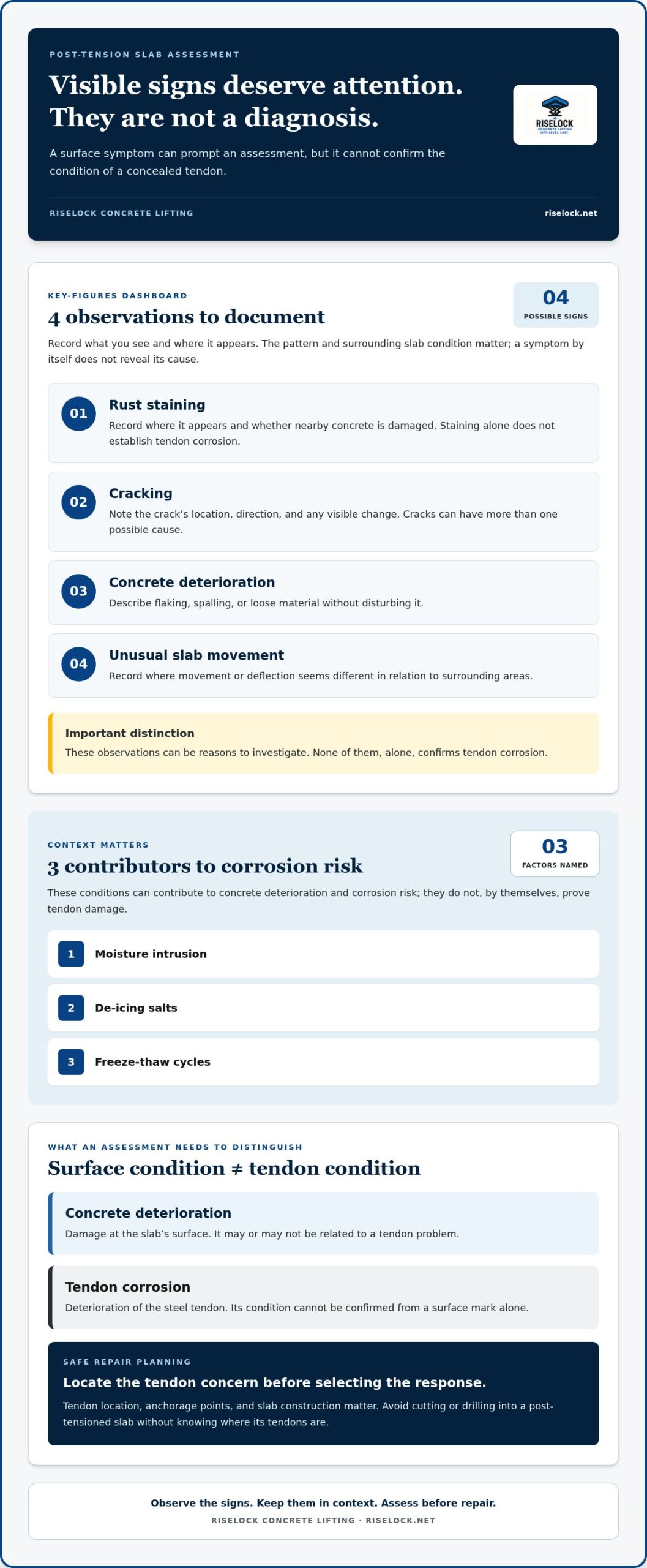
- Rust staining, cracking, concrete deterioration, or unusual slab movement may signal a concern. Consider them in context rather than treating a visible symptom as a diagnosis.
- Learn the assessment sequence for post tension cable corrosion repair Wheatridge, from describing the concern and locating affected tendons to selecting an appropriate repair response.
- Tendon locating, tendon repair, tendon replacement, and concrete repair serve different purposes. The identified tendon and concrete conditions guide which work is appropriate.
- RiseLock provides tendon and concrete repair services for post-tensioned structures as a PTI-certified contractor and fully insured company.
Post-Tension Cable Corrosion in Wheat Ridge: Why It Deserves Attention
Post-tensioned concrete depends on steel tendons working with the slab. If a tendon corrodes, its condition may affect how the system performs, but a surface crack or rust-colored mark alone can’t tell you whether that has happened. Moisture intrusion, de-icing salts, and freeze-thaw cycles can contribute to concrete deterioration and corrosion risk. The useful first step is distinguishing a visible symptom from a confirmed tendon problem.
Tendon corrosion is deterioration of the steel tendon; visible concrete deterioration is damage at the slab’s surface, which may or may not be related. The two can occur together, but one doesn’t automatically prove the other. Likewise, a smooth, intact-looking surface doesn’t establish that hidden tendons are sound.
How post-tension tendons support a concrete slab
A post-tension tendon is a tensioned steel element within a concrete system. Its force helps reinforce the slab by placing the concrete under compression. Tendon locations, anchorage points, and the way the slab was built matter when planning a repair. Cutting or drilling in the wrong place can interfere with a tendon, so understand the system before work begins. For an overview of the method and its components, see What is Post-Tensioned Concrete?
Post-tensioned foundations and slabs aren’t approached exactly like ordinary concrete surfaces. Knowing the layout helps guide repair work, rather than treating the slab as solid, uniform concrete. RiseLock’s post-tension installation guide explains how tendon placement fits into a structure and why locating tendons is part of responsible repair planning.
Why surface appearance cannot confirm cable condition
Rust staining, cracks, flaking concrete, or unusual slab movement can be reasons to investigate, but each symptom can have more than one possible cause. A crack may reflect a concrete issue unrelated to tendon corrosion; staining may indicate moisture without revealing what is happening to the steel. The pattern, location, and surrounding condition of the slab all matter. These signs deserve attention, not assumptions.
Corrosion may also develop where it isn’t visible from the surface. Neither a single mark nor an apparently sound finish can confirm a tendon’s condition. Avoid cutting or drilling into a post-tensioned slab based on a guess about where the steel lies. Assessment and tendon locating help establish what is present before a repair approach is selected.
For owners looking into post tension cable corrosion repair Wheatridge, the distinction matters: concrete repair addresses affected concrete, while tendon repair or replacement responds to the identified condition of the steel. The appropriate work depends on what assessment reveals about both. This system-specific approach keeps visible symptoms in context and directs attention to the structural concern.
Possible Signs of Corroded Post-Tension Cables in Wheat Ridge
A stain, crack, or change in a slab’s surface can be unsettling, but no single visible symptom identifies its cause. In a post-tensioned structure, these observations may be reasons to investigate the concrete and tendon system together. Their meaning depends on where they appear, how they relate to other conditions, and whether they change over time.
Visible symptoms can prompt an assessment, but they can’t confirm tendon corrosion on their own. A photograph can help show what you’ve noticed, but it can’t establish the condition of a concealed steel tendon. An isolated surface mark isn’t a tendon diagnosis, and a lack of obvious damage doesn’t confirm that hidden components are sound.
What rust stains, cracks, and concrete damage may indicate
Rust-colored staining may be associated with moisture or materials within or near concrete, but its appearance alone doesn’t establish that a post-tension tendon is corroding. Cracks can arise for different reasons, while flaking or spalling concrete may point to deterioration that warrants attention. In a post-tensioned slab, the location and pattern of these conditions matter. An assessment is needed to distinguish a surface concern from tendon damage.
Look at the broader picture rather than relying on one clue. Note whether a crack crosses a larger area, whether concrete is breaking away, or whether a section of the slab appears to move or deflect differently from nearby areas. These observations can help describe the concern, but they shouldn’t be used to decide what caused it.
- Rust staining: Record where it appears and whether nearby concrete is damaged.
- Cracking: Note the crack’s location, direction, and any visible change.
- Concrete deterioration: Describe flaking, spalling, or loose material without disturbing it.
- Unusual slab movement: Record where the change is noticeable in relation to surrounding areas.
When a Wheat Ridge property owner should seek an assessment
Seek an assessment when concrete symptoms appear around a post-tensioned slab, particularly if several observations occur together or the condition seems to be changing. This doesn’t mean corrosion is confirmed. It means the issue deserves a closer look in the context of the whole slab and its construction.
Keep a simple record: the location, what the surface looks like, and whether you’ve noticed a change. Photos taken from a consistent viewpoint can document appearance, but they remain supporting information, not a diagnosis. Don’t cut, drill, or chip into the slab to investigate; tendon locations need to be understood before intrusive work is considered.
For property owners considering post tension cable corrosion repair Wheatridge, separating observations from conclusions is a useful first step. RiseLock provides locating, repair, and replacement of damaged tendons, as well as concrete repairs for post-tensioned structures. Learn about RiseLock’s post-tension repair services as you consider the right next step for a slab concern.
How Tendon Corrosion Is Assessed Before Repair or Replacement
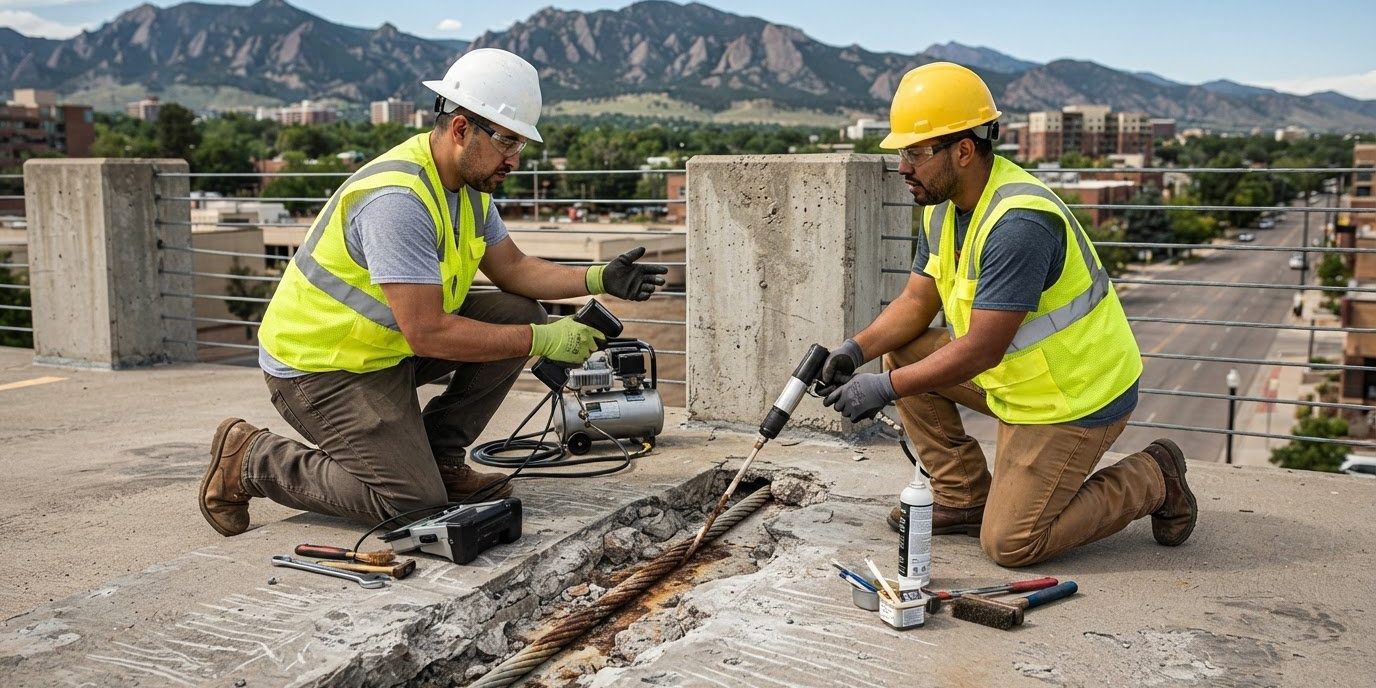
A sound repair decision follows a clear sequence. The visible concern starts the conversation, but the work depends on what’s found in the tendon system and the concrete around it. Locating damaged tendons is a distinct part of the process. It helps establish where the concern is instead of assuming every stain or crack means a tendon needs replacement.
For a Wheat Ridge property owner, the assessment can be understood in four steps:
- Understand the concern. Describe what prompted attention and where it appears on the slab. Notes about the location and observed changes help frame the issue.
- Locate damaged tendons. Identify the tendon area relevant to the concern before deciding what work is appropriate.
- Determine the service. Consider whether the identified tendon condition calls for repair or replacement, or whether concrete repair is also needed.
- Address affected concrete. Plan concrete work in relation to the tendon findings, rather than treating surface damage as a separate diagnosis.
Locating damaged tendons in a post-tensioned slab
Knowing where tendons lie matters because they’re part of the slab’s structural system. Their location helps guide repair planning and focus work on the area associated with the concern. RiseLock provides tendon locating as part of its post-tension services, alongside repair and replacement of damaged tendons. Locating is an important step, but it doesn’t automatically mean replacement is necessary; the next decision depends on the identified condition.
Deciding between tendon repair, replacement, and concrete repair
Tendon repair and tendon replacement are different responses to a damaged tendon. Which is appropriate depends on the condition identified during assessment, not simply on the presence of a surface mark. Concrete repair is also distinct: it addresses affected concrete in a post-tensioned structure, but it doesn’t take the place of tendon work if a tendon is damaged. A project may involve one or more of these services, depending on the findings.
This distinction keeps the repair decision specific. A crack or deteriorated area may call for attention to the concrete, while an identified tendon concern requires a tendon-focused response. Assessment connects those findings rather than presuming one service resolves every part of the problem. It also gives the owner a clearer basis for understanding why repair, replacement, concrete work, or a combination may be considered.
For anyone researching post tension cable corrosion repair Wheatridge, locating comes before selecting the response. RiseLock connects tendon locating with repair or replacement, then considers related concrete repairs in light of the identified condition. This sequence matches the work to the concern without treating every visible symptom as proof of tendon damage.
Repairing Corroded Post-Tension Cables: What Wheat Ridge Owners Should Understand
Post-tension repair isn’t a single, interchangeable service. Tendon locating, tendon repair, tendon replacement, and concrete repairs each address a different part of the concern. The appropriate work depends on the identified tendon condition and the affected concrete, not on a generic checklist or one visible symptom. Assessment connects what’s found to the scope of work without assuming every concern requires the same response.
| Service | Purpose | What guides its use |
|---|---|---|
| Tendon locating | Identify the tendon location relevant to the concern and planned work. | The slab and the area being assessed. |
| Tendon repair | Address an identified damaged tendon through repair. | Assessment findings about the tendon’s condition. |
| Tendon replacement | Replace an identified damaged tendon when that response is appropriate. | The condition of the tendon and the repair assessment. |
| Concrete repairs | Address affected concrete in a post-tensioned structure. | The location and extent of concrete damage. |
Tendon repair versus tendon replacement
Tendon repair and tendon replacement are distinct services. Repair addresses an identified damaged tendon; replacement is a different response for an identified damaged tendon when appropriate. Neither option should be assumed from a surface mark alone. Suitability depends on the condition identified during assessment, so the decision follows the findings rather than a preset rule that all corrosion requires replacement.
This distinction matters when comparing repair options. A concern may involve a tendon, the concrete around it, or both. The service selected should reflect what the assessment identifies. That keeps the conversation focused on the actual condition instead of treating “repair” as one catch-all task.
How concrete repairs relate to tendon work
Concrete repairs address damage to concrete within a post-tensioned structure. They can be related to tendon work because both may be part of addressing one slab concern, but they are separate scopes: repairing concrete doesn’t itself repair or replace a damaged tendon. Likewise, concrete lifting is not a tendon corrosion repair method. Keeping these categories distinct helps clarify what each part of a project is intended to address.
For broader context on concrete restoration, RiseLock’s Denver concrete repair guide discusses concrete repair considerations beyond tendon-specific work. For post tension cable corrosion repair Wheatridge, let the identified condition guide whether tendon locating, tendon repair, replacement, concrete repairs, or a combination is appropriate.
RiseLock provides locating, repair, and replacement of damaged tendons, as well as concrete repairs for post-tensioned structures. To discuss a tendon or concrete concern in Wheat Ridge, contact RiseLock about post-tension repair.
RiseLock’s Post-Tension Cable Corrosion Repair in Wheat Ridge
Post-tension concerns call for work that accounts for both the tendons and the concrete around them. RiseLock supports Wheat Ridge property owners with locating, repairing, and replacing damaged tendons, along with concrete repairs for post-tensioned structures. These are distinct services, and the appropriate scope depends on the identified condition rather than an assumption based on surface appearance alone.
RiseLock’s services for post-tensioned structures
Locating helps identify the tendon area relevant to the concern. From there, tendon repair or replacement may be appropriate depending on the tendon condition, while concrete repair addresses affected concrete in the structure. One service doesn’t automatically substitute for another; a project may require tendon work, concrete work, or both based on its findings. This coordinated focus is central to post tension cable corrosion repair Wheatridge.
RiseLock is a PTI-certified contractor and fully insured. Its work includes post-tension installation as well as locating, repairing, and replacing damaged tendons. For owners, that means the discussion can focus on the particular slab concern and the relevant post-tension services, rather than treating every crack or stain as the same repair problem.
A clear next step for a Wheat Ridge property owner
If you’ve noticed a possible concern, sharing its location and what you’ve observed gives RiseLock a practical starting point for discussing the work. If you already have assessment findings, those can help describe what has been identified. RiseLock can provide a fair estimate based on the concern and service involved, without assuming tendon replacement is necessary in every case.
Repair work on a post-tensioned structure deserves care and a clear understanding of what the work is intended to address. RiseLock emphasizes professional work ethics and customer focus, with the assurance, “We guarantee the job is done right.”
To discuss a post-tension concern at your Wheat Ridge property and request a fair estimate, Contact RiseLock about post-tension cable repair.
Take the Next Step Toward a Clear Repair Plan
A concern in a post-tensioned slab can feel difficult to act on when its cause isn’t obvious. You don’t need to settle on a diagnosis or decide between repair and replacement before starting a conversation. Share what you’ve noticed and where it appears; that gives RiseLock a practical starting point for discussing the next step for your Wheat Ridge property.
For post tension cable corrosion repair Wheatridge, RiseLock provides tendon locating, repair, and replacement as a PTI-certified contractor and fully insured company. The work is guided by the condition identified, helping you move from uncertainty toward a considered path forward.
RiseLock serves property owners in Wheat Ridge, Denver, Aurora, Centennial, Parker, Colorado Springs, Englewood, Littleton, Lakewood, Arvada, Thornton, Wheatridge, Castle Rock, Castle Pines, and Boulder. Contact RiseLock about post-tension cable repair to discuss your concern and take a clear first step.
Frequently Asked Questions
Can post-tension cables corrode inside a concrete slab?
Yes, a steel tendon can corrode while concealed within a concrete slab if moisture reaches it. Moisture and de-icing salts can contribute to corrosion, while freeze-thaw cycles may contribute to cracking that allows moisture intrusion. Surface appearance alone can’t show what’s happening inside. If a slab has signs of deterioration, a post-tension-focused assessment can help determine whether the concern involves concrete, tendons, or both.
What are the signs of post-tension cable corrosion?
Possible signs include rust-colored staining, cracks that widen, flaking or spalling concrete, efflorescence, or unusual slab movement. These clues aren’t specific to tendon corrosion and can have other causes. Consider how the signs relate to each other and where they appear rather than treating one mark as proof. A sudden tendon blowout is a serious failure sign; don’t approach or disturb the affected area.
Can a corroded post-tension cable be repaired, or does it need replacement?
A damaged tendon may be repaired or replaced, depending on its identified condition and the assessment findings. Corrosion alone doesn’t establish which service is suitable, and replacement isn’t an automatic response to a suspicious stain or crack. The repair decision considers the tendon and affected concrete. RiseLock provides tendon locating, repair, and replacement, so the appropriate service can be based on the specific post-tension concern.
Does rust staining mean a post-tension cable has failed?
No, rust staining by itself doesn’t confirm tendon failure. It can be a reason to investigate, but the stain’s appearance doesn’t establish its source or the condition of steel concealed in the slab. Note where the discoloration appears and whether nearby concrete has other changes, then share those observations during an assessment. Avoid drilling or chipping around the stain to look for a tendon.
Does post-tension cable corrosion mean the whole concrete slab must be replaced?
No, tendon corrosion doesn’t automatically mean the entire slab needs replacement. The appropriate work depends on the condition of the tendon and the extent of affected concrete. A focused tendon repair or replacement, with related concrete repairs where needed, may be considered based on the findings. No single visible symptom can determine the scope. An assessment helps establish what’s affected before decisions about the slab are made.
Does RiseLock provide post-tension cable repair in Wheat Ridge?
Yes. RiseLock provides locating, repair, and replacement of damaged tendons, along with concrete repairs for post-tensioned structures. Wheat Ridge property owners researching post tension cable corrosion repair Wheatridge can discuss the observed concern and assessment findings with RiseLock. The company also serves Denver, Aurora, Centennial, Parker, Colorado Springs, Englewood, Littleton, Lakewood, Arvada, Thornton, Wheatridge, Castle Rock, Castle Pines, and Boulder.
Is post-tension cable repair the same as concrete lifting?
No, these are different services. Post-tension cable repair addresses a damaged tendon within a post-tensioned structure. Concrete lifting addresses sunken or uneven concrete surfaces, such as a driveway, sidewalk, patio, or garage floor. Lifting isn’t a method for repairing a corroded tendon. Identifying whether the concern is tendon-related, surface-related, or both helps clarify which service addresses the issue.