
A hollow, echoing thump beneath your footsteps is a clear warning that your concrete slab has lost contact with the earth below. When shifting Front Range soils contract during dry periods, bridging cavities quietly form beneath basements and garages, making it critical to fix hollow spots under concrete floor Littleton homes before unsupported slabs crack or settle under daily traffic.
You already know that leaving empty pockets beneath a slab invites structural damage, yet the thought of jackhammering finished surfaces creates valid dread over dust, disruption, and downtime. Fortunately, stabilizing your subgrade doesn’t require tearing out the slab or compounding soil stress with heavy traditional grouts.
Discover how professional polyurethane void filling diagnoses, stabilizes, and permanently repairs hollow sub-floor spots across Littleton homes. This guide explains the regional geological factors driving sub-slab voids, illustrates how expanding geotechnical foam restores structural load capacity within thirty minutes, and details the steps required to secure lasting floor stability.
Key Takeaways
- Acoustic tap-testing and sounding techniques allow homeowners to detect hidden sub-slab voids early, preventing sudden slab fractures before surface settlement begins.
- Modern geotechnical polyurethane injection delivers a clean, permanent method to fix hollow spots under concrete floor Littleton homes without disruptive slab demolition.
- Expanding high-density polymer cures within 15 to 30 minutes, restoring full load-bearing capacity without adding heavy surcharge weight to vulnerable subgrade soils.
- Seasonal shrink-swell cycles in Littleton’s native bentonite clay strata create sub-floor cavities, requiring solutions engineered specifically for local soil behavior.
- Vetting qualified local contractors requires verifying commercial-grade hydraulic proportioning equipment and a precise understanding of floating versus structural slab foundations.
Identifying Hollow Spots Under Concrete Floors in Littleton
A sub-slab void occurs when the supporting soil base consolidates, shrinks, or washes away beneath a rigid concrete surface, leaving an air pocket between the earth and the floor. Concrete possesses immense compressive strength, but it relies on uniform ground contact to distribute downward weight. When bridging cavities form, that foundational balance disappears. Knowing how to detect these hidden spaces early is vital for property owners who need to fix hollow spots under concrete floor Littleton structures before minor settlement becomes structural failure.
Acoustic mapping provides the most dependable, non-invasive method for identifying voids before visual cracks emerge. Dragging a heavy steel chain across bare concrete quickly differentiates solid subgrade from empty space; a dull, muted scrape indicates firm ground support, whereas a sharp, hollow rattle reveals an underlying void. For finished spaces or localized spots, a weighted golf ball tap-test works remarkably well. Bouncing the ball every few inches produces an echoing ring over unsupported pockets, clearly outlining where the concrete spans an empty expanse.
Visual clues often accompany these acoustic changes. Unlike superficial crazing or shrinkage lines, true void-related cracks track the unsupported perimeter and widen under load. Property owners may notice springy vinyl planks, sudden grout line crumbling in tiled basements, or baseboards detaching from the floor as the slab subtly sags into empty space. Understanding these symptoms aligns with the fundamental mechanics of concrete leveling and slabjacking methods, where prompt diagnostic mapping separates localized cosmetic flaws from serious load-bearing failure.
Acoustic and Visual Indicators of Sub-Floor Voids
An echoing hollow ring confirms the concrete slab has completely detached from its gravel or soil bed. As the slab flexes without substrate contact, brittle materials above give way. Grout joints shear apart, floor tiles crack along clean lines, and baseboards reveal widening gaps along wall perimeters. Hairline cracks often propagate along the void perimeter, outlining the hidden boundaries beneath your feet.
The Structural Risks of Delayed Void Remediation
Delaying repairs turns simple cavities into major structural liabilities. Unsupported concrete cannot sustain heavy point loads; a parked vehicle in a garage or heavy partition framing in a finished basement will cause unbacked slabs to shear along void edges. These subterranean cavities also act as conduits for subsurface moisture along foundation walls, which accelerates erosion and makes the urge to fix hollow spots under concrete floor Littleton properties a matter of urgency rather than deferred maintenance.
Polyurethane Foam Injection: Modern Void Filling Versus Alternatives
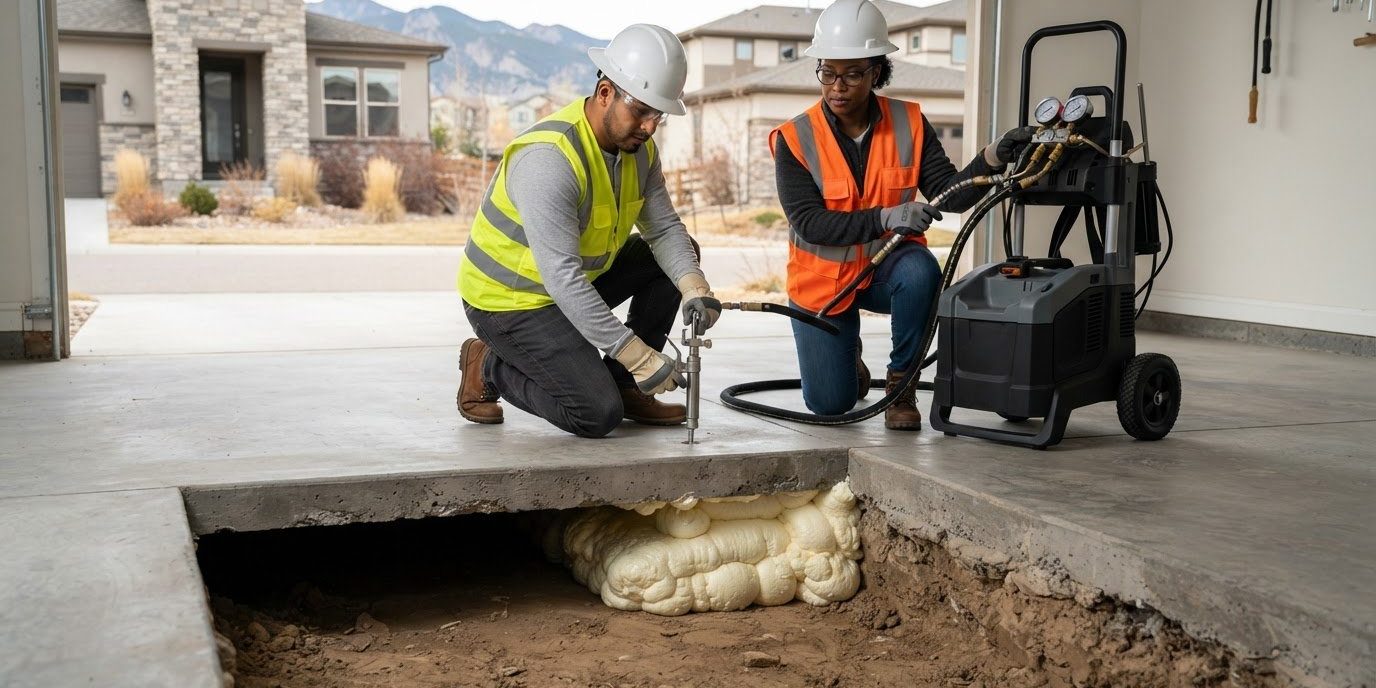
Two-part expanding geotechnical polyurethane foam solves sub-slab cavities through precise chemical mechanics. When an isocyanate component and a specially formulated polyol resin blend at the injection tip, an exothermic reaction creates a dense, closed-cell matrix. As this material expands, it flows into microscopic fissures, drives out standing moisture, and solidifies into an impermeable structural base. This controlled expansion makes it possible to fix hollow spots under concrete floor Littleton structures while restoring uniform ground contact. For property owners addressing uneven surfaces alongside hidden cavities, modern concrete leveling restores flat, secure surfaces without structural stress.
Subgrade stability depends heavily on total surcharge weight. According to research from the Colorado Geological Survey on expansive soils, shifting clay strata undergo extreme seasonal volume changes that undermine solid foundations. Adding excessive material weight beneath a slab often triggers secondary settlement in these fragile soils, making material density a primary concern during restoration.
Why Lightweight Foam Outperforms Heavy Mudjacking Slurry
High-density geotechnical polyurethane weighs roughly 2 to 4 pounds per cubic foot. In contrast, traditional mudjacking slurry adds 100 to 120 pounds per cubic foot. Pumping heavy cementitious grout beneath an already compromised slab increases the burden on weak Front Range soils, accelerating consolidation over time. Polyurethane foam’s hydraulic expansion exerts radial force that compacts loose sub-base gravel without introducing hundreds of pounds of unnecessary mass.
Avoiding Destructive and Costly Concrete Replacement
Demolishing an interior concrete floor causes widespread airborne dust, loud disruption, and extended residential downtime. Worse, pouring fresh concrete directly over an unstable subgrade ignores the original settlement cause, ensuring future cavities will form beneath the new slab. Choosing non-invasive polyurethane concrete lifting establishes an enduring, eco-conscious repair that stabilizes your home’s substrate without invasive excavation. Homeowners looking to fix hollow spots under concrete floor Littleton basements or garages can consult with RiseLock to evaluate their floor’s structural profile.
Step-by-Step Professional Process for Filling Concrete Floor Voids
Remediating subterranean cavities beneath interior living spaces demands surgical precision rather than brute force. When technicians arrive to fix hollow spots under concrete floor Littleton residences, they follow a methodical sequence designed to preserve finished flooring, stabilize sub-base aggregate, and restore structural load paths. This disciplined approach follows established engineering protocols, reflecting principles found in the Federal Highway Administration subsealing and slab stabilization guidelines for continuous slab support.
Every phase of the remediation protocol targets complete cavity filling without subjecting delicate interior partition walls to unintended upward movement:
- Diagnostic Mapping: Locating the exact perimeter and depth of the cavity using acoustic tapping equipment and optical laser leveling receivers.
- Micro-Borehole Drilling: Creating penny-sized injection pathways without fracturing surrounding concrete or severing internal steel reinforcement.
- Plural-Component Injection: Dispensing high-density geotechnical polymer into subgrade pockets using calibrated hydraulic proportioning systems.
- Dynamic Elevation Monitoring: Tracking slab movement in real time at sub-millimeter scales to verify void filling before lift occurs.
- Clean Patching: Extracting mechanical injection hardware and sealing ports flush with high-strength cementitious compounds.
Sub-Slab Void Mapping and Strategic Micro-Drilling
Technicians establish the subterranean void boundaries by combining acoustic resonance mapping with multi-axis laser receivers. Once the perimeter is established, operators drill 5/8-inch micro-ports through the slab. Unlike legacy methods that demand large two-inch cores, these dime-sized holes preserve slab reinforcement integrity. Drill holes are placed strategically every three to four feet across the mapped zone to ensure overlapping radial foam expansion.
Controlled High-Density Polymer Injection and Monitoring
Specialized mechanical delivery guns inject plural-component geotechnical liquid through the micro-ports directly into the subgrade void. The low-viscosity liquid travels across subterranean gravel, finding empty channels and driving out pocket moisture before expanding into a rigid structural polymer. Continuous optical laser levels monitor the floor surface during injection. This tracking detects sub-millimeter movement instantly, signaling that all underlying voids are packed solid before unwanted slab lift occurs.
Port Sealing and Immediate Operational Readiness
Once injection ceases, technicians extract the mechanical injection stems and vacuum each aperture clean. Holes are patched using high-strength, non-shrink cementitious grout tinted to match the surrounding floor finish. Because high-density polyurethane achieves over 90% of its full compressive strength in just 15 to 30 minutes, interior spaces become fully usable immediately. This rapid turnaround allows homeowners to fix hollow spots under concrete floor Littleton homes without staging multi-day relocations or halting household routines.

Littleton Soil Dynamics: Why Sub-Slab Voids Form Along the Front Range
Subterranean shifts along the Front Range stem directly from the underlying geology of the Denver Basin. Littleton sits over sedimentary bedrock formations, primarily the Denver, Arapahoe, and Pierre Shale layers. These strata contain high concentrations of weathered volcanic ash that formed smectite and bentonite clay minerals. Because Littleton receives an average of roughly 17 inches of precipitation annually, punctuated by intense spring storms and extended drought, the soil experiences continuous moisture volatility. When moisture levels drop, the sub-base retreats, leaving floating basement and garage slabs suspended over empty air.
Expansive Clay Soils in Arapahoe and Jefferson Counties
Bentonite and montmorillonite clays expand by 10 to 20 percent in volume when saturated, generating thousands of pounds of swelling pressure per square foot. During prolonged dry spells, these clays desiccate and shrink away from the underside of rigid concrete floors. Because finished basement slabs shelter subgrade soils from ambient rainfall, moisture evaporation under heated interior spaces creates localized dry zones. The clay drops downward, forming structural bridging gaps beneath the slab.
Subgrade Compaction Deficits and Subsurface Erosion
Geological shrinkage isn’t the only driver of floor cavities. Subgrade settlement frequently traces back to initial construction practices where utility trenches received inadequate mechanical compaction before the slab pour. Under-slab sanitary lines and supply plumbing can also develop pinhole leaks over decades, silently washing away sandy base aggregate into deeper strata. Combined with Littleton’s 36-inch frost line and seasonal freeze-thaw cycles, subgrade moisture migration progressively erodes uncompacted gravel, undermining interior floors from below.
Understanding this subterranean movement clarifies why simple cosmetic patches fail to fix hollow spots under concrete floor Littleton properties. Addressing these cavities requires an engineered, moisture-resistant polymer that fills intricate underground voids without reacting to cyclical clay changes. If hollow sounds or shifting floors suggest underlying settlement in your home, schedule a precision subgrade assessment with RiseLock to restore your slab’s load-bearing integrity.
Selecting a Concrete Leveling Contractor for Your Littleton Property
Selecting the right specialist to fix hollow spots under concrete floor Littleton basements or commercial spaces requires looking beyond standard flatwork credentials. Subgrade polymer injection demands specialized chemical knowledge and industrial-grade mechanics. High-performance repairs rely on commercial hydraulic proportioners that heat and pressurize plural-component resins to exact ratios. Equipment lacking precise temperature and pressure controls yields inconsistent density, leading to incomplete void fill or premature foam collapse under heavy floor loads.
Working with a dedicated regional owner-operator ensures direct accountability that national lead brokers can’t match. Local specialists understand how Front Range geology behaves across Littleton, Centennial, and Englewood. They tailor resin density specifically to counteract regional clay movement, treating the sub-base with long-term stability in mind rather than applying generic field methods.
Essential Qualifications to Require from Local Lifting Specialists
Interior slab stabilization requires distinct qualifications from routine exterior driveway repairs. Property owners should verify that a contractor carries comprehensive liability insurance tailored to interior residential work. Technicians must demonstrate specific experience navigating sub-floor utilities and finished flooring materials. Reputable specialists also provide clear diagnostic evaluations, detailing cavity boundaries before drilling begins rather than guessing injection volumes during the procedure.
Restoring Slab Stability with RiseLock Concrete Lifting
RiseLock Concrete Lifting delivers methodical, high-precision void remediation across the South Metro area. Using specialized high-density geotechnical polyurethane, our technicians stabilize unsupported slabs through discreet 5/8-inch injection ports that preserve finished surfaces. The closed-cell polymer cures within 15 to 30 minutes, restoring full load-bearing capacity without dust or invasive demolition. If hollow thumping or micro-cracks indicate void development, contact RiseLock to schedule an on-site diagnostic assessment and permanently stabilize your floor.
Securing Lasting Stability Beneath Your Littleton Concrete Floors
Sub-slab cavities don’t resolve on their own, but restoring foundational stability doesn’t require invasive floor demolition. Detecting hollow pockets early prevents perimeter shearing and sudden structural cracking. By utilizing high-density geotechnical polymers engineered specifically for Colorado expansive soils, homeowners can fix hollow spots under concrete floor Littleton residences cleanly and permanently. The lightweight material consolidates subgrade voids without adding heavy surcharge weight to sensitive Front Range clay, curing within minutes to restore true load-bearing contact.
You don’t have to tolerate echoing footsteps or worry about impending slab failure beneath your home. RiseLock protects interior spaces using discrete 5/8-inch injection ports that are patched seamlessly to preserve your flooring aesthetics. Backed by a proven local track record across Littleton, Centennial, Englewood, and Denver properties, our team delivers the surgical precision required to stabilize your floor for years to come. Schedule a precision void assessment with RiseLock today and reclaim complete confidence in the solid ground beneath your feet.
Frequently Asked Questions
How do I know if there is a hollow spot under my Littleton concrete floor?
You can identify sub-slab voids primarily through acoustic changes and subtle physical symptoms. Walking across the floor often produces a hollow, drumming resonance rather than a solid, deadened thud. Bouncing a golf ball across bare concrete clearly delineates empty sections by pitch. Visually, watch for sudden grout cracking in tiled floors, baseboard separation along interior walls, or hairline surface fractures that follow the perimeter of unsupported concrete.
Will injecting polyurethane foam crack or lift my interior tile or hardwood flooring?
No, precision injection is carefully controlled to prevent damage to finished floor coverings. Technicians monitor slab elevation continuously using optical laser levels measuring fractions of a millimeter. The polymer is introduced in controlled increments to fill subterranean voids and establish continuous ground support before any lift occurs. Because 5/8-inch access holes are positioned inconspicuously, injection preserves existing tile, hardwood, and laminate installations without cracking delicate finishes.
Why do concrete slabs in Littleton develop hollow spots underneath them?
Slabs develop hollow cavities largely due to Littleton’s native bentonite clay geology. Expansive Front Range soils swell with moisture but shrink drastically during prolonged dry conditions, pulling away from concrete slabs. Subsurface plumbing leaks, improperly compacted fill dirt in utility trenches, and concentrated runoff also wash fine aggregate away over time. These converging factors create unsupported spans, prompting property owners to fix hollow spots under concrete floor Littleton spaces before slabs fracture.
How long does high-density polyurethane void filling last in Colorado soils?
Geotechnical polyurethane foam provides a permanent repair designed to last the structural lifetime of the concrete. Because the closed-cell polymer is chemically inert, it will not decompose, rot, or leach into surrounding groundwater. Unlike cement-based slurries that wash away or break down over repeated freeze-thaw cycles, high-density foam remains impervious to moisture and retains its compressive strength indefinitely beneath Front Range residential slabs.
Can I fill a hollow space under a concrete slab myself using canned spray foam?
Canned retail spray foams lack the compressive strength and chemical formulation needed for structural void filling. Standard DIY foam is designed solely for thermal insulation and readily crushes under minimal floor loads. In contrast, professional structural remediation utilizes specialized two-part geotechnical resins heated and pumped at high pressure through hydraulic proportioners. Attempting DIY foam fills leaves voids unsupported and fails to solve subgrade stability challenges.
How long after polyurethane injection can I walk or drive on the concrete floor?
Interior concrete floors are ready for normal foot traffic and heavy structural loads within 15 to 30 minutes following injection. The chemical reaction between the polyol resin and isocyanate components takes place within seconds, expanding rapidly and reaching over 90% of its ultimate compressive strength almost immediately. Homeowners don’t need to evacuate, clear rooms for days, or delay daily household activities while the repair cures.
Is polyurethane foam injection waterproof and safe for interior home basements?
Yes, geotechnical polyurethane is completely hydrophobic and fully safe for residential interior spaces. Its dense, closed-cell structure naturally repels moisture, preventing groundwater migration and dampness from rising through basement slabs. Once cured, the polymer is entirely non-toxic, odorless, and emits zero volatile organic compounds. This makes it an exceptionally clean and safe solution to fix hollow spots under concrete floor Littleton finished basements and utility rooms.