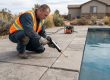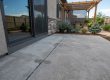

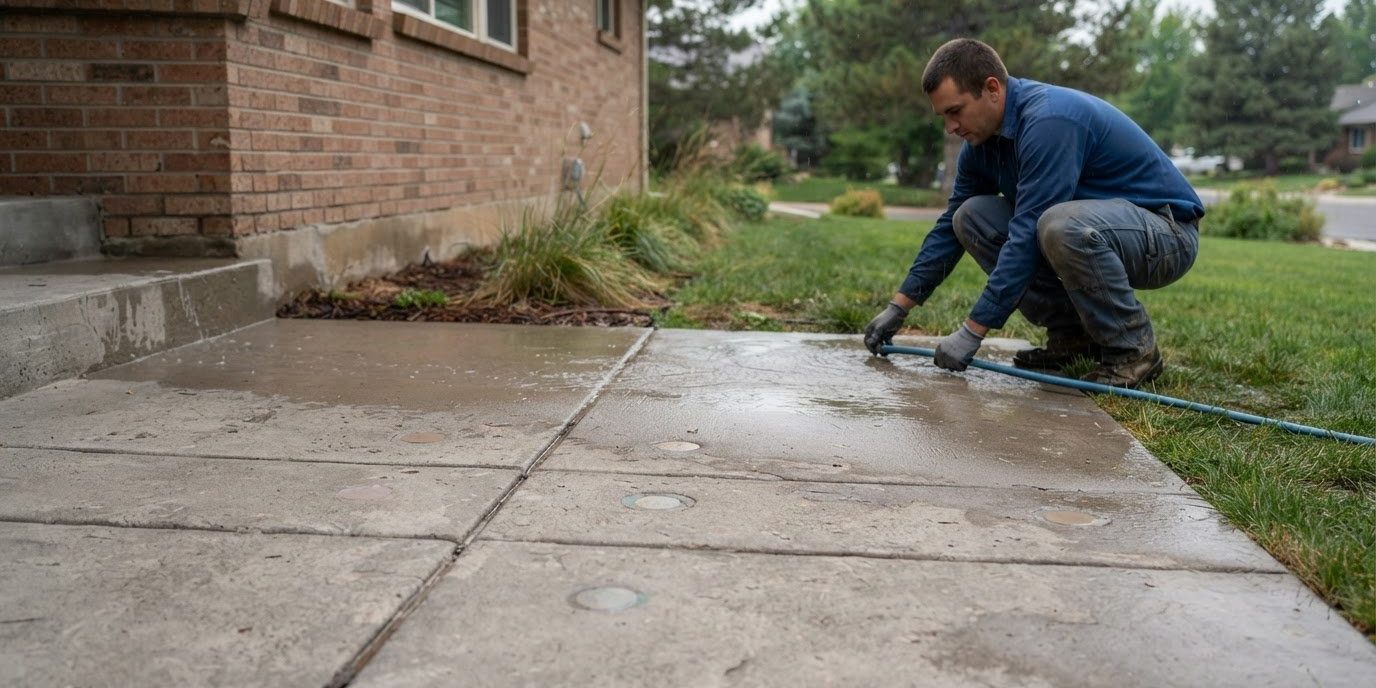
What if lifting a sloping patio level leaves water running toward the house? To fix a sloping concrete patio in Littleton, the goal is to correct settlement while preserving drainage away from the foundation. Pacific Northwest National Laboratory guidance calls for impervious surfaces within 10 feet of a foundation to slope down and away at a 2% grade, continuing for 10 feet or to the edge of the surface, whichever is less.
If you need to fix a sloping concrete patio in Littleton, concrete lifting may be an option when soil movement has settled an otherwise sound slab. Extensive cracking or weakened concrete can change the repair approach. The visible slope matters, but so do the support beneath the slab and the route runoff will take after correction.
This guide explains how drainage, backfill settlement, and slab condition affect patio leveling in Littleton. You’ll learn what to assess before choosing a repair, how to spot possible drainage issues, and when damaged concrete may need repair rather than lifting.
Key Takeaways
- Plan patio correction around where runoff should go, not just how level the surface looks.
- Backfill compaction, soil shrinkage, and water erosion can each contribute to settlement; identifying the cause helps guide the repair.
- Slab condition influences whether lifting is suitable or whether cracking and damage call for a different repair approach.
- Repair estimates depend on the patio’s size, settlement, access, drainage needs, and the work required beneath the slab.
Concrete estimates and project planning
Planning to fix a sloping concrete patio in Littleton starts with defining the slab’s dimensions, uneven areas, and intended drainage path. One Littleton patio measured roughly 25 feet by 10 feet, with about a half-inch difference between its high and low spots. Those measurements establish the footprint and slope, but they don’t reveal the full repair scope. Assessment also considers cracks, access, underlying support, and where runoff will flow after correction.
Start by assessing the concrete and its support. A sound slab over settled ground presents a different problem from fractured concrete or an unsupported edge. The repair plan should account for the area to correct, the amount and direction of lift, access to the patio, and drainage. RiseLock provides an estimate based on the site conditions.
For new concrete flatwork in Littleton, planning should account for proper excavation, a compacted base, drainage away from the house, and well-placed control joints. These elements address support and water movement, rather than simply changing surface height. For example, one proposed overlay called for 2 1/2 inches of new concrete at the house and 1 inch at the far end. That is not a universal design specification; existing cracks and slab condition affect whether an overlay is suitable. A plan to fix a sloping concrete patio in Littleton should prioritize the desired drainage direction as well as the finished height.
- Measure the slab and map its high and low areas.
- Record cracks, edges, and visible separation.
- Plan the corrected slope around drainage away from the house.
- Include excavation, base preparation, and control-joint placement when planning replacement work.
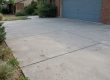
For context, a Littleton customer requested leveling for approximately 350 square feet of sunken driveway. That example shows why area matters, but the driveway figure alone doesn’t determine a patio estimate. A smaller slab may require more involved correction if access, drainage, or concrete condition complicates the work.
Causes of concrete settlement and cracking
In Littleton, a patio can settle when the soil beneath it no longer supports the slab evenly. Soil added around a home may not have been compacted sufficiently before the concrete was placed. As backfill compresses, support can drop beneath part of the patio, causing sections to sink or tilt. An edge beside disturbed ground may move before the rest of the slab.
Dry conditions can also contribute to settlement. Drought-related soil shrinkage may leave gaps or fractures beneath concrete in Littleton. As support changes, stress concentrates in the slab, which can cause a new crack or widen an existing one. When fixing a sloping concrete patio in Littleton, the crack pattern can offer clues about movement below the surface.
Rainfall can change ground support in another way. Water may soften or erode soil, leaving unstable pockets beneath a patio. Runoff that repeatedly crosses one edge, for example, can contribute to changing ground conditions. You may see a settled corner, a low section, or cracks where the slab spans a void. Assess drainage along with the concrete, since correcting the surface alone may leave the underlying issue unaddressed.
- Loose backfill: Added soil compresses and reduces support beneath the slab.
- Drought shrinkage: Drying soil can pull away from concrete and leave gaps.
- Rainfall erosion: Water can soften or remove soil, creating unstable pockets.
To help identify the likely cause, note where the patio sits low, where cracks appear, and whether runoff passes nearby. A low area beside disturbed ground suggests a different support issue than erosion along a water path. These observations help guide an assessment for fixing a sloping concrete patio in Littleton. The repair should account for both the slab and the ground supporting it.
Leveling and lifting sunken patio slabs
In Littleton, a settled patio may be corrected by leveling or lifting its slab. The right approach depends on the concrete’s condition and the intended drainage direction.
Sunken Slab Leveling
Leveling addresses uneven sections by raising low areas to meet adjoining concrete. The assessment should consider whether the slab is intact, how far it has settled, and whether correction would preserve drainage away from the house. A Littleton walkway was reportedly lifted in 2018, then sank again. That example highlights why the supporting ground and water movement matter alongside the surface height.
Patio Slab Lifting
Concrete lifting raises a sunken slab by filling or stabilizing the space beneath it. RiseLock uses expanding polyurethane foam to lift concrete in Littleton. The correction should account for the patio’s high and low edges, nearby structures, and intended drainage direction. Raising the slab until it looks level may send runoff toward the house, so appearance alone should not determine the finished position.
One suggested patio pitch is 1/4 inch per foot away from the house. Treat that figure as a proposed target, not a universal setting: site drainage and the patio’s layout affect the correction. A forum example estimated raising the house end by 1/2 inch to reach level, then lifting it more than another inch to establish an outward slope. The key is to plan for drainage, not levelness alone.
Before choosing a lift, the slab’s cracks, edges, and settlement pattern need assessment. A 10 x 24 patio was described in a Littleton leveling request, but its dimensions alone don’t determine the repair method. The concrete’s condition and access to the sunken area also matter. A lift can address a slab that has settled; extensive damage may require concrete repair instead. Matching the method to the slab helps avoid treating a surface symptom while overlooking its support.
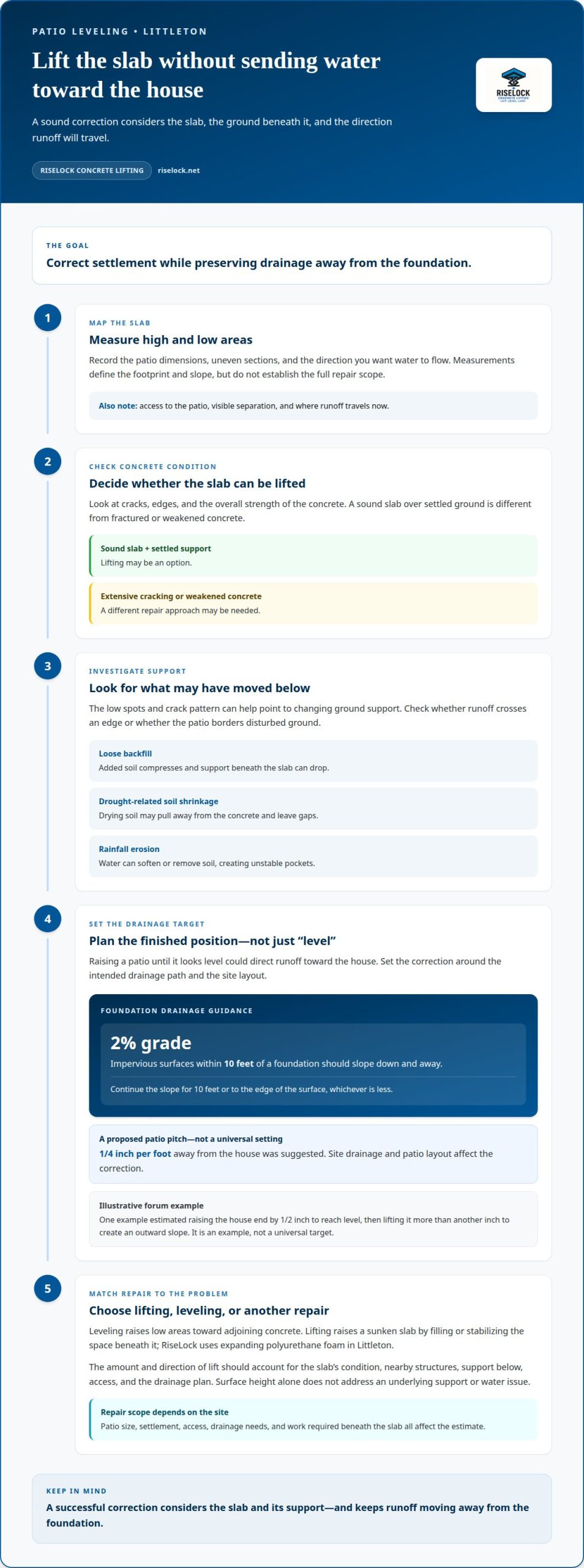
Clay soils and freeze-thaw conditions in Littleton
Clay soils and freeze-thaw weather can affect concrete patios in Littleton. A repair plan should consider seasonal ground movement as well as the current slope. Leveling changes the slab’s position, while drainage and soil support affect how well the correction suits the site. The goal is a stable surface that directs runoff appropriately.
Clay conditions and yard layouts vary across Littleton, so drainage needs differ from patio to patio. A low area beside the house, a sloped yard, and planting beds around the patio can all create different runoff paths. Observe where water travels during rainfall, then plan the corrected surface and surrounding grade together. One slope recommendation is not a complete drainage plan for every property.
Paver patios offer a useful comparison because their base can be adjusted during installation. A typical aggregate base is 4 to 6 inches deep, while the bedding-sand layer is typically 1 inch. Softer clay conditions may require a thicker base. Those dimensions describe paver construction, not a specification for lifting an existing concrete slab. They show how soil conditions can affect support decisions.
Assess whether the slab is intact and whether its current pitch sends water toward the house. A different yard layout may need a different drainage approach. Consider the patio edge, nearby structures, and where runoff goes after leaving the concrete. In Littleton, freeze-thaw exposure makes drainage and slab condition important parts of planning, not details to leave until after leveling.
A practical review follows these steps:
- Identify the patio’s low points and the direction water currently flows.
- Account for clay conditions and freeze-thaw exposure when assessing support.
- Plan the corrected slope alongside the yard’s drainage path.
For example, a patio beside a house on a sloped yard may need a drainage plan that carries water away without concentrating runoff at another edge. The finished repair should suit both the slab and the surrounding Littleton landscape, rather than rely on a standard detail.
RiseLock Concrete Lifting
RiseLock Concrete Lifting helps Littleton property owners assess sloping patios and choose a suitable concrete repair approach. The assessment considers the slab’s condition, how it settled, and whether repositioning it can maintain drainage away from the house. For a sunken, serviceable slab, concrete leveling with polyurethane foam can address the uneven surface. Damaged concrete may need concrete repair instead.
The right next step depends on the patio’s condition, not just its slope. RiseLock Concrete Lifting can help match the observed problem to a repair plan that accounts for the slab and its drainage needs. Contact RiseLock to discuss your sloping patio in Littleton.
Plan the next step for your patio
Before deciding how to fix a sloping concrete patio in Littleton, consider what you need from the space: stable footing, usable access, and drainage that works with the yard. For homeowners also looking into broader outdoor living additions or garden buildings, planning guides from builders like wbc-construction.co.uk can provide useful ideas on integrating new structures into your property layout. These goals help keep the repair discussion focused on the patio’s condition, not just a change to its surface.
RiseLock provides Concrete Leveling and Polyurethane Concrete Lifting for settled concrete, as well as Concrete Repair for damaged slabs. The company also provides Post Tension Installation for projects requiring that work. The appropriate service depends on the concrete and the project’s needs.
A useful next step is to describe where the patio has settled and how you want the area to function after repair. Start a conversation about your patio project with RiseLock Concrete Lifting. A clear discussion can help you move from a sloping surface toward a considered plan for your outdoor space.
Frequently Asked Questions
How Should a Littleton Patio Handle Drainage and Grading?
A Littleton patio should direct runoff away from the house without concentrating water at another edge. The U.S. Environmental Protection Agency advises regrading to release runoff gradually after carrying it away from the house. Deeper-rooted native ground covers and shrubs can stabilize unavoidable slopes and help prevent erosion. For example, a patio beside a sloped planting bed needs a route that disperses water rather than channeling it against the foundation.
What Causes Concrete to Settle or Crack in Littleton?
Settlement and cracking can occur when soil support changes or stress becomes uneven across a slab. In Littleton, the location and pattern of damage can help clarify what is happening. Note whether a crack runs near a sunken corner, crosses a joint, or appears beside disturbed ground. A crack with a height difference indicates movement; a surface mark without displacement presents a different repair consideration.
What Should Homeowners Confirm Before Patio Work Begins?
Before work begins, the project scope should identify the slab’s condition, the areas requiring correction, and the intended drainage direction. It should also clarify whether the work involves lifting, concrete repair, or replacement. For example, a patio with one settled edge and intact concrete presents a different scope from a slab with extensive damage. These details align the repair method with the patio’s actual condition and planned use.
What causes a concrete patio to slope or sink in Littleton, Colorado?
In Littleton, a patio may slope or sink when added soil around a home was not compacted sufficiently, drought causes soil to shrink, or rainfall softens or erodes supporting ground. Several conditions can contribute to different settlement patterns in the same yard. A low patio edge beside a runoff route, for example, calls for attention to both the slab’s position and nearby ground conditions.
How can I tell whether a sloping concrete patio needs leveling or replacement?
Leveling may suit a slab that remains intact but has settled unevenly; replacement may be more appropriate when damage leaves the concrete unsuitable to retain. Look at whether cracks are accompanied by shifting, whether edges remain connected, and how much of the patio is affected. In cases where complete removal is required, experienced property services like JBM Custom Contracting can handle concrete demolition and clearing prior to new prep work. The assessment should weigh the slab’s condition alongside the correction needed.
What methods are used to repair a sloping concrete patio, such as mudjacking or polyurethane foam lifting?
For an intact sunken slab, RiseLock uses polyurethane foam lifting: small holes are drilled, expanding foam is injected beneath the concrete, fills voids, lifts the slab, and hardens to create a stable base. For damaged concrete, RiseLock provides concrete repair. Traditional mudjacking is a separate method and is not offered by RiseLock. The company serves Littleton, Denver, Aurora, Centennial, Parker, Colorado Springs, Englewood, Lakewood, Arvada, Thornton, Wheatridge, Castle Rock, Castle Pines, and Boulder.