What if the fastest-looking fix leaves the cause of your floor damage untouched? In a busy facility, cracks, worn patches, and uneven concrete can interrupt traffic and equipment movement. But the visible surface doesn’t always show whether the slab has shifted or settled. A practical industrial concrete floor repair Lakewood plan starts by documenting the damage and assessing the slab, not choosing a repair method by appearance alone.
It’s understandable to want repairs that restore dependable use while limiting disruption to daily operations. The right approach depends on what’s happening at and beneath the concrete. Surface deterioration may call for targeted repair, while a suitable sunken or uneven slab may benefit from polyurethane lifting and leveling. Structural concerns may require a different response, including reinforcement where appropriate.
This guide explains what common industrial floor problems may indicate, how repair options address different conditions, and what to consider when planning work around equipment, traffic, and facility operations. A clear assessment of the damage and its cause helps facility teams compare options and plan work around the needs of the site.
Key Takeaways
- Track crack patterns, spalling, joint wear, and changes in slab height to build a clearer picture of floor damage.
- Consider elevation, joints, loading, and moisture together before deciding how much repair is needed.
- Compare targeted concrete repair, polyurethane lifting, and replacement based on the slab’s condition and the result required.
- Plan work by mapping affected areas, equipment routes, access needs, and facility communication.
- For industrial concrete floor repair Lakewood facilities can use concrete repair and leveling, polyurethane lifting, or structural reinforcement, depending on the assessed need.
Industrial Concrete Floor Repair in Lakewood: Recognizing Slab Problems
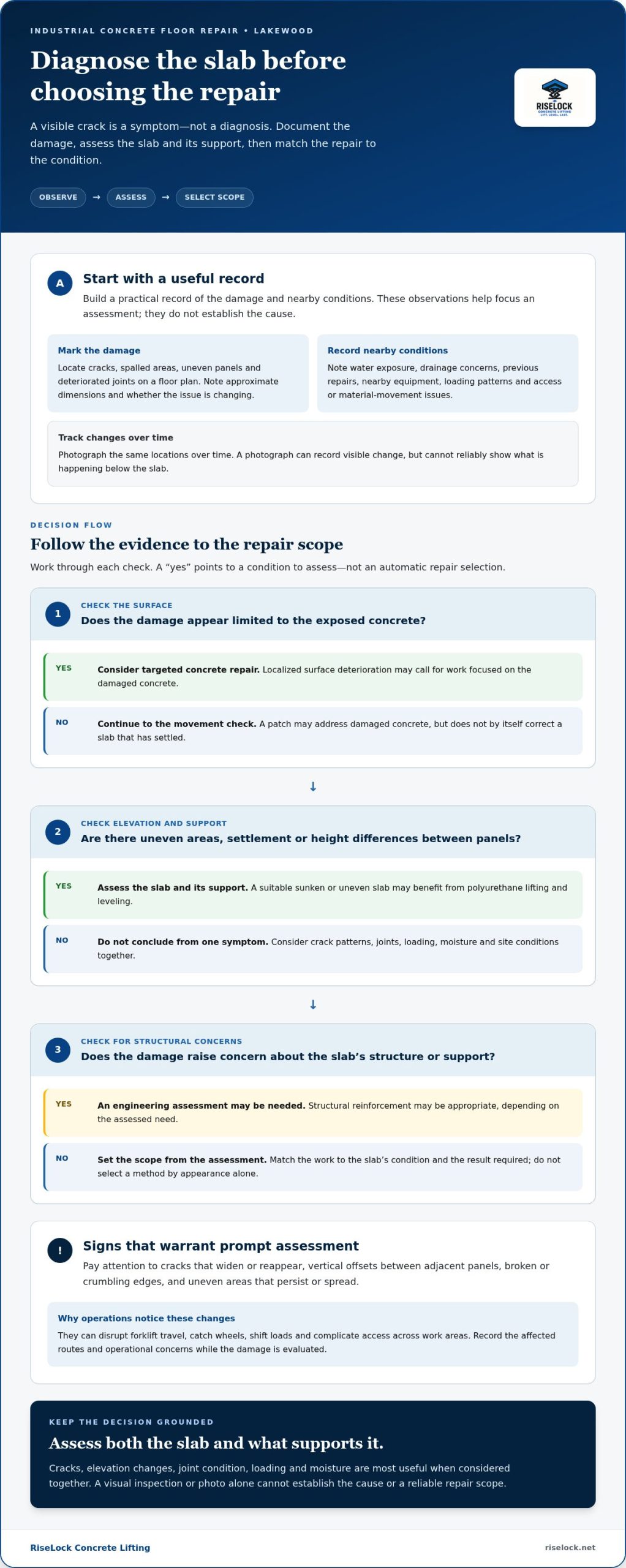
Industrial concrete floor repair restores damaged or unstable slabs to suitable service. The goal is not simply to cover visible flaws. First determine whether the issue is limited to the surface or involves the slab’s support and stability. Cracks, spalling, uneven panels, settlement, and deteriorated joints are different symptoms, and each needs assessment before selecting a repair approach.
Forklifts and other wheeled equipment repeatedly load the same routes, while machinery concentrates weight in specific areas. Water exposure, joint condition, and site conditions can also affect floor performance. Surface deterioration affects the concrete’s exposed layer; movement beneath a slab can change its elevation or support. The distinction matters: a patch may address damaged concrete, but it won’t by itself correct a slab that has settled.
Which industrial floor symptoms need prompt assessment?
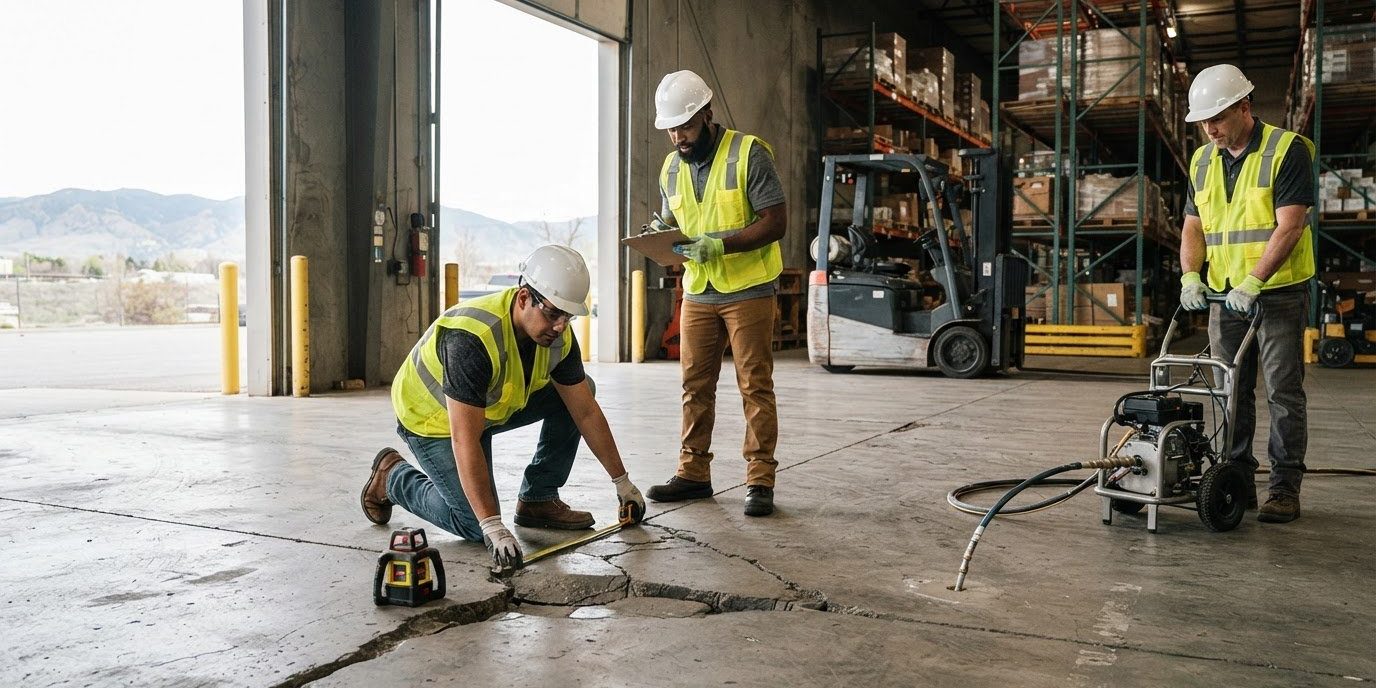
Watch for cracks that widen or reappear, vertical offsets between adjacent panels, broken or crumbling edges, and uneven areas that persist or spread. These changes can disrupt forklift travel, catch wheels, shift loads, and complicate access across work areas. Record the location, approximate dimensions, whether the damage is changing, and any nearby joints or signs of water exposure. Those observations help describe the problem, but they don’t establish its cause.
What can cause concrete floors to crack or settle?
Potential contributors include repeated or concentrated loading, inadequate or changing support beneath the slab, water reaching the concrete or underlying materials, and stress at joints. Construction conditions can also influence how a floor performs over time. Concrete may deteriorate through different physical and chemical processes, including reinforcement corrosion and chemical attack. See this overview of causes of concrete degradation.
A single crack or low spot can have more than one explanation. Consider its pattern, relationship to joints, elevation change, loading history, and signs of moisture together. A photograph can help record an issue, but it cannot reliably reveal what is happening below the slab. For facilities considering industrial concrete floor repair Lakewood, a site-focused assessment helps distinguish surface wear from movement and define the repair scope. Lakewood facilities should evaluate their actual slab and site conditions rather than assume a regional cause. The same care applies when reviewing guidance on concrete repair in Denver, Colorado.
How to Diagnose Industrial Concrete Floor Damage Before Repair
A sound repair plan follows a defined sequence: document the symptoms, assess the affected area, consider likely causes, then determine the scope of work. This keeps the decision grounded in the slab’s condition rather than in a single visible crack or low spot. Repair selection should follow an assessment of both the slab and the support beneath it.
Safety and diagnosis go together. OSHA’s general requirements for walking-working surfaces address maintaining safe walking-working surfaces, including floors. Recording hazards and affected routes helps facility teams describe operational concerns while the damage is evaluated.
What should a facility team document before an assessment?
Build a practical record, not a diagnosis. Note where damage occurs, its approximate length or area, whether it has changed, and what equipment or traffic regularly passes nearby. Add observations about water exposure, drainage concerns, joints, and previous repairs if that history is available.
- Mark cracks, spalled areas, uneven panels, and joint deterioration on a floor plan.
- Photograph the same locations over time to record visible changes.
- Describe nearby equipment, loading patterns, and any access or material-movement issues.
These details help focus an assessment, but a checklist or visual inspection cannot establish what is happening beneath the concrete. Where the damage raises structural concerns, an engineering assessment may be needed to evaluate the slab and its support.
How does the damage cause shape the repair scope?
Localized surface deterioration may call for work focused on the damaged concrete. A slab that has settled or lost support presents a different condition: treating only the visible crack may leave the underlying issue unaddressed. If movement keeps recurring, the assessment should consider contributing conditions beneath or around the slab, rather than simply repeating a surface patch.
Crack patterns, elevation differences, joint condition, loading, and moisture observations are most useful when considered together. For example, a crack near a joint means something different if adjacent panels also show a height change or the area is repeatedly exposed to water. No single observation proves the cause, and photographs alone can’t establish a reliable repair scope.
For industrial concrete floor repair Lakewood, documenting the evidence first helps distinguish a surface repair need from a leveling or support concern. A concrete leveling guide can offer useful background on uneven slabs. RiseLock’s concrete repair and leveling services address assessed slab conditions with an approach matched to the project.
Comparing Industrial Slab Repair Approaches for Lakewood Facilities
The right repair depends on what the assessment finds: surface damage, a slab that has settled, or deterioration extensive enough to warrant evaluating replacement. These approaches address different conditions, so they aren’t interchangeable. For industrial concrete floor repair Lakewood, compare the slab’s condition and the result required before weighing access and work sequencing.
| Approach | May suit | Condition to assess | Intended result and disruption considerations |
|---|---|---|---|
| Targeted concrete repair | Localized cracks, spalling, or damaged edges | Whether damage is limited to the affected concrete or linked to movement or support issues | Restore a defined damaged area. Work is focused, but access and preparation depend on the repair scope. |
| Polyurethane lifting | Suitable sunken or uneven slabs | Whether the slab is in a condition that can be lifted and whether the support concern is appropriate for this method | Raise and stabilize eligible concrete. Injection uses small access points, with the work area and access needs determined by the site. |
| Replacement evaluation | Extensive deterioration or damage that may make repair unsuitable | Overall slab condition, structural concerns, and facility requirements | Consider a new slab where assessment indicates repair may not meet project needs. Demolition, placement, and access can affect operations. |
When can polyurethane lifting help an industrial slab?
High-density polyurethane foam is injected beneath suitable sunken concrete to lift and stabilize the slab. Small injection access points allow targeted intervention, but the result depends on the slab’s observed condition and project requirements. Lifting isn’t a universal fix for cracks, spalling, or deteriorated joints; those may need concrete repair or another response. A polyurethane concrete lifting guide can explain the method in more detail.
When might repair or replacement need further evaluation?
Extensive surface deterioration, structural damage, or slab conditions that aren’t suitable for lifting can change the repair decision. Visible cracking alone doesn’t automatically mean replacement is necessary. The scope should follow the extent of damage, the slab’s condition, and the intended use of the floor.
Keep structural work distinct from surface finishes. Coatings and decorative systems change the wearing surface; they don’t, by themselves, correct settlement or reinforce a slab. Post-tension installation is structural reinforcement for relevant project needs, not a general-purpose fix for every damaged floor. RiseLock provides concrete repair, leveling, polyurethane lifting, and post-tension work matched to the assessed condition, rather than applying one solution to every facility.
Planning Industrial Concrete Floor Repair Around Lakewood Operations
A well-planned repair accounts for the floor and the work that depends on it. Before setting a sequence, identify the affected zone, how people and equipment move through it, and what access the repair approach requires. For industrial concrete floor repair, Lakewood facilities should base the work plan on the actual repair scope and site conditions, not assume a standard schedule or uninterrupted access.
How can facility teams prepare for repair work?
Start with a floor map. Mark the damaged areas, nearby pedestrian routes, forklift paths, equipment locations, and any access points that may be affected. Then coordinate expectations with employees, tenants, and operations leads so people understand which areas may need to be kept clear and how movement through the facility may be managed.
- Identify alternate routes for people, materials, and equipment where practical.
- Note access constraints near machinery, stored materials, or active work zones.
- Coordinate site-specific safety procedures with the teams responsible for facility operations.
These preparations help surface conflicts early, but they don’t determine the repair sequence by themselves. Access needs depend on the selected method, the affected area, and conditions at the facility. Lakewood facilities should base planning on their own site rather than assume particular seasonal or weather-related effects.
What should a repair plan communicate?
A clear plan gives facility stakeholders a shared understanding of the work. It should summarize the observed damage, the selected repair approach, the work area, and the intended result. It should also describe relevant access restrictions and operational considerations, such as routes that may be affected or equipment that needs to be moved.
Keep the sequence project-specific. A localized repair and work on a settled slab may have different access needs, preparation steps, and effects on facility activity. Rather than promise a fixed timeline, communicate how work areas and operating considerations will be coordinated as the scope is established.
For a smoother handoff, assign a facility point of contact, share the work-area plan with affected teams, and establish how updates will be communicated if site conditions require an adjustment. This keeps employees informed without assuming every area can remain accessible throughout the work.
RiseLock’s concrete repair and leveling services can be matched to the assessed slab condition and facility needs. Include affected areas and operational constraints when planning industrial concrete floor repair.
RiseLock’s Approach to Industrial Concrete Floor Repair in Lakewood
Industrial concrete floor repair starts with understanding the slab’s condition and how the facility uses it. RiseLock serves Lakewood and nearby Front Range communities with concrete repair, concrete leveling, high-density polyurethane lifting, and post-tension installation. These options address different needs, so the repair plan follows the assessment rather than defaulting to one method for every floor.
How RiseLock matches repair methods to slab conditions
For suitable sunken or uneven slabs, polyurethane lifting can raise and stabilize the concrete. Concrete leveling addresses unevenness where the slab’s condition makes that approach appropriate. Neither method is a universal solution for every crack, damaged surface, or structural concern; the observed damage and support conditions guide the choice.
Localized deterioration may call for concrete repair focused on the affected area. If a project requires structural reinforcement, post-tension installation can support slab integrity as part of that work. It’s a distinct structural service, not a general-purpose treatment for surface wear or every damaged floor. Separating these needs helps align the work with the intended result.
That distinction matters in commercial and industrial settings, where floor performance affects equipment movement, material handling, and access. RiseLock’s approach centers on diagnosing the slab and selecting a suitable restoration or stabilization method, rather than treating every visible defect as the same problem.
What to do next about a damaged Lakewood facility floor
Before discussing repair, note where the damage appears and how it affects facility operations. Record visible changes, nearby equipment or traffic, and any access constraints. This information helps frame the site’s needs and supports a focused conversation about the repair scope.
For industrial concrete floor repair Lakewood facilities can draw on RiseLock’s concrete repair and lifting services. Describe the affected slab, observed conditions, and operational concerns to help focus the discussion on a suitable repair approach.
Have a damaged facility floor in Lakewood? Share the condition of the concrete and how it affects your operations with RiseLock to discuss your repair needs.
Plan Your Next Step With Confidence
A dependable floor repair plan begins with the slab’s actual condition. Document visible damage and operational concerns, then use that information to distinguish surface deterioration from settlement or structural needs. The repair approach should fit the diagnosis, whether that means targeted concrete repair, leveling, polyurethane lifting for suitable sunken slabs, or reinforcement where structural requirements call for it.
For industrial concrete floor repair, Lakewood facilities can turn to RiseLock for concrete repair and leveling, including polyurethane lifting for residential and commercial slabs, as well as post-tension installation for structural reinforcement. Each project calls for an approach suited to the slab and the facility’s requirements.
Ready to discuss the floor conditions affecting your operation? Discuss your Lakewood concrete repair project with RiseLock. A clear assessment is a practical first step toward restoring dependable use of your facility floor.
Frequently Asked Questions
What causes industrial concrete floors to crack or settle in Lakewood?
Industrial slabs can crack or settle because of loading, changes in support beneath the concrete, water exposure, joint conditions, or construction factors. A visible crack alone doesn’t reveal which cause is responsible. In Lakewood, evaluate the actual floor and site conditions before attributing damage to local weather or soil. Document where the damage appears, how it changes, and which areas are affected to help guide a useful assessment.
Can polyurethane foam lift an industrial concrete floor?
Yes. Polyurethane foam can lift and stabilize some sunken concrete slabs when the slab and site conditions are suitable. It isn’t a universal solution for every crack, surface defect, or structural problem. The repair approach should follow an assessment of the slab, likely causes of movement, and facility requirements. RiseLock provides polyurethane concrete lifting and leveling for applicable projects, including commercial slabs where the assessed conditions suit this method.
How do you know whether an industrial concrete floor needs repair or replacement?
The choice depends on the extent of the damage, the slab’s condition, and whether its support remains suitable. Localized deterioration may be addressed with targeted concrete repair, while extensive damage or structural concerns can call for a broader evaluation. Cracks alone don’t determine whether replacement is necessary. A site-specific assessment helps clarify practical options, which may include repair, lifting, reinforcement, or considering replacement based on the floor and project requirements.
Will industrial concrete floor repair stop facility operations?
Not necessarily. The effect on operations depends on the repair method, work area, access needs, and facility layout. Before work begins, identify affected traffic routes, equipment, restricted areas, and communication needs. Don’t assume every project requires a full shutdown or that access can remain uninterrupted. A project-specific plan helps coordinate work with facility operations and set clear expectations about how people, materials, and equipment can move around the work area.
What is the difference between concrete floor repair and floor coating?
Concrete repair addresses damage in the slab itself, such as deterioration or suitable settlement. A coating is a surface system applied to a prepared floor, and it doesn’t automatically correct movement or support problems beneath the concrete. The two approaches serve different purposes and may address separate needs. First identify whether the concern is the slab’s condition or its finish, so the work targets the underlying issue rather than only changing the floor’s appearance.
How should a facility prepare for industrial floor repair?
Start by recording damaged areas, visible changes, equipment routes, and operational constraints. Identify employees, tenants, and operations leads who need information about access or affected zones, then coordinate communication before work begins. Keep safety planning specific to the facility and selected repair scope. A standard checklist or schedule won’t fit every site, so preparation should reflect the actual floor condition, work area, access requirements, and day-to-day facility operations.
Does RiseLock provide industrial concrete floor repair in Lakewood?
Yes. RiseLock serves Lakewood and provides concrete repair, leveling, and polyurethane concrete lifting for commercial applications. Lakewood facility teams can discuss the affected slab and operational concerns with RiseLock. Suitable sunken or uneven concrete may be addressed through lifting and leveling, while post-tension installation supports structural reinforcement needs. RiseLock also serves Denver, Aurora, Centennial, Parker, Colorado Springs, Englewood, Littleton, Lakewood, Arvada, Thornton, Wheatridge, Castle Rock, Castle Pines, and Boulder.