
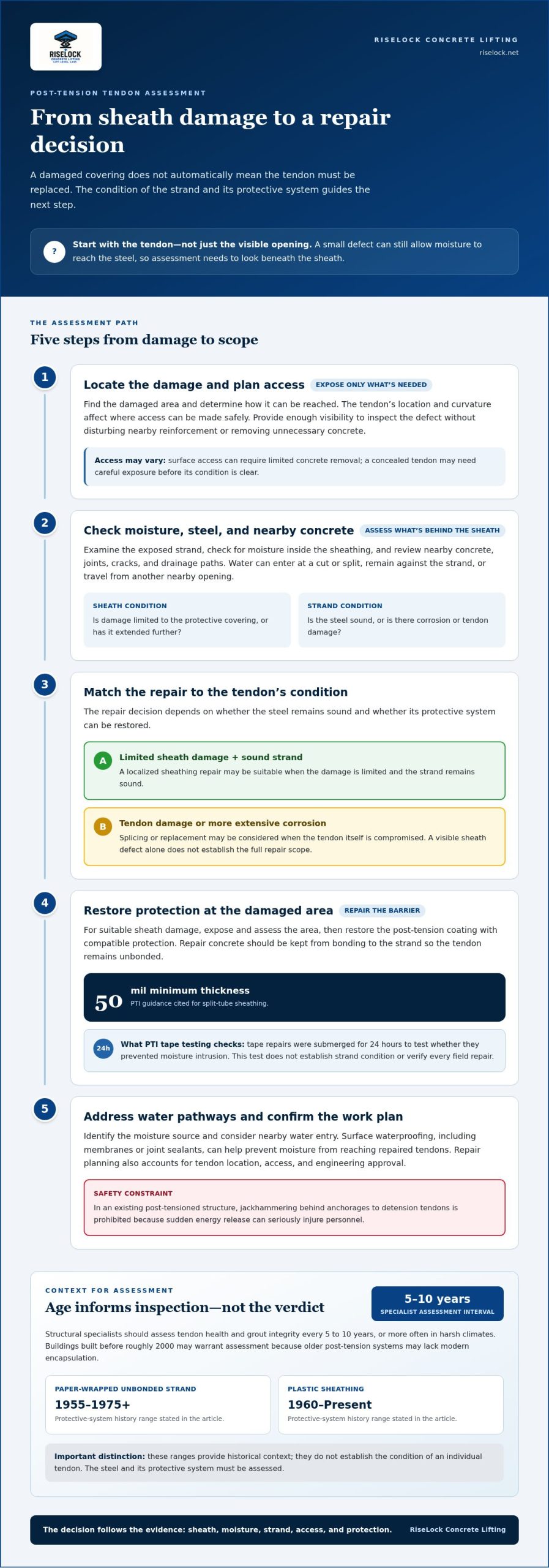
A damaged sheath doesn’t automatically mean a tendon must be replaced. In Parker, post tension cable sheathing repair may be suitable when the damage is limited and the strand remains sound. If the tendon itself is damaged or corrosion is more extensive, splicing or replacement may be considered. The decision depends on the steel’s condition and whether its protective system can be restored.
It’s understandable to wonder whether a visible break in the sheathing signals a larger structural problem. Assessment starts by examining the damage, checking for moisture and corrosion, and determining whether the tendon can remain protected in place. This article explains what that assessment involves, how repair differs from splicing or replacement, and which factors guide the decision, so you can understand the path from damaged covering to a repair plan.
Key Takeaways
- Separate damage to the protective sheath from damage or corrosion affecting the steel tendon; the condition of each guides the repair decision.
- Moisture inside the sheathing should be assessed before repairing a short slit or small gouge.
- PTI guidance specifies repair materials and coverage details, including split-tube sheathing with a minimum thickness of 50 mil.
- Splicing or replacement may be considered when the tendon itself is compromised, while limited sheath damage may be addressed with a localized repair.
- Repair planning also accounts for access, tendon location, and engineering approval, not just the visible damage.
Cable lifespan and corrosion protection
Post-tension tendons are designed to serve a building throughout its service life when their protective systems are properly maintained. That protection relies on the sheath, corrosion-inhibiting coating, anchorage details, and surrounding concrete working together. A damaged sheath can expose the strand to moisture and weaken this barrier. The visible opening may be small, but the condition beneath it matters.
Moisture intrusion is a key corrosion concern. Water can enter through a cut or split in the sheath and remain against the steel strand. Corrosion gradually reduces the steel’s effective cross-section and can affect its ability to carry prestressing force. Water may also travel through leaking joints or cracks in nearby concrete, making its source harder to identify from the surface.
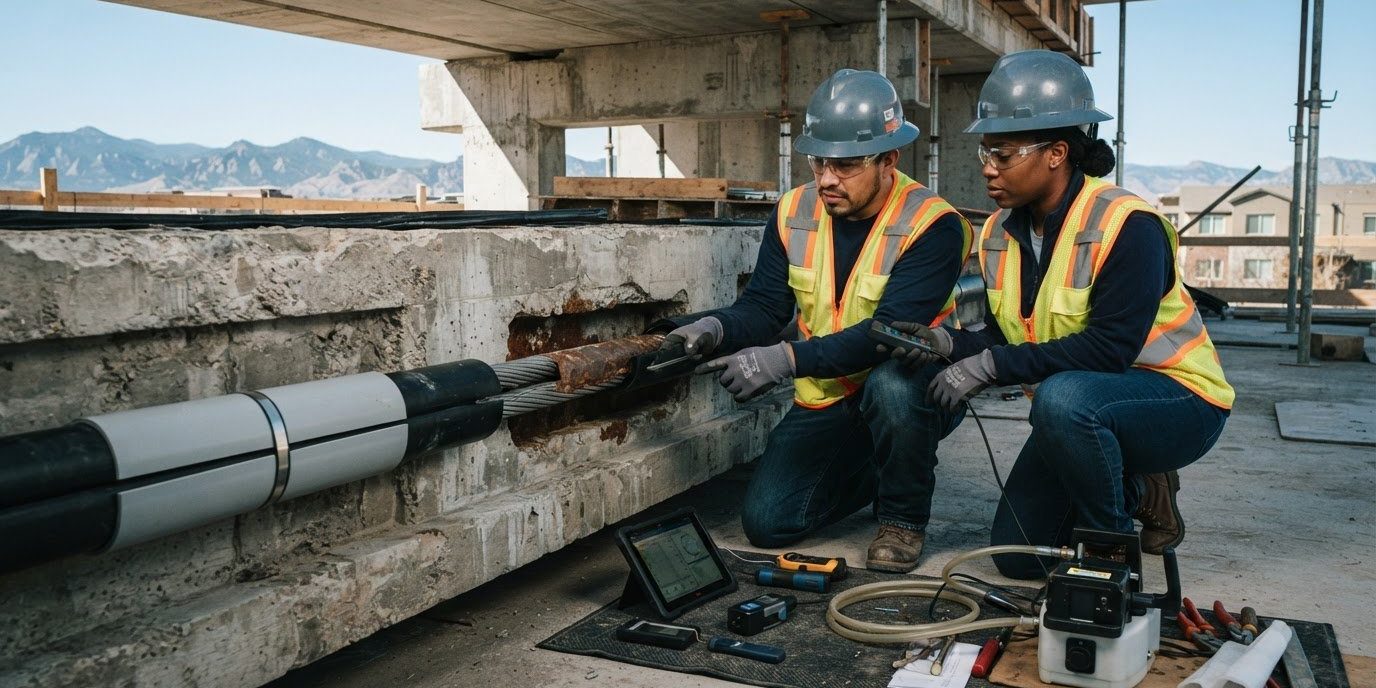
Inspection should establish whether damage is limited to the covering or extends to the tendon. A focused assessment includes locating the damaged area, examining the exposed strand, checking for moisture inside the sheathing, and reviewing nearby concrete and drainage paths. Buildings built before roughly 2000 may warrant assessment because older post-tension systems may lack modern encapsulation. Structural specialists should assess tendon health and grout integrity every 5 to 10 years, or more often in harsh climates.
System age can provide context, not a verdict. Paper-wrapped unbonded strand systems are dated from 1955-1975+, while plastic sheathing is dated from 1960-Present. Those ranges describe protective-system history; they do not establish the condition of an individual tendon. A newer system can still be vulnerable where sheathing is cut, water collects, or protective details have deteriorated.
Corrosion can begin when the barrier is breached and moisture reaches steel. Physical damage during construction or later work can create that breach. Poorly sealed openings and persistent water exposure can also sustain corrosion. If steel loss or tendon damage progresses, the strand may no longer perform as intended. The 2021 Surfside collapse is a reminder of the potential consequences of undetected post-tension damage, not proof that every sheath defect signals imminent failure.
For limited sheathing damage, a proper repair restores the post-tension coating over the affected area. It also helps keep repair concrete from bonding to the strand, so the tendon remains unbonded. Surface waterproofing, including membranes or joint sealants, can help prevent moisture from reaching repaired tendons. The practical sequence is to identify the moisture source, assess the tendon and protective layers, repair suitable damage, then address nearby water pathways.
Testing can inform how a tape repair addresses moisture, but it is not a substitute for the repair objective: PT coating must be restored at the damaged area, while repair concrete is kept out of the sheathing so the strand stays unbonded. In tests performed by the Post-Tensioning Institute, tape repairs were submerged for 24 hours to test whether they prevented moisture intrusion. The test focuses on blocking water at the repair; it does not establish the condition of the strand or verify every field repair. Assessment of the specific tendon remains important when deciding whether protection has been restored.
What Is Post-Tension Cable Repair?
Post-tension cable repair addresses damage to the tendon’s protective system or to the tendon itself. For sheathing repair, the damaged area is exposed, checked for moisture and strand corrosion, then restored with compatible protection. The repair material and method depend on how much sheathing is missing and whether the steel remains sound.
Access shapes the work. A technician needs enough room to see the damage and reach the tendon without disturbing nearby reinforcement or removing unnecessary concrete. Surface access may involve removing a limited area of concrete; concealed tendons may need careful exposure before their condition is clear. The tendon’s path and curvature also influence where access can be made safely.
Repair scope affects labor, materials, and disruption, so no single cost fits every case. Relevant factors include the depth and extent of concrete removal, tendon accessibility, steel condition, and whether the work is limited to sheathing or involves tendon repair. Restoring nearby finishes and addressing water entry can add work. A visible defect alone does not establish the full repair scope.
Preventive maintenance offers a broader budgeting frame than an isolated repair. One general recommendation is to allocate 2-4% of a building’s value annually for ongoing upkeep. That allowance covers building maintenance as a whole, not a post-tension repair price. Inspections, drainage, joint condition, and timely attention to concrete cracks can help identify moisture pathways before they affect a tendon.
Some repairs need more extensive access. For corroded button-headed tendon wires, access holes may be needed approximately every 10 ft (3 m), with wires typically removed in 10 ft (3 m) sections. This applies to that wire-removal work, not every sheathing repair. The number and location of openings depend on where corrosion occurs and how the tendon is arranged within the concrete.
Safe access also depends on tendon force. In an existing post-tensioned structure, jackhammering behind anchorages to detension tendons is prohibited because sudden energy release can seriously injure personnel. Tendon location, anchorage position, and curvature therefore guide exposure and repair planning. A tendon cut is preferably made near the middle of a slab or beam, away from curvature; in a continuous member, it is typically near the quarter point of the span.
Repair planning connects the defect, access route, and surrounding concrete into one scope of work. Reviewing structural repair considerations can help clarify how concrete condition relates to the work required around a tendon.
Cable sheath, duct, and anchorage protection
Look for a split, cut, puncture, or missing piece of sheathing where a tendon is exposed during concrete work. These visible signs may indicate a breach, but they don’t show whether moisture has entered or the strand is affected. For post-tension cable sheathing repair in Parker, assess the defect’s extent before selecting materials or opening more concrete.
The sheath separates an unbonded strand from surrounding concrete and moisture. A duct or sheathing repair must close the damaged area without bonding the strand to repair concrete. Anchorage protection matters too: exposed steel or gaps near the tendon end can create paths for moisture. Treat the sheath, anchorage, and nearby concrete as connected parts of the protective system.
For a short slit or small gouge, check for moisture inside the sheathing before proceeding. According to the Post-Tensioning Institute (PTI) Field Procedures Manual, taping can be used for nicks or cuts such as 1/4 x 2 in. when no significant portion of the original sheathing is missing. More extensive material loss may call for a split-tube repair instead.
PTI guidance provides specific material and coverage details:
- According to the PTI Field Procedures Manual, split-tube sheathing must have a minimum thickness of 50 mil and extend 3 in. beyond each side of the damaged sheath.
- PTI recommends self-adhesive, elastic, waterproof repair tape at least 2 in. wide.
- For limited damage, PTI recommends at least two tape layers extending at least 3 in. past the damaged area in both directions.
- For split-tube repairs, wrap the tube with waterproof tape and extend the tape 3 in. onto intact sheathing.
Overlap onto intact sheathing helps seal repair edges against water entry. Match the method to the damage: a small nick with intact surrounding sheath differs from a section with missing protection. Basic duct tape does not meet the stated elasticity and moisture-proof requirements for post-tension sheathing repair.
At an anchorage, examine nearby concrete and possible water paths as well as exposed tendon components. A sheath repair alone does not address damaged anchorage parts or moisture entering through adjacent concrete. The repair scope should account for each observed condition, rather than treating a surface covering as a complete system repair.
A practical assessment follows a sequence: locate the defect, establish its extent, check for moisture, examine exposed strand and anchorage protection, then select compatible materials. This helps distinguish localized protection work from broader tendon intervention. Post-tension cable sheathing repair in Parker should account for both the damaged covering and nearby conditions that could expose the repaired area to moisture again.
Use waterproof repair tape that is self-adhesive and elastic, rather than a covering that lacks either property. The tape should seal the sheath while keeping the strand separate from repair concrete.
For limited tendon sheathing damage, the PTI Field Procedures Manual recommends at least two layers of repair tape extending at least 3 in. past the damaged area in both directions. Apply that coverage as part of the sheath repair, not as a substitute for assessing the damage.
Engineering standards and repair documentation
In Parker, permit requirements depend on the repair scope and applicable local review. Document tendon or anchorage alterations as structural work so the relevant building officials can assess the project requirements.
Colorado contractor qualifications also depend on the work being performed. For post-tension repairs, assess whether the team follows PTI/ACI repair practices, coordinates with the Engineer of Record, and documents materials, tendon condition, and completed work.
Myth: A sheathing repair is only a materials choice. Reality: The repair needs an approved method, compatible materials, and a record showing what was done. The Post-Tensioning Institute (PTI) identifies 1985 as the date of its Recommended System, reflecting the role of established corrosion-protection practices in post-tension work.
Approval and documentation should connect the repair design to site conditions. The Engineer of Record should approve post-tension sheathing repair tape before application. That approval helps establish that the tape and method suit the specific tendon repair, rather than relying on a generic material description.
A useful repair record can capture the key decisions and evidence:
- Identify the tendon location and describe the observed sheath, strand, and anchorage condition.
- Record the repair materials and method, including tape or split-tube details.
- Document moisture observations and any measures addressing water entry.
- Include the Engineer of Record’s approval and the completed repair details.
Testing history also matters. PTI performed tests to qualify post-tension repair tapes in 2002. Those tests provide a technical basis for evaluating repair tapes, but they do not replace project-specific approval. The selected tape must meet the repair requirements and be approved before use.
Splice work adds design details that sheathing repair alone does not involve. For coupler installation, the specified allowance is movement equal to 1.5 times the expected elongation. Recording this requirement alongside the coupler details helps preserve the design intent and gives the Engineer of Record a clear basis for review.
Evidence: Standards matter most when they guide decisions and appear in the project record. A file linking the observed defect, approved method, specified materials, and completed work gives future inspectors a practical repair history. For Parker projects, clear documentation also distinguishes a localized protection repair from work affecting the tendon or anchorage system.
In Parker, permit requirements depend on the repair scope and applicable local review. Document tendon or anchorage alterations as structural work so building officials can assess the project requirements. Contractor qualifications also depend on the work being performed.
Repair, splice, or replacement decisions
Myth: Any damaged sheath means the entire tendon needs replacement. Reality: The decision depends on whether damage is limited to the covering or reaches the steel strand, anchorage, or tendon force. A localized sheath defect with sound steel may allow a protective repair. Strand damage or substantial corrosion can require a more extensive engineered solution.
Repair, splice, and replacement address different conditions. A sheath repair restores the barrier around a tendon that remains suitable for service. A splice joins tendon sections using a designed coupler system. Replacement removes compromised tendon material and installs a designed alternative. Steel loss, tendon location, anchorage condition, and structural role guide the appropriate approach.
What are the risks of cutting or repairing a post-tension cable without a specialist? A tendon stores force, so an uncontrolled cut or disturbance can release energy suddenly and seriously injure people. In an existing post-tensioned structure, jackhammering behind anchorages to detension tendons is prohibited because of that release risk.
Cut location also matters. The preferred repair cut is near the middle of a slab or beam, away from a point of tendon curvature. In a continuous member, a repair cut is typically located near the quarter point of the span. These are design considerations, not instructions for unqualified cutting; tendon layout and repair details must guide the work.
How quickly should damaged post-tension cable sheathing be repaired? Arrange an assessment promptly, especially if the opening exposes strand or moisture is present. Water entering through a breach can sustain corrosion, so repair planning should address both the damaged sheath and the path that lets moisture reach it.
Use the observed condition to frame the decision:
- Repair: The defect is limited to sheathing, and inspection finds the strand suitable for continued use.
- Splice: Tendon damage requires a connection designed around the tendon’s force and coupler requirements.
- Replace: Corrosion, strand damage, or anchorage concerns make localized protection inadequate.
Couplers require movement allowance equal to 1.5 times the expected elongation. That detail shows why a splice is a designed tendon intervention, not simply a way to bridge a cut. The Engineer of Record’s approval, tendon location, and repair documentation help preserve the structural design intent.
For Parker structures, base the choice on evidence from the exposed tendon and surrounding concrete. A sound strand with a limited coating defect presents a different repair question from corroded steel or a damaged anchorage. This distinction guides the scope toward localized protection, a designed splice, or tendon replacement.
RiseLock Concrete Lifting: Polyurethane Concrete Lifting
RiseLock Concrete Lifting provides Polyurethane Concrete Lifting for settled or uneven concrete slabs. This service addresses concrete elevation and leveling, not damaged post-tension sheathing or tendon corrosion. Those conditions require assessment and repair focused on the tendon system.
If a slab is uneven alongside a tendon concern, keep the issues distinct. Tendon protection involves the sheath, strand, and anchorage; concrete leveling addresses the slab’s position. RiseLock also provides Concrete Repair and Post Tension Installation, addressing concrete condition and post-tension work, respectively.
For a settled slab or related concrete concern in Parker, contact RiseLock Concrete Lifting to discuss the appropriate next step, or visit riselock.net.
Take the Next Step With a Clear Repair Plan
A damaged tendon can raise questions beyond the visible defect: what needs attention now, and how might it affect the surrounding concrete? Keep those concerns distinct. Have the tendon issue assessed as structural work, and consider slab-level concerns separately so each receives an appropriate response.
For post-tension cable sheathing repair in Parker, RiseLock Concrete Lifting provides Post Tension Installation, Concrete Leveling, and Polyurethane Concrete Lifting for related concrete needs. These services address different project requirements; concrete leveling or lifting does not replace tendon assessment or sheathing repair.
Bring the observed damage and any concerns about uneven concrete into the conversation. That gives you a practical starting point for understanding which work relates to the tendon and which relates to the slab. Contact RiseLock Concrete Lifting today to discuss the next step for your concrete project. A careful plan can make the way forward clearer.
Frequently Asked Questions
Can exposed post-tension cables be repaired without replacing the tendon?
Yes, an exposed tendon can sometimes be repaired without replacement if the damage is limited to its protection and the strand remains suitable for service. For example, concrete work may expose the sheath while leaving the steel intact. Avoid probing, cutting, or covering the tendon before its condition is assessed. The cause and location of exposure help determine whether localized repair is suitable.
Post-tension cable repair warranty and inspection options near Parker
Structural specialists should assess tendon health and grout integrity every 5 to 10 years, or more often in harsh climates. An inspection should locate the damage, check for moisture, and examine the strand and nearby concrete; warranty terms are not covered here.
Post-tension cable repair cost in Parker, Colorado
Repair cost depends on concrete removal, tendon accessibility and steel condition, and whether the work is limited to sheathing or involves tendon repair. Restoring finishes and addressing water entry can add to the work.